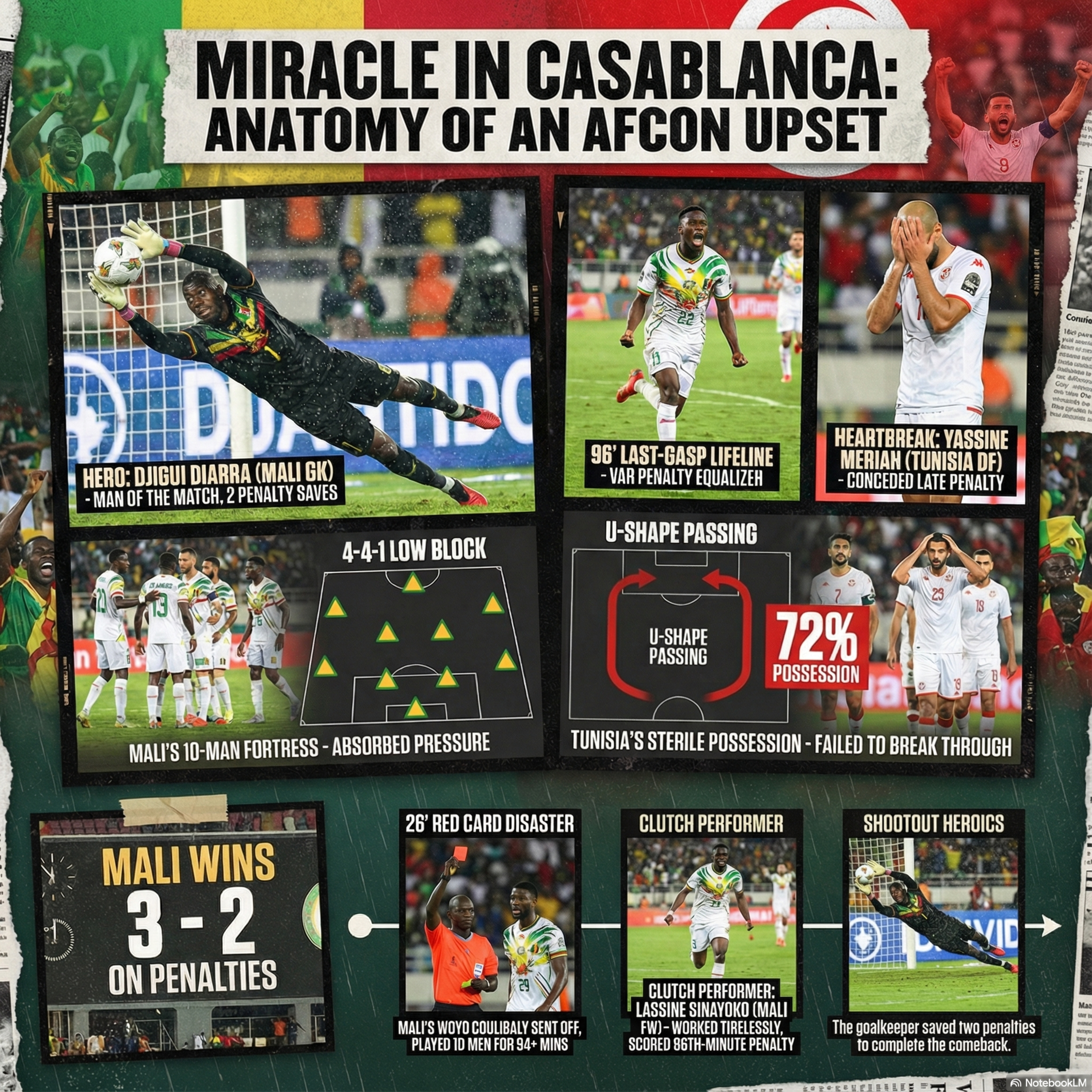
Mali's Ten-Man AFCON Resilience Masterclass
About this episode
Mali's Ten-Man AFCON Resilience Masterclass
Listen now on Spotify, Apple Podcasts, Amazon and other streaming services! Don’t forget to subscribe, share, and leave a ⭐⭐⭐⭐⭐ review to help more players and coaches discover the power of Techne Futbol and Data Technology in the beautiful game.
#TechneAfricaFutbol #TechneFutbol #TrainWithTechne #Playermaker #TraceFutbol #Hudl #FootballTech #FootballInnovation #PlayerDevelopment #CoachTools #SmartFootballTraining #AfricanFootball #CAFOnline #FIFA #FIFAYouth #CAFDevelopment #YouthFootballAfrica #NextGenFootball #FootballScouting #TalentIdentification #DigitalScouting #EliteYouthDevelopment #FootballJourney #FootballAnalytics #FIFAForward #FutebolAfricano #TrainTrackCompete #FootballExcellence #FootballAfrica #TheFutureOfFootball
If you thought you had seen every single kind of drama knockout football could possibly throw at you, well, you need to think again. This wasn't just a match. This was, I mean, an absolute force of nature. A clash so chaotic, so dramatic and honestly so profoundly inspiring that it is going to be etched into the annals of African football history. Forever, no question. We are talking about the kind of game that really forces you to question everything you thought you knew about tactical resilience, about, you know, the limits of human endurance.
It really did transcend football. I mean, the atmosphere in Casablanca, Morocco was already electric. It was a highly anticipated AF CON 2025 round of 16 match. But then you add in the heavy, relentless rain. The pitch conditions were something else. Exactly the slick pitch and then you layer on the immense psychological weight of the history between these two nations, Mali and Tunisia. It just it turned into something truly existential. A pressure cooker. It was a pressure cooker designed to test the mental limits of every single man on that pitch.
And the final score barely even begins to scratch the surface. Molly won. Tunisia won after a grueling some grueling 120 minutes of sheer physical pain. And then Molly somehow seizes V32 in the penalty shootout. But as you just said that result, it only tells you the ending. It tells you nothing about the impossible journey they took to get there. Precisely. And that's our mission today. This is a true deep dive. We are not here for the highlights reel. We are here to dissect layer by layer, how Molly the Eagles engineered a victory from a position that statistically, physically, and historically, it should have been completely impossible.
This wasn't just a win, it was a strategic benchmark. It was a profound test of psychological endurance and really textbook tactical discipline that offers crucial, actionable lessons for every team in the African game. It's a case study in crisis management. And the entire narrative of this match was just, it was violently and I think unnecessarily shifted in the 26th minute. That's when Molly's full back Woyo Kulabali gets a red card. And for the next agonizing 94 minutes of game time, Molly is operating with a 10 man disadvantage.
94 minutes. They had to retreat into this compact, impenetrable low block against a team that had, I mean, get this, 72% possession. It's a staggering number. Think about that for a second. 94 minutes down a man in a knockout game? OK, let's unpack this. How on earth do you turn that kind of sustained siege into a victory? Well, it starts by acknowledging the sheer magnitude of the task. They had to immediately throw out their entire pre game strategy and you know, invent a whole new system in real time.
Right on the fly, but. Before we get into that tactical brilliance, we have to understand the psychological landscape they were fighting in because that that informed every single decision, both the panic ones and the courageous ones that were made that night. Yeah, the context is everything. When Molly and Tunisia face each other, it's just never a simple game of football. This specific fixture carries this immense sort of festering historical weight. This was the 4th consecutive AFCON tournament where these two nations have met.
Four in a row. Four in a row and that kind of repeated exposure. It breeds familiarity, yes, but more importantly, it breeds a specific intense rivalry, attention, a level of tension that just transcends normal competition. They know the players, they know the coaching staff's tendencies and they are constantly, you know, seeking to one up the last encounter. And hanging over the entire stadium was that unforgettable specter of the 2021 man. Oh, you can't talk about this game without talking about that one.
That controversial encounter in Cameroon, the one where the referee Jenny Sacazzi infamously blew the final whistle early not once but twice the. Chaos that followed. The global chaos, the security forcing the referee off the field, the protests from the Tunisian coast, I mean, that memory was fresh, it was raw and it was completely unresolved. It was a global embarrassment for the tournament really, and what it did was establish this massive, unspoken psychological debt. From Tunisia's perspective, they felt fundamentally owed by fate.
They felt they had to win this match to correct what they saw as a past injustice. Which can be a powerful motivator. It can be incredibly powerful, but it can also lead to over aggression and crucially impatience, which I think we saw play out later in this game. And on the flip side, Molly entered this match trying to prove that their previous dominance was no fluke. I mean, coming into this round of 16 clash, Molly was unbeaten against Tunisia in four previous AFCON meetings. That includes the win in 2021 and even a clean sheet victory way back in 1994.
So they have their number basically. The psychological edge, despite Tunisia being this, you know, historical continental powerhouse, it actually lay with the West Africans. They've consistently found ways to neutralize that perceived technical superiority of the North African sides. It was Molly basically saying we know how to beat you and we know how to frustrate you. And that historical confidence is just. It's irreplaceable. It means when that red card happens, instead of collapsing in despair, there's a deep seated belief in that Malian squad that they have the DNA to handle this opponent no matter what the circumstances are.
OK, so let's look at the paths they took just to get here to this dramatic climax in Casablanca, because the contrast in their tournament trajectories is absolutely stark. Night and day. Molly arrived as the draw specialist. And that nickname really tells you everything you need to know about their approach. Yeah, it does. They qualified as runners up by drawing all of their group games, 1111 and 00. They only scored two goals in total. Which is a worry. It's a huge worry. It points to a clear lack of clinical finishing, a very worrying sign for a team with title ambitions.
But on the other hand, their defense, marshalled by coach Tom Sanfield, was just unbelievably robust. Save Feet was defiant about it. He kept reminding everyone about their qualifying record, where they conceded only one goal in six qualifiers. Molly's whole story was slow, methodical, secure, prioritizing defensive perfection over any kind of offensive flair. Tunisia, on the other hand, was just Their journey was defined by turbulence. They started strong, had a dip, and then they suffered a pretty demoralizing loss to a formidable opponent, their coach, Sammy Trabulsi.
He was forced to publicly admit that they had fallen short of expectations in the group stage. And that they needed a mental reset. A desperate mental reset for the knockouts. So for Tunisia, this match was all about redemption. A loss here against a rival they feel they should dominate would just confirm a period of stagnation and failure for the 2004 champions. The pressure was immense. That weight of expectation combined with that historical grievance we talked about meant the pressure on Tunisia to dictate and dominate was enormous before the 1st whistle even blew.
And we can't overlook the environmental factors. They turned out to be the ultimate equalizer, didn't they? Oh, absolutely. Casablanca being a North African venue, you know it naturally skewed the atmosphere towards Tunisia. The stands were full of their vocal supporters. But then the heavens opened. The heavy rainfall was just relentless. And that is the critical analysis point. It's so often overlooked, but the weather dictates the tactical landscape oh so well. The slick surface, it radically increased the speed of the ball, forcing players to make decisions quicker than normal, but at the same time it made footing treacherous and increased the risk of a heavy touch or a poor touch.
So who did that really favor? I mean, Tunisia relies on intricate technical passing combinations, right? Quick one twos, subtle movements. That kind of play is inherently jeopardized when the ball is skidding around unpredictably. Precisely. The rainfall substantially favored Molly's inevitable defensive game plan. When you're defending deep, a simple clearance becomes reliable, predictable, and highly effective. Whereas for Tunisia. For Tunisia, attempting a clever through ball carried a much higher risk of the ball just skipping away or an attacker over running it.
So if you're defending with 10 men, you will take that environmental advantage every single time. OK, so let's break down the tactical evolution of this match. Let's start with Phase 1, the sparring match that first 26 minutes before, you know, all the chaos arrived. Amali started in a pragmatic 4231 and Senfeed's goal was clearly defined. Deny Tunisia any space in those little pockets between the lines. And that initial structure, it relied so heavily on the engine room. You had Eve's Basuma and Al You Diang operating as this ferocious double pivot.
Aggressive. So aggressive in the press, so quick to transition the moment they won the ball. They're basically designed to disrupt Tunisia's rhythm high up the pitch and force them into hopeful long balls. And Tunisia was in their typical 433, very possession heavy. They tasked Elias Kiri with dropping deep, you know, often between in the center backs, almost acting like a quarterback. Dictating the temp exactly, and the technical ability of Hannibal Mesbury and Ben Romdaim was supposed to be the key to unlocking that central defense.
And the outcome of that phase was, you know, it was balanced, but it was tense. Molly successfully created an early threat, mainly through the direct running of Lacine Sanayoko, who looked isolated but also quite dangerous. Yeah, he did. Tunisia had all the possession high numbers, but penetration was low. Crucially, Molly's physical midfield had successfully neutralized Tunisia's expected technical advantage. It was a proper intense sparring session. Until the 26th minute. Until the 26th minute.
And then the abrupt, unforgiving turning point, the red card, Royal Coulibaly's tackle. It wasn't just poor timing. I mean post match analysis unanimously called it reckless and utterly unnecessary. It was a moment of complete madness that forced Molly to rely entirely on Grid and immediately triggered a master class in crisis management from the band. It really did. And this is lesson #1 for any African team hoping to win a tournament, discipline is paramount. An unnecessary emotional mistake like a late studs up challenge can cost you a tournament.
Even if your team somehow wins in the end, it just puts an immense unfair burden on your teammates. So Santi, it's response, it was immediate, it was decisive and it moved us straight into Phase 2, the 441 low block adjustment. He sacrificed his attacking midfielder immediately to plug that defensive gap. Who did he pull and how did he re engineer the shape so quickly? He pulled Muhammadu Dombia off the pitch within minutes, which is a very brave move because it lefts it in Yoko truly, truly isolated up top.
All on his. Own The structure shifted into two narrow banks of four and the objective became crystal clear. Make the central area of the pitch absolutely impenetrable. The entire tactical objective boiled down to denying Tunisia any angle for a vertical pass into the box. But what made this adjustment so phenomenally effective? I mean, beyond just the shape. Lots of teams play a low block. It was the mechanism and the acceptance of risk. Molly narrowed their defense so significantly that they basically ignored the wide channels until the ball was actually played there.
They invited the cross. They consciously invited Tunisia to cross the ball and this was a strategic gamble, placing their entire faith in the aerial superiority and decision making of their center back pairing Uzma Kamara and Abdulai Dabi. If those two faltered, the whole plan failed. I have to challenge that a little bit though. Inviting crosses against a strong, physically imposing North African side who are known for their set piece dominance and aerial powess. Isn't that a massive gamble? It is a massive gamble.
Were they just relying on the rain making the crosses unpredictable? Or is this just pure, unadulterated faith in their central defenders? I think it was a calculated risk that factored in the conditions. While Tunisia is physically strong, the rain makes a perfectly whipped cross much harder to execute and it makes the landing unpredictable for the attacker. But fundamentally, yes, it was faith in Kamara and Diaby. They were told win every header, clear every ball. But the true definition of this tactical shift wasn't actually in the back four.
It was in the midfield duo. Here's where it gets really interesting, because if you're playing two narrow banks of four, especially down a man, you are just hemorrhaging space on the flanks. And that's where the superhuman effort came in. The defining feature of the next 94 minutes was the heroic, relentless lateral shuttling workrate of Bazuma and Diang in central midfield. Unbelievable. They were tasked with covering the workload of three players. When the ball went wide left, Diang spread it across to provide cover.
When it went wide right, Bazuma took on the same responsibility. That just sounds physically unsustainable. Can you give us an idea of the kind of physical toll that placed on them? It was immense. They weren't just running, they were closing down space aggressively, cutting out passing lanes, forcing Tunisia into just lateral side to side movement. Data later suggested they both clock distances that were far beyond the average for a midfielder. They were covering the equivalent of an entire fullback zone.
In addition to their central duties, their relentless effort prevented Tunisia from getting space for long range shots, which would have been the easiest way to break the low block if those two hadn't been functioning. As a tireless 2 man shield, they were the key to Molly's endurance. OK, let's turn to Tunisia. They have the numerical advantage, a stunning 72% possession. They're playing at a quasi home venue, but they just cannot break Molly down. The sources point directly to Tunisia's flaw, the dreaded U shape circulation.
This is a textbook example of sterile possession, and it was a total strategic failure. The numerical advantage actually became a psychological trap for Tunisia. How so? They became comfortable, safe. Their past maps clearly showed the ball just circulating across the back line, from left, back to center, back to right, back and back again, repeatedly. They were moving the ball around Molly, not through them. But why did they accept this? With a man up, you have to be able to create an overload somewhere that forces the defense to compromise the.
Primary problem was a lack of willingness to take risks, and that was driven by two factors. First, they prioritize ball safety. The slick conditions made risky passes, especially high velocity vertical ones, prone to error. And the second. Second, there was a constant underlying fear of Lacine Sonioko's counter attacking pace. Ah, so Molly's lone striker, isolated and exhausted, was still acting as a sychological deterrent. Absolutely that fear KET Tunisia cautious. They rarely committed both full backs forward at the same time, which is essential to creating, you know, a 3V2 or 4V3 overload on the flanks against a compact 441.
So they didn't create the overloads. They failed to overload the wings, and if you can't overload the wings, you can't pull the center backs out of position. They chose ball safety over penetration, which is a crucial lesson on how not to break down and organize discipline defense. They basically ran out the clock on themselves. So was that U shape a failure of Tribelsi's instruction, or was it a failure of the individual players who were just unwilling to accept the risk of that killer pass? I think it was a failure of execution that stemmed from a lack of drilled attacking patterns.
I mean, Tribelsi substitutes later showed he understood the need for width and an aerial threat. Right. But the players on the field for that 60 minute window, they seem to prioritize just keeping possession and avoiding a counter attack above all else. They're waiting for a perfect chance that the Molly and Block is just too disciplined to ever concede. OK, so the goals. They were scored so late that they caused this immense, just instantaneous psychological whiplash for everyone involved. Oh, absolutely.
Let's start with Tunisia's goal in the 88th minute. For many, this felt like the inevitable end, the aerial breakthrough that finally validated the numerical advantage. And it was the cruel product of sheer 10 man fatigue. Molly's deep, resolute retreat had finally started to show visible cracks. You could see it. The defenders reaction times were slower. The lateral shuttling of Diang and Bazuma was less explosive. Tunisia recognized that central penetration was impossible and successfully shifted their focus to the wide areas for one last push.
They found the substitute Aliassad on the left flank. And this is where the fatigue punished the Molly and right back he was exhausted from covering ground for over an hour and he allowed so I just a little too much time to lift his head and set himself up for the delivery. And the cross itself was a thing of beauty. It was. It was delivered with significant whip curling away from the goalkeeper and straight into that critical area we call the corridor of uncertainty. Right between the keeper and the defense.
That 6 yard channel where the keeper fears the punch and the defenders fear the deflection and fear of Shawat, another tactical substitute. He demonstrated elite striker instincts that Molly's fatigue defense just couldn't match. What was so key about Charlotte's movement and all that chaos? He used a specific technique called a double movement. He fainted toward the near post, which drew the defender, Amadou Dante, slightly forward. OK. And then he suddenly peeled off Dante's back shoulder, creating separation toward the penalty spot.
A tiny fraction of space was all he needed. Then the finish. A powerful downward header that skated on the wet surface, leaving Dyer absolutely no chance. This looked definitive like the Checkmate move. It perfectly validated Trabelzi's late tactical changes. 2 minutes left down, a man exhausted. The narrative was written. The stronger side eventually wins, but then the 90th plus 6th minute Molly goal? Salvation from the spot. What tactical instruction even allowed Molly to get into a position to earn that penalty?
Sanfiya told his men to abandon the low block entirely. They knew the risk was a 2 nil loss, but the reward was parody. Ho for broke. They threw central defenders forward for a desperate, high risk Hail Mary free kick. The chaos that ensued saw the ball ricochet in the box and that's when it struck the extended arm of Yasin Mariah. An unnatural position. His arm was away from his body, creating an unnatural barrier. In the modern game, regardless of intent, that positioning is decisive. And the drama of the VAR intervention was critical here.
The referee initially allowed play to continue. He did, but the technology stepped in. The VAR team correctly advised a review, confirming the handball was a clear and obvious error by the defender. And the weight. The psychological pressure added by that delay, 2 agonizing minutes where the entire stadium was frozen watching the referee walk to the screen, was unbelievable. That wasn't football anymore. That was theater orchestrated by technology. And Lacine Sonioko, the tireless lone striker who had run non-stop for 96 minutes.
He assumed responsibility. After all that running, after all that pressure, he had to be running on fumes. What about the execution of the penalty? He displayed absolute nerves of steel. He didn't try to place it gently or outsmart the keeper with a finesse shot. He opted for raw, unforgiving power and clinical placement drove the ball low into the bottom right corner. Goalkeeper keeper Dahman guessed correctly but simply couldn't get down to the sheer velocity of the strike. And the significance of that goal?
It's monumental. It instantly shattered Tunisia's morale and shifted the psychological momentum firmly back to the 10 men of Mali, confirming their ultimate unbelievable resilience. OK, so when we look at the player ratings, they're like a direct mirror of these lessons. We're talking about selfless effort, high pressure positioning. Let's celebrate Molly's defensive heroes. We have to start with Jiggy Diarra, who earned a 9.8 and the Man of the Match award. His performance wasn't just good, it was a goalkeeping master class, particularly in those wet conditions.
Total command. He commanded his area, Florida State, ensuring Tunisia could never profit easily from the dozens of high crosses he faced. Is there one save that really stands out as match defining? The 79th minute fingertip save from Medbree's free kick. That save was absolutely crucial because if Tunisia had taken the lead then Molly would have had to abandon their low block with 10 men for 15 minutes. It would have been a disaster. It would have almost certainly resulted in a second goal in the end of the contest.
Yeah, I kept the score at 00 until the dying minutes, allowing Molly to survive until their chaotic equalizer and then his two technically perfect saves in the shootout. Just define the glory. Then you have the definition of the self sacrificing forward Lasine Sanayoko rated a 9.0. It's pretty rare for a lone striker in a 441 to get such a high rating unless they're constantly scoring. Well, he wasn't scoring screamers, but he was the single most vital release vowel for his defense. He was the outlet, right?
He consistently held up the ball against two and sometimes three defenders, winning key fouls that allowed his exhausted defensive lines to push up 15 yards and just catch their breath. It's about buying time. His job wasn't to score, it was to earn 5 seconds of rest for his teammates and then to step up and convert that world class penalty under the most extreme pressure. That is selfless, career defining performance that every African team needs in its core. And the unsung heroes at Central Shield, Alio Diang, rated 8.5.
And of course, Ease. Bazuma Diang's tactical discipline was just flawless. In that moment of red card chaos, he became the calm center, immediately filling the gaps left by the expelled fullback and tirelessly breaking up countless Tunisian attacks. He was everywhere. His ability to perfectly read the game meant that Kamara and DAB could concentrate purely on the aerial threat and not worry about runners through the center. They were the physical embodiment of that low block strategy. OK, let's shift focus to Tunisia side, their key strengths and more importantly, the critical lapses that really cost them the game.
Hannibal Medbury 7.5 was clearly their most dangerous player in that first hour. He was the only one willing to risk failure for the sake of penetration. He consistently attempted those vertical passes that could actually break the low block, and his constant technical movements even drew the red card. But the lapse here was from the coach, wasn't it? It was Sammy Trabelsi's decision to substitute him surprisingly early. Taking off your most creative player when you're facing a deeply entrenched 10 man defense undeniably reduced Tunisia's offensive threat right when they needed creativity most.
It was a real head scratching decision. And then we get to the critical individual errors that ultimately sealed their fate, starting with Woyo Kulabali, the Malian defender who got the red card rated a disastrous 2 point O. That reckless and unnecessary red card serves as a warning on discipline that absolutely cannot be overstated. Elite teams cannot afford to put their entire mission in jeopardy through an emotional reaction in a knockout map. The moment of individual. Recklessness almost erased all of Molly's tournament hopes, but the truly critical?
Lapse for Tunisia was Yasin Mariah, rated 4 point O, who committed that handball penalty in the 96th minute, the high cost of a single. Lapse in concentration His decision to raise his arm in the box was universally deemed inexplicable by analysts. He cost his team the win in regulation time. These are the small individual moments of mental failure under pressure that decide tournaments and Mariah lapse. Is a profound example of that. So the game then descended into phase three, the chaos and fatigue of extra time.
Mollies objective was now reduced to one single command survive and get to penalties and Sanfi was. Incredibly shrewd here, showing excellent foresight. He introduced fresh legs Hamari, Troya Ray and Ibrahima Sissoko specifically to refresh the legs of his defensive players. Just keep the structure. The goal was purely tactical. Ensure that the integrity of the low block did not collapse from sheer physical exhaustion. Tunisia, in contrast, became increasingly desperate, pushing their defensive line nearly to the halfway line in pursuit of a winner which nearly cost them.
Everything Dorjalis Nunny broke away in the 101st minute, only denied by a desperate last ditch tackle, and that just confirmed. The immense risk in Tunisia's high pressure. They were essentially gambling everything on a winner before the shootout. But there was another key moment in extra time that truly highlighted Molly's underlying quality, even while running on empty. What was that? They're coordinated. Offside trap. That's a huge strategic. Point. I mean, how do you execute a high defensive line when your team is already exhausted and down a man?
It speaks to the training. Molly's coordinated line holding was validated in the 107th minute when Shawad's potential second goal was ruled offside by Semi Automated Offside Technology right by SEO 2. The coordination required. For the center backs to step up in unison, even while running on fumes, is a testament to rigorous drilling under pressure. It prevented what would have been a decisive, fatal goal. OK, so this match was also a. Fascinating duel between the two managers. Let's compare their performances.
It really was and. Tom Sanfiat of Molly. Given the circumstances, he deserves an A grade for his crisis management. He didn't just manage. The crisis. He delivered a tactical master class. What were the defining elements of his brilliance? Well, first and foremost. His reorganization after the card was swift, effective, and perfectly executed. Second, and this is crucial, he did not pull Suneoco back. Keeping that lone striker high was a genius move. It ensured a constant counter attacking threat, even if it was remote.
This single decision prevented Tunisia from committing all 10 outfield players to the attack, forcing them to always leave 2 center backs deep. So it provided. Relief that threat provided. Momentary, invaluable relief for his defense. And what about his use? Of the bench specifically holding back Elbilal Toure. That was the peak of his. Foresight Toure is a key attacking threat, yet Cynthia had held him back, saving him specifically for the penalties. That's smart. That is excellent use of squad depth.
He knew that the physical exhaustion of the first choice players would make them less reliable in a shootout, so he swapped out tired legs for a fresh high quality finisher right before the whistle. But despite the victory. We have to look for cons. Where are the chinks in Sandfield's armor? Two Major. Concerns emerged for me. First, the team discipline is a genuine issue. The reckless red card put the entire mission in immediate jeopardy. He has to address the emotional control in the squad. And the second the.
Reliance on the low. Block requires immense unsustainable physical exertion. The physical toll on his key players Besuma, Diang, Sunyeoko is a massive liability going into the next round, especially on a short recovery window. Even confirmed his pragmatic results over flair approach post match. He said we have to be more efficient but we won. The cost of that victory may yet be felt. OK, now Sammy Trabelsi. Of Tunisia, he had the advantage for over 90 minutes. We've assigned him AC grade. He really failed to capitalize on a monumental advantage.
He did have some positives. His late substitute Saad and Shas, they combined for the goal, so he correctly identified the need for with an aerial presence late on. But the cons here are damning. The core failure was the systematic inability to break down A10 man team for over 60 minutes of football. I wonder if that indicates. A lack of preparedness and training. Do they spend enough time practicing against deep low blocks? It points directly to a. Systemic lack of drilled attacking patterns designed to counter compact discipline defenses.
Their strategy seems to be pass it faster, pass it wider, which just wasn't enough. They needed more complex vertical runs and third man movements, and they never produced them if Trebelsi had pulled a. Central defender earlier say at the 60 minute mark and use a third forward who specializes in diagonal runs. Would that have forced Molly to break their rigid 441 shape sooner? It's a compelling counter. Argument. A specialist runner like that, who doesn't just rely on aerial threat but on quick combination play would have forced Bazuma or Dean to commit to the channel, creating space centrally.
Trebelsi was just too conservative until it was far too late. But the ultimate failure? Wasn't tactical was it? It was purely about game management in the final moments. Absolutely crucial. His failure to manage the final two minutes of regulation, allowing that chaotic, desperate free kick to occur in a dangerous area, reflects A damning lack of instructions from the touchline. His players should have been told if the ball goes into a chaotic area, booted into the stand except the corner, but do not concede a free kick in the final third.
It's so basic. Trabelsi had warned. Pregame that the match would be decided by small details and his team ultimately fell victim to those very details in the 96th minute. That is coaching failure in modern African. Football technology is no longer an optional extra. It is the definitive silent arbiter of fate. For sure, this match was defined by two pivotal technological interventions that swung the momentum. Let's start with the VAR decision that awarded this stoppage time penalty. That penalty decision.
Was a critical triumph for VAR protocol and for fairness. The on field referee was genuinely unsighted due to the sheer cluster of bodies in the box. That's classic football chaos. The VAR team stepped in and correctly identified the clear and obvious error regarding Maria's arm positioning. So despite the immense. Drama and the nerve wracking weight. The process proved to be efficient and correct. It absolutely confirmed. The value of the technology when it's executed correctly, even under peak tension.
It showed that in the final minute of a knockout game, the correct application of the rules guided by technology overrides human error and the home crowd pressure. It redefines fair play. In that crucial moment, it. Did and then the technology. That often flies under the radar but is quietly reshaping the geometry of the game. Semi automated off site technology, or Esso. Esso proved its clinical. Worth during extra time the disallowed goal in the 107th minute. Xiao as a parent second goal was decided instantly by the technology.
No more drawing lines instead. Of 5 minutes of lines being. Drawn on screen, Esso rendered a verdict in seconds, showing show it was marginally ahead of the last defender. That speed is important, isn't it? I mean. Var adds drama but Esso kills it instantly with certainty. Is that a net positive for the spectacle or just for fairness? I think it's a net positive for the. Integrity of the game, which ultimately serves the spectacle better in the long run. The swift decision prevents the kind of prolonged acrimonious protests and emotional outbursts that played previous tournaments.
It ensures the critical flow of the game is maintained during peak tension, and it provides an objective certainty that allows everyone to just move on. It's an essential element of efficiency in the modern African game. OK, so if the match was a grueling. 120 Minute Physical test The penalty shootout was a pure psychological drama played out in 10 rapid nerve racking acts. This is where preparation meets. Mental fortitude head on and the flow of the shootout perfectly mirrored the massive psychological swings of the match itself.
Tunisia started with Yasin Mariah, the man who gifted Molly the lifeline that required. Immense courage and he buried it. Top corner perfectly struck. A strike of pure anger. And relief. He needed that redemption to try and wash away the memory of the handball. But then came the crucial, defining moment. Molly's captain, Eve's Bazuma, stepped up and missed the first kick, blazing it wildly over the bar. And for everyone watching that felt. Like the moment fate decided against Molly, it was the low point I. Genuinely felt that was the moment it slipped away.
So how did that not translate? Into immediate disaster for the next shooter. This is where penalty shootout. Psychology gets so fascinating that crushing myth, yes, paradoxically, it often releases the immediate pressure on the subsequent takers. Really, the overwhelming expectation shifts from we must score this to take the lead to we are already behind, we just need to catch up and stay in it. The psychological burden moves from execution perfection to simple survival. So the Malian takers who?
Followed Suneoko Dia Kite to Ray were able to convert with a degree of freedom that Bazuma lacked exactly they could focus. On raw technique without that crushing weight of expectation. Meanwhile, all the pressure piled onto Tunisia to maintain their lead and Ali Abdi stepped up for Tunisia's third kick and missed a carbon copy of the Zuma's miss, sending it high over the crossbar. A huge let off for. Molly, it just confirmed that the pressure had. Become unbearable for Tunisia, they needed to maintain their advantage and that desperation caused the technical failure.
And that's when Jiggy D Rs Brilliance took over. Tell us about his saves. Was it? Luck. Or was it preparation? It was preparation and. Technique combined, The first save against Ben Romdain was a magnificent full stretch dive to the bottom right. Pure athleticism, yes, but also based on a clear read of the shooter's body language. He waited until the very last millisecond to commit. And the second? Save the second. Against Eliza. Chori was an easy read of a poorly struck Telegraph penalty diary, clearly done his homework on Tunisia's takers and their preferences under pressure, and the final act was written by the.
Coaches foresight El Bilal Torre The sub saved specifically for the shootout, steps up for the winner and he delivered. Sending the keeper the wrong way with ice in his veins, The conclusion of this shootout is vital. It wasn't just luck, he was Dr. As detailed preparation, the cool confidence of the Malian takers and the coaching foresight to save a high quality finisher specifically for that moment of maximum pressure, we've dissected the match. The tactics, The psychology of the tech. Now let's synthesize this into actionable, high level strategic recommendations for the African game, starting with the tangible lessons for Molly's stunning success.
The first lesson, and perhaps. The most urgent for knockout football. It's about sustainability. Recovery is paramount, Absolutely. The physical toll on players like Sanyoko, Bazuma and Yang, and during 120 minutes with 10 men was extreme. If Molly wants to progress deeper, federation's most invest heavily in aggressive, sophisticated recovery protocols, cryotherapy, deep tissue massage, sleep optimization to ensure players can turn around quickly because physical exhaustion is the. Ultimate enemy of tactical discipline.
Exactly. Second, the. Glaring flaw that almost derailed them. Discipline check. We have to emphasize controlled aggression in training and team talks. Reckless mistakes like Coulibaly's red card will be punished more severely by the elite attacking teams remaining like the Senegal side they face. Next, players and coaches have to internalize the cost of an emotional reaction and finally addressing. Their offensive limitation counter attack precision Molly succeeded because they. Survived, but their transition efficiency has to improve dramatically against better possession size.
Like Senegal, they'll have even less of the ball. Sunyoko, the Lone Shriker, needs much faster, more coordinated support from the wide areas to truly exploit the massive spaces left behind by attacking full backs. The transition must be clinical, not just exhausting. Hope. OK, now for the painful. But necessary lessons from Tunisia's failure, focusing on overcoming their systemic obstacles. First, the technical overhaul needed to defeat low blocks, the persistent U-shaped passing. MAP is the symptom of a systemic issue.
In their talent profile, Tunisia produces many technically gifted midfielders who circulate the ball beautifully, but they lack penetrated passers. They need players who can break. Lines future squad selection and. Development must prioritize players who can break lines vertically, who are willing to take risks and execute the killer pass into congested areas rather than just circulate safely outside the box. Second, the most critical. Element that decides these close knockout games psychological resilience training Tunisia has a recognized.
History of crumbling and high pressure Afghan moments, the failure to close out the game against ten men and the subsequent penalty failure are symptoms of this deep seated lack of resilience. So what's the solution integrating? Sports psychologist to. Work specifically on closing out games, time management in the final 5 minutes and penalty mindset is just it's non negotiable for improving national team performance on the continental stage. And finally, managerial. Adaptation The federation needs to review whether a.
Conservative approach, demonstrated by Trebelsi's hesitant tactics, is truly suitable for a squad that boasts considerable attacking talents. The inability to adapt and dominate A10 man team suggests the philosophy may be too cautious for a team aiming for continental glory, especially when facing deep defenses. They need a system that forces the issue, not one that waits for it to resolve itself. So wrapping up then, the miracle. Of Casablanca is. Far more than a lucky victory in a penalty shootout, it stands as a profound strategic benchmark and a testament to the adage that defense and discipline win knockout matches.
Absolutely. Amali was tactically superior in terms of execution and desire, even when technically inferior and numerically disadvantaged. Their collective spirit and unwavering commitment to the structure, even when running on empty, was what ultimately won the day. It was resilience personified. But now the Eagles advance to face the reigning champions Senegal. The physical toll of 120 minutes with 10 men, plus the loss of the suspended Coulibaly presents a massive, massive hurdle. Sinfid's biggest battle now isn't tactical, it's physical recovery and maintaining the mental belief they just forged that is the real test of this.
Victory's value. The psychological I has to sustain them through the physical low of the short turn around. And that leads us to our final. Provocative thought for you, the listener, as you take this incredible knowledge forward. This deep dive showed us clearly that technical ability means absolutely nothing if concentration fails in the final 5 minutes of a knockout match. So if you had to choose one strategic investment for the immediate success of your national team, pure technical skill development, or high level integrated sports psychology, which one would deliver the greatest immediate return in a high stakes 120 minute knockout game like the one we just analyzed?
Think about that balance between mind and muscle. As we wrap up this deep dive.
 Apple Podcasts
 Castbox
 Castro
 Goodpods
 Moon FM
 Overcast
 Pocket Casts
 Podbean
 Podcast Addict
 Podcast Republic
 Spotify