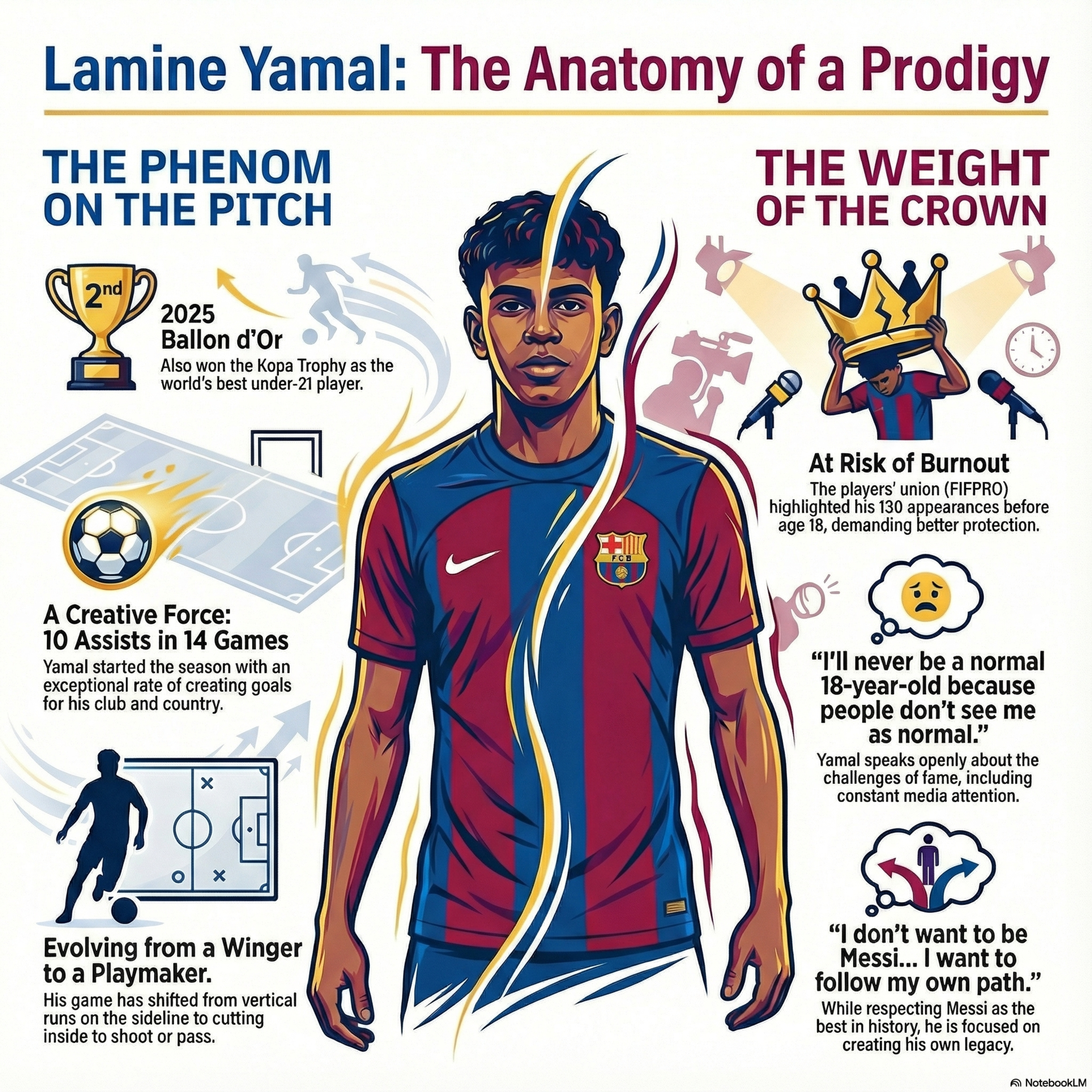
Lamine Yamal: Messi’s Heir and Barcelona’s Prodigy
About this episode
Lamine Yamal: Messi’s Heir and Barcelona’s Prodigy
Welcome to the deep dive. Picture this You're watching a game, and then it happens. A flash of movement, a burst of pure creativity, A dribble so smooth it just makes the entire defense look like they're, I don't know, standing still. And a set of training cones. Exactly. That's the electric energy we're talking about today, the kind that surrounds a a truly generational talent, a player who at 18 years old isn't just winning games, he's forcing the entire structure of elite football to literally bend around him.
So today we are not just going to celebrate his highlights, his sensational plays. No, we are going to dissect the entire ecosystem he's operating in the the tactical genius, the absolutely crippling workload, and of course, the stark personal pressures. And our mission here is really direct. It's vital, actually. It is. We want to take the lessons from this star's journey, the good and the bad, and forge them into a precise, actionable blueprint. A blueprint for sustainable talent development right across the African continent.
This isn't just analysis. You should think of this as a curriculum, one designed to protect and maximize the next generation of African football stars. And that's absolutely the right way to frame it. We have to see this player not just as you know, some wonder kid in a specific European league. We have to see him as a universal case study. A case study for what exactly? For the extreme demands of the modern game, I mean the pressures he faces, the relentless scheduling, the instant public criticism, the tactical experiments, they're just magnified versions of what rising African stars go through.
Especially when they make that big move. Exactly when they transition so rapidly, whether it's moving to a Major League abroad or even just stepping up to senior domestic play at 16 or 17, we've got a ton of information here from, you know, some really challenging statistical performances and big games to the deep mechanics of tactical shifts and maybe most importantly, these explicit welfare warnings coming from global player bodies. So we're essentially building the operational manual for talent development.
That's it. Our task is to filter this whole narrative down into four major non repetitive stages. Think of them as 4 distinct pillars of insight that African coaches, federations and player agents can apply. What? Right away? OK, we need to focus on structure, on longevity, strategic use of the player and career management. All of this to make sure that the continent's incredible wealth of talent isn't just exported, but it's cultivated and protected for the long haul. OK, let's unpack this. We're going to start right at the sharp end because talent as we know it guarantees you an opportunity, but it's character that dictates survival.
So our first lesson jumps right into the fire, into the absolute pressure cooker of elite competition handling, high stakes, failure and confrontation. The scenario that really gives us this lesson is what some have called, and I think rightly so, a game to forget. It was a massive rivalry match. You know the guy, the tight that just stops a nation and it ended in a tight 21 loss. But the story started long before the 1st whistle. It really did. The atmosphere around this young star was charged.
It was electric, but not in a good way. He had made some, let's say, controversial comments about the opponent earlier that week. Comments that the veterans on the other team definitely interpreted as disrespectful. Oh, absolutely. And the environment on match day was, I mean, it was toxic for him. From the moment he stepped on that pitch, every single touch was met with these intense jeers and boos. This wasn't just, you know, typical rivalry noise. This was personal. This was targeted psychological warfare.
And it worked. It absolutely worked. When you look at the raw statistics from his performance in that environment, you see a textbook case of a player whose incredible natural focus it was just completely fractured by all that noise. So what does a fractured focus look like? Let's talk about the cold hard data. Well, in terms of attacking output, it was just it was defined by struggle. He registered zero goals, 0 assists, zero shots on goal, and 0 accurate crosses. For a player who is supposed to be your team's primary attacking weapon, those zeros are They're damning, but even they don't tell the full tactical story of the disaster.
And this is where it gets really interesting for coaches, right? Especially those who are focused on modern possession based systems. The real failure is in the metrics that measure control of the ball. He had three unsuccessful touches, which, OK, that interrupts play, but then you see this staggering number. 21 possessions lost 2121 and to put that number into perspective for anyone listening, in a 90 minute game, losing possession 21 times from a single attacking player, that is catastrophic.
It's essentially giving the ball away every 4 minutes or so. It's half a game's worth of attacking momentum just vanishing into thin air. If you are trying to build rhythm, control the tempo, or, you know, breakdown a really sophisticated defense, that level of turnover from your main creator is a critical structural failure. So the technical errors were really just a symptom. Exactly. The misplaced passes, the heavy touches, all of it. There were symptoms of psychological distress, of a real lack of discipline in his decision making under that immense pressure.
So he wasn't playing against their defense, he was playing against the crowd, and he was playing against the ghost of his own comments from earlier in the week. Perfectly put. And that psychological battle? It didn't end the final whistle, It actually escalated immediately after. The post match confrontation. Yes, it was physical. It was verbal, involving veteran opponents like Carvajal and Vinicius Junior. This wasn't just a casual handshake and good game. This was a calculated dressing down right there on the pitch.
And the reports were pretty explicit about the message they were sending him. They told the young player in no uncertain terms that he talks too much and that he needed to keep quiet and just focus on his performance. These veterans were teaching a very expensive and very public lesson in humility. A lesson that's universal, really. Absolutely. Talent guarantees opportunity. It gets you noticed, it gets you the big club contract, it gets you the headlines. But professional and emotional maturity that determines survival at the elite level.
This whole incident is a stark mandatory warning for all rising stars. What's the warning specifically? That allowing external noise, letting arrogance creep in, or losing focus on your tactical execution just for the sake of showmanship, it will be punished. Experienced opposition. They're always looking for any crack in your armor, and in this game they found it and they exploited his immaturity perfectly. So let's translate this Let's take this stark psychological lesson and turn it into actionable insights for the African game.
We see young players achieve fame, achieve financial independence at breakneck speed. What's the key take away for them and the systems around them? Well, the challenge for African players is often intensified because of that very speed you mentioned. They might move from a relatively protected Academy environment straight into the intense glare of European media high salaries before they've had the chance to develop the necessary emotional armor. They're catapulted into the spotlight. Exactly, and to global visibility before they've fully integrated professional discipline.
Which means the infrastructure around them has to compensate for that rapid transition, it has to be stronger. Absolutely. This highlights an urgent need for African clubs, for academies and, critically, for the national federations to invest heavily in mental conditioning and professional conduct training. It is just not enough to coach the technical skills anymore. So what does that investment look like in practice? It means things like mandatory media training to handle those pre match press conferences and of course social media scrutiny.
It means dedicated access to sports psychologists, and not just for recovering from injuries, but for building resilience, for training them how to handle pressure. And a bit of humility, too. Yes, we have to instill discipline, a proper respect for the game's elders, and the professional humility that's required to handle intense scrutiny and confrontation. So an actionable step for an Academy director listening to this right now could be integrating modules on public speaking and conflict resolution right into their curriculum.
Precisely. The rising star has to be coached to understand that being a magnet for defensive attention, for trash talk, that's part of the job. But losing your cool or responding to it? That's a tactical weakness. Their focus has to be laser sharp. It does. The best response to you talk too much is simply winning the next match and putting in a flawless performance. That discipline that is the fundamental foundation for career longevity. If you can't handle the heat, your talent will just burn out quickly.
I couldn't agree more. Talent gets you the first contract, but professional maturity ensures you get to renew it. OK, let's pivot now from the psychological to the tactical. And this is where the story of adapting to genius really unfolds. Our second lesson is all about strategic player utilization, tactical evolution, and system reliance. And this is so key for coaches. The core principle here seems to be that when you have a generational talent on your hands, the strategic decision making has to revolve around them.
The system must adapt to maximize their unique ability, rather than forcing that unique talent into some rigid, pre-existing structure. Yes, and that's a vital lesson for African coaching strategy. So let's look at this player's journey. Initially he was used in a very defined, almost conservative way. His original tactical mandate was to be the classic wide threat. This meant he was supposed to stay glued to the touchline, relying almost exclusively on vertical dribbles so straight down the wing to beat his man and deliver crosses into the box.
And we even understand the mechanics of that old system. The crosses were aimed at very specific targets. They were. The design was to hit the near post for their traditional center, Ford Levandowski. Or sometimes they'd aim for the far post for the other winger, Ruffina, who kind of operates as an inside forward. But here's the crucial constraint. He was forced to stay wide because of the team's shape, the right half space, that corridor of uncertainty between the central defenders and the fullback.
It was already occupied by a deeper midfielder, someone like Donnie Almor, Fermi, Lopez. So if the winger, our star, cut inside too early, he would just run straight into traffic. He'd be neutralized by his own teammates position. So he was predictable, easy to double team, easy to crowd out if he tried to deviate from that straight line. The coach saw the ceiling was being hit, and that's what started this tactical revolution. So what specific advanced evolution did the coach implement to truly unlock his full, frankly terrifying potential?
The evolution was profound. It moved him from being just a wide creator to being a central penetrator and a goal threat. And the key, the absolute key was incorporating horizontal movements. So moving sideways, not just forwards. Exactly. He stopped being purely a wide threat and he started transitioning frequently into that right interior channel, the half space to take shots from outside the box or to penetrate centrally right into the heart of the defense. Wait, let's pause right there. Because for our listeners who might not, you know, live and breathe tactical analysis, we need to clearly define the half space.
It sounds like jargon, but it's so critical to understanding this. That's an excellent point. The half space, some people call it. The channel of chaos is that vertical strip of the pitch that's located between the central players, the center backs and midfielders, and the wide zones where the full backs operate. So it's not quite central, not quite wide. Exactly. It's the most difficult area for a defense to manage because it puts 2 defenders, the center back and the full back. In immediate conflict, who tracks the runner who leaves their position?
It forces a defensive dilemma. And by shifting this young star into that Channel. The coach gave him freedom. Freedom to run directly at the goal or to shoot by passing that immediate one-on-one challenge with the full back out wide. That explains the what of the change, but what drove the why? I mean, this didn't happen in a vacuum. It was driven by specific personnel changes and needs within the team. The first major driving factor was the change in attacking personnel, particularly the evolution of the center forward role.
With Lemandowski aging or sometimes injured, the coach started deploying a false 9. Often for your in Torres or someone similar. Right. And for those listening, you have to understand how false 9 works in relation to our winner. It's the key to the whole thing. So break it down for us, how does that create the space OK? So a false 9, unlike a traditional fix #9 doesn't stay up high wrestling with the center backs. They drop deep, sometimes as deep as the attacking midfield line to get on the ball.
And when they drop deep. They drag an opposing central defender out of position with them. Usually it's a sender back who follows them, pulling him away from the penalty spot. And this action leaves a massive empty vacuum, a wide open channel right in the heart of the opponent's defense. And now our winger, cutting in horizontally from that right half space, has a direct, unobstructed path right to the goal. Precisely. He is exploiting the central void that the false 9 just created for him. It's a beautifully coordinated tactical switch up.
And what was the other factor? The second driving factor was just sheer necessity. The team recognized that this player's dribbling ability was their unique cheat code for destabilizing high level defenses. They needed him to be the central point of friction. So they had to get him on the ball more and in more dangerous areas. Yes, by drawing 2, sometimes three defenders toward him when he penetrates centrally, he just destroys the opponent's defensive balance, and that creates immediate advantages for his team mates on the opposite side of the pitch or for midfielders making late runs.
So he goes from being a supplier on the edge of the game to being the engine of central penetration. And that, right there, is the difference between a good winger and a generational Dynamo. His dribbling, It's often described as bewitching. It forces defenders to commit, and once they commit, he makes the calculated decision. Shoot with power, play a quick through ball or just keep his central run going. His role completely changed. Now he has to score goals, not just create. Them a much higher goal scoring responsibility.
Yeah, you see him cutting inside from the flank, sometimes toward the center circle even to launch these distant shots. It's a whole new dimension to his game. So let's apply this. This is a crucial lesson for African coaches and technical directors. So often hear the critique that African teams, you know, they rely on individual brilliance, but they lack that strategic system play. Well, this specific tactical evolution teaches us that elite coaching identifies the unique dominant ability of the star player.
In this case, it's his dribbling and penetration, and then designs a sophisticated system specifically to open up space for that ability to thrive centrally. It's about building around your best player. It is African coaches must move beyond predictable 442 formations or just rigid wing play. They need flexibility. If you have a player with world class dribbling, you have to experiment with tactical structures like using a false 9 or rotating your midfield triangle to create that central vacuum that they need to operate in.
Which means you're not just coaching technical skills anymore, you have to coach positional intelligence. Absolutely. It's all about coaching players to understand patterns. It's not just run down the line and cross it, it's recognizing when the false 9 has dropped deep, it's seeing when that space opens up, and it's knowing how to exploit zones like the half space rather than just being stuck to the flank. Because if a player is only coached to be a slank runner. They're easy to defend, but if they're coached to be a fluid, positionally intelligent Dynamo, they become unstoppable.
And that tactical depth that ensures the longevity of their threat, which is a key part of protecting their career actually. That is a master class in modern tactical adaptation. But Speaking of longevity and protection, this tactical evolution comes with a dark side, doesn't it? The sheer physical cost of relying so heavily on such a young talent? It does. And that moves us from the tactical evolution to what is perhaps the most sobering and crucial lesson for the future of African football. We're talking about the sustainability crisis, youth overload and player welfare.
This is a warning that was issued by FF Pro, the global players union, and the numbers are genuinely alarming. They're shocking. Let's start with the one statistic that needs to be permanently fixed in the mind of every single club president, federation official and agent listening to this this star player accumulated a staggering 130 appearances for club and country before he even reached his 18th birthday. 130 it's, it's an exponential level of exposure and this record, it's just far surpasses any historical parallels.
You look at players who often cited for being used heavily as teenagers, you know, Iniesta or even Gavi more recently. This player's accumulation rate is significantly higher. So Fief Pro is basically using him as a poster child for this issue. They're not mincing words. They are using cases like this to scream a warning about the severe overload facing football's rising stars all over the globe. You hear 130 games and part of you thinks, wow, he's so talented, he can handle it. But what is the actual physical and psychological toll of this kind of chronic exposure, especially when it's coupled with insufficient rest?
It leads directly to what experts call structural injuries, premature physical wear and severe psychological burnout. And the physical risk? It's unique and highly specific for players who are still developing. Experts stress that for athletes under 21, the physical structures, the muscular framework, yes, but critically, the tendons, the ligaments and the growth plates remain highly, highly vulnerable. Can you elaborate on that, On the growth plate risk? Why is that detail so crucial for young athletes?
Of course, growth plates are these areas of cartilage at the ends of the long bones, and that's where bone growth happens in children and adolescents. They are inherently softer and much more susceptible to injury than mature bone structure. So when an adolescent is subjected to chronic repetitive high impact stress, which is exactly what playing 50 or 60 elite matches a year entails, these areas are put under immense strain. Short recovery periods mean that this micro trauma just accumulates. So this isn't just about a pulled muscle.
Not at all. This is a risk of long term or even permanent damage that can shorten a career or degrade their peak performance years before it should ever happen. And this whole issue highlights what 5th Pro calls the football anomaly. The culture of workloading football is fundamentally different, and often so much worse than in other major global sports. The contrast is just shocking when you look at it. Look at the culture in American sports like the NBA or Australian rules football or even Major League Baseball.
In those major leagues, athletes enjoy between 14 to 15 weeks of mandated, structured offseason rests. Wow, 14 to 15 weeks. The culture is built around downtime being absolutely essential for career preservation. European footballers on the other hand, who are often playing almost year round between their league cups and continental competitions. They're lucky if they get barely three weeks of unstructured downtime after a grueling year long campaign. And when you add international duty on top of that.
That downtime evaporates entirely. The pace is just unsustainable. So what are the specific protocols that FF Pro is urgently recommending to clubs and federations globally? I know they gave specific time frames. They're precise and they say they should be non negotiable mandates and they're all centered around the number 28. First, a minimum of 28 days of rest in the offseason. Total Rest Total rest away from the competitive pitch, allowing the structural components of the body to actually heal.
2nd A minimum of 28 days dedicated to preseason training. And why is that specific number important? Because that structured return to fitness, the time you need to rebuild strength and movement patterns gradually, is absolutely crucial for injury prevention. You can't just rush back. They also strongly recommend reduced international call ups to mitigate the fatigue and the extreme travel burdens. The message is crystal clear. It is without this mandated rest you are essentially shortening the players career and you are sacrificing their peak performance years.
Which brings us squarely back to the African game, where the risk profile for young talent is already uniquely heightened. We're talking about a kind of double jeopardy situation here. Precisely. African players face the intensity of their domestic leagues, which can sometimes involve, you know, suboptimal travel conditions, fewer medical resources and tighter scheduling. And that's combined with these severe international burdens. The travel alone must be grueling. Think about the frequency of AFCON qualification matches, the continental club tournaments, and the often grueling long haul international travel required to cross continents for just a single qualifier.
This workload accumulation, when you add it on top of a demanding European club schedule, it just far surpasses the physical limits of a developing athlete. So this requires immediate, non negotiable action from African federations. This isn't a suggestion anymore, it's a preservation imperative. It is the immediate action required by African football leadership has to focus on making mandatory rest periods a contractual reality. This means African federations need to develop and enforce joint protocols with the foreign clubs that employ their national team stars.
Protocols about what? About workload monitoring. If a young player has already played 55 games in Europe, the federation must show restraint during the next set of international breaks, even if the matches are really important. But let's introduce some friction here, because this is the real world challenge. If a federation relies heavily on a young star for key qualifiers and maybe they're struggling financially, how do they realistically tell that player no, you can't play in this lucrative friendly, you have to have 28 days off.
The financial and competitive pressure is. And that is the core conflict, the competitive pressure to qualify for tournaments and the financial pressure of needing those player fees or those friendly match bonuses. That's exactly why the system is failing. So the solution can't just rely on goodwill. No, it has to be structural change and external advocacy. Player agents, academies, continental bodies, they must standardize this REST requirement as a matter of player protection. It needs to become an accepted international norm, like transfer windows are, that young athletes must have a minimum recovery time.
It's a long term investment. They have to see that protecting the player for a 20 year career is infinitely more profitable than milking them for five years and watching them breakdown prematurely. This is about long term financial and competitive investment in your most valuable asset. A crucial and really a life altering lesson in sustainability. We need to save the careers of our greatest stars. OK, let's move to our final pillar. This one addresses the world off the pitch, the personal infrastructure required to navigate this rapid descent into global fame.
Lesson 4 The Stars ecosystem. Managing fame and maintaining roots. So important. When you go from being an unknown Academy player to a global superstar who's instantly recognizable at 18, your personal life just vanishes. This player has been incredibly candid about the restrictions that fame imposes on him. He spoke about the immediate confinement. He talked openly about paparazzi surrounding his house, about his face being constantly on TV and how the simple desire to go out for a quiet meal or a drink with friends is just impossible because he knows he'll be mobbed and.
His conclusion was pretty sobering. It was, he said. I will never be a normal 18 year old. And accepting that reality. That in itself is a sign of maturity, but accepting it also means you need an incredibly rigorous and trustworthy structure around you to manage the distractions, the temptations, the pressure of sudden wealth. That structure is the critical ingredient. He highlighted the necessity of having a trusted support system that actually enforces discipline. He admitted that when he suggests going out to eat or just socializing, the truth is that everyone says no.
And that, no, is the protective shield. It's the enforcement mechanism for discipline. And when he was asked who he listens to above all others, his answer was clear and immediate. His mother. So that trusted, non exploitative inner circle, family or professional mentors who have his long term interests at heart, that's what Shields him from the classic pitfalls that derails so many young careers. Financial mismanagement, excessive partying, losing focus, all of it. And the African application here is just profound.
So often, sudden wealth can attract predatory figures, exploitative agents, distant relatives or friends who are just looking for handout. Young African players need professional ethical guidance immediately. This needs to include things like mandatory financial literacy training taught by independent bodies before they receive their first massive contract. They need to understand how to protect their wealth and their career. And they need a circle that's disciplined enough to keep saying no. Even when the player is capable of buying anything he wants, that's when no is most important.
Beyond that immediate circle, though, there's this deep, palpable importance to his identity and his heritage, which seems to provide an essential psychological grounding for him amidst all this global. Pressure. His roots provide an anchor for him. He grew up in Roca Fonda, which is described as a struggling North African immigrant enclave. This background, plus his parentage, A Moroccan father and an Equatorial Guinea and mother, it gives him this deep transnational identity that ties him to more than just one city or one club.
And he actively celebrates this heritage. He symbolizes his neighborhood zip code, the three O 4, after he scores a goal. That small act feels huge. It is an enormously powerful grounding tool. He's taking the pressure of the global stage and using it to give back and remind himself where his fight originated. He even drew a direct parallel between the stress of playing for his elite club and the stress of being that small kid playing on the concrete pitch in Roca Fonda against the older, bigger kids.
Wow, that sense of fighting for survival, of overcoming uncertainty, there, it makes the current professional pressure seem manageable to him. So this celebration of his roots provides psychological resilience and a sense of purpose that goes way beyond just scoring goals. And for African talent, this connection to community and heritage is often their greatest source of resilience, especially when they move so far away from home. Absolutely. African players should be strongly encouraged to maintain and celebrate their heritage, whether that's through, you know, symbolizing a community identifier, funding local projects, or maintaining ties to their specific ethnic or national identity.
This connection provides essential psychological grounding amidst the global maelstrom. It acts as a powerful source of inspiration and accountability back home, and it protects them from the isolation that can cause a psychological breakdown. And finally, on this point, we have to discuss his maturity regarding comparisons. He has been extremely proactive in rejecting the biggest label in world football being the next Messy. And that is the ultimate sign of self-awareness and self preservation.
That label is a career killer because the expectation is just impossible. He stated it so clearly. He said he's the best in history. We both know I don't want to be messy and messy knows I don't want to be him. I want to follow my own path. He's defining his own legacy. His own trajectory? Exactly. He refuses to be weighed down by those impossible comparisons, which allows him to focus on his own unique blend of strengths rather than trying to replicate another legend's shadow. And that's a crucial final insight for coaching young African stars.
Empower them to define their own legacy. We must coach self identity. We have to tell them, be the first version of yourself, not the next version of someone else. By focusing on his own unique skills, his explosive pace, his centralized penetration, his willingness to shoot, he's carving out a new identity that is sustainable and independent. African academies have to help players manage these monumental expectations by celebrating their distinct identities and talents. So we've now systematically detailed these 4 pillars that are essential for African football sustainability, the need for emotional maturity and resilience in high pressure games.
The requirement for tactical flexibility to unlock central space for unique skills. The absolute imperative of enforcing physical rest and welfare protocols to ensure longevity. And the strength derived from a disciplined personal life, one that's rooted in community and ethical management. So if we circle all the way back to where we started that highly publicized game to forget the one defined by 21 lost possessions and that public confrontation, the ultimate overarching lesson we can extract from all this is just pure resilience.
Yes. The hallmark of a true star isn't avoiding failure, it's the immediate ability to rebound and produce results when the spotlight is at its absolute hottest. And this star demonstrated that resilience perfectly despite the disastrous loss, the verbal dressing down from the veterans, the constant chronic injury concerns. He rebounded immediately. The output speaks for itself. It does. He quickly returned to form in the very next match, scoring 1 and assisting another. It showed an immediate ability to shake off the noise and just focus on execution.
His consistency is actually terrifying when you consider his age. It is his data shows a player who consistently delivers high level creation. He registered an insane tally of tennis in just 14 club and country games early in the season. Which teaches us. It teaches us that failure, even very public failure, is momentary. The ability to recover, to adjust your focus, and to consistently produce elite results is the singular characteristic that defines a star who achieves true longevity. We began this entire deep dive with the premise of building a foundational curriculum for the African game.
We've analyzed this incredible talent that demands innovative tactical approaches, but we have also seen the severe risks of chronic overload and the absolute necessity of a disciplined personal infrastructure. So the final provocative thought We need African football leaders, the coaches, the agents, the federations and even parents to really confront is this. We know indisputably that the extreme workload accumulated by young stars, particularly the travel and qualification burdens, it compromises their long term longevity.
We know this is a fact. Given this knowledge, what is truly the more damaging outcome for the future of African football and its economic stability? Is it potentially reducing a young star's competitive minutes by 10 to 15% / a season to ensure they get that mandated 28 days of restorative offseason rest? Or? Or is it choosing to prioritize short term competitive gain and thus watching that star's entire multimillion dollar career be tragically shortened or their peak performance permanently degraded due to preventable structural damage caused by chronic overload and insufficient?
Recovery. That's the choice. That is the immediate, critical choice that African football leaders must make, and their answer will define the health and the prosperity of the continent's incredible talent for the next two decades.
 Apple Podcasts
 Castbox
 Castro
 Goodpods
 Moon FM
 Overcast
 Pocket Casts
 Podbean
 Podcast Addict
 Podcast Republic
 Spotify