Kenya’s Hidden Million Euro Football Scoreboard
About this episode
Kenya’s Hidden Million Euro Football Scoreboard
You know when you step into a stadium, or even when you're just watching a match on your screen at home, there's this expectation of absolute objective reality. Right. What you see is what you get. Exactly. You're looking at a pitch with very specific dimensions. You're watching a clock tick down from 90 minutes, you see the ball hit the back of the net and you look up at the scoreboard. It's totally binary. Yeah, it's entirely binary. Your team scored or they didn't. You won or you lost. It's comforting honestly because it's so visible.
I mean, the rules of the game don't change. But the moment you step off that pitch and into the global football transfer market, that visible scoreboard becomes, well, entirely irrelevant. Completely. It's replaced by something much more complex. Right. Suddenly you were subjected to a second scoreboard. A hidden algorithmic scoreboard. One that the fans in the stands literally never see. But it's the one that ruthless dictates the entire economic future of a nation's footballing dreams. Yeah. And today, our mission is to completely deconstruct that hidden scoreboard for you.
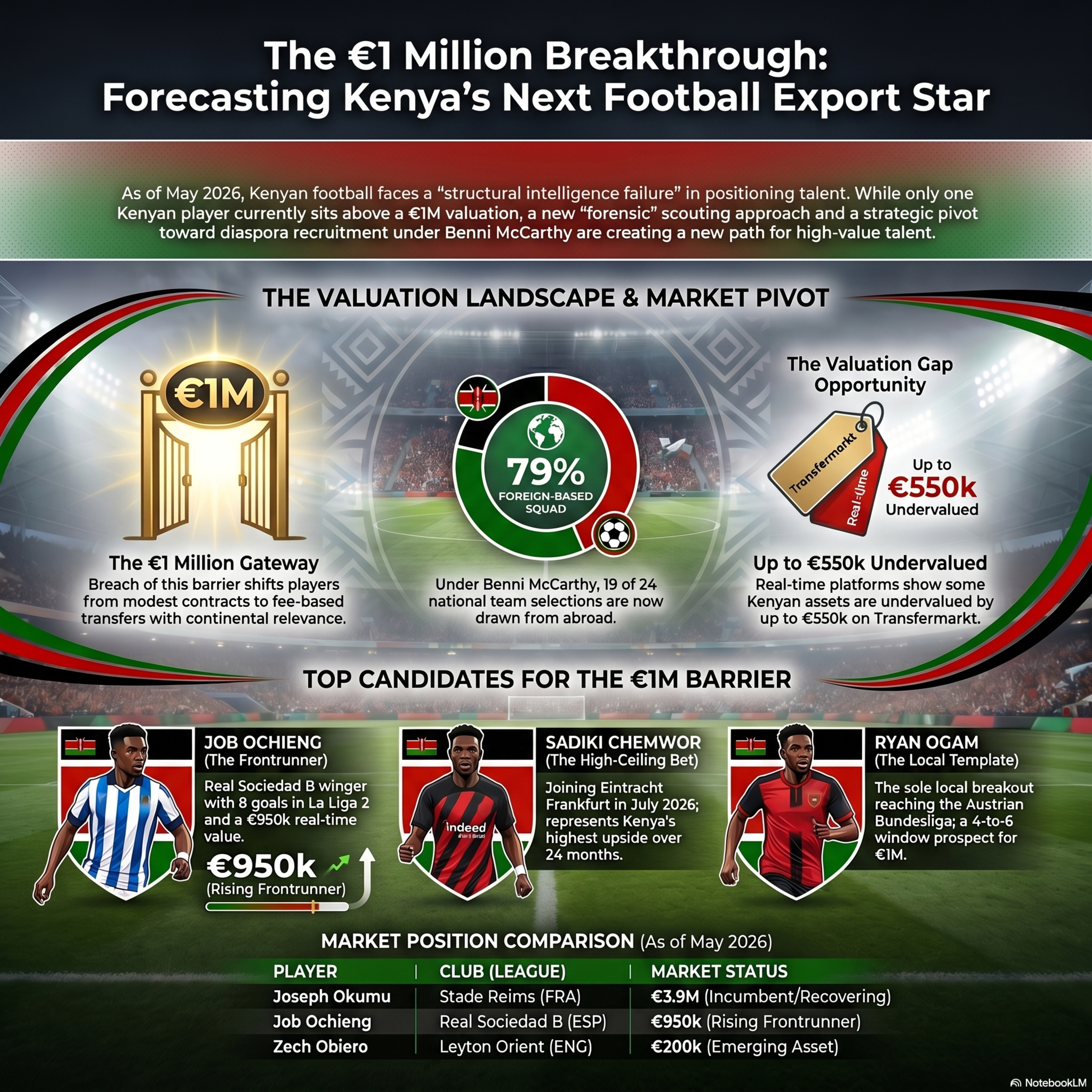
Listening, we're taking you on a deep dive, pulling back the curtain on the forensic economics of the Kenyan football transfer market. Specifically, taking a snapshot of the landscape as of right now, May 2026. Exactly. Because what we're looking at is, frankly, a landscape defined by a profound structural intelligence failure. That's the best way to put it. We have an entire ecosystem of just incredibly talented athletes who are consistently and systemically undervalued by global data algorithms.
And the stakes here, I mean, they aren't just about national pride, right? No, no, they're macroeconomic. Yeah, we are hunting for the answer to a highly specific, heavily guarded and really lucrative question. Which is who is about to break the elusive €1,000,000 valuation barrier? Exactly, and I find this fascinating because it transcends sports. Oh, absolutely. This is really a master class in how human talent is quantified, how it's packaged, and how it can be entirely misjudged by global metrics simply because it exists outside of preferred data zones.
Right, If you're listening to this right now, imagine if your professional worth like your entire career ceiling and ability to negotiate a salary was dictated by an API that didn't even have the proper scraping tools to measure what you do at your desk every day. That sounds like a nightmare. It is, and we're going to unpack the mechanics of why that happens and more importantly, map out the elite players who are currently hacking the system. But I think we need to establish the stakes first, €1,000,000.
Right, the magic number. Yeah, to a casual observer, it sounds like a nice round vanity number. You know, just a psychological milestone. But economically, it functions as something much more rigid. It's a structural gateway, isn't? It that's exactly what it is. In the architecture of the global football market, €1,000,000 is the line of demarcation between two entirely different economic realities. So what happens below that line? Well, when a player's valuation sits below that threshold, they're essentially trapped in a low liquidity zone.
Meaning they aren't moving for big money. Right. They're moving on free transfers or just nominal compensation fees. They're being placed on restrictive contracts in secondary or tertiary European leagues. And they probably really aren't getting the best representation either. No. Crucially, they lack the financial gravity to attract representation from elite boutique fee based agencies. Because there's just no money in it for the agents. Exactly, they simply don't generate enough Commission to justify the time of a top tier sporting director.
So they're essentially operating in the shadows of global sports finance like they are commodities, but they aren't globally traded assets yet. Not at all. But the moment a player's valuation crosses that €1,000,000 threshold, the physics of their career change entirely. They enter a qualitatively different market dynamic. Yeah, they attract proactive fee based transfer interest. They gain the leverage to negotiate complex performance bonuses. Image rights sell on clauses. All the stuff that builds real wealth.
Right. And most importantly, they become visible to clubs with genuine continental ambitions in the UEFA ecosystem. Which is huge for a nation like Kenya where the average player export value has historically hovered what well below the €500,000 mark. Way below. So breaching that 1,000,000 barrier isn't just about a single player getting rich, it's about proving a proof of concept for the entire domestic supply chain. OK, so let's look at the actual machinery driving this hidden scoreboard. The primary instrument the football world uses to establish these benchmarks is transfer marked.
Right, the big one. Yeah, now if you are an advanced fan of the game, you know the platform, you probably check it during every single transfer window. Oh, constantly. Everyone does. But we need to look under the hood here because a lot of people operate under the assumption that a transfer mark valuation is akin to a stocked ticker symbol. Like it reflects real liquid capital ready to be deployed. Exactly. And that assumption is the first major trap in understanding market economics right? It's a massive trap.
Transport valuations are not contract prices, they are not actual transfer fees, and they are definitely not salary multipliers. So what are they exactly? They represent a community crowd sourced consensus valuation, and that consensus is filtered through regional administrators or they call them judges. OK, so it's humans making these calls. Yes, and they are updated in periodic batches, not in real time. That feels like a crucial distinction. It is, and they are shaped by a very specific matrix of inputs.
They look at a player's recent statistical output, the UEFA coefficient of the league they operate in, their age relative to their positional peak. What else caps? Yeah, international caps, injury history and the remaining amortization on their current contract. OK, but because clubs and sporting directors and agents actively use these crowdsourced numbers as anchor points in real world multimillion euro negotiations, the valuations suddenly carry immense institutional weight. Exactly. The illusion becomes reality.
But here is the critical flaw we uncovered in our forensic analysis. This architecture is subjected to massive systemic biases, huge biases. And if you are an African player, specifically an East African player, these biases act as a concrete ceiling. The underlying mechanism causing this is what we refer to as the invisibility bias right, which is closely tied to the CI ES Football Observatories methodology. The algorithm essentially functions on proximity to the epicenter of football data. Which is Western Europe.
Right. The further a player operates from the Big 5 European leagues, the more heavily their statistical output is penalized by the mathematical coefficients. Let's give a concrete example of this just to show how punishing it is. OK, so if a striker registers 12 non penalty goals in the Kenyan Premier League, the KPL, the algorithm applies a dampening coefficient. So those 12 goals aren't treated like 12 goals. Yeah, those 12 goals might be weighted as the equivalent of, say, 1.5 goals in a major European league.
Wow, that's brutal. The. Resulting valuation movement is almost imperceptible. But if that exact same human being with the exact same bio mechanics and the exact same finishing technique registers 12 goals for a mid table club in the Austrian Bundesliga. It triggers massive automated upward revision. Just because of the geography. Because the Austrian Bundesliga sits securely within the UEFA data ecosystem, the algorithm trusts the defensive resistance in Austria. And it does not trust the defensive resistance in the KPL.
Exactly because it simply doesn't have the granular tracking data to verify. It so if I can synthesize this, it's not a credit score. Credit score implies you can slowly build trust over time through good behavior. Right, this isn't that. No, this is a closed financial loop. If you don't have the right currency, meaning European under 19 benchmarks or verified minutes in a recognized secondary European league, your wealth of talent is completely invisible to the clearinghouse. It doesn't matter if you are objectively the best athlete on the continent, your output is effectively dead data.
Dead data? That's a chilling phrase. I think it's a precise term though, and to be fair, the structural invisibility isn't necessarily a malicious conspiracy against East African football. Right, it's not a smoke filled backroom trying to hold them down. No, it is simply a profound intelligence gap. The raw athletic and technical productivity of African football simply isn't captured, codified and transmitted to the European market in a language and API that the market trusts. To give you context on how heavy this ceiling is, let's look at Kenya's record export, Joseph Okumu.
He moved to Stayed Rhymes in France for €12 million. That is the absolute historical peak. And as we'll discuss later, he achieved that despite the algorithm, not because of it. Yeah, he really had to break the system. So to break this closed loop, to force the algorithm to ingest your data, you need visibility. You need to circumvent the dampening coefficients entirely. And that brings us to one of the most polarizing, radical strategic pivots we have ever seen in international football. Enter Benny McCarthy.
Yeah, Benny McCarthy's tenure as head coach of the Harambe Stars, which began in March 2025, represents a complete paradigm shift in valuation strategy. You can just look at the squad, right? No, he looked at the structural intelligence failure we are discussing. He inherited a traditional squad architecture, you know, primarily domestic based players from the KPL, supplemented by a handful of overseas professionals. But by May 2026, within roughly 14 months, he had completely dismantled and reengineered the national team.
Reengineered is putting it mildly. Honestly, yeah. He effectively outsourced the national teams development. Just look at the roster for the May 2026 friendlies against Palestine and Kyrgyzstan. It's staggering. Out of 24 players called up, 19 are foreign based 19. That is the highest proportion of diaspora players in the entire history of the Kenyan federation. It is completely unprecedented, and if you map out the geographic distribution of this diaspora network, it is incredibly complex. Where are they all coming from?
You're looking at players embedded in six different European countries, operating within 5 different league systems and spanning 5 different birth nations. Give me some examples. Well, we have Samihina Kamau developing in the whole city under 20 ones in England. We have Caleb Kramer getting minutes at Adio den Hague in the Netherlands. So you are looking at athletes born in England, Germany, the Netherlands, Romania and Spain. Right. They are united by a Kenyan heritage, maybe a father, a mother or a dual passport, but their footballing DNA is entirely European.
And as you can imagine, if you're a loyalist to the domestic league, if you're sitting in a Roby watching local guys bleed for their clubs on uneven pitches every single weekend, this pivot feels like an absolute betrayal. Oh, the backlash on local social media has been visceral. I mean, there are accusations that these diaspora players lack genuine commitment, that they're just flying in to steal local jobs for a photo op. Yeah, there is a vocal contingent claiming that McCarthy, being South African himself, lacks respect for the domestic culture and is just prioritizing passport collection over genuine boots on the ground team building.
From a purely emotional and cultural standpoint, that reaction is entirely understandable, isn't it? Of course, the domestic league has a rich history and immense passion, but if we are conducting A forensic economic analysis, the domestic backlash is fundamentally wrong on almost every level. Let's dismantle the commitment argument first, because the data doesn't support it, does it? Not at all. Take Zeco Biera, right, Born in England, spent seven highly regimented years inside the Tottenham Hotspur Academy.
In early 2024, he tracked his own flights and navigated complex logistics just to join the Kenyan national team for a relatively low stakes FIFA series tournament in Rwanda. Right, He wasn't holding out hope for a call up to the England senior squad. He showed up in Rowana when the global cameras weren't even turned on. Exactly that requires a specific kind of dedication. But beyond the anecdotal evidence of commitment, the domestic pushback entirely misses the economic reality of the hidden scoreboard we just established.
Yes, the domestic league right now operates at a valuation floor. Because of those algorithmic dampening coefficients. Right, it is structurally impossible for a player operating solely within the KPL to break the €1,000,000 barrier. They have to get European exposure to trigger the algorithm. So McCarthy is simply recognizing that reality and adjusting his supply chain accordingly. Exactly. He's working with the system that exists, not the one people wish existed. This is where I think for you listening, you really need to to pause and reflect because this reveals something deeply unsettling about global sports.
It really does. If a 14 year old kid growing up in London has a statistically higher probability of accessing the Kenyan national team pathways than a 14 year old kid actually growing up in Nairobi, what does that tell you about the system? It tells you unequivocally that Kenya does not have an identity crisis, it has an infrastructure crisis. If seven years in the Tottenham Academy makes a player infinitely more valuable to the Harambee Stars than seven years in the Kenyan Premier League, the correct response from domestic stakeholders shouldn't be to lock the doors.
Or lobby against the diaspora. Or demand quotas. Exactly. The correct response is to look at the domestic infrastructure and realize it is failing to produce athletes equipped for the modern global market. McCarthy is not destroying domestic football. He is bypassing a broken assembly line. That's the perfect way to phrase it. Don't attack the algorithm, build a better Academy that forces the algorithm to respect you. Spot on. So McCarthy casts this massive European wide net. He brings in the diaspora to hack the valuation metrics.
Let's look at the absolute forefront of the strategy. Let's do it. Who is the player currently exploiting this dead a leg to maximum effect? Who is primed to shatter the €1,000,000 glass ceiling first? All of our forensic indicators point to 1 definitive front runner Job Oching. Let's open the file on Oching. He's 23 years old, born in Nairobi, which is an important distinction from the European born diaspora, very important. But he moved to Spain and received his critical developmental years inside the Real Sociedad youth system.
Right, he's currently operating for Real Sociedad B, often referred to as Sentin in Spain's La Liga 2. The distinction of his development environment is vital. Right. Oh, absolutely. La Liga 2 is an incredibly technical, defensively rigorous, high stress professional environment and Ocean statistical output in the 202526 season is crossing the threshold from intriguing prospect to undeniable market asset. What kind of player is he? He predominantly operates as a right winger who utilizes half spaces to drift inside and finish.
His numbers. In 22 appearances, he recorded eight goals and two assists. That is a rate of .36 goals per game. That's solid output. It is furthermore he was instrumental in helping Real Sociedad B achieve A miraculous run to win the Copa del Rey, although a poorly timed injury kept him out of the final. So he has the output and he has the pedigree, but here is the absolute wild card in the data. And this is where the structural latency of the algorithm becomes a massive exploitable opportunity for those paying attention.
It's fascinating. If you look up Job Oceang on transfer mark right now, his listed value sits at 4:00, €100,000. But if you cross reference that with Soccer Way, which utilizes real time form assessment tools and live API feeds rather than periodic community batch updates, his value is listed at €950,000. That is a €550,000 discrepancy on the exact same human being at the exact same moment in time. Right. Walk me through the mechanics of how a gap that massive even exists. It exists because different algorithms possess different latency rates.
Soccer Way's real time community, driven by event data providers, captured his Copa del Rey performances and his eight league goals instantaneously. So it saw the goals and reacted. Exactly. The algorithm recognized the UEFA coefficient of the standard second tier and spiked his value immediately. Transfer mark didn't. No transfer Mark's periodic review cycle, which relies on regional judges to manually approve valuation shifts, simply hasn't caught up to the reality of his 202526 season yet. So to the casual fan checking scores on their phone, that just looks like AUI glitch.
Sure, but to a boutique sports agency or in late scouting department? That gap is an arbitrage opportunity. Precisely. It's a highly lucrative commercial window to buy a player before the institutional consensus catches up to his actual output. And agents weaponize this data lag. Ocean is structurally trimmed for a massive transfer. Because Real Soul Cidad holds significant leverage, right? His contract runs until June 2028. Right. So they have no incentive to sell him at the artificially deflated transfer mark price.
They know what he's actually worth. He is the single Kenyan player in the best structural position to officially cross the 1,000,000 line by the January 2027 transfer window. Without a doubt. Let's extrapolate this into the immediate future. He is in the squad for the June 2026 friendly. Let's say he starts for the Harami stars, register as a goal or an assist, and then agents take that international footage and combine it with his LA Liga 2 heat maps. Right, That dual platform visibility proving he can produce in a European tactical setup in an international tournament setup.
That is the ultimate valuation accelerator, isn't it? It creates an undeniable narrative. International visibility validates the club output. And the club output proves the international performance wasn't a fluke. Exactly when a player achieves that dual platform validation, it forces the transform mark community to aggressively update their consensus to avoid looking well out of touch with the market. OK, so Joe Bo Shang is the immediate future. He's the imminent breakthrough. But to truly understand the physics of Kenyan football valuations, we have to contextualize it against the past.
We do. We need to look at the benchmark that proved the ceiling can be broken, and we need to look at the warning signs of what happens when you mismanage your evaluation arc. And Michael Oolunga. Perfect. Joseph Okumo is the incumbent benchmark. He's the sole Kenyan player whose historical data record confirms not just breaking the €1,000,000 barrier, but completely obliterating it. I honestly think Okumer's trajectory is movie script material because he defies everything we just talked about regarding European academies.
He barely does. He didn't come through the Bayern Munich, Nick or Tottenham systems. He started locally at Kim Leo FC in the Kenyan Premier League. He had to build his own algorithm manually. He went to South Africa, then he went to the United States, then he jumped to Sweden. Then he secured a move to KAA Gent in Belgium. Just relentless stepping stones. And finally, the pinnacle, a confirmed real world €12 million transfer to staid Reims in France's league, €112,000,000 for a KPL product. It is a phenomenal, almost unreproducible story of valuation growth through sheer geographical attrition.
Geographical attrition. I like that. He forced the UEFA ecosystem to acknowledge him by relentlessly climbing the secondary league ladder. However, our forensic assessment of Akumu right now is focused entirely on biomechanical recovery, not financial growth. Because of the injury. Right in August 2025, he suffered A devastating knee injury that effectively eradicated his entire 2526 season. Which is brutal for a player at his peak. His crowd sourced evaluation peaked at roughly €6 million in late 2022.
Today, the algorithmic platforms estimate his worth around €3.9 million. But from an analytical standpoint, that 3.9 million is increasingly a ghost number, right? Like a legacy figure, exactly because the algorithm demands recent data. Right. If you aren't generating high intensity sprints, if you aren't logging 90 minute matches, the system begins to aggressively discount your previous achievements. It essentially treats inactivity as depreciation. Wow. So the paramount question for Okuno heading into the critical 2627 season is biomechanical.
Can his knee joint withstand the elite physical demands, the sheer pressing intensity of French football? And if he does return to the pitch and his underlying physical metrics, his top speed, his acceleration phase remain intact. Then his valuation will experience a rapid recovery bounce. But if those physical attributes are permanently diminished. Then the algorithmic decline becomes exponential. He serves as the ultimate proof of what is possible, but also a stark reminder of the extreme fragility of athletic value.
Which transitions us perfectly to the captain of the national team, Michael Olinga. If Okumu is the benchmark of what is possible, Olinga serves as a highly complex cautionary tale about the economics of geography. Absolutely. Olunga's file represents exactly what happens when a player's valuation arc stagnates because they choose to exit the UEFA data zone during their statistical prime. Remind us of his projectory. Olunga reached a historic peak valuation of €9 million. He was proving himself in Europe.
He was at Girona and Spain's La Liga, but he made a calculated financial decision to leave Europe early and pivot into the Asian markets. He moved to Kashua race Hole in Japan, then to Aldu Hail in Qatar and currently he is at Al Arabi, also in Qatar, having moved on a free transfer right and the current data models list him at approximately €5.8 million. And that 5.8 million reflects A permanently declining aggregate arc. Now we must be absolutely clear here. The Asian and Middle Eastern markets are incredibly lucrative from a pure salary and wage optimization perspective.
Oh undoubtedly Olunga has secured generational personal which is a massive victory, but from a strict transfer market valuation standpoint, moving out of the UEFA ecosystem during your prime 25 to 29 year old window aggressively suppresses your crowd sourced value. Because the platforms just stop looking at you. Exactly. The transformer community, the European scouting departments, they simply stop ingesting your data. You become invisible again no matter how many goals you score in the Guitar Stars League.
So Okuma proves that a domestic KPL launchpad is possible, but it requires this relentless, almost masochistic level of self advocacy and a willingness to hop through five different countries just to prove you belong. It's the hard way. Yeah, but while Okumu had to build himself brick by brick, McCarthy seems to be exploring an entirely different strategy now, right? What if instead of building a player, Kenya could simply acquire a player who has already been perfectly engineered by the world's absolute best footballing machine?
You are referring to the intelligence file on Siddiqui Chumwar. From a purely analytical perspective, this is without question the most intriguing asset on the board. He represents the highest possible upside ceiling over a 24 month window. Let's layout the Chumwar file for the listener, because this is wild. Go ahead. He is 18 years old. In July 2026, he is scheduled to move to Eintracht Frankfurt in the German Bundesliga. But here is the critical detail. He has spent the last 10 years developing exclusively inside the Bayern Munich youth system.
10 years and he is currently a capped international for Germany at the Under 16 and Under 17 levels. To understand the value here, we really have to use a functional analogy. Think of a player's development as an operating system. OK, I like this. A player developing in the KPL is running on an outdated open source operating system. When you spend a decade inside the Bayern Munich system, you're being programmed on the most advanced proprietary iOS in the world. That makes perfect sense. You are receiving an education in tactical periodization, complex opposition analysis, spatial awareness, and biomechanical conditioning that simply does not exist anywhere within the Kenyan ecosystem.
And the scouts know this. Oh yeah, the current sporting director at Eintracht Frankfurt has publicly noted his elite game intelligence. He is not a prospect. He is a highly refined foreign built asset. But Despite that incredible pedigree, we have a massive strategic alert flashing red on our intelligence dashboard regarding Chamoir. We do, and it is a bureaucratic ticking clock, right? The FKF, the Kenyan federation, has a highly constricted, roughly 60 day regulatory window before his formal professional contract with Eintracht Frankfurt commences.
And McCarthy is actively and aggressively pursuing him. Yes, but securing a player of this magnitude requires high level, professionally coordinated legal execution. You cannot secure an 18 year old Bayern Munich product with a few casual WhatsApp messages and a promise of playing time. Definitely not. It requires a formal change of association application through FIFA's legal channels utilizing the updated 2020 eligibility statutes. Let me push back on the strategy though. Sure, let's assume the FKF executes the paperwork.
Florida State. Let's say the FIFA legal switch goes through. OK, Can you realistically parachute an 18 year old kid who would spend his entire formative life being trained in the hyper regimented, culturally specific environment of Bavaria? Drop him into the Harambee Stars locker room in Nairobi and expect instant tactical chemistry. That is the $1,000,000 question. Because you can't just extract a human being from their cultural context and expect their operating system to seamlessly sync with the rest of the squad.
That feels like a massive, potentially catastrophic integration risk. I completely agree and your assessment hits on the core vulnerability of the diaspora pivot. The technical and legal aspects of the transfer are merely the preliminary steps, right? You need immense nuanced cultural intelligence to make this integration successful. Kenmore needs to feel a genuine intrinsic connection to the project, not just view Kenya as a secondary fall back option because his pathway to the German senior national team is temporarily blocked.
So how do they manage that? This is exactly where the Federation must utilize someone with McDonald Mariga's specific experience. Experience. Oh, that's a great point. Mariga is a Kenyan who reached the absolute pinnacle of European football, winning the Champions League with Inter Milan. He understands both the European tactical mindset and the Kenyan cultural reality. So he acts as the translator, not just language, but culture. Exactly, if they manage the integration correctly utilizing Mariga as a bridge, Kenmore's valuation won't just break the €1,000,000 barrier, it could explode past 5,000,000 by 2027.
But if they mismanage it. He becomes alienated. The operating systems clash and they lose them to the German system forever. OK, so Chamor is the long range high ceiling gamble, Oshang is the immediate arbitrage front runner, Okumu and Olunga are the historical benchmarks. But surely despite the infrastructure crisis, the domestic league isn't completely devoid of exportable talent, right? What about the local engines that are currently being tuned in Nairobi? The KPL is not entirely dead as an export market, but the pathway has fundamentally narrowed.
Who is the best example right now? The most compelling contemporary evidence that local players can still ascend the valuation ladder is Ryan Ogum. Let's look at Ogum. He's 21 years old, born in Umaja, Nairobi, started his senior career at Tusker FC and he is now operating for Wolfsburger AC in the Austrian Bundesliga. His current algorithmic valuation fluctuates between 150 to €200,000. So he's on the radar. Yes, he serves as vital proof of concept that European secondary leagues, specifically in Austria and Scandinavia, are still maintaining scouting networks in East Africa.
But we have to look at the biomechanical reality of his transition, right? Always the Austrian Bundesliga relies heavily on gig and pressing. That means relentless high intensity closing down of the opposition. The physical demands, specifically the volume of sprints required above 19.8 kilometers per hour, are astronomically higher than the tactical reality of the KPL. So it's not just about having the technical skill to pass the ball, it's about whether your hamstrings can literally survive the tactical system.
Exactly. Our analysis indicates that Ogum's immediate development requires incredibly careful, deliberate load management by the Wolfsburger Sports Science Department. Because if they push him too hard, too fast. He will suffer micro tears, he will physically break down and he will become injured. And when you are injured, you don't play and. When you don't play, the algorithm freezes your valuation. Therefore, Ogum is not a prospect who will break the 1,000,000 barrier in two transfer windows. It's a longer play.
He requires a minimum of four to six transfer windows of sustained injury free European menace to aggregate enough data to reach that level. We also have the English corridor of the Diaspora Seco Biera, who we touched on earlier regarding during his commitment. He's 21, operating at Leyton Orient in England's League One. His club successfully survived a relegation battle, meaning he is looking at a platform of steady League 1 minutes for the 2627 season. Which means his stock is steadily rising.
But for every Ogum surviving in Austria or O Bureau establishing himself in League One, the data forces us to confront what we categorize as the stagnant files. The stagnant files, yes. These are players who successfully made the jump to Europe, who triggered the algorithm initially but then hit a wall. Richard Odata is the prototypical example of a stagnant file. Explain why. He is 25 years old, possessing dual citizenship for Kenya and Serbia. If you look at his resume on paper, it looks like a road map to success.
He had time at Partisan Belgrade, a stint with the Philadelphia Union and MLS Alborg in Denmark, Dundee United and Scotland. Right. But in November 2025 he moved to Uta Arad in the Romanian Liga on a free transfer. And despite all those stamps on his passport, his valuation is currently frozen solid at €150,000. Completely. Frozen. How does a player move through that many recognized leagues and completely fail to appreciate in value? Because moving clubs without securing consistent 90 minute starting roles actually harms your valuation.
Proximity to good football is not a metric. Participation in good football is. That is a great distinction. If you examine his 25126 statistical record in Romania, he registers appearances but very few starts and zero goals. He is a rotational piece. And the algorithm demands tangible output to justify an upward revision. Precisely. Another prime example of a stagnant file is Clark Odor. 26 years old, currently at Grimsby Town in England's League 2 right. He came up through the highly respected Leeds United Academy system but his contract is expiring right now in May 2026.
And at 26 years old, entering the market is a free agent. With a crowdsourced valuation hovering around a mere €120,000, the English football pyramid offers severely diminishing returns. The economic ceiling for a League 2 free agent is incredibly low. It really is. He remains a highly versatile tactical option, which is precisely why Benny McCarthy continues to include him in the national squad. But from a purely commercial valuation standpoint, a trajectory jump to €1,000,000 is virtually A mathematical impossibility at this stage of his career.
OK, we have exhaustively mapped the men's board. We've analyzed the diaspora, the local ascendants, the benchmarks, and the stagnant files we have. But there is a massive, completely unexploited goldmine sitting right in front of the global scouting community, and the traditional market metrics are completely, woefully ignoring it. It's almost unbelievable. I am talking about the Harambee Starlets, the Kenyan women's national team. Any comprehensive forensic analysis of Kenyan football value that deliberately ignores the women's game is fundamentally flawed and incomplete.
Completely agree. Tell the listener about the starlets right now. Well, the Rumby starlets have successfully qualified for the 2026 Women's Africa Cup of Nation's WAFCON. They secured their place by defeating Tunisia. And they have been subsequently drawn into what is undeniably the absolute group of death, right alongside the tournament hosts Morocco, Senegal and Algeria. Yes, the tournament got rescheduled to July and August of 2026, which places it perfectly in prime global viewing time. And you have elite athletes like Juana Lima Adam operating in top flight football in Denmark and Lily in a war playing in Romania.
High level European experience. But the algorithm is practically blind here, isn't it? The API isn't scraping this data. It is operating with a staggering latency rate transfer mark and the broader data ecosystem simply does not track the women's game, particularly African women's fixtures with the same granular, heavily resourced infrastructure that it applies to UEFA men's fixtures. The data scraping mechanisms. The event data providers, they just haven't built the architecture to accurately codify the value of these athletes yet.
They haven't, which is incredibly exciting from an economic perspective. If you are listening to this, think about it like venture capital in emerging markets. That's the perfect way to look at it. It is the equivalent of discovering a blue chip technology stock before the market has even assigned A ticker symbol to it. The value exists intrinsically, it just hasn't been formalized by the market makers. That is the exact economic principle at play. The first mover advantage here is colossal, right?
The European clubs, the boutique agencies and the federations who begin investing capital into building intelligence networks, bespoke data tracking models and commercial positioning for the Harambee starlets right now will realize massive compounding returns when the global valuation infrastructure inevitably catches up to the reality of the women's game. The athletic equity is there. It simply requires codification. Exactly. Speaking of things requiring codification, we need to turn our entire map upside down for a moment.
We have spent this DILP dive laying out an incredibly detailed strategy. How to hack the European algorithm? How to leverage the diaspora? How to integrate the data? But forensic analysis demands that we look for the hidden traps. What are the blind spots that could systematically derail every single projection and valuation trajectory we have just mapped out? Forensic intelligence absolutely requires us to ruthlessly interrogate our own baseline assumptions, right? And throughout this analysis, we have been operating on several massive, largely unstated assumptions.
Let's hear them. Assumption #1. Assumption #1 We are assuming the transfer mark and the broader UEFA centric algorithmic consensus is actually the correct metric for establishing value. Right. We've spent the better part of an hour treating this hidden scoreboard as the gospel truth of a player's worth. But is it? It wields immense power because it is the most globally referenced benchmark, creating a self fulfilling prophecy. But as we established with the CIS dampening coefficients, it possesses A documented systemic European bias.
So what happens if we ignore it? If we bypass the algorithm and look at actual historical FIFA transaction data, the landscape shifts dramatically. This leads us to an incredible intellectual provocation. Is €1,000,000 even the right question to be asking? Exactly. This detail genuinely stunned me when we reviewed the research. Let's go back to Joseph Okumo for a second. When he was physically sold to Staid Reims for 12 million actual EUR, his transfer mark algorithmic valuation at that exact moment in time was only €6 million.
Right. The actual liquid market, the real sporting directors deploying real club capital, paid exactly double what the crowdsourced algorithm dictated he was worth double. So if Kenyan football stakeholders invested in building their own robust proprietary scouting infrastructure and internal data systems, perhaps they wouldn't need to passively wait for European algorithms to validate their athletes. Right. Perhaps the €1,000,000 barrier shouldn't be viewed as an aspirational ceiling to break, but rather as an absolute, nonnegotiable baseline floor for any elite Kenyan export.
That completely flips the script on who actually holds the power. It really does, but there are logistical traps as well. Assumption #2 We are assuming that the federation, the FKF, actually functions with the bureaucratic precision required to execute the strategy. And an examination of recent history suggests that is a highly precarious, almost dangerous assumption. Yeah, the FKF has repeatedly faced FIFA suspensions, leadership vacuums and intense administrative instability. And the entire Diaspora integration project.
The highly sensitive FIFA eligibility switch for a talent like Chenmore. The massive logistical cord nation required for the 2027 Africa Cup of Nations, which Kenya is Co hosting. All of this requires elite bureaucratic competence. If the Federation descends into internal dysfunction ahead of AFCON 2027, the entire valuation strategy collapses from the inside out, regardless of the player's talent. Which brings us to assumption #3 the ultimate chaotic variable in any sports economic model, the predictability of injuries.
A massive factor. We analyzed what a knee injury did to Akuma's valuation trajectory. With AFCON 2027 looming on the horizon, these elite players are going to be subjected to a massive, unsustainable dual workload. Right, they will be required to execute high intensity club matches in Europe, followed immediately by exhausting travel to play high stakes international qualifiers across the African continent. The sheer biomechanical toll is a ticking time bomb for their valuations. And finally, we must address the most potent psychological counter argument to Benny McCarthy's entire diaspora pivot.
Oh. This is the part I find fascinating. We refer to this variable as the pressure cooker. Right. The theory posits that it is relatively easy for McCarthy strategy to look brilliant right now. Because the friendlies in Rwanda, the upcoming matches against Palestine and Kyrgyzstan, these are incredibly low stakes environments. The pressure is artificial. Yes, the diaspora recruitment hypothesis has not yet been stress tested under genuine existential competitive pressure. I want you to imagine the reality of AFCON 2027.
It is being played on home soil. OK, picture it. You are a 21 year old player who was born and raised in London, operating in the English League One. Suddenly you are playing in Nairobi, inside a stadium packed with 50,000 desperate, expectant, highly critical fans. That's a lot of weight. The entire nation's pride is resting on your shoulders in a must win group stage match against a continental heavyweight like Senegal or Ivory Coast. That is a categorically different psychological beast. Completely different if a player who grew up in the European system, who possesses very limited deep cultural ties to the daily lived reality of Kenyan football, steps onto that pitch and freezes.
Or underperforms under the crushing weight of that unique nationalistic pressure. The resulting domestic backlash would be absolutely catastrophic. It wouldn't just manifest as angry social media posts, it would provide the political ammunition to set the entire Diaspora integration project back by a decade. So what's the strategic consequence of identifying this risk? That McCarthy cannot afford to slow down the integration process. He must aggressively accelerate. It they need reps. Yes, these diaspora players need to log more caps, experience more shared suffering on difficult await trips, and be exposed to more pressure cooker environments long before the opening whistle of AFCON 2027.
They need to build that psychological resilience so we have a clearview of the targets like Ochieng and Chen Moir. We understand the algorithmic traps and the psychological pressure cookers. Right now, we need to build the blueprint. If we work backward from the ultimate objective, engineering a system where multiple Kenyan players routinely smash the €1,000,000 valuation barrier by 2027, what is the exact forensic operational playbook required from every single stakeholder in the ecosystem? We have to lay it out.
Let's start at the absolute top of the pyramid, the Federation. What do they need to do? The FKF requires an immediate operational paradigm shift. They must cease focusing their energy solely on game day squad selection and pivot entirely toward infrastructure management. What does that look like in practice? They need to establish a formalized, heavily resourced diaspora integration unit. This cannot be a superficial public relations wing. It must be a dedicated team of legal experts and logistical coordinators who handle the bureaucratic onboarding, passport acquisition and cultural immersion of foreign born players.
Like we talked about with Mariga earlier. Exactly. Furthermore, they must establish rigorous player welfare and data sharing protocols with European clubs. Give me an example of that. Well, if Joe Ocean sustains an injury while on international duty, the medical data communication back to Real Sociedad's sports science department must be instantaneous and seamless. Right, they have to act like a modern European club themselves. Exactly. That is the bureaucratic foundation. Now what about the agents, the deal makers who actually move the capital?
What is their blueprint? Agents operating in this space need to evolve from being passive reputation builders into proactive intelligence gatherers, meaning the era of securing transfers via a slick YouTube highlight reel is over. They need to generate structured, heavily quantified market intelligence briefs using advanced AI driven scouting platforms like ASAP. So they need to bring the data to the buyers. Yes, they must deliberately target specific secondary data zones, the Austrian, Finnish, Romanian and Belgian leagues.
Because those leagues are the stepping stones. Exactly. They have to actively pitch the raw statistical output, the underlying data APIs of Kenyan players to the sporting directors in these leagues to overcome the algorithmic latency we talked about. OK. And what is the operational mandate for the KPL clubs, the domestic teams who right now feel existentially threatened by this massive wave of diaspora call UPS? The mandate is simple. Do not fight the diaspora, monetize it. Monetize it I like. That the fact that a Kenyan flag is increasingly visible in the UEFA ecosystem is a rising macroeconomic tide that can lift domestic valuations.
But how do they actually capture that value? KPL clubs most urgently adopt electronic performance and tracking systems EPTS, which is what this means, investing in GPS tracking vests and utilizing platforms like Soccer B or Oliver Pro. When a scout from the Austrian Bundesliga inquires about your highly rated 20 year old winger, do not send them an anecdotal scouting report. What do you send them instead? Send them a CSV file of his physical low data, his sustained Sprint speeds, and his tactical heat maps.
You have to speak their language. You must provide European capital with the empirical evidence base they require to justify a financial investment to their board. And finally, the players themselves. If you are a young athlete lacing up your boots in Nairobi right now, staring at that hidden scoreboard, what is your personal blueprint for success? You must realize that the diaspora players flying in from London or Berlin are not your enemy. Right, they aren't stealing your job. No, they are your commercial proof of concept.
They are continually proving to the global market that a Kenyan athletic asset is viable and valuable. So what's your job? Your primary responsibility is to advocate for your own data relentlessly. Do not rely on localized, informal middle men. You need real representation. You must secure representation from internationally registered FIFA agents who possess established networks within the UEFA ecosystem. And when it comes to picking a club? You must prioritize transferring to club environments that actively capture and export your tracking data, rather than environments that only offer localized prestige but keep your metrics hidden in the dark.
This has been an absolutely phenomenal master class in sports economics. It's a complex web, that's for sure. Let's briefly synthesize the journey we've taken today. We began with the realization that the globally accepted transfer marked valuations are not a mirror of objective reality, but rather a crowd source algorithm hindered by dampening coefficients and a built in latency. Blind spot for African talent, right? We explored Benny McCarthy's radical, highly controversial solution, bypassing the broken domestic infrastructure entirely to cast a massive diasporanet across European academies.
A total paradigm shift. We identified Job Oceang at Real Sociedad as the imminent frontrunner, perfectly positioned to exploit a €550,000 data lag via an arbitrage transfer. And we unpacked the ticking bureaucratic clock on Siddiqui Chamoor, the high ceiling gamble trained in the Bayern Munich operating system. We also examined the biomechanical realities of Ryan Ogum's Austrian transition, and we uncovered the massive, entirely uncodified goldmine of the Harambee starlets ahead of Wavecon 2026.
It is an incredibly complex, highly volatile economic ecosystem, but the specific pathways to extracting and formalizing value are becoming increasingly clear for the stakeholders who are willing to understand and manipulate the underlying mechanics of the global data market. But before we conclude this session, our expert has one final lingering thought, an intellectual provocation that might just upend the entire foundation of everything we have discussed over the last hour. Yeah, we have spent this entire forensic deep dive analyzing precisely how African players, specifically Kenyan athletes, can prove their intrinsic worth to European data markets.
Right. We have implicitly treated the UEFA ecosystem as the ultimate unquestionable arbiter of global football value. But what if it's not? Exactly. If you zoom out and look at the broader macroeconomic shifts in global sports, you see vast, unprecedented amounts of sovereign capital currently pouring into the domestic leagues of Saudi Arabia, Qatar and the UAE. That's undeniable. This raises a critical question for the future. What happens when the next generation of Kenyan stars observing players like Michael Lalunga realizes they no longer need Europe's permission or an algorithm's mathematical blessing to secure a €1,000,000 valuation?
Wow. What if the geopolitical center of gravity for global football value is about to shift permanently South and East, bypassing the European API entirely? That thought fundamentally changes the rules of the hidden scoreboard. Thank you for joining us on this exhaustive deep dive. For you listening, keep questioning the consensus metrics, keep looking beneath the surface of the accepted data, and remember, the most important numbers defining our reality are usually the ones they refuse to put up on the big screen.
 Apple Podcasts
 Castbox
 Castro
 Goodpods
 Moon FM
 Overcast
 Pocket Casts
 Podbean
 Podcast Addict
 Podcast Republic
 Spotify