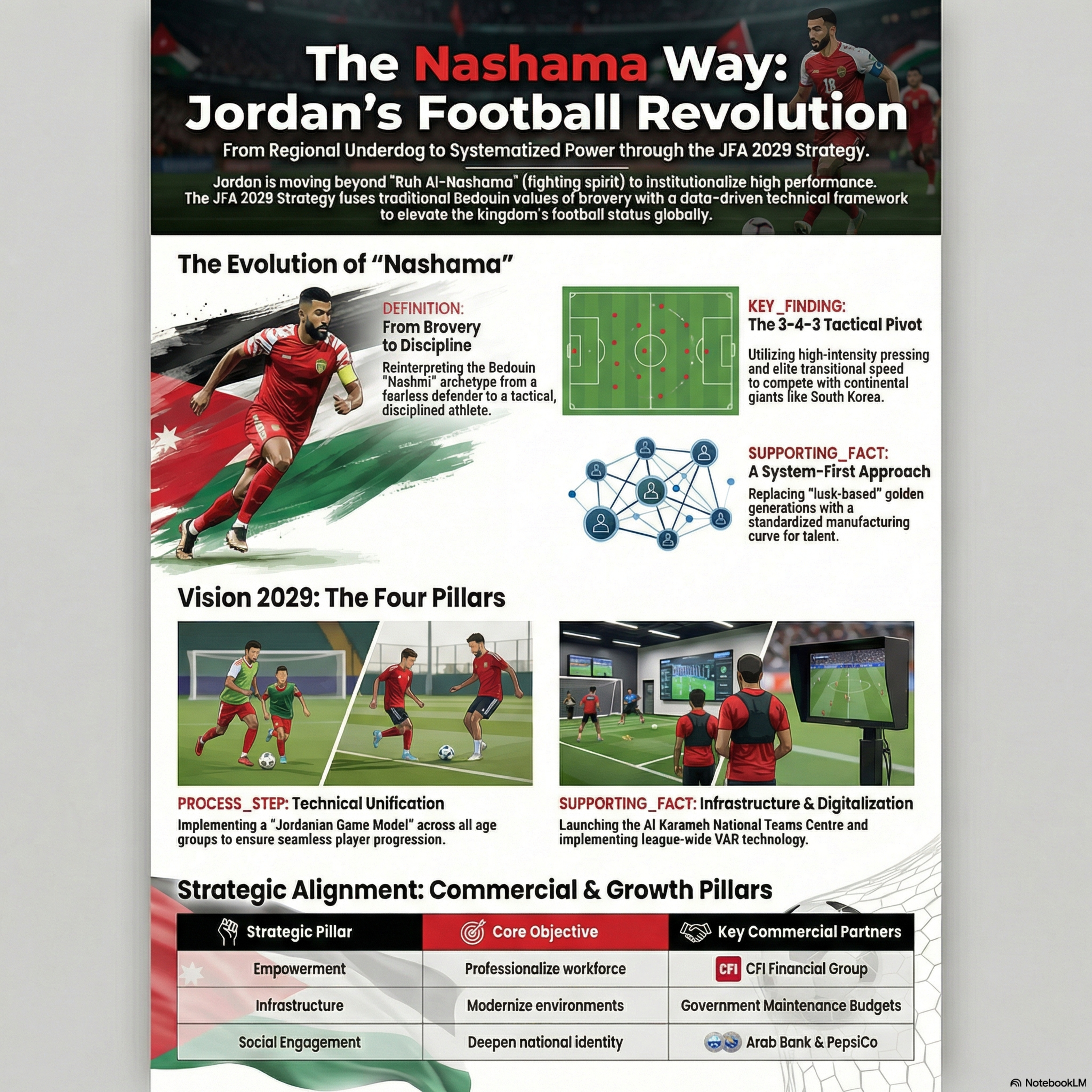
Jordan's Grit to Grid Football Revolution
About this episode
Jordan's Grit to Grid Football Revolution
Remarkable. It it just doesn't even begin to cover it. I mean, did you see it? I saw it. Did you actually sit there and watch what happened in the Asian Cup? Because I did. And I'm still buzzing. My heart rate is, I think it's still settling down. I think we all are. It was something else entirely. And we are just talking about a game here. This is, this feels like a seismic shift, you know, usually when we sit down to unpack a football revolution, we're looking at the usual suspects. Germany, Spain.
Exactly. We're talking about Germany in the early 2000s rebooting their whole Academy system because they got, you know, embarrassed at the EUR. Or we're talking about Spain inventing Tiki Taka or the Japanese 100 year vision. The big guys, the G7 economies with these massive, almost unlimited budgets and. We look at them and we say, well, yeah, of course they did it. They have the money, they have the population, they have the resources. It's the skyscraper theory, isn't it? If you have a billion dollars and 1000 architects, building a skyscraper is just a matter of time.
It's expected. It's almost boring because the input guarantees the output. But this, this is different. We are going to the heart of the Levant. We are talking about Jordan. And for anyone who has been tracking the game, watching the qualifiers or was glued to the screen during that run to the Asian Cup final, you know this feeling. You saw them take it to South Korea. You saw them play with a ferocity and a structure that just didn't make sense for an underdog. And the lazy narrative, the one I've heard in coffee shops and read in the casual columns, is wow, what a Cinderella story.
The. Fluke. What a burst of raw passion. Yes, the passion narrative. And that is exactly the narrative we are here to well, to destroy today. Because Cinderella's story implies magic. It implies a fairy godmother came down, waved A wand, and suddenly Jordan was in the final. And it's an insult. It's a huge insult to what actually happened. What we are witnessing isn't a fluke, it isn't just a golden generation that popped up out of nowhere, and it certainly isn't just about passion or fighting spirit.
No, this is engineered. That is the word that kept flashing in my mind as we absorbed all this wisdom about the current state of Jordanian football. It is engineered a. 100%. We are looking at a calculated industrial scale revolution. It's a fundamental shift from relying on grit. Just, you know, fighting hard and throwing bodies in the way. To building a grid. A grid, A system? A machine. It's the evolution from a street fight to a chess match. For 30 years, maybe more, Jordan was the Street Fighter.
Toughest guy on the block? Sure. Oh yeah, would give you a black eye. Absolutely. But eventually the Street Fighter loses to the martial artist who has technique, who has a plan that all. Now Jordan is becoming the grandmaster. They are learning the theory. So here is the mission for this deep dive. We are going to unpack the Neshama Way. And I don't just mean the nickname. We were talking about a blueprint. A full blueprint. It's this incredible fusion of ancient Bedouin heritage values that go back centuries, combined with high tech modern football strategy.
We've absorbed so much insight on this and we really want to break it down for our game, for the fans, the coaches, the people living and breathing this sport. And I want to be super clear about why this matters to you. Listening right now. You might be a fan screaming in the stands. You might be a youth coach trying to get U twelves to just pass the ball. Or you might just be someone who loves the game, right? This matters because it's the transition from trying hard to winning smart. It's about understanding that the shift from grit to grid is what separates the teams that make up the numbers from the teams that lift trophies.
I love that grit to grit. That's the theme right there. So we have a lot to get through and we are going to be systematic about this. No jumping around. We're going to build this house from the foundation up. Let's do it first. We're going to decode the cultural DNA. What exactly is an Ashme? Then? We're stepping onto the grass to dissect the tactical revolution, specifically that 343 formation that has everyone talking. Then we'll look at the factory, the infrastructure and the youth pipeline and finally the engine room, the business model that's paying for it all.
It's a 360° view, Yeah, from the soul of the player all the way to the fiber optic cables in the stadium. OK, let's dive straight. In Part 1, Decoding the DNA, we have to start with the name. The national team is called Al Nashama. Now think about world football nicknames for a second. What do we usually see? Animals. It's almost always apex predators. Right, the Three Lions. The Super Eagles. The Tigers, the Dragons, it goes on and. All it's all about biology. It's about aggression, it's about being the thing that eats the other thing.
It's it's about dominance. Criminal stuff. But Nashima is different. It's not an animal. You can't draw Nashimi as a mascot in the same way you can, you know, draw a lion. No, it's a concept. It's a human quality. So let's unpack this, because for our listeners who might use the word casually, I want to really dig into the weight of it. Al nashima, or the singular nashimi, is a uniquely Jordanian concept. It's deep in the Bedouin roots, very deep. If you open a dictionary, it might just say brave, but that's so flat it just misses the texture of the word.
It does. Brave is way too simple. A bank robber can be brave anash me is something else entirely. The core values are well, there are things like chivalry, magnanimity, and the courage to act in a crisis for the benefit of others. For the. Benefit of others, that's the key. It's a human quality, not an animal instinct. That is such a key distinction. An animal acts on instinct. A lion is hungry so it hunts. A Nash me acts on a code. A code exactly. Chivalry implies a social contract. It implies that I have a duty to the person standing next to me, to my tribe, to my community.
Yes. Go back to the Bedouin traditions. Who was the Nash? Me. He was the one who, when the tribe was in trouble, or when a guest arrived in the middle of the sandstorm, he stepped forward. OK, He gave a last of his water. He defended the camp. Not because he wanted glory. Not because he wanted to be the star of the week on some highlights show. But because it was his responsibility. It was his duty. It's collective responsibility over individual stardom. So when you translate that to a football pitch, it changes how you view a player.
You aren't just looking for the guy with the flashy boots who wants to dribble past five people to get on a highlight reel. No, you're looking for something deeper. You are looking for the player who views the 90 minutes as a national duty. It creates a different psychological baseline. I really believe that the player isn't an entertainer first and foremost. He's a servant of the cause and that is powerful. It's a different fuel source. It is. It's a fuel source that teams like, with all due respect, France or Brazil might not have in the same way.
Theirs is often about individual brilliance, individual expression, than the shot away is about the collective shield. But here is the rub. And this is where the old school versus new school clash happens, which I think is fascinating. Yeah, this is the core of the transformation. For a long time, historically, this Nashama spirit was interpreted in a very specific and I would argue a very limited way on the pitch. It was for decades. Being an Ashmi meant suffering. It meant, OK, we are technically inferior to Japan or Saudi Arabia, so we are going to throw our bodies in front of the.
Ball. Just pure grit. Pure grit. It meant last ditch tackles. It meant blood, sweat and chasing shadows for 89 minutes, hoping to nick a goal from a set piece. The heroic draw. Or deficit the heroic draw. We celebrated it if we lost one zeal to a giant. But we fought like lions. Or fought like Nashima. We considered it a moral victory. We've all been there. It was defensive resilience used to bridge a technical gap. It was knowable for sure, but it was reactive. You were letting the other team dictate the game and you're just trying to survive.
It and you can't win trophies just by surviving. You eventually run out of luck. You can't just defend your way to a championship. Correct. And this is the revolution we are seeing now. The leadership, the coaches, the JFA, they realize that the definition of bravery had to evolve. They had to redefine what it means to be an Ashmi in 2026. OK, So what is the new definition? How did it change? The new school bravery is mental fortitude. It's not about sliding in for a tackle. You can't win just to show passion.
That's reckless. It looks good for the cameras. It looks good for the cameras, but it's actually selfish because if you miss that tackle, you leave your team completely exposed. The new bravery is the discipline to stick to a complex tactical plan when your lungs are burning, when the crowd is screaming and when you are under extreme pressure. That's profound. Bravery is no longer just I am not scared of the ball. No bravery is I am not scared to play a risky forward pass because that is what the system demands, even if I might mess it up and lose the ball.
Exactly that. It's the shift from the fearless defender to the disciplined athlete. It takes that raw emotion, which can be volatile. It can leave to red cards. It can lead to losing your head. It's uncontrolled energy. And it channels it into a grid. It channels it into a system. It's controlled aggression. It's like taking a wildfire and turning it into a combustion engine. 1 burns the house down, the other dries the car. Perfect analogy. And that engine needs a design. You can't just have the energy, you need the mechanics.
Which brings us perfectly to Part 2, the tactical revolution. Because you can have all the mental fortitude in the world, but if you don't know where to stand, you're just a disciplined loser. Right, you're running around with purpose, but in the wrong direction. So we need to talk about the system and before we get to the specific formation, the 343, we have to talk about the history of volatility. This is the curse of so many developing football nations, the managerial merry go round. Oh, I know it well.
We've lived it. One year. We hire a defensive coach from, I don't know, Italy. We park the bus. Two banks of four. Next year he's fired. We hire a Dutch coach who wants total football. We try to pass it around the back for 20 minutes. He loses 2 games, he's fired. Then we hire a South American coach who wants flair. It was chaotic. And think about the players, think about a kid coming up through that system. It's impossible for them. At 16 he's told kick it long, get it out of the danger zone. At 18 he's told keep possession, be patient.
At 20 he's told press high win it back immediately. He never masters anything. It confused player development for a generation. You end up with players who are jacks of all trades and masters of none. So the JFA said stop. They hit the brakes hard. They decided to implement a unified coaching philosophy. This is a massive administrative and technical undertaking. It sounds huge. It is. They are creating a specific Jordanian game model. Homogenization. Now usually in art or culture we say homogenization is bad.
We don't want everything to look the same. But in high performance sports. It's the Holy Grail. You want AU 15 player at a training center in Urban to learn the exact same pressing triggers, the exact same defensive shape, and the same vocabulary as Musa Al Tamari in the senior team. So it reduces adaptation time. Drastically, when that kid gets called up to EU 20s or the senior team, he isn't learning a new language, he's just speaking the language he's known since he was 12, just at a louder volume at a faster pace.
And to make this happen, they needed an architect. Yes, and this is a crucial point. Enter the technical director and we have to make the distinction. This isn't the head coach, no. The head coach manages the first team. The technical director manages the football of the entire nation. The man is Abdelay bin Sultan. He's the coach of the coaches. Coach of the coaches, I like that. His mandate isn't just to win on Friday. His mandate is to ensure that this philosophy is actually being practiced on the grass at every age level, not just sitting in a binder in the JFA headquarters.
So let's get into the weeds. What is the philosophy? Because we saw it. We saw the 343. For the listeners who might not be tactical nerds, let's breakdown why this specific shape was the key that unlocked every. OK, so the 343 is the perfect marriage of the old Noshima and the new Noshima. Let's look at the back line first. 3 center backs the three. That's the security, that's the foundation. That's the heritage that taps into that old school defensive resilience. Having 3 central defenders means you almost always have coverage.
It means if one steps out to challenge a player, 2 are left behind. So it provides A psychological safety net. Absolutely. It allows the team to feel secure. It says we are hard to beat, we are solid. But if you just have three center backs, you can be too defensive, too narrow. That's where the four comes in the midfield four and specifically the wing backs. The wing backs are the engines of this entire system, but crucially, they provide with they stand right on the touchline. They're chalk on their boots.
Exactly. And this is where the geometry gets beautiful. By keeping the wing backs wide, you stretch the opponent's defensive line. You force their defenders to separate from each other. And when they separate, what happens? What does that create? You create gaps you createspace and specifically you create gaps in the half spaces. OK, half spaces. We hear commentators on TV say it all the time, but let's nail this down for everyone. Imagine the pitch is divided into 5 vertical lanes. You have the left wing, the right wing, and the center lane.
The half spaces are those two lanes in between the wings and the center. Correct, and that is the most dangerous area in modern football. It's too central for the opposing fullback to defend comfortably, but it's too wide for the opposing center back to defend comfortably. It causes confusion. It causes hesitation. And who operates in those spaces for Jordan? The stars, Yeah. The difference makers. Musa Al Tamari Yazin Al Naimat. The guys who can hurt you. Exactly. The entire system is designed to isolate these guys in those pockets of space.
The wing back pulls the defender wide, creating a channel and suddenly Al Tamari has roof to turn and drive at the goal. It's not accidental that they had such a great tournament. The geometry of the formation was built to serve them. But here's the thing that really stood out to me, and it's what makes them so unique. Jordan wasn't dominating possession. No, not at all. They weren't playing like Manchester City, just keeping the ball for 70% of the game and slowly strangling you. No, and that's a critical part of the identity.
The data shows they are often under 45% position, sometimes even lower. They are comfortable without the ball but, and this is the secret sauce, it's about what they do the second they win it back. Verticality, verticality, transitional speed. In the old days you'd win the ball, you'd be under pressure and maybe you pass it back to the keeper just to take a breath. Settle things down. Now the trigger is instant. Win the ball, play forward, Sprint. It's aggressive, it's direct. It's high risk though a forward pass can get intercepted.
It is high risk. You might lose the ball again immediately, but because you have those 3 center backs behind you is a safety net. You can afford to take that risk. It avoids what people call sterile possession, just passing the ball sideways for the sake of passing. Just keeping stats up. Right. Jordan plays to hurt you. Every pass has a destination, and that destination is the opponent's goal as quickly as possible. So it's a hybrid. You have the Bedouin shield at the back, Solid brave collective and you have this modern high velocity spear at the front.
That's a great way to put it. It turns their perceived weakness, lack of, say, technical dominance in midfield compared to a team like Japan, into their greatest strength, speed and directness. OK, so we have the Spirit, the new Nashima, and we have the tactics, the 343. But a tactic is only as good as the players executing it. Always. And for a long time we just hoped good players would appear. We hoped for a miracle. Now we are moving to Part 3. From luck to industry. This is the system first approach.
This is where we talk about Vision 2029 and honestly, this is the most ambitious part of the whole project. This is the big picture stuff. It sounds like a government manifesto. 4 pillars, 32 goals, 160 initiatives. I mean, it's massive. It's the industrialization of football, but the core mission here, the philosophical mission, is to kill a myth. Which myth is that? We need to kill the myth, the golden generation. Oh, we hear that all the time. Oh, this is Belgium golden generation. This is Croatia golden generation.
And it sounds like a compliment, but it's actually an admission of failure. It's an admission that your system isn't working. How so? Because a golden generation implies luck. It implies that you just happen to have a group of supremely talented kids born in the same five year window by complete accident. And what happens when they retire? You crash, you go back to obscurity for 20 years. Exactly. The JFA doesn't want a golden generation, they want a golden factory. They want sustainability. They want to replace luck with a manufacturing curve.
They don't want to pray that another Alta Marie is born in 20-30. They want to build a system that it negatively produces one or someone close to 1 every five to seven years. That is a huge shift in mindset. It's taking the romance out of it and replacing it with engineering. It's less magic, more science. It is, but that's how you win consistently. You look at the bust nations, France, Germany, they don't rely on luck. They have a pipeline, they have a system. And to build a pipeline, you need stability and you need power.
This brings us to the political aspect. We can't ignore the backing here. We can't. It's fundamental to all of this. HRH Prince Ali bin Al Hussein is the president of the JFA. The Crown Prince is heavily involved now in some contexts, having royalty involved. It's just ceremonial. Right. They show up, shake hands, cut a ribbon and go home. But here it's functional, it's operational. How so? What does that mean on the ground? Think about the obstacles to building infrastructure in a developing nation.
Land rights, municipality permits, tax laws, bureaucracy. Red tape everywhere. It can take 10 years to get a permit to build a new training. Pitch exactly. When you have the Royal family treating football as a matter of national importance, those doors open that red tape gets cut. So it sends a signal. It signals to the entire government apparatus this matters. Make it happen. It provides the political stability and, crucially, the land required for these massive projects. Speaking of massive projects, let's talk about the hardware Part 4.
Because you can have the best philosophy in the world and the best prints backing you, but if the players are training on a cow pasture, they aren't going to get better. The philosophy dies on bad grass. It's that simple. And the centerpiece of this hardware revolution is the AL Karame National Team Center. I've seen the plans for this. It looks like a fortress, like a high tech university campus for football. It is a fortress of excellence, it's secluded, it's world class, but the strategy behind it is what fascinates me.
It's about the shift to a camp based model. What does that mean exactly? A camp based model. It means isolation. Look, being a professional footballer in a tight knit society can be distracting. Sure, you have family obligations, you have friends, you have social media, you have the noise of the city. The AL Carame Center is designed to pull the elite athletes out of that environment for key periods. So when they cross the gates, the world disappears. Total control. The JFA can control their nutrition, their sleep, their recovery, their tactical classroom time.
You can't do that if the player goes home every night to his mom's cooking and stays up late playing video games. You're creating a high performance bubble A. Bubble of excellence. That's the goal, but. They can't stay in the bubble forever, they have to play in the league. And this leads us to the pitch problem. I found this fascinating because we rarely talk about the actual dirt and grass. It's the variable nobody discusses, but it dictates everything and you have to give them credit. The report was very honest.
The league stadiums have historically had uneven pitches, bumpy grass, hard soil. And why does that matter for the tactics? How does a bumpy pitch affect the 343? Connected back to verticality and speed. If you were running at full speed and the ball is bobbling because the grass is bad, what do you do? You have to slow down. You slow down, you take an extra touch to control it. You have to look down at your feet instead of up at the. Field and in that split second that offender closes you down, the attack dies.
Exactly, you literally cannot play the Neshama way. Fast one touch vertical on a bad pitch. The infrastructure was actively fighting against the philosophy. So the artificial pitch replacement project and the stadium upgrades aren't just cosmetic. They are not just for TV. They are tactical. They are fixing the floor so the dancers can actually dance. That is such a crucial insight. You can't ask a driver to race Formula One on a gravel Rd. Precisely. And alongside the physical grass, you have the digital infrastructure.
Let's talk about VAR. Video Assistant Referee Now everyone loves to hate VAR. It kills a vibe, it takes too long. But here it's being framed as a development tool. It's a behavior modification tool. Think about the local league. If there are no cameras, a defender learns that he can get away with a little shirt pull in the box. Sure. A little grab here, a little trip there. He could leave his foot in. He develops dirty habits because he isn't punished for them consistently. And then he goes to the Asian Cup.
And he does the same thing against South Korea and with 40 cameras watching from every angle. It's an immediate penalty. It's a red card. He costs his country the game. So bringing VAR into the local league forces the players to clean up their act before they get to the international stage. It forces discipline. It forces them to defend with their feet and their brains, not their hands and their cheap fouls. It prepares them for the reality of international football. And there's a knock on effect too, right?
Huge. To get VAR you need fiber optics run to the stadium. You need camera towers. You need a modern broadcast truck, so it forces the stadiums to modernize their tech backbone. It drags the whole broadcast standard up with. It and let's not forget the electronic archiving. That sounds a little boring, like filing paperwork, but it's actually about data. It's about data sovereignty for years. If you don't record the games properly, you can't analyze them. The history is lost. By archiving everything match reports footage, the JFA can start building a database on every player, every match.
You can track progress. You can use analytics. You can see trends. At the end of the day, you can't improve what you don't measure. So we have the fortress, the grass and the cameras. The hardware is getting there, but who is entering the fortress? We need to talk about the Talent Pipeline Part 5. The pipeline. This is where the future lives, and this is all about the Prince Ali Centers, which are known as Waited. Waited, which means promising. I love that name. It's perfect, isn't it? These centers are the engine room.
But the most critical aspect here is decentralization. Because Jordan isn't just Aman. The talent isn't all in the capital. Exactly. For a long time, if you were a talented kid in a village in the South or up north near the border, you are invisible. The academies were in the capital. The scouts were in the capital. So you had to be lucky enough to be discovered. The weighted Sanders are planted in the governor. It's They are taking the game to the talent rather than waiting for the talent to come to the.
Game they are casting a massive net a. Huge net. They're looking for that kid in the desert who has raw speed but no formal training, and they're catching them young, ages 6 to 12. That's the golden window for development. It is. That is where you install the operating system. Remember the unified philosophy we talked about? This is where it starts. They teach the 8 year old the same principles of movement of spacing as the national team. So it becomes second nature. By the time that kid is 18, he doesn't have to think about the system.
He is the system. It's ingrained in his football DNA. And it's not just football drills, right? I read it was more holistic than that. Much more. Fit Kids programs. They teach nutrition and health from a young age and character building. They are teaching them the Nashama values chivalry responsibility alongside passing and shooting. So you're building a person, not just a player. You're building better citizens, which sounds cheesy, but it builds better teammates. I want to take a moment here to talk about the women's game because this revolution isn't just for the men.
Jordan has really been a pioneer in the region for women's football. Absolutely. Hosting the U-17 Women's World Cup in 2016 was a watershed moment. It changed exceptions overnight, but now it's about sustainability, it's about building on that, and a great example is the pathway of someone like Rawan. Altal, a former player. Right, former national team player who's now a coach. This is the cycle you want. This is sustainability in human form. Explain that. She played, she retired the JFA, supported her coaching education, often with partnerships with the Dutch FA who are brilliant at this, and now she is coaching the next generation of girls in these Wan centers.
She's a living example of the pathway. Representation matters so much. When a 10 year old girl sees Ronwyn blowing the whistle and commanding respect on a pitch, she sees a future. She sees that it's possible. It validates the pathway. It's not just a hobby, it's a career. So we have the plan, we have the place, we have the people, but there is one giant ugly elephant in the room. There always is money. All of this fiber optics, foreign technical directors, nutritionists, camps, new pitches. It costs a fortune.
And let's be honest, Jordanian clubs aren't exactly swimming in cash. So Part 6, the engine room. This is where the JFA had to get really creative and frankly, very smart. They had to shift from a charity model to a commercial model. Meaning they couldn't just keep asking the government for handouts. No. Government budgets are tight. There are other priorities. So they had to make football a business asset and the master stroke, I think, was lobbying for tax exemptions. Explain that. How does that work?
Why is it so important? OK, so the JFA worked with the government to ensure that money spent on football sponsorship is tax exempt. That is brilliant. It effectively lowers the cost for a profit company to get involved if a CEO is looking at its marketing budget. Sponsoring the league isn't just a donation anymore. It's not charity, it's a tax write off. It makes financial sense on a spreadsheet it. Completely changes the conversation. It incentivizes the private sector to step in where the state can't.
And we are seeing the results. Big names are signing up. We are CFI Financial Group. They didn't just put a logo on a shirt. They rebranded the cup competition the Jordan Cup. CFI, this is global trading platform. Their target audience is young, financially literate people. And they see Jordanian football as a way to reach them. It's a strategic alignment. It's not just I like football, it's this helps my business grow. And then you have the Arab Bank. A huge one, the official Bank of the national team.
This is an institution with deep roots in the country's history. Linking the National Bank with the national team adds gravity. It adds prestige. It legitimizes the project. It tells the rest of the market this is stable, this is serious. But it's not all corporate. There is a soul to this business strategy, too. I saw the plans for the National Football Museum. I love this project. It turns history into an asset. By building a museum, you are telling the fans your memories matter. The history of this team matters.
It makes it tangible. It cements the Nashama brand. It gives tourists a place to go. It gives kids a place to learn about the legends. It makes the legacy tangible. And the CSR work the corporate social responsibility. This is so important, working with refugees, working with underprivileged communities, partnering with companies like PepsiCo for grassroots festivals. This is crucial because it keeps the Nashama spirit alive. Remember what Nashmi means? Collective responsibility. If the national team becomes just a cold corporate billboard, you lose the fans, you lose the soul by doing this work.
They remind everyone we are still your team. We represent all of Jordan, not just the sponsors it. Balances the checkbook with the heart. Exactly. You need both to survive. So let's bring this in for a landing. We have covered a lot of ground here. We've gone from the Bedouin tent to the tactics board to the construction site, to the bank vault. What is the synthesis? What is the headline for this whole revolution? The synthesis is maturation. The Neshama Way has grown up. It started as a warrior spirit, beautiful, raw, emotional, we will fight you on the beaches, that kind of thing to your heart.
Now it is a corporate deedadriven high performance strategy. The brave have become the organized. The Braves have become the organized. I like that. That's it right there. And the window of opportunity is right now. It's 2026 to 2029. This is the critical window. They have the momentum from the Asian Cup. They have the eyes of the world on them. They have the political backing. If they can pour the concrete now, build the centers, fix the pitches, lock in the sponsors, they set themselves up for 20 years of success.
But if they miss it, if they hesitate? If they take their foot off the gas, if the clubs rebel against the unified philosophy, or if the money dries up, it could all evaporate. The risk is real. This is a fragile moment. I want to leave the listener and you with a final thought, A bit of a provocation, maybe. Go for it. We've spent this last what, hour praising the system, the grid, the machine, the homogenization. I know where you're going with this. Football, at its absolute core, is about magic.
It's about the unexpected. It's about the player who does something that no coach could ever teach them. It's about that, that beautiful chaos. The street element, the unpredictable genius. Exactly. So here's the question. As Jordan builds this rigid, data-driven, homogenized factory, do we risk coaching the wildness out of the players? Do we risk losing the next Musa Al Tamari, who is electric precisely because he is unpredictable, because he doesn't fit perfectly into the unified philosophy? Can a strict system still allow for the beautiful chaos that makes football, well, football?
That is the ultimate tension, isn't it? That's the $1,000,000 question. Can you be organized without being robotic? Can you have a grid that still allows the lightning to strike? That is the test for Ben Sultan in the JFA. They have to build a system that supports the artist, not one that stifles him. It's a fine line to walk. Well, I tell you what, I am going to be watching the next match with a totally different set of eyes. A new pair of glasses. I won't just be looking for the goals anymore.
What are you looking for? I'll be looking for the transition speed. I'll be looking at the defensive shape when they lose the ball. I'll be looking for the system at work. And looking for the Nashama Spirit channel to the lens of that new discipline. Exactly, to everyone listening, thank you for taking this deep dive with us. We really hope this gives you a new lens to view the beautiful game in Jordan. It's been a real pleasure. Keep watching, keep analyzing, and we'll catch you on the next one.
This is the deep dive. Signing off.
 Apple Podcasts
 Castbox
 Castro
 Goodpods
 Moon FM
 Overcast
 Pocket Casts
 Podbean
 Podcast Addict
 Podcast Republic
 Spotify