Ivory Coast Shatters Champion's Curse Tactics
About this episode
Ivory Coast Shatters Champion's Curse Tactics
Listen now on Spotify, Apple Podcasts, Amazon and other streaming services! Don’t forget to subscribe, share, and leave a ⭐⭐⭐⭐⭐ review to help more players and coaches discover the power of Techne Futbol and Data Technology in the beautiful game.
#TechneAfricaFutbol #TechneFutbol #TrainWithTechne #Playermaker #TraceFutbol #Hudl #FootballTech #FootballInnovation #PlayerDevelopment #CoachTools #SmartFootballTraining #AfricanFootball #CAFOnline #FIFA #FIFAYouth #CAFDevelopment #YouthFootballAfrica #NextGenFootball #FootballScouting #TalentIdentification #DigitalScouting #EliteYouthDevelopment #FootballJourney #FootballAnalytics #FIFAForward #FutebolAfricano #TrainTrackCompete #FootballExcellence #FootballAfrica #TheFutureOfFootball
If the Afghan Trophy is the crown jewel of African sport, then the knockout rounds, well, that's where the real test begins. Specifically, the round of 16. It's where the architectural integrity of a champion is either, you know, validated or just completely and utterly exposed. And this isn't just about scraping by. It's not about survival. No, no. It's about executing a plan with ruthless, almost clinical precision. And today we are sitting ringside right here in the tactical bunker, analyzing a match that wasn't just a football game, far from it.
It was a master class and modern adaptive coaching. And on the flip side, a profound and tragic cautionary tale about systemic failure. Indeed, and you know we have to look past the three-year score line. I mean, a score like that suggests it was easy, right? But the real story is in the profound tactical and psychological lessons this one fixture offers. This deep dive is really for you, the student of the African game who wants to understand not just what happened in Mericac. But why? Why it happened?
Exactly why it serves as a blueprint for elevating tactical standards across the entire continent. Absolutely, we are tearing into one of the defining clashes of the AF Con 2025 round of 16, the defending champions Cote d'Ivoire securing a truly, truly dominant statement victory over their regional rivals Burkina Faso. Right there at the Grand State America on January 6th, 2026. And this match, when you look at it in isolation, it's a stunning tactical display. But then you zoom out, you juxtapose it with the day's other results, and it becomes the clearest possible road map for success.
And critically, a painful map showing the route to failure. Our mission today is very, very targeted. We want to systematically unpack the technical and the psychological elements of this Ivorian performance. OK. We have to extract the specific systemic lessons and I mean everything from the high defensive line of the losing side to the flexible asymmetrical roles of the winners that can directly elevate the tactical integrity and headed of edge required to succeed in these tournaments. OK, let's unpack this monumental clash then, and I think we have to begin not with the whistle, but with the immense psychological and historical weight that these two sides carried into that stadium.
The context here is just overwhelming. This was the West African Derby. Does it get much bigger? No, we're talking about the elephants versus the stallions. 2 nations that share a massive 584 kilometer border. This fixture is charged with more than just football. It's regional identity. It's regional identity, it's rooted in shared history, economic ties, it's a foundational rivalry and. Crucially, that historical narrative leading up to Merickek was well, it was fundamentally asymmetrical, wasn't it?
Completely Ivory Coast has always loomed large as the dominant Big Brother. Before this game, the Ivorians held a very strong, a very clear psychological lead in the head to head record. What were the numbers? It was nine wins to Burkina Faso's three across 20 previous meetings. So this is not a balanced rivalry. It is a relationship of historical dominance, and that history it translates directly into a tangible psychological burden. You can see it on the pitch. You could. Burkina Faso entered that knockout stage knowing they had never, ever secured A knockout stage victory over Ivory Coast.
They'd lost group stage meetings in 2010 and again in 2012. So the Stallions weren't just fighting the opponent on the day. No, they were fighting decades of accrued expectation and, frankly, failure. And you could physically see that psychological debt manifesting in their gameplay. You really could. They played with what observers called frantic urgency. Now, frantic urgency in a highly technical game like football means two things over commitment and a compromise decision making process. Exactly.
They were rushing passes, taking speculative shots from anywhere, and crucially, they were trying to force an equalizer the second they went one zill down. There was no composure. And that is the pivotal lesson here, isn't it? For African teams in these heated derbies, the weight of history is a psychological burden that you have to actively manage. You have to. If you allow that burden to compromise your mental preparation, you might as well just throw your tactical plan in the bin. Burkina Faso was reacting emotionally, trying desperately to rewrite the script, and that's what led them down the path of, well, tactical suicide later in the match.
Which brings us to the other side of that coin, the monumental psychological obstacle that Cote d'Ivoire had to overcome the notorious champion's curse. Ominous is an understatement. It really is, if you track the history of the AFCON since Egypt successfully retained their title way back in 2010. A long time ago now a. Very long time. The subsequent tournaments have seen defending fighting champions consistently stumble at this exact stage, the round of 16, or sometimes even earlier. We've seen giants fall, Zambia failing to get out of the group, Nigeria facing these ignominious early exits.
Right. This curse represents 16 years of accumulated psychological pressure on whoever is holding that title. And yet, here is Cote d'Ivoire, led by coach Merse Fay, not just navigating that curse, but completely shattering it with what you can only call a resounding statement of intent. What is the mere fact of breaking this curse? Tell us about the culture Faye has instilled. Because, you know, motivation isn't enough at this level. No, it speaks volumes about the culture of resilience and, more importantly, tactical maturity.
Faye is a coach who was born from adversity. He took over during that traumatic previous AFCON campaign where they nearly exited. Exactly so. His core philosophy is rooted in tactical discipline and calculated in game adjustments. This team learned the hard way that rigid systems fail under pressure. Flexibility survives. Flexibility survives. The three two comeback against Gabon in their final 2025 group game perfectly exemplifies this, doesn't it? Oh absolutely, there were two nil down staring at a disastrous group stage exit.
Yet they absorb the trauma. They adapted mid match and they overturned that deficit to top the group. Precisely that comeback was the forging moment for this squad. It wasn't just a mental victory, it was a tactical one. It taught them how to nap, navigate immense adversity, how to absorb pressure, and crucially, how to make the necessary in game adjustments under duress. So they arrived in Merrick with this this assuredness. The confidence of champions who learned from their past mistakes, that was the primary differentiator.
The Ivorians arrived rested, strategic and calm. And the stallion. The stallions were frantic and burdened by history. The contrast couldn't have been starker. OK, so let's move from the psychological arena to the technical, the pre match tactical battle. I mean, it dictated the opening 35 minutes and ultimately the entire match. It was a plash of completely contrasting systems. Let's break down the Ivorian approach first. Phase deployment of the 433 formation was just a master class in modern tactical fluidity.
It was beautiful to watch it. Really was his primary objective was clear, secure, absolute midfield control and couple that with aggressive exploiting width and he signaled his serious intent by going back to his absolute strongest starting XI after arresting players in the final group match. The spine was robust. You're right. You had Yahia Fofana providing that calming presence in goal and then that back 4 duet, Kasunu Indica and Conan offering a superb blend of, you know, physical dominance for aerials, but also that recovery pace to track runners.
But the true innovation, the real genius, was in the midfield engine room. Francasi's role was so, so complex and so pivotal. He wasn't just a box to box runner. Not at all. He was the great oscillating pivot, constantly shifting between being a deep lying destroyer, shielding the defense when Burkina Faso press, and then instantly becoming a box to box creator, driving forward with vertical passes when they had the ball. So his movement was dynamic. It was dictated by the phase of play, not a fixed position on a tactics board.
Exactly. And partnered by Ibrahim Sangare, their joint mission was absolute suffocate any central progression and force Burkina Faso to play exclusively through narrow, predictable channels. If you dominate the center, you control the tempo. You control the tempo, you control the ball recoveries, and you control the game's direction. Which leads us to the key innovation that I think African teams really have to study the asymmetric attack. Yes, Fey explicitly instructed Ahmad Diallo to abandon the traditional touchline winger roll.
This is where the depth of modern tactical planning really, really shines. Still, it's more about that what does it actually mean for Diallo to drift into the half spaces, and how does that movement specifically create problems for the opposition's defensive geometry? OK, so the half spaces are those crucial vertical corridors between the opposing fullback and their newest center back. By drifting inside, Diallo forced a catastrophic choice upon Burkina Faso's defensive line. A dilemma. A total dilemma.
The right center back, Edmund Taxoba. He doesn't want to leave his central zone and expose the goal. But if he doesn't track Diallo, Diallo is receiving the ball centrally, completely free to shoot or pass. So it creates an immediate central overload. The moment Diallo shifts from the touchline into that Channel, it pulls a central defender out of their comfort zone. And this is the beauty of the asymmetry. That movement instantly allowed the attacking fullback guerrilla duet to overlap high and wide with impunity, just charging into the space Diallo had vacated.
So Ivory Coast wasn't just playing a system, they were executing a strategy designed to isolate a specific defensive vulnerability. And that vulnerability was the Burkanabe right back Adama Nagalo, who is now forced to manage these complex 1V1 or even 2V1 decisions every time Diallo drifted. It's about being unpredictable but perfectly coordinated. The lesson for the The African game is clear then. It's crystal clear success demands flexible roles, the oscillating midfielder, the drifting forward to systematically exploit specific spatial weaknesses.
Which brings us, unfortunately, to the tragic flaws of Burkina Faso's system, that fragile 4231 under coach Brahma Treirai. Their intent was defensive solidity and leveraging counterattack speed, but two critical decisions just doomed them. The first one was the goalkeeping gamble. Herf Coffey had sustained A thigh injury in the final group match against Sudan. His fitness was clearly clearly compromised, yet Trere selected him for the starting Avor. In a high stakes knockout match, what are the immediate consequences of playing an injured keeper?
I mean, it's not just about saving shots, is it? Not at all. It's about command, mobility and confidence. A compromise keeper often fails to command their area. They hesitate on crosses and crucially, their decision making speed is slowed, especially on when to sweep behind a high defensive line. And that nervousness, it's like a virus. It is. It transmits panic and erodes the confidence of center backs like TAP, Soba and Dio. And the second, and arguably the fatal flaw, was the tactical suicide of the Highline.
They instructed their defensive line to push extremely high, trying to compress the space Cassier and Sangare had to work in. And this is where the strategic inconsistency became a critical error. They pushed the defensive line high, which is an aggressive move, right? But they did not coordinate this with intense, immediate pressure on the Ivorian ball carrier in midfield. This coordination crisis left the highline dangerously exposed. A high block is a weapon only when used with a coordinated high press.
Exactly, if you fail to press the source of the pack pass, which was Kessie, you leave vast inviting acres of space behind your back 4 for a team with the speed of Ivory Coast to just run into. So they brought the aggressive sports car to the race, but they forgot to put the engine in the high press. That's a perfect analogy. The lesson here for coaches developing African talent is the necessity of tactical coherence. A high block is only viable with ruthless coordinated pressure, implementing an aggressive modern strategy without ensuring the personnel have the fitness, the cohesion and the understanding to execute it.
It turns a sophisticated choice into a critical liability. And they became victims of their own ambition. The Ivorian tactical plan was executed instantly and with surgical precision. The match was functionally decided within the first third, so we have to analyze this period in forensic detail. Let's start with phase one, exposing the weak link from minute zero to 15. The immediate disaster. Yes, the moment the match kicked off, Ivory Coast immediately activated their plan, targeting Adamo Nadalo on that Burke and the Bay right flank.
And within 3 minutes the tactical success was evident. Diallo received the ball in the pre clanned half space, precisely where Fey wanted him. He drove directly at Nagalo, who was already dealing with the ambiguity of Diallo's movement versus Duets overlap. And Nagalo was forced into a desperate mistimed challenge, a yellow card in the 4th minute. A tactical catastrophe that instantly shifted the balance of power. Why was it so consequential in minute 4? Because it neutralized Nagalo's ability to defend aggressively, he was now, you know, walking a tightrope incapable of committing to firm tackles or aggressive interceptions for the next 86 minutes.
It effectively granted Ahmad Diallo the freedom of the flank. Ivory Coast had won the critical tactical duel for that entire side of the pitch in 4 minutes without even scoring a goal. And this high pressure environment also immediately exposed the vulnerability of their goalkeeping gamble. Absolutely. By the 10th minute, Herv Kofi was showing those early nerves, a simple deep cross from the right flank, the very flank Diallo was exploiting, and Kofi flaps at it hesitantly. He fails to claim or Perry convincingly.
The defense scrambled it clear, but you could see the tremors running through the back line. That momentary instability signaled to Ivory Coast that the entire back 4 was fragile even before the goals arrived. OK, Phase 2, the breakthrough and validation from minute 16 to 30. The calculated finish As the Ivorian midfield settled their dominance became total. Kessie and Sangare established a passing rhythm, denying Burkina Faso any meaningful central possession and forcing their pivot to collapse inward.
Creating a vacuum a. Huge vacuum in front of the defense, and in the 19th minute, the inevitable breakthrough arrived. This wasn't a moment of individual magic, but the validation of a perfectly executed plan. Walk us through it. The sequence began centrally. Cassier released a quick vertical pass that just bypassed the Birkenabe central pivot. The ball finds Diallo in space created by Nagalos mandated hesitation from that yellow card. Diallo doesn't rush. He takes one touch to settle, confirms the space and unleashes A precise low finish past Kofi 10.
Clinical efficiency. But the real psychological moment arrived with the VAR check that followed. They scrutinized a potential foul by Evan Gasand on Nagalo in the build up. For the Stallions, this was a moment of hope, a potential reprieve. The VAR officials took their time, but they ruled that Gessen's contact was merely A legitimate contest of strength. Goal stands. Goal stands. And that VAR decision wasn't just technical, it was a profound psychological blow. It validated the Ivorian physical dominance and confirmed that the officials would allow a higher threshold for physicality.
For Burkina Faso, already struggling, this felt like the rules themselves were stacked against them. Their morale was just fracturing, Which? Brings us to phase three, the double blow in the sliding doors moment, the last 15 minutes of the first half the. End of the game, really. It was Burkina Faso's response to going one deal down was exactly what Immers Faye would have predicted. Desperation. Desperation. An emotional decision to push the highline even higher, trying to equalize possession and territory.
And that gamble was instantly and ruthlessly exploited. The game was effectively over just 13 minutes after the opener. The 2 double goal came in the 32nd minute and Ahmad Diallo once again was the architect. He received the ball, drove rapidly toward the box, drew in the remaining defenders and squared a pass toward the penalty spot. Now we have to stop here and focus entirely on front Cassie's moment of brilliance, which elevated this from a good goal to a tactical highlight. Absolutely. Kessy, despite being the obvious recipient for the past, displayed an incredible high football IQ.
He saw the movement of the defenders and, crucially, he saw the unmarked position of Yandi Amande behind him. So instead of shooting. Instead of shooting or controlling, he executed a perfect composed dummy. He let the pass run clean through his legs. Which froze the final defender. Froze him completely eliminated Coffee's already shaky angle, leaving Diamande with an empty net to sweep the ball into that simple non action. The dummy was a masterstroke. It confirmed the Ivorians were thinking 2 steps ahead of a defense running on fumes.
But the game's flow almost shifted dramatically just before halftime, the sliding doors event in the 40th minute. Dango Watara, the only stallion showing any genuine threat, cuts inside beautifully and unleashes A ferocious curling strike. It beat the keeper. Beat Yahia Fafana completely, but it rattled the woodwork and bounced safely away. If that goes in, it's 21, the atmosphere is electric, and Burkina Faso enters the locker room with renewed hope. Instead, it merely highlighted the difference.
Ivory Coast was clinical and efficient, capitalizing on their chances. Burkina Faso was unlucky and inefficient. That moment confirmed the narrative of the first half and. Before the break, Coach Treire makes the substitution. He pulls off the booked Nagalo. For Blati Toure, this was an explicit public admission that his initial tactical setup had failed catastrophically. A bitter but vital lesson. Acknowledge failure and adapt quickly, even if it hurts. OK, so the second-half phase, four for a minute, 46 to 80, Champion game management.
This was a textbook clinical demonstration of game management mode from phase perspective. With A20 cushion, the priority instantly shifted from dominance to efficiency and energy conservation. They instructed the team to drop their engagement line significantly. They invited Burkina Faso to have the ball. Which served a dual purpose one conserve energy for the looming quarterfinals and to allow the stallions to push high, creating deep counter attacking space for them to exploit later if needed.
But even in cruise control, the fundamental defensive structure held firm, didn't it? It did. The midfield pivot became a discipline shield preventing any vertical passes, and Yahiya Fafana provided the key moment of individual assurance in the 62nd minute, reacting sharply to smother a close range effort from Watara. That save was symbolic. It wasn't spectacular, but it was reliable. It ensured the clean sheet remained intact, confirming that even when the team relaxes tactically, individual responsibilities are maintained.
That's the hallmark of champions. By the 80th minute, Diallo was withdrawn to a deserved standing ovation. His mission was complete. He wasn't risk for the final stretch, another sign of calculated game management. Focused on the larger tournament goal. Which brings us to the final 10 minutes, phase five, the final insult. Total collapse. The final goal in the 87th minute wasn't about Ivorian strategy. It was a painful display of Birkenabe exhaustion and total structural resignation. Substitute Bazimana Toure intercepts a sluggish pass in transition.
The mental fatigue was just palpable. He went on a solo run and the Birkenabe defense was described as non existent. They'd given up the chase. No one was tracking the runner. And her Coffey was once again caught in no man's land. Positioning anticipating a cross that never came, he allowed to raid a fire inside the near post. Three O the perfect visual metaphor for the afternoon. A professional, ruthless side executing a plan against the side that experienced a total structural and psychological surrender.
A brutal analysis. Now we move to the essential phase of this deep dive, analyzing the why for the African game. Why did this structural failure occur, and what specific lessons can be institutionalized across the continent? Let's revisit the tactical suicide. The high defensive line was the defining tactical error, but it was a symptom of a deeper coordination crisis. It's a calculated risk, but only if the press is perfect. And it wasn't the structural failure was that midfield vacuum. Because there was no coordinated press to stop Kessie or Sangari, the highline was never protected.
Ivory Coast just played one or two crisp vertical passes to bypass that first line of pressure. And they had direct access to all that exposed space behind the defense. Which meant every single Ivorian attack was immediately dangerous. This highlights a crucial issue in coaching development across Africa. Many teams try to emulate sophisticated European pressing structures without the necessary internal cohesion and, frankly, the energy levels to sustain it for 90 minutes. So Burkina Faso was playing offside trap roulette, but they failed to bring the gun, the high press, to the table.
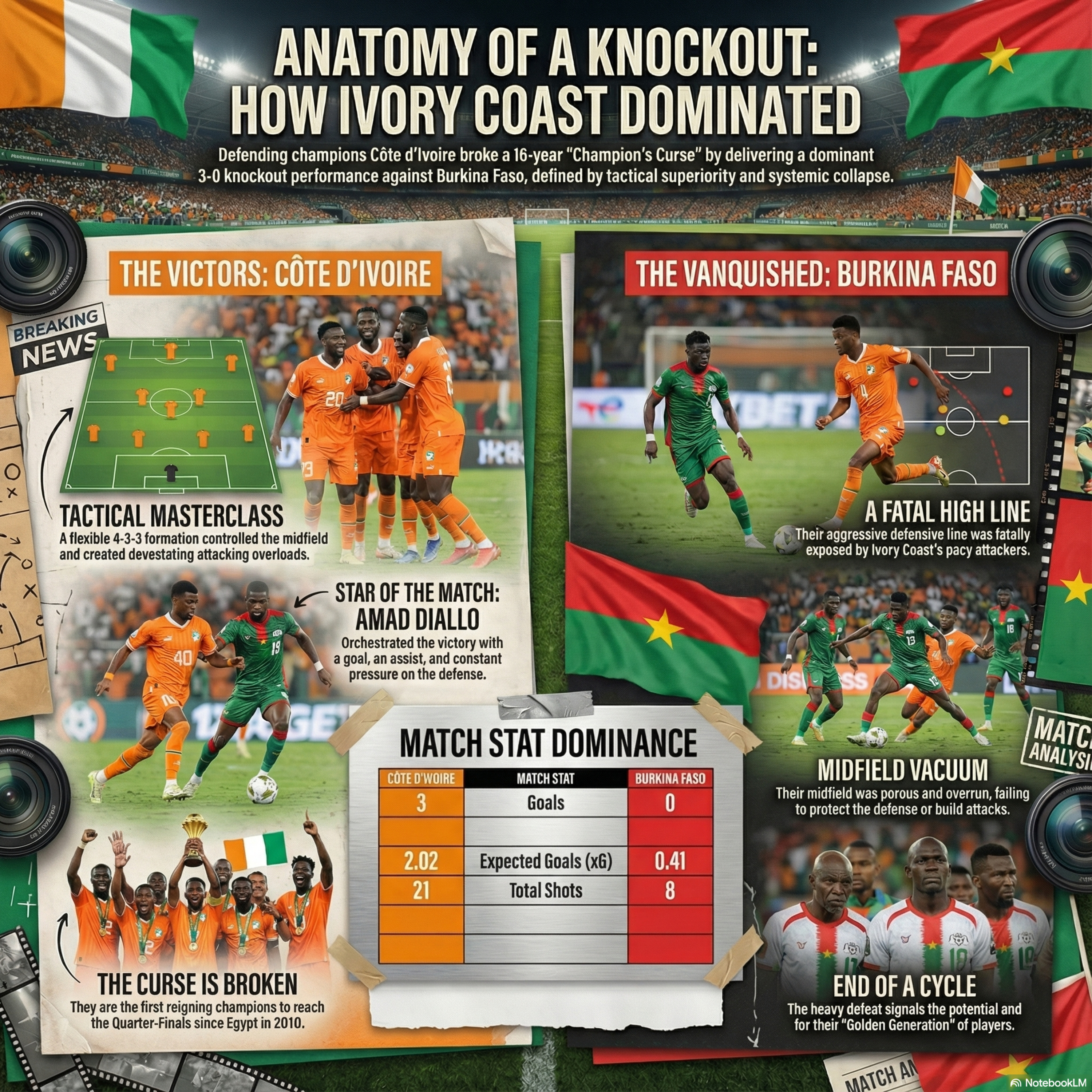
Precisely this highlights a continental imperative. Strategic risk must be married to coordinated execution. If you opt for an aggressive system, your midfield pressure must be relentless and unified. Otherwise you're just exposing your entire defense to be ruthlessly exploited. A foundational coaching lesson which leads us to the midfield vacuum itself. Engine room supremacy. The stats here are just shocking. Staggering Kessie, Sangaray and Damonde completed passes with an accuracy rate of 90% combined, the highest midfield passing accuracy recorded in the entire tournament up to that point.
That level of efficiency and control just eliminates any chance for the opponent to build sustained pressure. And conversely, Burkina Faso's central play was porous and ragged. Their pivot was constantly caught flat footed, turning sideways or backward. They were tactically outnumbered and functionally out thought in the engine room. Lesson for African football development seems pretty clear then. Midfield superiority dictates knockout matches. Investing in a resilient, high accuracy central pivot is non negotiable for continental success.
OK, Finally, the goalkeeping crisis. Reliability. Trump's risk? We have to isolate the impact of Herve Coffey's erratic performance. His selection, despite the injury, was not just a technical failure, it was a failure of leadership. The instability he displayed, flapping across his poor positioning, was a catalyst for panic. His mobility was clearly compromised. He couldn't rush out to sweep when the highline was breached. His hesitation turned dangerous through balls into clear scoring opportunity.
In a knockout Derby, a nervous goalkeeper transmits panic directly to his defenders. It eroded the already shaky confidence of Tapsoba and Dio. It forced them to drop deeper than instructed, which undermine the highline strategy even more. He was visibly living on the edge, taking risks that led to three goals, the opposite of the stabilizing presence you need. The lesson for technical directors is profound. In high stakes moments, reliability must categorically trump risk. The importance of selecting A calming, commanding presence and goal cannot be overstated.
Now, the true strategic significance of this Ivorian victory is magnified when we introduce the context of the day's earlier match, that grueling war of attrition between Algeria and Dr. Congo. This doubleheader provided 2 contrasting models of how to compete and how to lose at this level. And you have to look at them together. While Ivory Coast glided to a clinical 3 Dole win, Algeria labored against a supremely disciplined Dr. Congo side. That match was an absolute struggle. A war of attrition for 120 minutes.
It was Dr. Congo, unlike Burkina Faso, did not suffer A coordination crisis. They played with a compact, disciplined low block. They weren't naive, they were pragmatic. They frustrated Algeria for 100 in 18 minutes. And it took a singular late moment of individual brilliance, Edel Bulbina's 119th minute strike, to finally breach that resolute structure. So contrast those two narratives Dr. Congo lost due to a singular moment of magic, deep in extra time after a display of heroic structural discipline.
Burkina fossil lost due to structural collapse and tactical naivety within the 1st 30 minutes. And this contrast highlights the critical disparity in what we should call competitive integrity. A necessary term for African coaching. It is. It means African teams must learn how to lose. Well. Dr. Congo forced Algeria to empty their tank physically and emotionally for 120 grueling minutes. While Burkina Faso allowed Ivory Coast to essentially play at training ground pace for the entire second-half.
Competitive integrity means making your opponent work for every single inch and every single goal. It means maintaining structural stability even under the most intense pressure. The DRC model, despite the loss, preserved that integrity. Burkina Faso forfeited it. And this contrast has immediate and crucial implications for the tournament structure, doesn't it? The fatigue factor is immense. Huge Algeria enters the quarterfinals physically and emotionally exhausted, having struggled for 120 intense minutes.
Their psychological state is likely frustrated. Ivory Coast, on the other hand, enters their quarterfinal fresh. They engaged in controlled game management for 45 minutes. They can serve their energy reserves while Algeria burnt theirs completely. And that emphasizes the Ivorian killer instinct, They're champions mentality. They were just content to win. They won efficiently by ruthlessly exploiting weakness early. That ruthless efficiency is the mark of a true contender. OK, the eye test confirms the dominance.
But the numbers game, well, the numbers really speak volumes, validating our entire tactical analysis. Let's look at the stats. The expected goals or XG disparity is the most telling statistic. It confirms Burkina Fasa's plan failed to generate chances. Ivory Coast registered 2.02 XG. Burkina Fasa's was a meager 0.41. That number tells the objective story. The Stallions never look like scoring. And that .41 XG proves that Burkina Fasa's possession, which increased in the second-half, was entirely, entirely sterile.
They were just circulating the ball outside the Ivorian block, creating almost nothing. Meanwhile, Ivory Coast's offensive movements were highly penetrative. The staff show they generated 14 shots from inside the box compared to Burkina Fasas 3. They were consistently creating high probability shots from central dangerous zones. This is the difference between aimless passing and strategically aggressive possession. And what about ball recoveries? Enlightening Ivory Coast recovered the ball in the opponent's 3rd 15 times compared to Burkina Faso's six.
This confirms the effectiveness of their counterpress. Even after losing the ball, they got it back quickly and high up the field. And we can't overlook the historical significance. That third goal by Toure was the 160th Afghan goal for Cote d'Ivoire. Pushing them past Nigeria's 158 to become the second all time highest goal scorer in Afghan history, trailing only Egypt's 181. This victory wasn't just a win, it was a statement of continued historical offensive potency. Now this Apton has been defined by the successful integration of technology.
We need to touch on the positive role of VA R&S at in maintaining the competitive flow. The key technological moment was the VAR validation of that 19th minute goal. The ruling that the contact was a legitimate contest of strength was crucial for setting the tone. It'll have the game's characteristic physicality to thrive. It did and the implementation of semi automated off technology SAOT is a massive advancement. It resolved tight offside calls on Ivorian through balls in seconds. No more lengthy delays.
Which is vital in a high stakes, fast-paced encounter. It keeps the flow of the game. Individual brilliance always amplifies a successful system. Let's recognize the champion's spine, starting with the Man of the Match. Ahmad Diallo undisputed a 9.5 out of 10. His impact was comprehensive, a goal in assist and constant defensive disruption. His movement into the half spaces was the tactical solvent that dissolved Burkina Faso's defense. And he became the first Ivorian since Didier Drogba in 2012 to score three or more goals in a single Afghan tournament.
Then there's the captain, Frank Kesse with an 8.5. Beyond his incredible football IQ on the dummy, he dictated tempo with imperial authority. Seven chances created, tied with Diallo just underscoring his critical. Role and Yandiomande 8.0 He led the match and completed dribbles with 10, demonstrating his relentless movement and ability to carry the ball under pressure. Conversely, the failed resistance was tragically symbolized by Bertrand Troy. His final action, losing possession for the third goal, was a sad symbolic end for a legend.
It represented a generation that was just tactically outmatched. And we have to revisit Edmund Tapsoba, usually a beacon of reliability, he was constantly exposed by the lack of midfield protection. It just reiterates the final point. The greatest individual defender cannot save a fundamentally flawed structure. So this dominant Ivorian victory has completely redefined the championship landscape. It gives them immense momentum. Let's look at what comes next and synthesize our lessons. Cote d'Ivoire now faces what everyone is calling the final before the final, a Titanic quarterfinal clash against Egypt A. Fixture steeped in history, A replay of the 2006 final and the 2008 semifinal, both famously won by the Pharaohs.
And the tactical challenge for Fey is immense because it requires immediate adaptation. Unlike the naive highline of Burkina Faso, Egypt possesses A rigid, conservative and historically effective defensive structure. So we can't rely on exploiting vast space behind the defense. No, he will need to adjust his midfield plan. Kessie and Sangaray will likely need to adopt more conservative positions, focusing on intricate possession around the box rather than vertical counterpunches. Breaking down a compact low block is the next test.
The momentum is undeniable, though. They broke the Champion's curse. Now they face the Pharaoh's curse of historical defeats to Egypt. Their form is key, unbeaten in the tournament, winning six of their last eight, but their ability to transition quickly from high pressing execution to a patient, pragmatic approach against Egypt will be the acid test. And for Burkina Faso? For Burkina Faso, the three Layo defeat signals the immediate, painful need for a comprehensive rebuild of their tactical identity.
The end of the road for their golden generation. It is the. Challenge for the new coach is immense, integrating talents like Ouattara and Tapsoba with new depth, but critically addressing the structural and tactical naivety that was so brutally exposed. So if we distill this entire deep dive into the most crucial transferable lessons for the African game, we land on 4 non negotiables. 1st, tactical pragmatism. You must have the maturity to know when not to use an aggressive highline. If your execution isn't world class, your strategy must be conservative, not aggressively inconsistent.
Second. Midfield dominance knockout matches are one in the engine room. An accurate, flexible central pivot is essential to control tempo. 3rd psychological strength. The ability to navigate the historical burden of derbies or the pressure of being champions is critical. Rise to the moment with calm execution, not frantic desperation. And 4th and this is so important, the necessity of competitive integrity learned from Dr. Congo's model. Even in defeat, maintain structural stability and force your opponent to empty their tank.
This has been a profoundly insightful and, for the Stallions, A brutal analysis. The difference between a controlled victory and a catastrophic collapse often comes down to one or two tactical inconsistencies. The Ivorian victory provides a rich textbook example of elite planning, execution and ruthless game management. And that contrast on the day, Ivory Coast gliding to efficiency while Algeria labored for 120 grueling minutes. It just highlights the premium placed on clinical efficiency. The Champions have definitively proven that tactical resilience and the clinical exploitation of weakness define elite knockout football.
The question for every aspiring African national team now is not just who they play, but how they prepare their entire structure from the highline to the goalkeeper to compete for 90 minutes or more under extreme pressure. Think about that. What structure in your organization or your own strategy is currently designed for aggression but lacks the necessary defensive coordination to back it up? We'll see you next time on the deep dives.
 Apple Podcasts
 Castbox
 Castro
 Goodpods
 Moon FM
 Overcast
 Pocket Casts
 Podbean
 Podcast Addict
 Podcast Republic
 Spotify