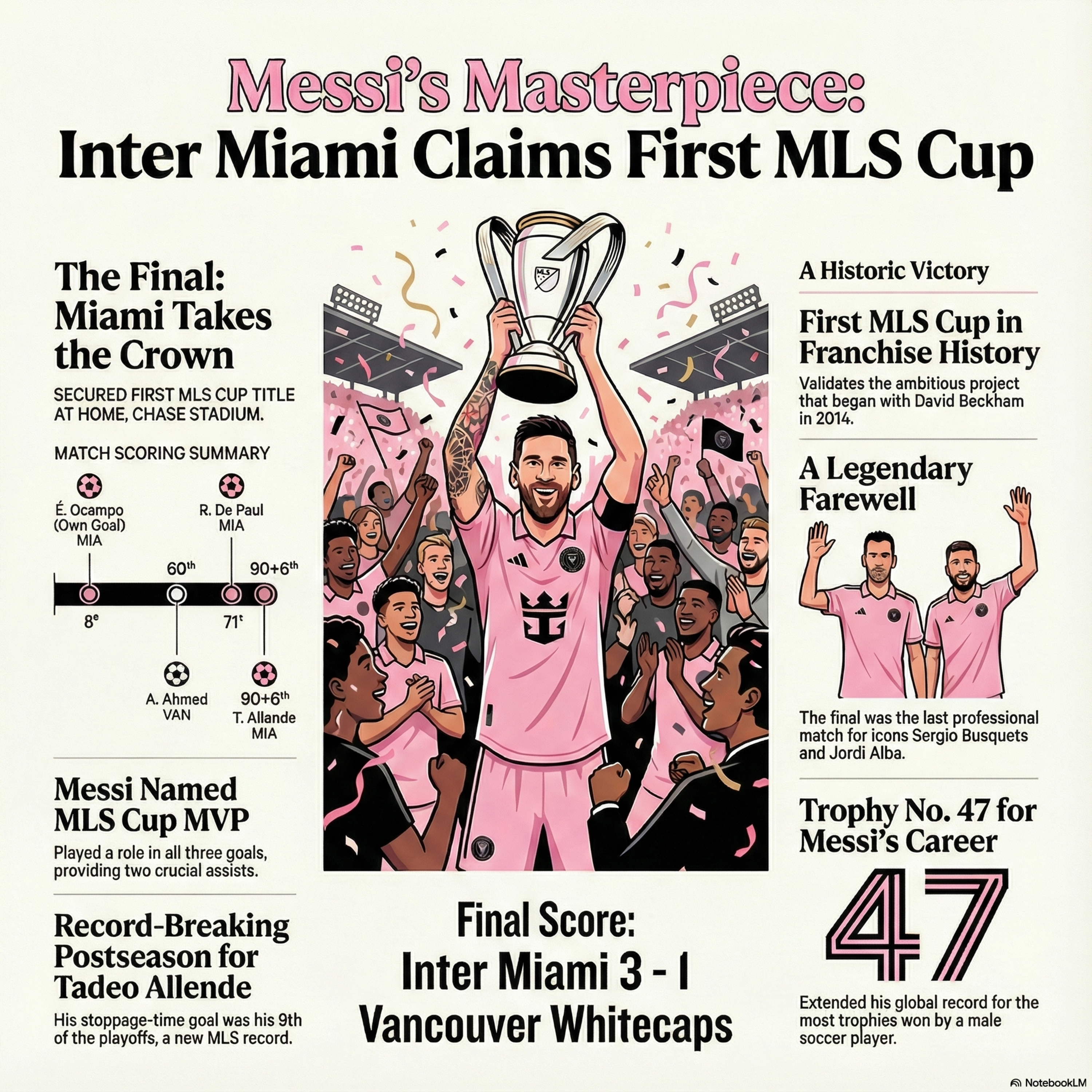
Inter Miami Claims First MLS Cup
About this episode
Inter Miami Claims First MLS Cup
Listen now on Spotify, Apple Podcasts, Amazon and other streaming services! Don’t forget to subscribe, share, and leave a ⭐⭐⭐⭐⭐ review to help more players and coaches discover the power of Techne Futbol and Data Technology in the beautiful game.
#TechneAfricaFutbol #TechneFutbol #TrainWithTechne #Playermaker #TraceFutbol #Hudl #FootballTech #FootballInnovation #PlayerDevelopment #CoachTools #SmartFootballTraining #AfricanFootball #CAFOnline #FIFA #FIFAYouth #CAFDevelopment #YouthFootballAfrica #NextGenFootball #FootballScouting #TalentIdentification #DigitalScouting #EliteYouthDevelopment #FootballJourney #FootballAnalytics #FIFAForward #FutebolAfricano #TrainTrackCompete #FootballExcellence #FootballAfrica #TheFutureOfFootball
Welcome to the deep dive. If you like us, watch the final of the 2025 Football Championship. You saw that 31 score line, right? And you probably thought, well, OK, the biggest *1. The expected result happened. Exactly. But that score line, it's really just a historical artifact. It is we are here to look way past the goals, way past the confetti, because what actually unfolded wasn't just, you know, a great sports story. It was a total seismic event. A seismic event that provides really a complete blueprint for how competitive organizations can achieve massive accelerated growth.
And that's our mission today. We're going far beyond the usual analysis. Oh yeah, we are not just recounting a match. We are extracting the strategic, the tactical and the financial DNA of a champion. I love that the DNA of a champion. We want to take that essential wisdom, you know, the principles of elite performance, of calculated investment, of visionary team building, and apply them directly to a massive opportunity. And that's accelerating growth and competitive parity within the African game.
Precisely, we need to see how these systems, these systems of success, can be replicated even on a different continent with different challenges. It's like we're shortcutting decades of potential trial and error for ambitious clubs and leagues by just giving them the Champions homework. That's a great way to put it. So let's just confirm the snapshot for you. We are analyzing the 2025 league final, where Inter Miami CF secured a pretty decisive 31V over the Vancouver Whitecaps. And this win, it wasn't just about lifting a trophy.
This was Miami's first ever league title. Huge moment for the club. And it was powered by their star forward, who, despite winning the league's Golden Boot, really acted as the ultimate facilitator of this game, providing 2 massive assists in the final itself. That three one result is the headline. You're right. But the depth of the story, I mean, it lies in the systems, the managerial courage and the sheer financial and personal investment that really stretched back over a decade. A decade. It's incredible.
So we have to analyze those fine margins of execution that decided the match and also the long term strategic decisions that made that final result even possible in the first place. OK, so let's unpack the game itself, because what that scoreboard doesn't tell you is how messy the opening was, right? And how completely dominant the losing Team Vancouver was for these huge stretches in the match. It's true the first goal came quickly and it set a tone, but maybe not the one Miami actually wanted.
What do you mean by that? Well, Miami did establish pressure right from the start. 8 minutes in you can see the ripple effect of that star players influence. Just his presence on the field. Just his presence, there was this quick sequence involving him in on the forward today, Olende, and it forces a reaction inside the box. So Miami gets on the board. It's 10, but it was an own goal. An own goal by Vancouver defender Eddie A Ocampo. Exactly, and that is so telling. It immediately shows you that the immense pressure applied by elite talent, what some people call gravity, it was already forcing defenders into those uncomfortable high risk positions.
The kinds of positions where mistakes just become inevitable. They were unnerved. You could see it right from the start. But Vancouver, and you have to give them immense credit for this. They didn't panic. If anything, that early goal seemed to, I don't know, steal their resolve. Oh, it absolutely did. They immediately took control of the tempo, the territory, the ball itself. They owned the game. It was incredible to watch. They absolutely bossed the game for the next 50 minutes. I mean, if you looked at the statistics leading up to the second-half, Vancouver held a staggering 65% possession.
65%, that's dominant complete. Domination. They had more shots, they controlled the midfield and they were frankly the better, more cohesive unit on the pitch. Which is the paradoxical truth of these high stakes football matches, isn't it? It is. You can be the objectively superior team in terms of structure and control and still find yourself down a goal early. And they did eventually capitalize on that domino. They did. In the 60th minute. Canadian international Ali Ahmed He Nets this brilliant equalizer.
But the analysis of that goal is so critical here. It wasn't some amazing piece of tiki taka that carved up the defense, was it? No, not at all. It was clearly labeled and I think correctly, a goalkeeping lapse from Rocco Rios Novo. So right there, 60 minutes into the biggest match of the year, we have our first crucial lesson for any team aiming for a title. What's that? A-Team that is structurally dominant, that has all the possession, can have its entire game plan completely neutralized by one single critical moment of poor execution.
A poor pair of hands from what looked like a routine save. Exactly. And that's the whole game. That is the defining characteristic of elite competition. The difference between a champion and a runner up is so often less about the overall possession and more about, you know, a three millisecond lapse in concentration. In Vancouver, they had every right to feel they were in the driver's seat. Players like Emmanuel Sabi were causing huge problems for Miami's backline. They were, but the psychological shift after they equalized was immediate, and it just proves that football is 1 not by holding the ball for long periods, but by punishing singular mistakes and producing moments of pure genius.
And the defining moment, the one singular turning point that I think broke Vancouver's competitive spirit. The one that mattered most. It came just 11 minutes later, wasn't a set piece. It wasn't a sustained attack. It was one player capitalizing instantly on one major unforced error. Can we just walk through that sequence? Because it's incredible. Please at the 71st minute. The sequence should be mandatory viewing for every aspiring defensive midfielder and every forward. Vancouver's excellent amid Andres Cubas, he makes a critical error.
Just one bad pass. One errant pass across the midfield that just a little too slow, a little too predictable. And this is the danger of facing a global star. They are always lurking, always ready to punish that one lapse. And he was. He saw it instantly. Instantly, he stole the ball. But the genius, the genius was in the immediate next action. In the time it takes to blink, he delivered what was described as an incredible, perfectly weighted surgical pass through a tiny, crowded gap to Rodrigo DePaul.
And DePaul converts 2/1. DePaul converts and it's 21, just like that. The narrative basically says that Cuba's just learned what opponents have been tormented by for decades. The second you make a high leverage mistake near that man, the game is over. It's. Just over. That pass, threading it through that gap, that was the singular moment of pure clinical genius that Vancouver just could not recover from. Mentally or structurally? It was pure surgery, and while we focus on the genius, and we should, we also have to acknowledge the role of just cruel, cruel fate in these high stakes.
Finally. Well, this is heartbreaking. The sources highlight that just minutes after Vancouver equalized, and this is before Miami took that 21 lead, they had this moment of unbelievable bad luck. And triple post the triple post, There was a shot that hit one post, bounced across, hit the other post and somehow stayed out. It narrowly avoided crossing the line. Millimeters. Yeah, the agony of sport right there. It emphasizes just how thin that line is between victory and defeat. You're the dominant team.
You finally get your equalizer and then the woodwork denies you by millimeters. And then immediately, your opponent's superstar delivers the deathblow. It's just devastating. The Vancouver coach, Jasper Sorensen, he even reflected on it with this, like, brutal honesty. He suggested maybe that was the luck we needed to be champions. And that confirms it. While strategy is absolutely key, luck and momentum in those clutch moments, they are non negotiable factors in winning titles. I can't plan for it.
You can analyze tactics endlessly, but sometimes the ball just has to bounce your way. And because Miami had the ultimate creator on their side, they didn't need the ball to bounce. They just needed one opening. Just one and the closing goal in stoppage time making it three. One, that was just the seal on the trophy. Right. Secured by Tadeo Allende. That goal actually set a new postseason scoring record for him at nine goals. Which is an incredible run. And predictably, it came off yet another key pass from the star forward that extended his overall campaign assist total to a massive 28.
28 and nine of those in the postseason along. 9 assists in five playoff games. It is just staggering. So let's synthesize this. Let's make it a clear, actionable lesson for the African game. We saw a Team Vancouver, that boss so much of the game, 65% possession, more shots, and they lost three one. What is the fundamental teaching here? The core. Lesson, and it's a harsh 1 is the absolute non negotiable requirement for clinical surgical efficiency. It's not about how much of the ball you have. Not at all.
African clubs, particularly those competing in continental tournaments where the margins are razor thin and the pressure is immense. They have to prioritize clinical finishing and the complete elimination of critical errors in their own third. Vancouver created chances but couldn't take them. Miami created fewer but converted instantly when they got the opportunity. So this final is a lesson. It is a harsh, definitive lesson. Unmatched finishing, instant capitalization on turnovers and the ability to convert that one clear cut chance when the match is tied.
That's what wins cups, regardless of how much you dominate the midfield percentage wise. It is the victory of efficiency over aesthetics. Perfectly said. Efficiency over aesthetics. And that's a powerful distinction that moves us perfectly into the next section, which is all about the underlying structure that enabled that efficiency in the 1st place. This is where it gets really, really interesting for me. We're moving from the 90 minute performance to the underlying tactics. The star player was named MVP of the final, but as he said, he didn't score the goals.
He was the ultimate facilitator. So what was the tactical mechanism that allowed him to completely flip his role from primary scorer to primary architect? It was a beautiful piece of tactical engineering from the manager Javier Mascherano, and this wasn't just the star relying on his old role, this was a purposeful, designed evolution. So what was the specific shift? The key shift was moving him to a false nine position within a 433 formation. OK, so for you listening at home, if you're not super deep into the tactical jargon, what is a false 9 fundamentally?
Fundamentally, a false 9 is a center forward who doesn't stay central, they drop deep into the midfield. So instead of challenging the center backs head on, he's pulling them out of position. He's confusing them. Exactly right. The false nine position allowed him to drop deep, often into that little pocket of space between the opposing midfield and their defense. Which is a nightmare for defenders. It disorganizes the opposing center backs because now they're faced with this impossible choice. Do I follow the greatest player in the world into midfield and leave a massive gap behind me?
Or do I stay put and just allow him to turn and dictate the entire play freely? There's no good answer. And he was operating so fluidly across both the right and left channels, not just centrally, which is where you might have seen him five years ago. This positional fluidity, it creates that an immense gravity we talked about. Let's focus on the concept of gravity. We hear it used to basketball all the time, but in football, what does the star forwards gravity actually look like on the pitch? Gravity is the magnetic pull he exerts on the oppositions entire defensive structure.
Because of his quality, because of the threat he poses, he naturally draws multiple defenders, often 2 center backs and a defensive midfielder right to his vicinity. And he doesn't even have to beat them. He doesn't have to beat them, he just has to occupy them, and this creates a chain reaction. The defenders are pulled out of their functional positions, which opens up these vast tracks of space either behind them or in the wide channels. So much Rana's genius wasn't just moving the star, it was populating those newly created gaps with players who were specifically designed to run into them.
Precisely. The system was built to maximize the potential of what we call complementary runners, and This is why players like Matteo Silvetti, who had two goals and three assists in the playoffs, and Tadeja Lende, who finished with nine goals and two assists. The guys who actually scored. The guys who scored This is why they thrived. These are the younger, faster, more vertically inclined players whose primary job is just to attack the spaces that are opened up by the star forward's gravitational.
Pull so the star is the key that unlocks the defense. But the younger players are the ones Turing the lock and scoring the goals. It is a stunning example of tailoring your system to the current capabilities of your greatest asset. And this brings us directly to Masturano's development as a manager. Because he showed real guts in implementing the system he did, the sources note. He is a young manager on the rise, willing to make the necessary adjustments. But what was the most defining, maybe even surprising, adjustment he made in this postseason run?
It was what's been called the gutsy call and it was enormous. He made the tactical decision to bench a high profile legendary forward Luis Suarez. A huge name with huge historical cachet. For the younger, faster, more vertically inclined Matteo Silvetti and that decision, it just screamed that tactical fit and team structure supersedes emotional loyalty or star power. But wasn't that a huge risk? Yeah, especially for a final. I mean, prioritizing an unproven youth player over a proven decorated legend like Suarez shows massive confidence.
Maybe. Bordering on arrogance. I don't think it's arrogance, I think it's conviction. Conviction in the system. Mostrano knew that while Suarez offered incredible hold up play and, you know, world class finishing, of course the false 9 concepts required vertical running to exploit the space. So that he offered that verticality, that pace, that willingness to run channels that Suarez at this stage of his career just couldn't consistently provide anymore. And that decision paid off. It galvanized the attack.
It made the entire system functional. And it paid off handsomely in the high stakes post season. That is managerial courage, the willingness to disappoint a star for the benefit of the overall team structure. And crucially, this tactical shift, which was primarily offensive in its design, had this massive defensive benefit. It did. It proves that old adage that a good offense is a good defense. It certainly did. The structural shift helped confine the game to specific manageable channels, which dramatically improved their rest defense.
And for the listener, rest defense is essentially what? It's how quickly A-Team reorganizes and protects against a counter attack immediately after they lose possession. Because Miami's offense was structured to funnel the play and maintain a compact shape even when they were high up the field. They were just less exposed centrally. Their defensive focus was more limited. And the results on that end of the field were stunning. Absolutely. They dramatically reduced the number of goals. They conceded only four and five playoff games while scoring 17.
That's a championship winning defensive record. It is, and it was built not just by better tackling, but by better structure. It proves definitively that a well structured offense can fundamentally aid a previously flawed defense through smart organization. Good structure makes the whole squad look better. It mitigates the weaknesses of individual defenders. Now, in fairness, we have to dedicate some significant time to the opposition to Vancouver because their coaching job, led by Jasper Sorensen, was cited as one of the best in league history.
Truly, they were an outstanding, resilient unit. Sorensen's work was masterful. I mean, he's dealt with immense adversity, major injury, setbacks to key players, but he didn't use any of it as an excuse. No, instead he compensated by prioritizing player development. He did nurturing young talents like Tate Johnson, Reyna Lomi and Tristan Blackmon into quality national team caliber players before integrating their own mid season * Thomas Miller. So Vancouver built what was called a ruthlessly balance and aesthetically beautiful unit first, and then Miller was integrated.
But he wasn't the project. The system was the project. That is the key distinction. Miller was integrated as a force magnifier, someone to enhance the existing system rather than demanding the system be built around him. Which is a critical model for global success. It is. Miller just understood how to fit into the scheme and make everyone around him better, shifting their formation seamlessly from a 433 to a potent 423 1 based on the phase of play. It proves you can integrate elite talent successfully if your system is robust enough to handle.
It, and Vancouver's tactical challenge to Miami in the final, It was brilliant. They forced Miami's midfield to flatten out. They drew the star player deeper and deeper. Right, making Miami function more like a diamond with an old fashioned #10 at times they made it incredibly difficult for Miami to transition out of their own 3rd for large parts of that game. They executed their plan to perfection for about an hour. They did, but that is the double edged sword of high pressure midfield control.
If you push your midfield up to compress the space and control possession, you inevitably concede space in behind for those vertical runners. For the Allende's and the silvettes. Exactly. And if you concede that space to Mascherano's highly vertical direct system, you are going to be punished eventually. Vancouver blinked first at the 71st minute with that errant pass. And that was the moment Miami, using the geometry of the False 9, won the match. So let's bring this section to a close with the critical blueprint for African football.
The lesson here is on talent management and maximizing your resources. The lesson is absolutely clear, success requires a strong functional youth developing system first before you integrate any elite high profile talent. Vancouver model. The Vancouver model, compensating for losses, developing young players and then using a star like Mueller as a force magnifier, that's the sustainable path for African clubs. The focus has to be paramount on local talent development. You have to nurture young players who provide pace and complement the tactical structure like Silvetti and Allende were used in Miami squad.
So the takeaways don't make an aging international name the sole centerpiece of the team. Do not. The system has to stand on its own, capable of weathering injuries or retirements or just poor form. It's a structural investment, not just a talent acquisition. OK, we've established that this victory was driven by tactical ingenuity and structural efficiency. But to really understand this blueprint we have to look past the tactics and examine the financial and the structural foundation. This championship wasn't built in a season, it was the culmination of a decade long struggle.
We are talking about the investment odyssey of David Beckham and his partners. It is a phenomenal story of conviction and extreme perseverance. When we see the title being celebrated, we often forget the sweat equity that's involved. Absolutely. This success was the result of a 12 year odyssey that began with this unique clause in Beckham's original player contract way back in 2013. Which gave him the right to purchase an expansion team at a deeply discounted rate. Right. But then he had to partner with the Maz brothers, who provided the local knowledge in the capital.
And then they had to battle for years, through political wrangling, land disputes, local skepticism, just to secure the expansion slot. Which was finally awarded in 2018. Finally. In 2018, twelve years of grinding political and logistical battles just to get permission to start a team, that right there is the first overwhelming lesson. It is. You need a long term vision measured in decades, not seasons, and you need absolute conviction that your project is going to succeed. And that kind of commitment, it signals seriousness to the entire global football community.
But let's zoom in on the physical infrastructure, because that is the defining symbol of the commitment. They struggled for years to find a permanent stadium site. They did, initially settling for a temporary home that many people felt was just inadequate for a world class club. But the crucial commitment was the eventual confirmation of the privately funded $1 billion Miami Freedom Park. $1 billion, privately funded. That is not just a stadium, that is a statement. It is a massive statement of intent.
It's a mixed-use development. It's set to debut the following April and the timing is just perfect. Unbelievable. They haven't just won the title, they now have a championship banner ready to hang on the opening day of their glittering new state-of-the-art stadium. That kind of infrastructural commitment, securing the facility, ensuring the revenue streams, building the mixed-use elements, that is what elevates a club from just being a participant to being a global enterprise. The ownership quote really resonates here.
It's worth every single effort and dreams come true. But the key was taking that long term vision and then leveraging it with the biggest piece of personnel acquisition possible. And that acquisition was the real game changer. Recruiting the main star was a multi year effort. It was a three-year campaign. Three years. Three years it involved management flying all over the world to meet the star in his inner circle, in Paris, in Barcelona, in his hometown of Rosario, even in Doha. This was not a casual transaction.
It was a sustained courtship, a massive, complex investment to ensure he didn't just come alone. And the investment went beyond just the star. They successfully recruited his core teammates Jordi Alba and Sergio Busquets and brought them into the adventure. Right. And that brought not just on field quality, but this undeniable aura and influence that instantly elevated the profile of the entire team and the entire league. And that aura translates directly into quantifiable commercial. The financial payoff was staggering and immediate.
Since the Stars arrival, the club's Forbes valuation has approximately doubled, doubled revenues skyrocketed, reportedly ranking them at the top of the league almost overnight, and their social media presence became vast. Suddenly they're competing with major global European powerhouses. This is the quantifiable return on a massive targeted strategic investment designed to lift the entire brand. This success has also ignited A crucial league wide debate about fairness and competitiveness, which we have to address, especially when we're talking about applying these lessons to Africa.
Yes, it seems like success is increasingly driven by teams pushing the financial envelope with high spending on what they call designated players. This is the competitive arms race we have to discuss, and to fully understand it, we need to clarify the financial mechanism for the listener, please. Most people know there's a standard salary cap designed to maintain parity, but the league allows teams to sign a limited number of designated players or DPS whose full salaries don't count against that cap.
So it's a loophole essentially. It's the financial loophole. It's the essential tool that allows teams to sign superstars outside the regular financial constraints. It's vital for attracting global talent, but it's inevitably polarizing for league parody. And the evidence suggests that those aggressive DP heavy teams are the ones who are winning. Absolutely. The pattern among recent champions is crystal clear. They are off the teams that maximize their designated player slots and spend aggressively to acquire high caliber international talent.
And Miami isn't slowing down. No, their management is already promising to reload and defend in 26. It signals that this aggressive spending is the new norm. They are driving an arms race, forcing other clubs to raise their investment levels simply to keep up. The hope, I guess, is that this global spotlight generated by the star leads to long term league fandom attracting European fans, cementing the league's global status. They're consciously trying to echo that original New York Cosmos ballet era of the 70s.
And that connection to the past is important, but they have to avoid the collapse that LEAD experienced. The key to sustainability lies in converting those temporary star chasing viewers into long term, locally loyal fans. And that conversion depends so heavily on the intrinsic commitment shown by the players themselves. It does, which brings us to the emotional side of the investment highlighted by the farewells of Alba and Bousquettes. This point is so powerful. It's immensely powerful and it resonates so deeply with team building.
The final was the last professional match for these two legends, Jordi Alba and Sergio Busquets. And the sources emphasized that these guys who have won literally everything at the highest level of European football, everything, they closed their careers lifting a trophy and they showed that they really gave a shit about winning this league. And that level of emotional investment is crucial, isn't it? Especially when you bring an international talent, It validates the entire project. It absolutely does.
They didn't come just for a paycheck. They treated this league like a serious competitive project that required their full commitment and that dedication. It changed the entire club mentality. It provided an immediate, non negotiable professional standard for every young player on that squad. So they're genuine Emotional investment is as important as the $1 billion stadium. You could argue it's even more important in the short term. So let's summarize the blueprint for the African game from this massive commercial and structural section.
OK, first, African football must commit to a long term commercial strategy mirroring Beckham's 12 year goal. You cannot build a sustainable, globally relevant product on short term whims or one season contracts. Then second. Second, and this is crucial, clubs must secure modern, commercially viable physical infrastructure reflecting that $1 billion stadium project commitment. Infrastructure underpins all revenue, right? And finally, the talent. Finally, strategically acquiring talent must be done with an eye toward elevating the entire brand and competitive level recruiting players who are genuinely invested.
The Alba Busquets factor is what drives the global attention and revenue increases necessary for financial sustainability. Investment has to be in lockstep with genuine emotional commitment. OK, let's really unpack this now. We've dissected the clutch moments, the tactical structure and the decade long commercial foundation, right? So now taking all this knowledge, all this analysis, we need to provide clear, actionable lessons from the success story that can fundamentally benefit the growth and competitiveness of the African game.
This is the ultimate objective of our deep dive. And I think we see 4 distinct strategic imperatives emerging directly from the data. These are the pillars that African leagues and clubs must focus on to accelerate their growth path. OK, let's start with what might be the most difficult one, the one that really counters the natural instinct to just chase the biggest name. Imperative one, prioritizing structure over individual names. The Masharano Sernson lesson The core lesson here is non negotiable star power, especially aging star power must be integrated into a functional youth developing system.
You just have to look at both finalists. Look at both finalists. Vancouver upselled because Sorenson developed young local players Johnson, Alami, Blackmon before integrating Mueller. Miami maximized their star by building a system of vertical runners, Silvetti Alande, to attack the space he created. So how does that translate directly for African clubs, the ones who are looking to sign high profile players, maybe from the diaspora, who are returning later in their careers? African clubs need to move away from focusing solely on the celebrity of the player and focus on the technical managers, whether they're local or international, who can establish tactical discipline.
So it starts with the coach. It starts with the coach and the system. They have to prioritize leveraging youth and pace, the Silvetti and a Linda model to complement those high profile acquisitions. If you sign a star distributor, you must have the fast vertical runners ready to exploit the space he creates. Because a star without a system is just a high salary. Exactly. But a star with a system is a champion maker. This focus on verticality and system over individual brilliance is the key to competing internationally.
OK, moving on to the concept of time and commitment, that struggle that literally took a decade. Imperative too long term infrastructure and branding. The Beckhamus lesson. The Miami project signaled seriousness to the entire world by fighting for years for a franchise and then securing a $1 billion stadium project. This commitment is the foundation of long term commercial credibility. And this is an area where African football often struggles right with outdated facilities that really hamper revenue generation and branding.
Absolutely sustainable growth relies critically on modern, safe, commercially viable stadiums and professionalized front office operations that are capable of managing these complex multi $1,000,000 projects. The goal can't just be short term glory. It can't be. It has to be building a powerful, recognizable global brand that attracts international investment and justifies the increased media and sponsorship deals you need for financial sustainability. If the facility is world class, the brand can be world class and the revenue will follow, which crucially allows clubs to retain their best local talent for longer.
Infrastructure is the economic engine. Now on to the Third Point. This one requires the leagues themselves, not just the clubs, to look in the mirror about their financial rules, the arms race. Imperative 3 The competitive arms race The parity debate, The pattern in this league were expensive. Designated players often win. It suggests that absolute parity is receding in favor of aggressive spending that drives the competitive level higher. And Miami's management is already promising to reload and defend.
They're confirming this trend. They are and this forces African leagues to make a really strategic decision regarding their financial regulatory structure. How should they balance ambition with the quality? Tough question. They have to critically examine their financial regulations, whether that means salary caps, special player rules, foreign player quotas to find the right balance for them. Should they aim for a system designed for parity where every team has an equal chance? Or or should they incentivize the spending even if it creates a top tier of super clubs that brings the global visibility and star power necessary to lift the entire league's profile?
The push in this league is clearly to raise the cap because star attraction drives the overall league level up. African leagues must engage in this debate seriously. Aggressive ambition requires aggressive regulatory frameworks to support. It, and finally, the emotional investment, the least quantifiable but maybe the most potent lesson for changing a club's culture. Imperative 4. The power of genuine commitment The ABBA Busquets factor The emotional difference was the dedication shown by players like Alba and Busquets, legends who had won everything, but they still care deeply about this project.
They treated the league with respect and dignity and that changed the mentality overnight. It sets the professional standard for everyone else on the team, especially the youth players. It does when African clubs recruit players, particularly those from outside the continent or from the diaspora, they have to focus intensely on those who are genuinely invested, invested in the project, in the community, in the growth of the league, not just collecting a final check. Because that buy in validates the entire endeavor.
For sponsors, for fans, and most importantly, it sets the required competitive standard for the entire squad. A player who is emotionally bought in is a foundational piece. One who is only financially motivated is a short term risk to your club's culture. So when we put all the pieces of this monumental victory together, what we really see is that the triumph wasn't just about the flash of one player's magic on the field. And it wasn't a sudden stroke of luck either. It was about a decade long, relentless commitment to infrastructure, a willingness to implement strategic and, you know, gut wrenching personnel and tactical changes like benching a legend.
And a non negotiable winning mentality that was instilled by leadership and veteran dedication. That's the whole package. Exactly. The biggest take away for any league or club that's looking to grow is this simple truth. Massive ambition requires massive, multifaceted investment across infrastructure, personnel, and tactics. You need the guts to make difficult tactical changes like prioritizing function over fame. And you need both sides of the coin. You need both the global star to open the commercial door and you need the disciplined vertical runners to score the goals that he sets up.
It's a complete 12 year package of commercial and competitive alignment. This was a victory for the Blueprint and it has set the definitive bar for the next season. And that's our final provocative thought for you, the listener. This championship victory, driven by massive * power, has already created intense internal pressure. The winning club now faces an immediate critical competitive rebuild. Because of the retirements. Because of the retirements of foundational committed players like Alba and Bousquettes and the necessity of retooling the squad around that false 9 system.
So if massive * power can achieve a title but immediately faces this type of necessary reconstruction, what does that tell us about the foundational non star talent that's required to sustain success year after year? That's the real question. That search for sustainable, replaceable and loyal non star talent, That is where the real work begins for any club aiming for a dynasty. And it's the biggest challenge facing every ambitious African club that secures its own major signing next season.
 Apple Podcasts
 Castbox
 Castro
 Goodpods
 Moon FM
 Overcast
 Pocket Casts
 Podbean
 Podcast Addict
 Podcast Republic
 Spotify