How Uganda Schoolboys Dismantled Ghana Academy Elite
About this episode
How Uganda Schoolboys Dismantled Ghana Academy Elite
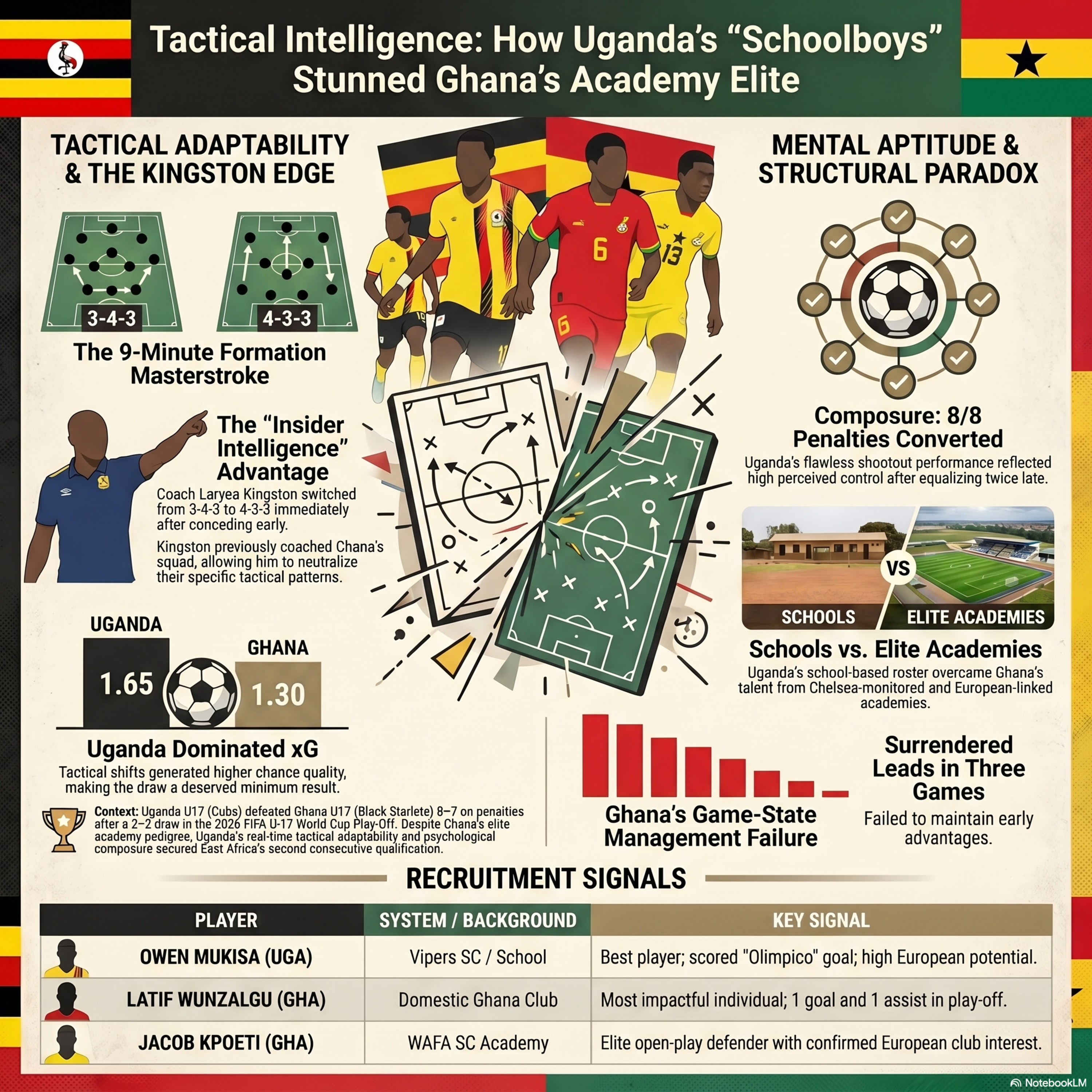
A miracle sports upset is, well, it's never magic. It is almost always a highly specific failure in one system, being actively dismantled by a superior intelligence in another. Welcome to the deep dive. Glad to be here for this one, it's a fascinating topic. Yeah, so it's it's Sunday, May 24, 2026, and yesterday just a single soccer match decided a ticket to the FIFA U-17 World Cup in Qatar. Right Uganda U-17 versus Ghadi U-17. Exactly. And you know, if you just glanced at the box score this morning, you would see a two 2 draw and then a dramatic 87 penalty shootout victory for Uganda.
Yeah, on paper, it looks like just a standard thriller, right? Like a classic underdog story where the scrappy team just had, you know, more heart. Right the heart over talent narrative. Exactly. But when you look at the raw data in the actual strategic decisions being mowed on the pitch, that narrative completely shifts. Completely, which is why our mission today isn't to give you some standard sports recap. We are here to decode the hidden architecture of a monumental upset. Because it really was an architectural teardown.
It really was. We are going to unpack exactly how a team of Ugandan school boys systematically dismantled an elite European linked Ghanaian Academy pipeline, right? Through real time tactical adaptability, the weaponization of psychological intelligence, and my favorite part, the actual peer reviewed science of high pressure penalty shootouts. Yes, the science is wild. This story reveals A staggering amount about human psychology, organizational behavior, and just systems management in general. Oh, totally.
I mean, if you've ever had to face down an opponent, whether that's a business, academia, or sports with 10 times your resource forces, this match is a literal master class in how to neutralize that gap. OK, let's unpack those. We have to start with the opening minutes of the match because it was a total disaster for Uganda. An absolute train wreck. Right, they rolled out in a 343 formation which was completely unannounced prior to kick off. Yeah, it's clearly a bespoke plan, right? Designed to exploit Ghana's width.
But it just imploded. I mean, within 9 minutes, Ghana countered. They shredded Uganda's high defensive line and Erika Dugianfi scored right through the Ugandan goalkeeper's legs. Yeah, and to understand why it failed so quickly, we really have to look at the mechanics of a 343. Walk us through that. Well, when you play with only three dedicated central defenders and you push your wide players high up the pitch as wing backs, you leave these massive pockets of space on the flanks. So the sides are just totally exposed.
Exactly, and if your opponent has incredibly fast, technically gifted wingers, which Ghana absolutely does, they can simply bypass your midfield entirely. They just run right past them. Right. They exploit those empty spaces out wide and suddenly your 3 central defenders are totally overwhelmed. It's a high risk gamble. And for Uganda, the empirical evidence screamed that it was the wrong bet. Literally less than 10 minutes in, Yeah. Which puts the Ugandan coach Lauria Kingston in just the ultimate nightmare scenario.
Because most coaches in that spot, they freeze, don't they? Well, almost all of them. They wait until half time to fix it. Just, you know, hoping their team can survive the bleeding until they get to the locker room. But Kingston does something incredibly rare. He doesn't wait in the 10th minute 10, he instantly abandons the 343 and completely reconfigures the team into his trusted 433 formation. And that real time pivot fundamentally alters the physics of the game. How so? Well. By shifting to a 433, Kingston drops an extra player into the defensive back line, so he creates dedicated full backs on both the left and the right.
Which instantly plugs those empty spaces on the flanks. Yeah, exactly. And simultaneously it creates this solid three man triangle in the center of the midfield. Suddenly, Uganda isn't just surviving, they are generating sustained possession. They completely neutralize Ghana's counterattacking threat. I mean, it's not just about acting quickly. It's about structural precision under fire. Yeah, absolutely. It's like realizing the foundation of a building is cracking under uneven weight and instead of just, you know, patching the drywall, you instantly shift the load bearing beams to distribute the stress perfectly.
That's a great analogy. But I have to push back here. How did Kingston know exactly how to fix it so perfectly? And so fast. I mean, tactical brilliance alone rarely accounts for that level of rapid, flawless execution against an elite team. What's fascinating here is the underlying context that reframes this entire match. The inside job element. Yes, Lauria Kingston used to coach this exact Ghana Black Starlets team in 2024. Which is just crazy. It is he literally discovered and developed Ghana score players.
He brought in their captain Joseph Narby. He shaped the tactical DNA of the very team he was now systematically dismantling. So he wasn't just reacting to random variables, he was predicting known behaviors. Exactly. If you apply that to the business world for a second, it's like competing against a tech startup where you personally design their entire software architecture 2 years ago. You know exactly where the bugs are. Right, you know exactly what will break them. Precisely, and in sports psychology we understand this through a framework called Lazarus cognitive motivational relationship.
That is a mouthful. What does that actually mean? It sounds complex, but it dictates that your threat appraisal, which is the level of debilitating anxiety you feel when facing an opponent, is basically an equation based on perceived demands versus perceived resources. OK, so if the opponent is a mystery, the perceived demands are sky high and your anxiety spikes. You nailed it, but because Kingston intimately knew Ghana's automatisms, their player habits, their exact defensive shape and transitions, he had practically 0 uncertainty.
He knew the demands perfectly exactly. The Ghanaian coach, Dr. Prosper Narta Ogum was looking across the pitch at a Ugandan team he had to figure out on the fly. While Kingston was looking at a puzzle he had already solved 2 years prior. Right, And that intimately low threat appraisal allowed Kingston to execute a massive tactical pivot in minute 10 with a completely clear, unpanicked mind. And for you listening, think about how this mechanism applies to your own high stakes environments. When you face a daunting challenge, your anxiety plummets if you truly understand the internal mechanics of the obstacle.
Yeah, familiarity is a weapon. It is. It doesn't just breed comfort, it mechanically destroys fear and clears your working memories so you can solve problems in real time. And that psychological clarity is what allowed Uganda to take control of the match post switch. They just started dominating possession, dictating the tempo. Which leads to sustained pressure. And that pressure led to one of the most bizarre moments of the tournament in the 34th minute. Oh, the Olympico. Yes, Uganda's captain Owen Mukisa takes a corner kick and scores an Olympico.
Let's let's define the mechanics of that for a second, because it sounds impossible. Basically isn't possible. Right. An Olympico is a goal scored directly from the corner flag, curving into the net without a single teammate or opposing player touching the ball. Yes, statistically we are talking about an expected goals or XG probability of roughly 1002. That is microscopic it. Is a statistical statistical anomaly. I mean the amount of curve, the wind, the goalkeeper misjudgment required to make that happen is astronomical.
But because Uganda had shifted the momentum and forced Ghana back on their heels, they created the chaotic conditions where an anomaly like that could actually punish the defense. Exactly, and it tied the game 11. Now, Ghana is an elite team. They absorb that statistical miracle, they get to halftime, and then in the 51st minute, they strike back. Yeah, a brilliant dummy run by the Ghanaian forward creates a pocket of space. And Latif Abdul Wenzalgu scores from close range. Ghana retakes the lead to 1.
And this is exactly where a systemic, fatal flaw in Ghana's organizational behavior reveals itself, isn't it? Yes, it really is. They are up to one with 39 minutes left in regulation and instead of utilizing their superior talent to push for a third goal and kill the game. They drop into a passive deep defensive block. Exactly. Let's define that for anyone who hasn't spent years studying soccer tactics. A deep block means packing all 10 outfield players into the defensive third of the pitch. Yeah, you are basically suffocating the space near your own goal to prevent easy shots.
But mathematically, you're surrendering the rest of the entire field to the opponent. And in modern football, if you sit in a deep block for 39 minutes without generating any counter attacking outlet, you aren't actually defending What are you? Doing then. You are simply inviting the opponent to practice their offensive sequences inside your penalty area over and over again. It turns a dynamic match into a static siege. And the pressure just compounded. Uganda is probing, passing, whipping in crosses.
The tension is building with every single phase of play. You could just feel it coming. You really could. Finally, the dam breaks. In the 91st minute stoppage time, Uganda sends a cross into the box and a Ghanian defender, Nicholas Essuman commits a handball. The VAR confirms. It Yep. Penalty awarded to Uganda. Arafat Ibanda steps up, sends the Ghanian keeper the wrong way and scores. It's 22. So what does this all mean? Wait, I was supposed to say that? So what does this all mean? Well, it brings us to the structural chasm between these two rosters, because to truly grasp why this two 2 draw going into penalties was such a systemic shock, we really have to look at the resource disparity.
The talent pools couldn't be more different. Ghana fielded players from elite, highly funded academies. We're talking about the West African football Academy, Banab FC, Hockley FC. Right. Ghana's Captain Narby already has a confirmed degree agreement to join AC Horsens in Denmark. Their striker Arwino Yao Gavi is actively being monitored by Chelsea scouts. These are players groomed for the European market from childhood. And on the other side, Uganda fielded players almost entirely from local high schools, Amy's College, Udo Secondary School.
Yeah, out of their entire squad they only had one single player linked to a European club pathway, Liam Concocka at Oxford United. The financial and infrastructural gap is literally millions of dollars. But you know the danger here is romanticizing the lack of resources. Because it would be so easy to say this was a triumph of schoolyard grit and heart over the sterile Academy system. But that's just not what the mechanics of the game show us, right? Framing it as heart beating talent is incredibly dangerous, Dangerous for Uganda's long term development.
This was not a victory of the school system. It was a triumph of highly localized coaching intelligence temporarily neutralizing a massive resource gap. Kingston's inside knowledge was the great equalizer today. Exactly. If we connect this to the bigger picture, Uganda is going to the World Cup in Qatar. And they are going to face the Academy products of Brazil, Spain or France. And Kingston isn't going to have coached those kids two years ago. He won't have that inside track. So if Uganda assumes they don't need elite infrastructure just because they won this specific match, they will get structurally crushed on the global stage.
That is the crucial take away. However, in the context of this specific qualifier, Uganda forced the game to a penalty shootout after extra. Time and they won it eight to seven. They were flawless 8 for 8 conversion against an elite Ghanaian team. Which brings us to the actual science of the penalty shootout. Because for decades, commentators, fans, coaches, they've all called penalties a lottery. They call it a coin toss, a game of pure luck. Yeah, but the data tells a completely different story.
Walk us through that because you mentioned earlier that calling it a lottery is actually toxic. The lottery myth is one of the most pervasive and toxic fallacies in sports. Professor Gir Jordais from the Norwegian School of Sports Sciences has spent years studying this. The psychology of penalty shootouts. Exactly. He has analyzed every major shootout since 1976, well over 700 kicks, and his research firmly debunks the idea of a coin toss. So why is the lottery framing so dangerous for the players?
Because it trains players to relinquish perceived control. Think about it. If a coach tells a player just go out there, it's a lottery, whatever happens, happens. The player's brain interprets that as a lack of agency. They're just along for the ride. Right, And when human beings lose perceived control in a high stakes environment, their anxiety skyrockets. But conversely, if you believe you own the outcome through technique and routine, you maintain control over your physiological stress response.
And your conversion rate goes up. It's really that simple. So it's about ownership versus surrender. And to understand how this played out between Uganda and Ghana, we really have to look at the psychological state, what psychologists call valence of both teams entering that shootout, right. Valence in psychology refers to the intrinsic attractiveness or aversiveness of a situation. So positive valence means you approach an event as a rewarding opportunity, yes? And negative valence means you treat it as a threat that must be avoided.
Let's apply that here. Uganda enters the shootout in a state of maximum positive valence. I mean, they just came back from behind twice. They. Scored an impossible Olympico. They scored a 91st minute equalizer just to stay alive. They're playing with house money. Every step toward the penalty spot is just another opportunity for glory. Furthermore, they weaponized a concept called emotional contagion. Oh, this is fascinating. Jordae's research shows that teams who celebrate wildly and make direct eye contact with their teammates after individual shootout goals actually win at significantly higher rates.
Because emotional contagion transfers that positive valence right through this God. Exactly, and Uganda's players were reportedly celebrating every single converted kick like they had already won the whole tournament. Now look at Ghana. They are absolutely drowning in negative valence. Just think about the accumulated psychological trauma they carried to that penalty spot. It was heavy. It was just to qualify for this playoff. They were eliminated from the main AFCON group stage by a literal random drawing of lots because they were tied on every metric with Algeria.
A blind draw ruined their tournament. Then today they blow A10 lead. Then they blow A-21 lead in the 91st minute. They're carrying the weight of catastrophic failure. To them, the shootout isn't an opportunity to win. It's a terrifying minefield where one misstep means ultimate disgrace. Which perfectly explains the tragic hero of the match, Jacob Koetti. Yeah, poor Kopoetti. Kopoetti is a phenomenal elite defender from the West African Football Academy. He was structurally brilliant for all of regulation, but he is the one who misses Ghana's 8th penalty.
He hits the crossbar and loses the game for his country. Here's where it gets really interesting, because we have to look at this miss through the lens of cognitive science. That's. Specifically, the Yerks Dodson law. Right, it wasn't a character flaw or a lack of technical skill that made Copoetti. Miss No, not at all. It was the predictable scientific result of maximum negative valence pressure and systemic over arousal. Explain the mechanics of the Yerkus Dodson law for us, because it completely changes how we view clutch performances.
The Yerkus Dodson law describes the inverted U curve of arousal and performance. OK, so at low stress levels you are unmotivated and sloppy. As stress increases to a moderate level, your focus peaks. That is the optimal zone at the top of EU curve. The flow stays. Exactly. But when stress becomes extreme, you slide rapidly down the other side. Yes, you experience cognitive overload, tunnel vision, loss of fine motor skills and a complete breakdown in execution. And Kopoetti was at the very bottom of that curve.
He stepped up to take a shot where a miss meant instant catastrophic elimination for his country. The. Pressure was unbearable. Meanwhile, Uganda's 8th taker stepped up to take a shot where a goal meant going to the World Cup. It is a fundamentally different psychological load on the nervous system. Exactly. Ghana's crumbling system set Kopoetti up to fail. It was an environment of maximum negative valence pressure, and his cognitive loads simply exceeded human capacity at that moment. You know that systemic psychological failure actually exposes a massive inefficiency in how players are scouted globally.
Oh. Without a doubt. Because traditional scouting algorithms, they look at technical stats like Kupoete missing a crucial penalty and they downgrade him. But they completely ignore the systemic psychological load he was placed under by his team's tactical mismanagement. That's the real recruitment signal hidden in this match. Market inefficiencies occur when scouts only measure the what and totally ignore the why. Yeah. And on the flip side, you have incredible undervalued assets emerging from this game.
Right. Look at Owen Mukisa from Uganda, the engine of the midfield, the guy who scored the statistical anomaly Olympico. He has zero European links right now. None, and he operates with high positive valence and immense tactical stamina. He should be a priority target for literally any major club scouting network looking for an undervalued asset. And on the Ghanian side, look at Latif Abdul and Salih Oh. He was brilliant. He played as a left forward, provided an assist, scored a goal and was consistently the most dangerous man on the pitch against a highly organized Ugandan defense.
But because Ghana lost, his market value might dip. Right, but his individual metrics suggest he is vastly undervalued. But I think the most glaring lesson about talent management comes from how the Ghanaian coaching staff tried to handle the shootout itself. Oh, the substitution. Yes, in the 100th minute, right before penalties, Ghana subbed in a specialist goalkeeper, Michael Arma, specifically for the shootout. And Arma didn't save a single penalty. Uganda went a perfect eight for eight against the so-called specialist.
I mean Ghana subbed in a specialist goalie but it feels like putting a Band-Aid on a broken leg. You cannot fix a team wide psychological collapse with a technical roster swap. That is exactly what the data shows. You cannot substitute your way out of psychological distress. It just doesn't work, no. The research dictates that you have to train mental aptitude long before the whistle blows. You have to build structured pre kick routines for your players. You have to practice under manufactured negative valence pressure.
Exactly. Swapping A goalkeeper might change the optics, but it does absolutely nothing to lower the cognitive threat appraisal of the outfield players taking the kicks. So true. As you listen to this, I really want you to reflect on your own high pressure environments. When the stakes are at their absolute peak, are you treating the outcome like a lottery? Are you relying on luck? Right. Are you telling yourself that it's just down to luck, stripping away your own perceived control and letting anxiety take over?
Or are you building structured routines? Exactly, Are you leaning into to positive emotional contagion with your team and maintaining agency like that Ugandan U-17 squad? And this brings up a much larger, almost provocative question for the future of talent evaluation. What's that? Well, we live in a world where AI and algorithms are rapidly taking over sports scouting and corporate recruitment. Everyone is tracking expected goals, past completion rates, or in the business world, localized KPI metrics.
Right, it's all data-driven. But what happens when an AI model finally learns to quantify psychological resilience and positive valence under extreme pressure? Wow. Will the players and employees we currently dismiss as unpolished or lacking Academy pedigree suddenly be recognized as the most statistically valuable assets in the world? It really makes you wonder how much world class potential is sitting right in front of us disguised by the wrong metrics. Thank you so much for joining us on this deep dive.
Keep learning, keep pushing back on the surface level narratives, and keep questioning the systems around you. We'll catch you next time.
 Apple Podcasts
 Castbox
 Castro
 Goodpods
 Moon FM
 Overcast
 Pocket Casts
 Podbean
 Podcast Addict
 Podcast Republic
 Spotify