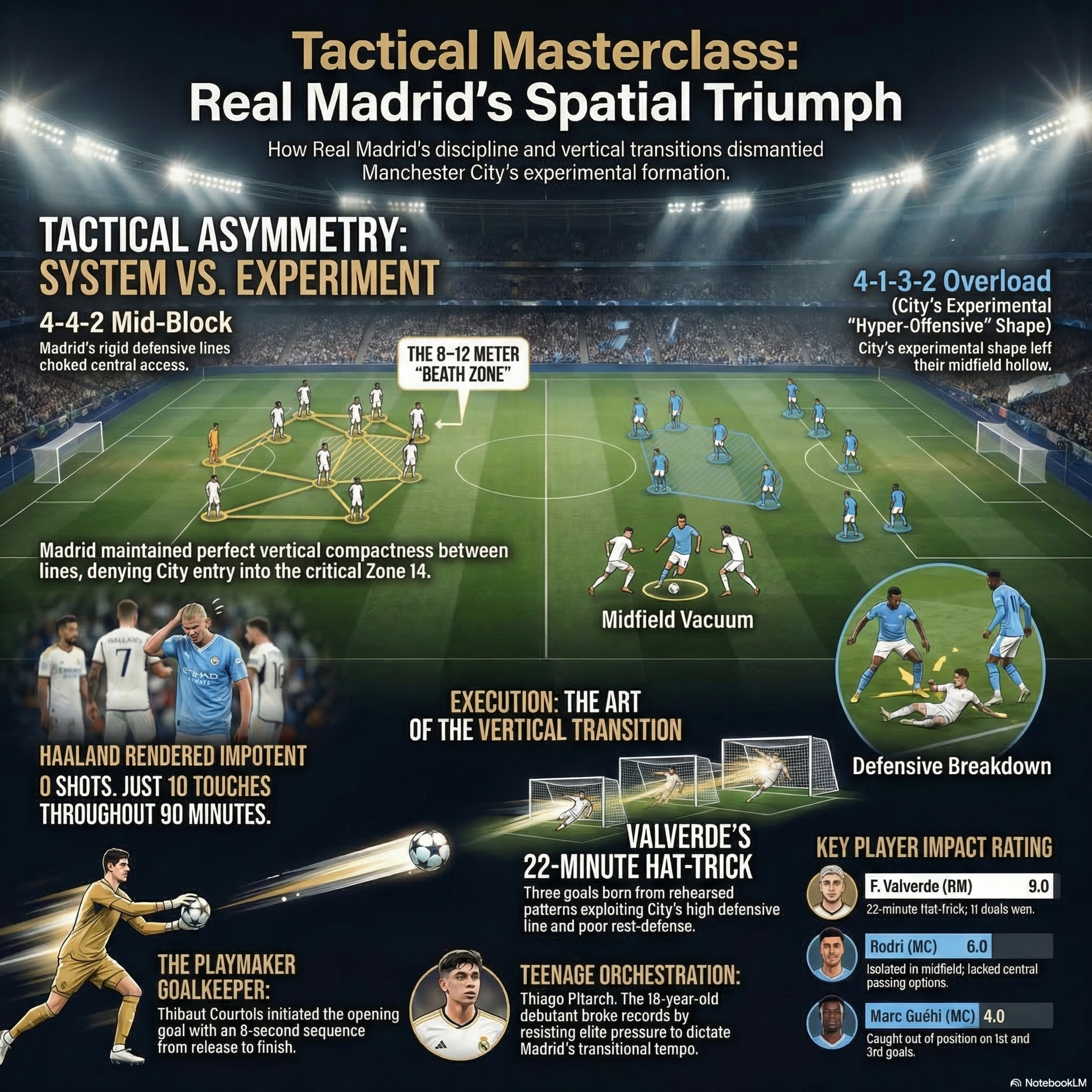
How Real Madrid's Geometric Trap Dismantled Man City
About this episode
How Real Madrid's Geometric Trap Dismantled Man City
OK, let's unpack this. 90 minutes on the pitch. 10 total touches, zero shots, zero chances created. Yeah, it's, I mean, it's staggering when you hear it out loud like that. Right. I want you to really let those numbers sink in for a second, because we are talking about Erling Allen here. Arguably the most lethal, physically dominant striker of his generation. Exactly. So how does a team featuring him, backed by this massive, record-breaking transfer budget, get completely and utterly neutralized by a squad stitched together with teenagers and reserve defenders?
It sounds like a glitch in a simulation, honestly. When you look at the raw data in isolation, it simply doesn't compute at all. No, it really doesn't. But that, you know, that is the beauty of what we are going to unpack today. It wasn't a glitch. It was a highly intentional, geometrically perfect trap. OK, so picture the scene. It is March 11th, 2026. You're standing under the colossal blinding lights of the Santiago Burnabay. The. Atmosphere there is just, it's something else entirely. Oh, it's electric.
The air is thick, carrying that specific tension you only ever feel on European football's greatest nights. And what is unfolding on the grass in front of you is a quintessential David versus Goliath narrative. Right, but with a massive twist. Exactly. The script has been violently flipped. Real Madrid, historically the ultimate royalty of European football, is David. They are completely decimated, stripped down to the bare studs by a catastrophic injury crisis. Barely holding it together. Yeah, right.
And stepping onto the pitch as the opulent, heavily armored Goliath is Manchester City. It's a profound role reversal and it completely changes the psychological baseline of the match before a single ball is even kicked totally. You look at the 2 starting elevens walking out of the tunnel and the sheer disparity and resources in momentum and available personnel at that exact moment in time, it's just staggering. It really is. You have a City team built on absolute complex luxury facing a Madrid team clinging to sheer survival.
And that is exactly the mission of our Deep Drive today. We're not just giving you a play by play recap of a football match. No, that would be a massive disservice to the tactical clinic we actually witnessed. Right, we are looking at a definitive master class in tactical asymmetry. We are going to explore the dark arts of spatial manipulation, the psychology of decision fatigue. Oh. Decision fatigue. I love that. Yeah, it's huge here, and we'll breakdown exactly how a meticulously organized underdog entirely dismantled a 264,000,000 LB predictive model.
Because while the television cameras, you know, the casual viewer and even many seasoned pundits are perpetually mesmerized by the ball. Yeah, watching who is dribbling it, how fast it is moving across the grass. Exactly. True strategists watch the space. They watch the voids. They watch the breathing room between the defensive lines. Because what happened under those lights in Madrid was a triumph of spatial engineering over financial dominance. So to really grasp the magnitude of what happened when the referee finally blew that whistle, we need to transition away from the roaring stadium for a minute.
We have to step directly into the boardrooms and the physio rooms of both clubs really. Yeah, we need to understand the incredibly severe contrasting realities these two squads were living in leading up to this night. Let's start with the absolute inferno in Madrid. Inferno is the right word. This wasn't just a bump in the road. No, this was a full blown organizational crisis. It was institutional chaos. I mean, you have Javi Alonso, who was brought in to establish a new era, dismissed earlier in the season despite holding an early lead in La Liga.
Is wild to think about. Right. And when you have that kind of managerial turnover, you immediately introduce internal friction. The locker room fragments, performances become wildly inconsistent. The tactical identity just kind of dissolves, doesn't. Completely dissolve. Right. So who steps into this absolute pressure cooker? Alvaro Arbiloa. A former player, yes, but crucially, an Academy coach. Yeah, he is pulled from the youth setups and thrust into the managerial hot seat of the biggest club in the world.
And he doesn't just inherit a team in emotional turmoil, he inherits a medical ward. The structural pillars of the institution are entirely absent. It's unbelievable. No Killian Bape, no Jude Bellingham. Rodrigo is sitting up in the stands in a designer jacket serving a suspension after that red card against Benfica. So the attacking spine is completely severed, but the defensive situation is arguably worse. No Etter militone, no David Alabarre. Long term absentees everywhere you look. Just brutal.
When a manager steps into a situation like that, the playbook goes out the window, right? You can't rely on individual brilliance to bail you out because the brilliant individuals are literally in the recovery room. It is like taking a Michelin star chef who usually works with truffles and wag you beef, throwing him into a kitchen and saying, yeah, saying listen, the fridge is broken, the suppliers didn't show up. You have to win this high stakes cooking competition using only these dusty canned goods for the back of the pantry.
That's a great way to put it. Meanwhile, ET Guardiola just walked into the kitchen next door after buying out the entire luxury grocery store. Exactly. And that contrast is where the tactical narrative actually begins. Arbolo had to stabilize the emotional core of his squad before he could even think about drawing a tactical map on a whiteboard. He had to implement a stripped meritocracy, which meant pulling 18 year old Academy talents into the absolute highest stakes environment imaginable. And he had to look his team in the eye and accept a very difficult truth.
He basically had to say we are going to lose the possession battle tonight, they are going to have the ball. Right. Madrid had to embrace a brutal stripped down, prioritizing structural solidity and vertical lethality. When you look across the Cunnel of Manchester City, the reality is the absolute polar opposite. They're completely stabilized domestically, cruising along and they just went on a 264,000,000 LB shopping spree in the January window. Yeah, they bring in Mark Gady to completely solidify the back line, and they sign Antoine Simenyo to add even more terrifying versatility to an already stacked attack.
It is an absolute embarrassment of riches. It is, but with those immense riches came a fascinating and ultimately fatal tactical evolution from Guardiola. OK, tell me about that. What was he trying to do? Well, he's experimenting with a highly complex 4132 system. He is trying to integrate a squad full of players making their Champions League debut for the club into one of the most demanding tactical frameworks in the history of the sport. Wow. In a knockout tie, no less. Exactly. He wants to field as many attacking threats as humanly possible, basically relying on a solitary pivot Rodri to act as the lone safety net for the entire operation.
So what does this all mean? When you pit A-Team stripped to its absolute bare survival instincts against a team burdened by its own complex luxuries, what does that actually do to the psychology of the 22 men on the pitch? It's massive because it feels like City had so many options, so many patterns they could run, that it might actually become a disadvantage. You've hit on the concept of cognitive load. Yes, what happens is a massive divergent in clarity. The team fighting for survival, the underdog operates with absolute terrifying clarity.
Because their instructions from Arbiloa are simple, mechanical and binary. If you fail to stand in your specific zone, the entire structure dies and you get blown out. There is no ambiguity. On the other hand, the team with boundless luxury falls victim to decision fatigue before the game even reaches its peak. Right, because City's players are trying to execute highly experimental hybrid roles. You have a full back trying to be a central midfielder in possession while also remembering to cover a world class winger in transition.
When intense pressure is applied, that complexity fractures. That makes perfect sense. The more complex machine, the more moving parts there are that can break under stress. Exactly. So let's take this psychological contrast and project it onto the actual physical grass. Because if you are Arboloa and you know you are vastly out resourced on paper, how do you beat them? You can't outrun them for 90 minutes. No, absolutely not. And you can't out pass them right? So you have to shrink the battlefield.
You have to fundamentally change the geometry of the pitch. This brings us to the foundational theory of kitsch geometry. Every single team organizes itself along 3 mathematical axis depth, width and height. OK, break that down for us. So depth dictates your vertical staggering, meaning how your defensive line relates to your midfield line, which creates or chokes passing lanes. Width is how far your players stretch horizontally across the grass from touchline to touchline. Right and height. Height is simply how high up the pitch your most advanced player is positioned.
We hear commentators talk about teams being compact all the time, but it's not just a buzzword for trying hard defensively is. It not at all. It is a strict mathematical calculation of space. Johann Kraiff famously said that defending is merely a matter of calculating how much space to defend. It sounds philosophical, but it is deeply pragmatic. It really is. It reduces the overwhelming chaos of 22 moving bodies into a strict matter of meters. Modern statistical models drawing from elite competitions like the Champions League in the World Cup have actually identified A quantifiable golden ratio for an elite mid block.
And the numbers behind this are staggering when you think about the discipline required. An elite block maintains an average team length from the deepest center back to the highest forward of exactly 27.3 meters and a width of exactly 40.1 meters. But the absolute critical metric, the one that defines life or death against a Guardiola team, is the vertical distance between your defensive line and your midfield line. Right. And what does that gap need to be? It has to be strictly between 8 to 12 meters.
That 8 to 12m gap is the Holy Grail. Wow. Just 8 to 12 meters. If that distance expands to, say, 15 or 20 meters, you grant a player like Bernardo Silva access to turn and face your goal. And if you compress it too much horizontally, dropping down to 30 meters wide, you give cities wingers a free runway on the flanks. Finding and holding that exact mathematical footprint shifting as a synchronized unit while the ball is moving at elite speeds, That's incredibly demanding. It requires constant verbal communication and microscopic adjustments from every single player.
Wait but I have a question about that. If Madrid's lines are only 8 meters apart and they are intentionally sitting in this rigid 27 meter box, aren't they just inviting City to camp outside their penalty area and non-stop press them? It seems like that, right? Yeah. How does voluntarily giving up territory and sitting in a rigid block, letting a 264,000,000 LB team dictate the ball actually become an offensive weapon? For a team like Real Madrid, it sounds like torture. It is torture for the team with the ball, and that is the genius of it.
It becomes an offensive weapon through sheer spatial denial. OK, spatial denial. How so? By maintaining that extreme vertical compactness, you deny the opponent access to what tacticians call zone 14. Ah, zone 14, the golden square. Just for context where you're listening, Zone 14 is the rectangular area located perfectly centrally right outside the opponent's penalty box. Right. It is historically the domain of the classic number den and statistically the just lethal area on a football pitch to possess the ball.
So by sitting in that rigid 8 to 12m block, Madrid essentially built an impenetrable brick wall around Zone 14. Exactly. They forced Manchester City to play the ball in AU shape around the perimeter of their formation. Center back to full back, full back down the wing, maybe a backward pass, swing it to the other center, back out to the other wing. It's giant U shape. And when you possess the ball without being able to penetrate the center, possession ceases to be an offensive threat. It becomes a sterile, highly frustrating exercise in passing just for the sake of passing.
So you are holding the ball, but the other team is holding the space. It's a complete paradigm shift. City has the illusion of control because their possession stats are climbing to 7075%. Right, but Madrid is perfectly comfortable because the ball is only in harmless areas. Exactly. And when we look at the starting formations, as the referee blew the whistle, we saw this geometric theory perfectly mapped out in human bodies. Let's examine Arbaloa's 442. A classic unyielding structure. He lined up with Phil and Mendy on the left, Antonio Rudiger and the young Dean Hyson in the center and Trent Alexander Arnold on the right side of the defense.
Right in midfield, Federer Valverde on the right or really into many and the 18 year old Tiago Pedark in the engine room and Brahim Diazat out on the left up top, operating as a pair and this is junior and Arctic Guler. The primary intention of this personnel was the absolute denial of central penetration, but equally important was the mechanism designed to spring forward. Because Venetius and Guler weren't up there acting as traditional target man. No, not at all. They weren't trying to wrestle with Ruben Diaz to win headers.
They were there to occupy the center backs, ready to drop deep or drift wide into the channels. Intentionally creating vacuums of space for those midfield runners, specifically the Verde, to explore during offensive transitions. Exactly. And facing this incredibly tight, coiled spring of a formation was Guardiola's expansive, hyper ambitious 4132, which as soon as City took possession, aggressively morphed into a wild 235. A235 Just Wild, Jeremy Doku and Savino were pinned to the touch lines, stretching the width to the absolute physical maximum of the grass.
Holland and Semenya were packed centrally. Nardo Silva was operating in those inside channels, the half spaces. And Nico O'Reilly, a highly rated youngster, was acting as an inverted left back, meaning he physically stepped inside into the midfield when City had the ball. And all of this left Rodri completely isolated at the base of the midfield. Now what's fascinating here is this is where we uncover the fatal flaw hidden within Guardiola's ambition. OK, what was the trap? By striving for extreme maximal width, pushing Docu and Savino so far out their boots were practically on the chalk, and pushing 5 bodies right up against Madrid's defensive line, Guardiola actually disrupted his own team supply chain.
Wow. He stretched his own team so thin that they broke themselves. Yes, Guardiola's 235 was like a stretch rubber band. The wider docu and Savino pulled, the thinner and weaker the middle of the band got. And the moment Madrid cut the tension on the wings by refusing to be dragged out, the middle just snapped under its own weight. That is a perfect visualization. They pushed so many players high and wide that their central midfield literally became a ghost town. They left Rodri, the best holding midfielder in the world, on an absolute island.
Which is crazy to think about. It is when you stretch your team that thin. You don't just stretch the opponent's defense. If the opponent refuses to stretch, you stretch your own passing distances. Making your own structure incredibly fragile to counter attacks because your players are too far apart to support each other when the bowl turns over. Precisely. It is staggering to think a $264,000,000 machine could be defeated by simply, well, refusing to engage with it on its own. Terms, Yeah. Patience as a weapon.
But static formations drawn on the screen only tell half the story. The real magic, the actual execution, is in the dynamic movements, the pressing triggers. How did Madrid actually spring the trap and turn City's formation against them? Let's talk about choking the center. You mentioned Venetius and Guler earlier. They weren't running around like Mad Men slide tackling the city center backs. No, because aggressive tackling from the frontline against elite ball playing defenders like Diaz and Gahi often just leaves you out of position.
Right. One simple pass bypasses you and suddenly the opponent has a numerical advantage. Instead, our Belowa instructed them to utilize a concept called Cover Shadows. We hear this term a lot in modern analysis. Let's make sure we completely unpack how a cover shadow physically works on the pitch. Think of it like a solar eclipse. The forward, let's say Venetius, positions himself not to immediately Sprint and win the ball from the center back, but to perfectly block the passing lane to the most dangerous opposing midfielder behind him.
Which in this case is Rodri. Exactly. Venetius uses his body to cast a literal shadow over Rodri receiving angle, so if Mark Gee has the ball, he looks up and he physically cannot pass the ball straight forward to his playmaker without hitting Venetius in the shins. Oh wow, so Gay and Dias are forced into a state of hesitation. They are standing there with the ball completely unpressured, but with absolutely nowhere progressive to go. Right. They can't play forward, so they have to play a slow sideways pass to a full back.
And those slow sideways passes were exactly the triggers Madrid was waiting for. Yes, the moment the ball traveled laterally, the trap slammed shut. Which brings us to the flanks, and specifically the absolute tactical and physical master class put on by Federico Valverde. Valverde's performance in this match defies logic. It was the absolute epitome of tactical discipline paired with superhuman physical exertion. Let's give his role some context. Yeah, let's set the stage for what he had to do.
Trent Alexander Arnold is a phenomenal footballer, a generational passer of the ball, but isolated one-on-one against the explosive, chaotic pace of Jeremy Doku. That is a nightmare scenario for any defender. Doku will drop his shoulder and leave you in the dust 9 times out of 10. Exactly. Arbel Owen knew this was City's primary weapon, so he gave Valverde a very specific, incredibly demanding instruction. Valverde was tasked with the dropping deep instantaneously. The very split second the ball was played out to Doku, he created a localized high speed double.
Team turning a terrifying one-on-one isolation into a suffocating 2 on one. Exactly. Valverde and Alexander Arnold essentially use the touchline as a third defender, trapping Doku. Valverde's numbers on the night are just absurd. 4 tackles, 4 clearances, 11 defensive duels, 1. Incredible. But the true genius of his performance wasn't just the defending. Right, and this is where it elevates from great defending to tactical genius. While he was dropping deep to help with docu, he was simultaneously instructed to mentally and physically pin Nico O'Reilly.
Oh man, poor O'Reilly. Remember, O'Reilly is a 20 year old kid tasked with this incredibly complex hybrid role of starting at left back and inverting into central midfield to help the isolated Rodri. And how does Valverde pin him? By maintaining a starting position during City's buildup that is just high enough and just threatening enough to constantly remind O'Reilly of the massive expanse of green space behind him. It is a psychological pinning. O'Reilly is standing there looking at Valverde, thinking if I step inside into the midfield like Pep told me to and we lose the ball, Valverde is going to absolutely destroy the empty space I just vacated.
So O'Reilly hesitates. He doubts the system. He stays a few yards deeper than he should. And because he stays deeper, City never gets that crucial numerical superiority in the center of the pitch. Wow, Valverde. Fractured cities build up almost single handedly through sheer positioning, intimidation and an unbelievable aerobic engine. It is the ultimate blueprint for how a midfielder can dictate a game without even touching the ball. And while Valverde was destroying City's left flank, we have to talk about what was happening, or rather, what wasn't happening in the center.
The ghosting of Erling Heyland. Yeah, 10 touches in 90 minutes. For a player who regularly breaks scoring records, it is almost difficult to comprehend how does that physically happen. You don't just erase a six foot four physical phenomenon by accident. Yeah, you erase him by understanding that a striker, no matter how physically dominant or instinctual, is entirely dependent on the ecosystem around him, right? Because City's midfield was hollowed out by their own expansive shape, and because Madrid's cover shadows prevented any central penetration, City was forced into a highly predictable, desperate pattern.
Push the ball to the extreme, wings to Deku and Savino, and attempt hopeful crosses into the box. Exactly. And waiting for those crosses licking their chops where Antonio Rudiger and the young Dean Heissen. Real Madrid's central defensive density rendered those wide crosses completely impotent. Rudiger is a physical monster. He absolutely relished the physical battles, sweeping up behind the line and aggressively challenging Hotland in the air. And meanwhile, Weissen operated as a proactive interceptor.
He wasn't just reacting to the ball, he was anticipating it. He finished the game with an astonishing 93.6% pass accuracy, meaning every time he intercepted a cross or a loose pass, he immediately initiated counterattack rather than just clearing it into the stands. He was cutting the wires to Highland's communication lines. Highland was marooned on an island entirely disconnected from his team's dysfunctional supply chain. Just watching crosses sail over his head or get intercepted before they even reach the penalty area.
It proves that neutralizing A superstar isn't always about man marking him tighter or kicking him. It is about systematically dismantling the mechanisms his team uses to get him the ball. That's such a great point, and with City structure fundamentally broken, their midfield hollowed out and their primary striker isolated, we transitioned into the the exact explosive moments where Real Madrid made them pay the ultimate price. The micro dynamics of a 22 minute master class. The underlying data from the match perfectly illustrates how deceptive territorial dominance can be.
City held the ball for vast stretches, passing it in that harmless U shape we talked about. But they generate A minimal .59 expected goals. Exactly. Well, Real Madrid, operating almost entirely without the ball and relying purely on the counter transition, generated A staggering 2.63 expected goals. Because territorial dominance means absolutely nothing if you can't access the critical geometry of the pitch. Let's trace how Madrid exploited this, starting with goal one. Yeah, let's break that down.
It is a sequence that takes exactly 8 seconds from the goalkeeper's hands to the back of the city net. 8 seconds. Let's break those 8 seconds down frame by frame. It starts with Tebow Courtois casually claiming a loose over hit cross. Now, the hallmark of elite transition play isn't just physical speed, it is instantaneous situational awareness. The moment Courtois secures the ball, he doesn't just look down and roll it to his center back. He actively scans the horizon for the structural flaw in City's transition defense.
And he sees it immediately. Nico O'Reilly has caught too high up the pitch, trapped in that failed inversion experiment. Exactly the entire left flank of Cities defense, the space O'Reilly was supposed to be guarding, is just 50 yards of empty grass. Courtois possesses world class distribution. He bypasses the entire congested midfield with one massive, perfectly weighted launch. He hits a long pass directly into that vacant channel. And Valverde, who has been mentally preparing for this exact trigger all weekend training, explodes forward.
Now look at the physical and mental reactions of city center backs. Mark Gay, a massive January signing making his Champions League debut for the club, is caught totally flat footed. He misreads the flight of the ball entirely, stepping forward forward when you should be dropping. Ruben Dais realizes the danger but cannot shift his body weight across the pitch fast enough. Gilverde's execution is flawless here. He takes the ball down impeccably with his first touch without breaking stride. Yeah, he uses his second touch to breeze past a rushing GM, Luigi Donoruma, who is caught in No Man's Land and finishes Cooley into an empty net.
8 seconds. It was ruthless, rehearsed vertical perfection. The goal 2 is where the absolute genius of our below is spatial manipulation really shine. Here's where it gets really interesting. This wasn't just a long ball over the top, it was a masterpiece in misdirection. Let's analyze Venetius Junior's movement leading up to the second goal. This specific sequence highlights exactly why starting without a static number 9 was a strategic advantage. As Madrid launches a counter, Venetius purposely drifts wide into the left half space.
He is essentially taking the beat. He wants the defender to follow him. Exactly. He is pulling City's defensive line out of its central alignment. Abdul Qadir Kusanarov, operating on the right side of City's defense, gets dragged completely out of position following Venetius toward the touchline. And because City's defenders are inherently terrified of Venetius isolating their teammate one-on-one, the central defenders, DS and Gehi, instinctively shift heavily to their right to offer cover. And what happens when three defenders compress to one side of the pitch?
It creates a massive gaping void right in the center, directly at the edge of the penalty area. And now, if Madrid had a traditional Strider on the pitch, a City defensive midfielder would be occupying that space to mark him. But because they don't, the void is entirely untracked. It is Dead Space. So by running into a vacuum, Valverde is essentially making himself unmarkable because there is no defender assigned to guard empty grass. Wow, so it changes the defensive geometry from and a man to man to space.
Exactly. Valverde initiates a late bursting run from deep inside his own half. He covers 60 yards at full Sprint. Venetius hits a precise low cut back pass into that exact void. Valverde arrives like a runaway freight train and finishes emphatically. City's understaffed, disjointed midfield utterly failed to track the late runner. It is a fatal consequence of hollowing out their own central structure. It perfectly illustrates the concept of arriving versus waiting. When a striker waits in the box, he is static.
He is marked by a defender who can engage him physically right. But when a midfielder arrives at full speed into an engineered vacuum of space, he has all the forward momentum. The defender is reacting backward. The arriving player is practically unstoppable. It is a devastating mechanism. And then comes Goal 3 in the 42nd minute, the total psychological and physical collapse of City's rest defense. Yeah, Brian Diaz receives the ball in the right half space after another City turnover. And again, notice the recurring theme.
Diaz has ample time to turn and scan the field and minimal pressure applied to him because there is absolutely no city midfield screen to disrupt him. Rodri is too far away and the inverted fullbacks are out of position. Diaz looks up, assesses the high defensive line and delicately chips a pass right over the top of the center backs. And this is where the mental toll of the match becomes glaringly obvious. Mark Gahey The 264,000,000 LB defensive rebuild project is entirely bypassed by a simple chipped pass.
When you watch the analysis back, there is a distinct lack of physical desire or situational awareness from gahey to turn and track the run. It is a cascading failure, right? Oh, absolutely. The complex tactical structure failed first. That failure led to severe physical exhaustion because the defenders were constantly sprinting backward to chase counterattacks. And that intense physical exhaustion inevitably led to a total cognitive and the logical collapse in the defensive line. Decision fatigue set in.
Valverde, still operating at maximum intensity, meets the chip ball perfectly and volleys it past Donoruma, a 22 minute hat trick. The tie is fundamentally sealed before the halftime whistle even blows. Now, while Valverde rightfully grabs all the headlines and the match ball for his clinical finishing, we absolutely have to pivot to the architect working quietly in the shadows. We do. The player who actually allowed Real Madrid to survive that intense, suffocating pressure during City's possession phases, enabling those rapid transitions.
We need to talk about the teenager Thiago Fattarge. His inclusion in the starting 11 is perhaps the most romantic, yet structurally crucial element of Arbello's entire game plan. We are talking about an 18 year old Academy graduate. A kid who literally broke a 30 year club record held by the legendary rival, the youngest Spanish player to ever start a knockout match for Real Madrid. 18 years and 220 days old. Stepping into the central midfield engine room against arguably the best midfield duo in the world, Rodri and Bernardo Silva, in a Champions League quarter final, the pressure is unimaginable.
But if we examine how he played, it is an absolute revelation in modern midfield mechanics. Patark operated in a double pivot alongside Chomini. Now Chomini is the physical destroyer. His primary job is to intercept, tackle and break things up. Right. Patark's job was entirely different. Orchestration under extreme duress. What you saw on the isolated tactical camera was a master class in the micro mechanics of possessing the football. Constant rapid scanning of his shoulders before the ball even arrived.
Elite body orientation. Let's drill down into that. When we say elite body orientation, we mean Patarc was already standing half turned before the pass even reached his feet. Exactly. While a nervous or inexperienced player receives the ball fully facing his own goalkeeper, which forces him to stop the play and turn blindly, Patarc receives it sideways, already looking up the pitch. He's essentially shaving a full second off his decision time. And shaving that single second is what completely neutralizes a high speed counterpress from someone as aggressive as Bernardo Silva.
If we connect this to the bigger picture, Pete Tark acted as the primary pressure release valve for the entire team. Arbello specifically chose this teenager over a seasoned international like Eduardo Como Vinga for one specific reason, his profound ability to demand the ball in impossibly congested areas and resist the press without hiding. He possessed what analysts call elite passing hygiene. Casting hygiene, meaning he never takes a sloppy touch, he never plays a pass to a teammate's weak foot and he never panics.
He didn't make a single panicked clearance all night. Every time he won the ball or received it under pressure, he retained it, manipulated the tempo and allowed Real Madrid to construct their counterattacks with deliberate precision rather than frantic desperation. The comparisons to a young Tony Cruz were flooding social media immediately. And honestly, it brings up a fascinating psychological phenomenon. How does an 18 year old kid walk out of the tunnel into a cauldron like the Burnabir against the most expensive team in history and dictate play like a veteran who's seen 1000 battles?
Sometimes the absolute fearlessness, the borderline ignorance of youth, is exactly what you need to break the tension of a crisis. It is the ultimate testament to cognitive training. The highest level of the sport is no longer just dictated by raw physical attributes, size, speed, tackling ability. It is dictated by cognitive speed. It is about scanning, spatial processing and that Immaculate passing hygiene under extreme physiological stress. So we move chronologically into the second-half. Imagine you are Alvaro Arbiloa.
You are sitting in the dressing room on a three nil lead. You have miraculously executed the perfect half of football. But you're facing a deeply wounded team managed by Pep Guardiola, a manager famous for his obsessive halftime adjustments. How do you manage this incredibly delicate game state for the next 45 minutes? You manage it by leaning even harder into your structural discipline. You don't get arrogant. Madrid deliberately sat even deeper, further compressing that crucial space between their defensive and midfield lines.
Shrinking it from 10 meters down to maybe 8 meters. They essentially dared Manchester City to try and break down a fortified low block using a tactical system that had already proven to be centrally hollow and dysfunctional. But there is a massive moment in the 58th minute that severely tests the emotional and structural resilience of everything Madrid had built. Venetius Junior breaches the highline once again utilizing his pure pace and he is clumsily brought down by Donna Roma inside the penalty box.
The referee points to the spot penalty. This is a fascinating psychological and hierarchical moment within the team dynamic. It really is. The camera zooms in and he catches Venetius picking up the ball, looking directly over at Valverde and physically offering him the penalty. He is essentially saying take it, score a historic 4th goal in a Champions League knockout match. Submit your legacy tonight. And Valverde, in an incredible display of humility and team first mentality, shakes his head and declines.
He leaves it to the designated penalty taker. Venetia steps up, clearly lacking his usual rhythm, strikes a dreadfully weak penalty and Dunnaroma makes the save. Now, if you follow the normal narrative arcs of football matches, that saved penalty is the ultimate spark. That is the dramatic turning point. That is the exact moment the momentum violently shifts, The home crowd suddenly gets nervous, the wounded giant wakes up, and city scores 2 quick goals to flip the tie on its head. But it didn't happen.
City completely failed to spark a comeback. Why didn't that massive emotional swing translate onto the scoreboard? Because momentum is purely an emotional concept, but the game of football is still bound by physical, geometric and structural realities. You can. You have all the emotional momentum in the world pumping through your veins from a heroic penalty save, but if your central midfield is still a ghost town, your wingers are still isolated against double teams, and your striker is still completely disconnected from the play, you cannot physically capitalize on that emotion.
Wow, City simply lacked the structural coherence to turn psychological momentum into geometric penetration. That is a phenomenal way to phrase it. Structure acts as a literal fire break against emotional momentum. It doesn't matter how fired up City was, they still couldn't pass the ball through a brick wall. And Arbello didn't just sit back on his cooler and watch. He proactively managed the physical decline of his players with suffocating substitutions. Yeah, he brings on Eduardo Kemivinga and Frank Garcia.
The goal here isn't to change the tactical system or look for a fourth goal. It is to refresh the aerobic engine of the team. The physical toll of shifting that 8 to 12m block from side to side for an hour is agonizing. He needs to maintain the exact same intensity in those wide pressing traps and central cover shadows. Cama Vinga comes in with fresh legs and ensures that any late attempt by city to build sustained pressure is violently and cleanly disrupted. End of the dying minutes. He even throws on youth Academy prospects like Manuel Angel and Franco Mastantuono to rundown the clock.
It is the ultimate display of managerial confidence bordering on arrogance. He is essentially broadcasting to Guardiola. I am closing out a victory against your 264,000,000 LB machine using my Academy kids. It is a profound statement of tactical and institutional superiority. On the night, it completely validated our below as makeshift meritocracy. So the final whistle blows. The Burnabay erupts. A30 demolition that no predictive algorithm on Earth saw coming. But here's the reality check. This is only the first leg we have to look ahead to the return fixture at the Etihad Stadium in Manchester.
Both of these brilliant tactical minds now have to retreat to their offices, pull out the footage and solve the incredibly complex puzzle that was created in Leg one. Let's start with Manchester City's imperatives. How on earth does Guardiola restore central supremacy and attempt to overturn a three goal deficit against the team that just completely shut him down? Cordiola has to swallow a very bitter, deeply philosophical pill. He has to completely abandoned the wide trap. The expansive 4132 hybrid system is fundamentally broken against this specific disciplined Madrid mid block.
He cannot afford to start 3 pure wingers Doku Savino alongside a pure poacher like Holland. The math just doesn't work. He has to sacrifice at least one, maybe two of those wide players and insert a true ball retaining central midfielder, someone like Mateo Kovacic or an advanced Phil Foden. He desperately needs to artificially repopulate that ghost town in the middle of the pitch. He needs bodies in the center. Exactly. He needs to create passing triangles to break the rigid lines of the block and crucially, to provide immediate counter pressing support for rodgery when the ball is inevitably lost.
If the center is full, the counterattack is slowed down. And secondly, he must completely redefine his REST defense. Right, Let's define that clearly. Rest defense isn't what you do when you don't have the ball. It's how your defenders intentionally position themselves while your team is attacking, specifically preparing for the exact moment you lose possession. City's rest defense failed miserably because O'Reilly was effectively playing as a midfielder, leaving huge gaps behind him. Spot on. The Nico O'Reilly inversion experiment was a catastrophe against the spatial intelligence of Valverde City.
Must scrap it for the second leg. They must deploy A genuine, defensively sound defender, Ashoku Givardiol or a Nathan Ake, whose sole priority is stopping the transition, not adding a superfluous, confusing body to the attacking buildup. And what about activating Holland? He can't afford another 90 minutes of wandering around with 10 touches. He has to stop relying on aimless crosses from the extreme flanks into a crowded penalty area guarded by massive aerial dominators like Rudiger and Chua Mini.
It is playing right into Madrid's hands. City has to generate chances through intricate, rapid combination play in those half spaces, using quick one twos to physically pull Madrid center backs out of their comfortable static zones. You have to create actual dynamic running gaps that Helen thrives in, rather than asking him to win static headers against two men. OK, let's flip the tactical board. What are Real Madrid's imperatives? You are taking a three nil lead to Manchester. How do you sustain the threat without falling into the trap of passive, desperate defending, which we know can be absolutely fatal away at the Etihad?
The blueprint is already perfectly drawn. It is entirely about execution under massively increased psychological stress. They must fiercely, almost religiously, maintain that 8 to 12m vertical compactness. If City repopulates the center, as we strongly suggest they must, Madrid's wide players Valverde and Diaz have to tuck an even tighter to Chewamani and Patark, clogging the middle even further. And they have to exploit the inevitable reality of the game. State City has to score three goals. They have no choice but to attack.
Their defensive line is going to be pushed exceptionally high, maybe resting right on the halfway line for the first minute. Precisely. Madrid must continue to use Courtois elite long range distribution and Hoisen's progressive passing to just completely bypass the midfield entirely. Don't try to pass through a congested midfield. Play over it. They need to launch Venetius and Valverde into the vast oceans of space behind Diaz and Gehee and are below a must be hyper proactive with his energy rotation again.
The physical toll of shifting back and forth against the desperate City side for another 90 minutes will be immense. Bringing Coma Vinga on at the 60 minute mark to sustain those crucial pressing triggers is absolutely non negotiable. OK, I have to play devil's advocate here. We sit here and say we know exactly what city should do. We just mapped out the logical adjustments, but based on everything we know about Pep Guardiola, his deep history of overthinking in these massive Champions League ties, oh the.
Overthinking is legendary. Can he actually swallow his immense pride and simplify his beautiful complex machine, or is he fundamentally psychologically addicted to tactical complexity? It is the defining question of his career, isn't it? It is the crux of Guardiola's genius, but it is also his Achilles heel. His entire footballing philosophy is built on the unwavering belief that positional superiority achieved through complex rotations and maximizing width, is the ultimate answer to any problem on a football pitch.
To ask him to revert to a simpler, more pragmatic, centrally focused structure is asking him to temporarily abandoned his tactical religion. It is a massive psychological battle between his pragmatic need to survive the tie and his deep philosophical need to win his way. We've perfectly transitions us to zoom out from this specific fascinating tie and look at what these 90 minutes mean for the broader evolution of European strategy and, frankly, global football tactics. Because what we are witnessing isn't just a game, it is a massive ideological clash.
Positional play versus space manipulation. For over a decade, Guardiola's interpretation of Wuego de position, the idea of monopolizing the controlling the opponent through endless possession and dictating the tempo, has been the absolute hegemony of elite football. Every top team wanted to copy it. But what Art Biloa orchestrated at the Burnabay was a highly refined, heavily modernized throwback to the lethal pragmatism we saw in early Who's a Mourinho or Carlo Angelotti teams. This raises an important question.
Is the era of sterile possession dying? It is certainly facing its most rigorous intellectual challenge. This match proved definitively that rigorous spatial denial combined with hyper optimized offensive transitions can systematically dismantle the most elaborate possession structures ever built. Madrid converted a tiny fraction of total possession into a devastating 2.63 expected goals. It exposed the extreme often ignore danger of structural overcomplication. City tried to integrate multiple 264,000,000 pieces into hyper complex hybrid roles and it resulted in a total systemic failure.
The cognitive bandwidth of the players was overloaded. Tactical flexibility is a beautiful concept on a whiteboard, but in the heat of battle it absolutely failed against rigid structural integrity. It is the ultimate proof that you do not need to control the ball to control the game. You don't need infinite budgets to cultivate tactical discipline, geometric precision, and lethal timing. It is a profoundly democratizing force in football strategy. It means a meticulously coached underdog always has a puncher's chance if they can master the mathematics of the pitch.
Completely. If you perfect the execution of that 812 meter vertical block, if you cultivate the cognitive scanning speed of players like Young Pitt Arc, and if you unleash transitions with the devastating synchronized timing of El Verde, you can engineer these exact same systemic failures against any giant in world football. You yield the ball, but you dictate the geometry. Exactly. Which leaves us with a final provocative thought to Mull over as we wrap up this deep dive. We live in an era where the sport is becoming increasingly dominated by big data, complex algorithms and incredibly dense tactical models that require a PhD to understand.
Yeah, the game is getting very, very complicated. But what if the next great tactical revolution isn't about inventing new, endlessly complicated hybrid roles for players? What if the future of the game is actually a regression to extreme spatial fundamentals? Where the team that runs the lease but has the cognitive brilliance to stand in the absolute smartest places inherits the Earth. Exactly. We started this journey looking at 2 would drastically different teams walking out under the blinding lights of the Bernabeu, the 264,000,000 LB Goliath wrapped in shining expensive heavy armor and the decimated injury ravaged David holding nothing but a meticulously calculated geometric map of the battlefield.
And it turns out, when you know exactly where to stand and exactly when to strike the voids, the armor simply doesn't matter. Thank you for joining us on this exploration of space, strategy and survival. Keep your eyes on the voids and we will see you on the next deep dive.
 Apple Podcasts
 Castbox
 Castro
 Goodpods
 Moon FM
 Overcast
 Pocket Casts
 Podbean
 Podcast Addict
 Podcast Republic
 Spotify