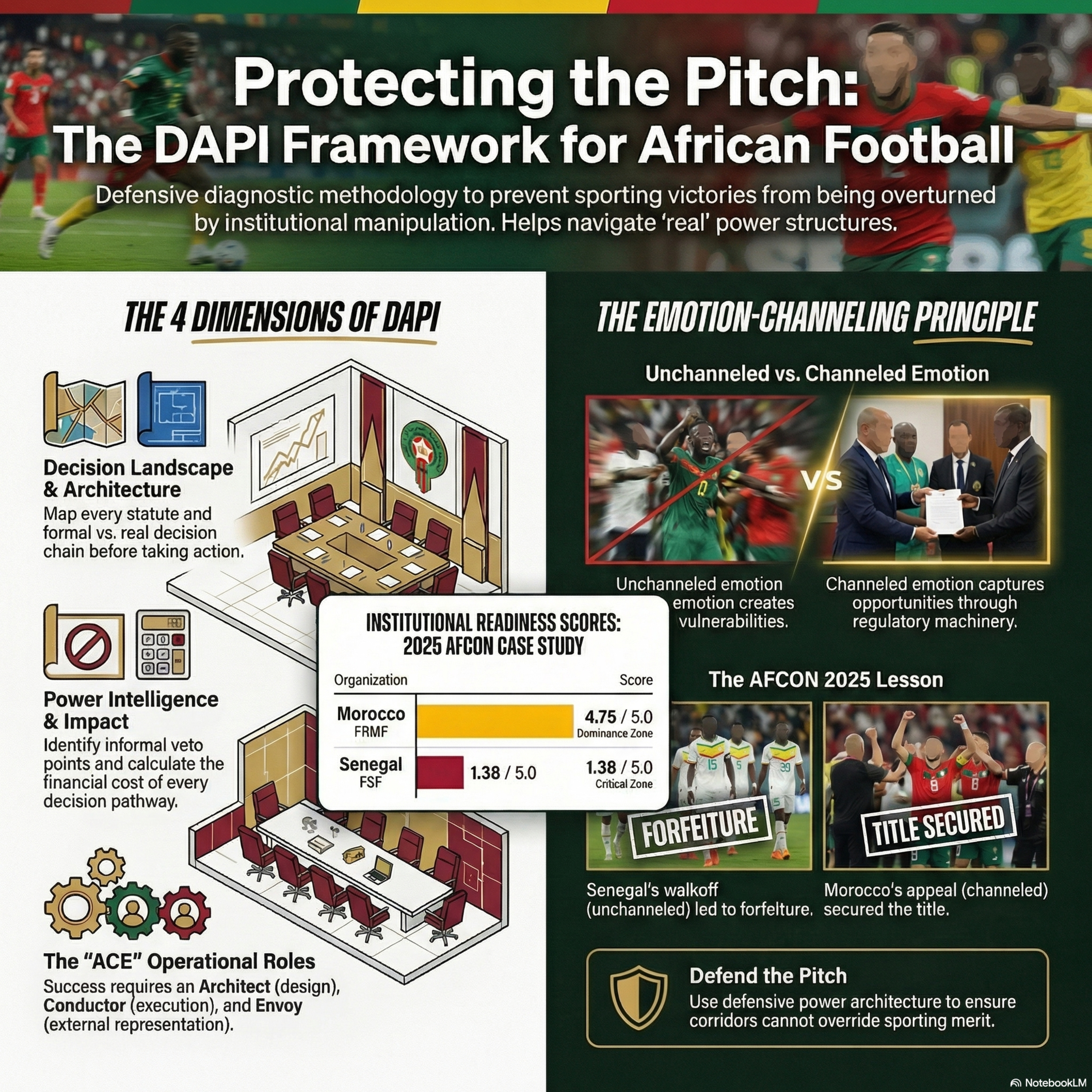
How Not To Lose The Afcon 2025 Title In The Boardroom
About this episode
How Not To Lose The Afcon 2025 Title In The Boardroom
Imagine stepping into a stadium where the air is just practically vibrating. Oh yeah, that electric feeling. Exactly. You are watching your national team in the final of the biggest tournament on the continent. The tension is just unbearable. And then the final whistle blows. Picture the absolute euphoria that erupts, like the players are collapsing on the grass, utterly spent. The fireworks are echoing into the night sky, painting the clouds. It's the ultimate peak it. Is you watch your captain lift that trophy, the metal gleaming under the stadium lights.
You are the Champions of Africa, your country. You know, they declare a national holiday. The celebrations go on for weeks, flooding the streets, just a pure expression of joy. And then, right. And then imagine waking up exactly 57 days later. You're sitting in your living room, checking your phone and discovering that it's all just gone. Completely erased from history, as if that final whistle never actually mattered at all. Erased. Stripped away. And the most terrifying part? It wasn't because of like, a massive doping scandal.
No, not at all. It wasn't because Interpol uncovered a syndicate of bribed referees. It was because of a decision made in a quiet, windowless boardroom thousands of miles away from any football pitch. Yeah, that's the reality we're dealing with. Welcome to the Deep Dive. We are setting the stage in March 2026 and we are staring down a harsh, harsh reality in the African game right now. We really are. The most expensive, catastrophic failures in professional sport today are no longer sporting failures, they are decision making failures.
The corridors of power are literally overriding the pitch. And that tension, that tension between the grass and the boardroom, is really the absolute Crucible of modern sports. Yeah, like what happens when the institutional machinery governing a sport becomes more decisive or even more lethal than the athletes actually playing it? That is the exact question we are answering today. Our mission is to tear apart the mechanics of institutional power. Which is so needed right now. Absolutely. We are going to explore why historic, deeply respected football federations are bleeding millions of dollars in completely avoidable fines and losing titles they rightfully won on the grass.
Millions. It's staggering. We're looking at a diagnostic model called the DPI framework. That's a decision architecture and power intelligence. But more importantly, we are going to figure out how to use this exact intelligence to build an impenetrable shield around the African game. Because you have to have a shield. You do. Because right now, trying to win a championship without understanding institutional power is like, well, it's like playing a brilliant, grueling game of chess, surviving every attack, capturing the opponent's king.
Only to realize they were actually playing poker. Yes, playing poker and they just bought the board from the casino. That visual hits the nail on the head. Honestly. You just cannot win a game if you don't realize what game is actually being played. And to understand how an opponent just, you know, buys the board out from under you, we have to expose this fundamental structural flaw in how almost every sports organization on the planet operates. It's a vulnerability we call the structural gap. OK, a structural gap implies something is missing or like disconnected.
What are the two sides of this gap? So it's the vast, often fatal distance between an organizations organogram and its actual power map. An organogram like the corporate chart. Exactly. Think about any major Football Federation or club. They all have an organogram. It's that glossy laminated chart hanging in the corporate office somewhere. Right, with all the little. Boxes. Yes, the boxes. It shows exactly who is supposed to make decisions. You have the president sitting at the top, a clean line pointing down to the general secretary.
More clean lines pointing down to the head coach, the legal director. Exactly, the communications chief. It looks incredibly logical. It implies total order and control. It's the official chain of command. Like if there's a problem, you look at the chart and you know exactly whose desk it lands on. On paper, sure, but almost none of these organizations take the time to draw a power map. And a power map is different how? A power map doesn't care about job titles at all. A power map tracks where the influence actually flows.
Oh I see. Like who actually has the president's ear at 2 point AM when a crisis hits? Which external sponsor holds an unofficial unspoken veto over commercial decisions? Or, you know, with which Ultra supporter group in the stands is quietly terrifying the board of directors into submission. That happens more than people think. All the time. So the structural gap is this profound blindness that occurs when an organization pretend that the neat piece of paper on the wall is the reality of their environment.
But wait, I mean, if you've ever worked in any corporate office or any government agency or a sports team, you know the official boss isn't always the person pulling the strings, right? We all know it. We all inherently know this. So if everybody secretly knows the organogram is just a piece of paper, why do these massive federation's dealing with millions of dollars continue to act like it's the the absolute truth? It's a great question. Why rely on the illusion until the entire system just collapses?
Because the organogram provides an incredibly seductive illusion of safety. Safety. Yeah, it's clean. Acknowledging the real power map requires an organization to admit extreme vulnerability. Right, they'd have to admit they aren't fully in charge. Exactly. If a Federation president admits that a specific political patron, or maybe a vocal fan group actually dictates policy, they are admitting they aren't fully in control. And ego won't allow that. Ego, politics, you name it. If they admit that a rival host nation has better structural proximity to the regulatory committees, they have to face a terrifying reality.
So they just pretend it's not happening. They stick to the script, they build their strategies and make their decisions based on the official rules of the organogram, deliberately blinding themselves to the fact that the actual game is being judged by a completely different set of invisible mechanics. And when you are operating blinds like that, what happens when the pressure ramps up? That is what we call the pressure test. The pressure test. Under normal, sunny day conditions, you can pretend the organogram works fine.
Everything is calm, right? But the second a crisis hits, when national pride is on the line, when a championship title is hanging by a thread, when millions of dollars are suddenly at risk, the organization instantly abandons the organigram. Just goes out the window. The laminated chart goes right out the window, human nature takes over, and the organization defaults entirely to the real power map. And if you haven't actively mapped out that reality beforehand, you are making split second high stakes decisions using the wrong information.
You're pushing them through the wrong channels. Exactly, relying on people who have titles but no actual power to fix the problem. Which brings us, I think, to the most volatile, explosive element of this entire dynamic, the absolute fuel that runs African football and really all high stakes sports. Ocean emotion. You cannot talk about a crisis without talking about the emotional state of the people inside it. And yet the conventional sports industry completely misdiagnoses emotion. If a federation hires like a traditional governance consultant during a massive crisis, the very first piece of advice they will give is almost always take a motion out of it.
We need to stay rational. Lower the temperature. Which, if you were talking about the final of a continental championship, sounds not just difficult, but completely impossible. It is worse than impossible. It is psychologically naive and just operationally useless. When we are talking about high stakes African football, we are not talking about a quarterly earnings report for a paper company. Right. This is national pride. You are dealing with intense national identity. You are navigating historical, sometimes generational, grievances.
So much baggage. Tons of it. You are dealing with the crushing commercial pressures placed on federations and the deeply personal career stakes of the athletes. Emotion is the baseline. It is a constant. You can't just turn it off. You cannot look at a coach or a federation president whose nation just watched a continental title slip away under highly controversial circumstances and tell them to be rational. Right. Trying to tell someone in that state to stay rational is like walking into a burning building and telling the people inside to calmly calculate the thermodynamics of the fire.
Exactly. The fire is burning. You have to deal with the heat. The emotion is going to express itself regardless of what a consultant tells you. The heat cannot be eliminated. OK, the only variable that matters, the only thing you can actually control, is where that emotion gets directed. Where it gets directed. Yes, this brings us to a foundational concept, the emotion channeling principle. We have to separate how humans process crisis into two distinct categories, unchanneled emotion and channeled emotion.
Let's draw the line between those two, because this seems like the exact point where titles are won or lost in the boardroom. Let's start with unchanneled emotion. Unchanneled emotion is when an organization or an individual expresses their intense devastation, anger, or frustration against the regulatory architecture. Against the architecture, right? It is the coach snapping on the touchline and ordering his team to walk off the pitch in protest. Oh wow. It is the federation president grabbing a microphone or jumping on social media to deliver a furious, unfiltered rant about corruption.
It's the fans throwing flares onto the field. I can see why people default to it, though in the moment it probably feels incredibly cathartic. It does. It feels like you were taking a stand. It feels like justice it. Feels like righteousness, yeah, but operationally, all it does is create massive, glaring procedural vulnerabilities. Because you're breaking the rules. You are stepping completely outside the protection of the rules and handing your opponent the exact legal leverage they need to destroy you.
So unchanneled emotion is basically an open explosion. It's a bomb going off It's loud. It looks spectacular to the people watching, but the blast radius just burns your own house down. That is a brilliant way to conceptualize it. It is an undirected blast and the. Alternative. Now look at the alternative. Channeled emotion. Yeah, this requires A profound level of discipline. This is when an organization takes that exact same fiery energy, the exact same blinding anger, the exact same sense of injustice, but directs it strictly through the regulatory architecture.
So instead of a bomb going off in the living room, you are capturing that wild explosion, sealing it inside a heavy steel engine block, and using the blast to drive a piston forward. You are weaponizing the anger. You are weaponizing it legally. Yeah, channeled emotion looks like a strategically timed, meticulously drafted formal protest. It is filing an appeal that ignores the emotional narrative and instead sites very specific bylaws within the required 48 hour window. So it looks cold, but it's fueled by the same fire.
Exactly. It is framing every single public statement around regulatory compliance rather than sporting grievance. It uses the fire, but the fire is completely contained within the engine of the rules. To really see the devastating difference between burning your house down and driving the engine forward, we need to look at the defining case study of March 2020. Sixth. Yes, we do. This is where theory becomes a harsh, terrifying reality. The AFCON 2025 final Senegal versus Morocco. There is no better Crucible for understanding institutional power than this specific match and the 57 days that followed.
It let me set the physical scene for you because you have to feel the temperature in the stadium to understand the decisions that were made. Please do so. Morocco is the host nation. The stadiums are packed, the atmosphere is deafening and the Moroccan national team is carrying a psychological burden that is almost unimaginable. It really was. They are trying to break a 49 year AFCON title drought, almost half a century of waiting, of close calls, of heartbreak, and now they are in the final on home soil.
The pressure to win is absolute. Crushing pressure. On the other side of the pitch, you have Senegal defending powerhouses, the kings of the continent. But Senegal is arriving at this final feeling deeply aggrieved. Very important context. Right throughout the tournament, they have perceived A creeping refereeing bias favoring the hosts. Whether that bias is real or perceived almost doesn't matter to the Senegalese squad. The psychological reality is that the deck is stacked against them. The perception is their reality.
Exactly. The pod isn't just simmering, it is ready to boil over before the ball is even kicked. That context is vital. Both teams are operating at the absolute limit of their psychological endurance, and the match itself is a grinding tactical stalemate. It is tense, physical and exhausting. And then we hit the final minutes of the match and the architecture of the game completely fractures. I want to break down this timeline minute by minute, because this is how a continental catastrophe unfolds in real time.
Let's do it. We are deep into stoppage time, 90 + 2 minutes. The score is deadlocked. Senegal pushes forward, the ball is whipped into the box and Ismailisar connects with a header. It's in. It's a late winner. Pure chaos on the bench. The Senegalese bench erupts. But wait, the whistle blows. The referee, Jean Jacques Nadella, disallows the goal for a foul in the build up. And instantly the psychological baseline we discussed is triggered. Instantly. The Senegalese players look at the big screens.
The TV replays show the contact was incredibly soft, minimal at best. So the perception of systemic bias is suddenly validating itself in real time. For Senegal, it's happening exactly as they feared. Exactly. The emotional temperature spikes into the red zone, The players are swarming the referee. The bench is incensed, but the game continues. It continues, but the structural integrity of the team's discipline is cracking. Then we hit 90 + 8 minutes. Morocco launches an attack. There's a tangled challenge inside the Senegalese penalty area.
Play initially waves on, but then the call comes from the VAR room. The dreaded VAR call. Right referee Nandala runs to the monitor. He watches the replay. He turns back to the pitch, points to the spot and awards Morocco a penalty. 90 + 8 minutes. A penalty to win the tournament for the host nation. This is the boiling point. The pressure test has officially arrived. Senegal's players and staff absolutely lose their minds. The sense of injustice is overwhelming. The pressure cooker explodes. Understandably so in that moment, right?
At 90 plus 12 minutes, 4 minutes after the penalty is given, amidst total bedlam, Senegal's coach Pep Thea snaps. He turns to his players on the pitch, waves his arms and orders them to walk off. Unbelievable. He is pulling his team off the field in the final of the African Cup of Nations. This is the textbook definition of unchanneled emotion. This is the bomb going off in the living room. Coach Thea is expressing his profound grievance against the architecture of the game. Total chaos erupts in the stadium.
Fan violence breaks out in the stands. Missiles are flying down on the touchline. The scene is surreal it. Was hard to watch. Moroccan ball boys are literally fighting with Senegal's goalkeeper trying to steal his towel. Players and coaching staff from both sides are clashing in the technical area. It is absolute bedlam. Total breakdown of order for. 14 agonizing minutes. The pitch is half empty. The biggest game on the continent is paralyzed. Finally, at 90 + 20 minutes, something incredible happens.
Senegal's captain Satyamani steps into the void. A true leadership moment. He gathers his furious teammates, he overrides his coach's instruction, and he persuades the team to step back over the white line and return to the field. I want to pause right there because what you just described is the literal collapse of the organogram. How so? Think about it. The head coach, the official authority figure on the chart, gave a direct order to walk off. The captain, a subordinate of the organizational chart, publicly reversed that order, and the team followed him.
Oh wow, yeah. The formal structure of the Senegalese team disintegrated on the touchline. The real power map asserted itself, and the real power maps that the players follow Maine, not Thia. It is stunning to watch that happen in real time so they get back on the pitch. We are now at 90 + 24 minutes. Think about the nerves here. I can't even imagine. Morocco's star playmaker Brahim Diaz steps up to take the penalty. The weight of 49 years of Moroccan football history is resting entirely on his shoulders.
He begins his run up. The pressure is astronomical. He decides in this moment of unimaginable pressure to try a penanga, A delicate ship right down the middle of the goal. Such a risky move, he. Strikes it. But Eduard Mendy, the Senegalese keeper, doesn't dive. He reads it perfectly, stands his ground and catches the ball. He saves it. Incredible. Raheem Diaz drops to his knees, left in tears on the pitch. The drought continues, the whistle blows for full time and the game goes to extra time. The emotional whiplash is almost impossible to quantify here.
Both teams are running on pure adrenaline and trauma. And in the 94th minute of extra time, Senegal's Pape guy finds space. He unleashes an absolute screamer into the top corner of the net. What a goal. The stadium falls dead silent except for the Senegalese bench. Senegal holds on to win one nil. The final whistle blows. They are the Champions on the grass. On the grass, that distinction is everything. Why is that distinction so important? Because while Senegal was celebrating on the pitch, completely consumed by the euphoria of their physical victory, Morocco was quietly retreating to the corridors.
Morocco was activating their power architecture. This brings us to the boardroom reversal, the 57 days that followed this incredible match. How does a team that just lost on the pitch steal the trophy back? While the Senegalese players were lifting the trophy, the Moroccan federation, the FRMF, immediately mobilized their legal infrastructure. They filed a formal protest right away. Yes, and here is the genius of their strategy. They didn't complain about the referee. No, they didn't argue about fairness or justice.
They entirely stripped the emotion out of their documentation. Instead, they cited 2 very specific rules in the CF Tournament Regulations articles 82 and 84. What exactly do those articles say? I mean, are they that powerful? Well, they are absolute. Article 82 explicitly states that if a team refuses to play or leaves the ground before the end of the match without the direct authorization of the referee, they automatically forfeit the match. Automatically. And Article 84 mandates that a forfeited match results in an automatic 3 year old loss.
But hold on, the referee did let them come back. The game wasn't abandoned. Then Dolla waited 14 minutes, they came back and he blew the whistle to restart play. They finished the game. Doesn't that mean the referee authorized it? That is exactly the defense you would expect, but the regulatory machinery doesn't view a 14 minute unauthorized absence as retroactively legalized just because the game finished. But didn't CF reject that at first? They did. Morocco's initial protest was in fact rejected by the CF disciplinary board.
The disciplinary board looked at it and said exactly what you just said. The game was completed. The result stands. So Senegal won the appeal. No, because Morocco's decision architecture anticipated that exact rejection. They knew it was coming. They knew the disciplinary board might hesitate to overturn a continental final, so they immediately escalated the case to the appeal board. What is the difference between the disciplinary board and the appeal board? The disciplinary board often deals with the immediate on the ground infractions.
But the appeal board is an independent tribunal. It is typically chaired by senior legal minds, often judges who look strictly at the black letter of the law, and the appeal board has overriding authority. Morocco knew the exact pathway. And on March 17th, exactly 57 days after Pep Guy scored that magnificent goal to win the match on the pitch, the Appeal Board handed down their ruling. They overturned the Disciplinary Board's initial decision. They ruled that the 14 minute walk off constituted a clear, undeniable violation of Articles 82 and 84.
Senegal's title was stripped. Morocco was awarded A30 forfeit victory. I am still trying to wrap my head around the sheer scale of this reversal. Senegal won the physical, grueling game of football. They survived the penalty. They scored the goal, but they lost the institutional. Team, that's exactly it, and I want to push. Back on something here because it's easy to paint Morocco as these cold calculating lawyers in suits and Senegal as a hot headed emotional players but that wasn't the reality was it?
Not at all. That is a dangerous misconception. Both teams were operating under immense, crushing emotional distress, right? Remember Brahim Diaz? After missing that penalty, when he had to go up and collect his Golden Boot award as the tournament's top scorer, he was publicly crying. He looked devastated. He posted on social media that his soul hurts. The Moroccan head coach Walid Rig Ragui faced such fierce immediate national backlash after the loss on the pitch that the pressure became untenable.
He was forced out of his job just weeks later. The emotional devastation within Morocco was so profound and volatile that their embassy in Dakar actually had to issue a formal diplomatic statement urging Moroccan citizens living in Senegal to demonstrate extreme restraint and vigilance to avoid violence. The stakes were literally threatening international relations. Exactly. The emotional intensity was identical on both sides. The fire was burning just as hot in the Moroccan camp as it was in the Senegalese camp.
So it wasn't about not having emotion. No, the only difference was the channel. Senegal expressed their emotion against the architecture coach thy throwing his hands up and ordering the 14 minute walk. Off in Morocco. Morocco expressed their emotion through the architecture. The lawyers drafting the Article 8284 appeal. Senegal literally handed Morocco the legal weapon, loaded it, and Morocco simply pulled the trigger. So how do we systematically measure this kind of institutional blindness? How do we evaluate what just happened so that an African federation never makes this mistake again?
This is where we need to deploy the four dimensions of the DAPI diagnostic framework. Right. DAPI is an incredibly precise diagnostic tool designed to score an organization's institutional readiness on a rigid scale of one to five. It removes the emotion from the post mortem. Let's deconstruct the disaster of the 2025 final using the four dimensions DAP and I. Let's start with D, the decision landscape. This dimension represents the rules, the bylaws, the literal terrain the game is played on. How did Senegal score here?
Senegal scored a one out of five. It represents total institutional blindness. Before coach Theo gave the explosive order to walk off the pitch, absolutely no one in the Senegalese delegation, not an assistant coach, not a team manager, not a federation official on the bench, checked the tournament regulations. No one pulled up articles 82 and 84. They simply did not know that the physical act of walking off triggered an automatic institutional forfeit. They made a massive, potentially lethal operational decision without mapping the terrain they were standing on.
That is staggering. And how did Morocco score on the decision landscape? I have to imagine if Senegal gets a one for ignoring the rulebook. Morocco was operating with military precision. Were there lawyers drafting this appeal before the match even ended? Almost certainly. Morocco scores A5 out of five here. Total dominance. They knew the rules so intimately that they realized they had a structural problem. What problem? There is a universal sporting doctrine that a referee's decisions on the field of play are final.
You generally cannot appeal A referee's subjective foul call or penalty decision. If Morocco had appealed by saying the referee shouldn't have given us that penalty, but then Senegal was mean about it, they would have lost. Oh, because that challenges the field of play. Exactly. So they completely ignored the refereeing aspect. They framed their entire appeal strictly around team conduct. The unauthorized walk off itself. That's This is a genius strategic pivot. By focusing solely on Senegal's conduct, they bypassed the field of play doctrine entirely.
They found a legal backdoor. Incredible. OK dimension to our architecture mapping this is about understanding your own decision chains. Who actually has the authority to do what? Senegal. Another one out of five for Senegal, Their internal decision chain was total, unmitigated chaos. Because of the coach and the captain. Right. The head coach bypassed the federation's legal and administrative advisors entirely to order a strike. There was no consultation. Then the team captain reverse the head coach's decision, again without consulting management.
Just improvising on the touchline. The formal organogram we talked about earlier wasn't just abandoned, it was incinerated right there on the touchline in front of millions of viewers. Well, Morocco. Morocco secures another five out of five. They followed the precise institutional pathway. They didn't just complain to the media. They filed the paperwork. Right, they went to the disciplinary board 1st. Yes, and here is the brilliant part of to architecture mapping. They likely fully expected the disciplinary board to reject the claim.
But they did it anyway. They knew they had to file it there simply to unlock the legal pathway to the independent appeal board. They mapped the chain of command, understood the sequential gates and walked the path. Florida State. That brings us to dimension 3P Power intelligence. This is the dark arts. This maps the influence networks who actually holds the cards in the rooms where the decisions are made. Senegal score is a 1.5 out of five. A little better, but not much. They played a brilliant heroic tactical game on the pitch.
They managed the physical space beautifully, but they had absolutely no map of the post match power dynamics. Didn't know who they were up against. They didn't know who sat on the CF Appeal Board. They didn't understand how that specific tribunal functioned, what kind of legal arguments resonated with them, or what historical precedents those judges relied upon. And Morocco. Five out of five. As the host nation, they naturally possessed incredible structural proximity to the governing bodies infrastructure.
Right. They were right there. But they actively leveraged it. They understood the composition of the appeal board. They knew the historical precedents regarding match abandonment. They had full high definition visibility of the influence network and knew exactly how to present a case that the board could not. Refuse finally. Dimension 4 Impact forecasting Calculating the true long term cost of an action before you take it. Senegal gets a two out of five here. Think about what that 14 minutes of emotional catharsis actually cost them in cold, hard reality.
The title, obviously. 1st The continental title was lost, but the financial bleeding is staggering. The Senegalese federation was hit with a $615,000 fine by C CAF Coach Style was banned for five matches and personally fined $100,000. Key players were suspended. And the legal fees? And because they are now fighting this at the Court of Arbitration for Sport in Switzerland, they are bleeding hundreds of thousands of dollars in ongoing legal fees. For 14 minutes. If a single person on that touchline had possessed the capability to run a 5 second cost benefit analysis, if they had forecasted the impact, they would have realized the price of that walk off was apocalyptic.
And Morocco's score for impact forecast. Morocco scores a four out of five. They highly accurately forecasted their legal victory. They knew the law was on their side. Why not a 5? The only reason they don't get a perfect five is that they may have slightly underestimated the massive reputational damage of winning a football tournament in the offices. There is a stigma attached to winning a trophy via lawyers rather than strikers. They also perhaps underestimated the severe diplomatic fallout it caused in Dakar, requiring embassy intervention.
But structurally, they forecasted the win. When you take those individual scores and average them out, the final DPI power index scores are just jarring to look at. Senegal ends up with a 1.38 out of five. Which is terrible. That puts them squarely in what the framework calls the critical zone, total institutional vulnerability. Morocco scores a 4.75 out of five, placing them firmly in the dominant zone. Complete opposites. The tragedy here is so vivid. Senegal did not lack talent. They had world class players competing in the best leagues in the world.
They didn't lack heart or stamina. They simply lacked an institutional map. And that map isn't just a static documents sitting in APDF file somewhere. A framework is useless unless it is brought to life by human beings, right? To survive the corridors of African football, you need specific people operating in what the framework identifies as the ACE operational roles. ACE, let's dig into these roles. Who exactly needs to be in your corner when the pressure test arrives? The A stands for the architect.
This is the entity or the mind that designs the decision architecture before the crisis even arrives. OK, so pre planning. Exactly. The architect's job is to read the regulations, map the regulatory terrain, and anticipate the legal traps. Morocco had a dominant architect, a highly prepared legal team that understood articles 82 and 84 so well that they were ready to deploy them the exact moment Senegal created an opportunity. Senegal. Senegal's architect was entirely absent. No one pre map the consequence of a touchline protest.
Then you have the seat of the conductor. Yes, the conductor is the operational orchestrator. When the crisis hits and everything is chaotic, the conductor stands in the center and make sure all stakeholders, the legal team, the communications department, the diplomatic liaisons are moving in perfect harmony. They keep the beat. Right. Morocco's conductor was exceptionally strong. They filed the appeals. Florida State managed the tight 48 hour legal timelines and kept the organization focused. Senegal's conductor.
Purely reactive. The response on the night was fragmented and uncoordinated, and it took them days to formulate a cohesive strategy. And finally, the E the envoy. The envoy manages the external narrative. They are the shield facing the public. They represent the organization to the world. The face of the operation. Morocco's envoy was dominant. They instructed everyone to strip the emotion out of their public messaging. They framed the entire dispute strictly as a matter of regulatory compliance.
Whereas Senegal. Senegal initially had no envoy control. The coach reacted emotionally on Instagram. Players were venting to the press. It took them weeks to finally mobilize their president and government to step in, demand an independent investigation and file a formal appeal. By then, the narrative was lost. No, I have to ask a very practical question here. Are these actual job titles? Does a Football Federation literally need to log onto a job board and post a listing for a chief conductor? Or is this about shifting the mindset of the people who are already sitting in the building?
It is absolutely about function, not titles. Please do not hire a chief conductor. The framework is about identifying capabilities within your existing staff. Your general secretary might naturally act as the conductor during a crisis. Your internal legal counsel or a sharp administrative assistant might be your architect. And the communications director. They should naturally function as the envoy. The DAPI framework simply asks leadership appointed question. Are these three functions operationally active in communicating with each other before the crisis hits?
If they aren't. If they aren't, you're going to lose the boardroom battle no matter how many goals your strikers score. OK. We need to shift gears and take a slightly darker turn here because everything we've talked about so far, understanding the rules, filing appeals, mapping the board sounds like a really smart, aggressive legal strategy. It is, but the framework draws a line, a very sharp defining ethical line. We need to talk about Level 2 match fixing. This is is a critical conceptual leap to grasp because it completely reframes how we think about corruption and integrity in modern sport.
OK, when the average fan hears the phrase match fixing, they immediately think of level 1. Right Level 1 is the classic cinematic stuff. Brown envelopes stuffed with cash handed over in a parking garage. Bribed referees blowing the whistle for ghost fowls. Players intentionally throwing games because of betting syndicate is threatening them. It's the Calciopoli scandal in Italy. It's Interpol Investigations. That is level 1 match fixing. It is purely transactional. It is explicitly illegal under criminal law and everyone universally agrees that it is corruption.
So what's level 2? What we are observing with the AFCON 2025 final exposes A vulnerability to something far more sophisticated, far more insidious. Level 2 architectural match fixing. Hold on, isn't calling it match fixing a bit sensational? If a federation uses the actual rules written in the CASF handbook to win an appeal, isn't that just really good lawyering? How is that corruption? That is the exact defense that makes level 2 so dangerous it looks like good lawyer, right? Level 2 is outcome manipulation that operates entirely through legitimate regulatory channels.
There are no wiretaps. There are no secret offshore bank accounts to trace. It's legal. An organization uses the correct articles, they follow the proper administrative procedures, and they heavily leverage their structural proximity to a governing body to legally override a fair sporting outcome. It is the legal capture of the governance layer itself. That is chilling when you put it that way. You can win the physical game completely legally, playing by the rules of football, but because the opposing team has compromised the governance layer, they can simply rewrite the reality of the result.
It is incredibly dangerous precisely because the system calls it governance. When the very architecture that was designed to protect fair competition is weaponized to destroy it, the integrity of the entire sport is compromised. The fans lose faith, the broadcasters lose faith. And this brings us to the crucial difference between offensive and defensive power architecture. Let's define those two postures, offensive versus defensive. Offensive power is building this kind of institutional dominance specifically so you can win regardless of what happens on the pitch.
It is using your influence networks, your lawyers, and your structural proximity to actively hunt for loopholes to capture the regulatory machinery. This is the inherent danger of Level 2. It is turning the boardroom into a weapon. And defensive power. Defensive power is building extreme regulatory awareness so that you're on pitch. Victories can never be stolen from you. It is understanding the exact same laws, the exact same historical precedence, and the exact same influence networks, but using them strictly as an impenetrable shield.
And this is so crucial to highlight regarding the African game. The entire purpose of understanding this DAPI framework is strictly for defense. Absolutely. The future prosperity of African football relies entirely on sporting merit determining the outcomes. The team that scores the most goals, plays the best tactics and shows the most heart should win. That's why we play the game. The future of the continents game cannot be determined by which host nation has the sharpest corporate lawyers or the most unspoken influence over an appeal board.
We have to ensure that the corridors of power can never override the grass. Exactly. You map the opponent's offensive capabilities so you don't accidentally hand them the weapon they need to destroy you. Like Senegal did. If Senegal's internal architect had mapped the regulatory terrain, they never would have walked off the pitch. They would have known it was a trap and Morocco's offensive legal architecture would have had absolutely nothing to attack. The game would have been decided purely by Pape Guy's goal.
So as it stands, Senegal has been stripped of the title by the CAF Appeal board. But the fight isn't over. Senegal has escalated the war. Yes, they have. They have officially appealed to CAS, the Court of Arbitration for Sport in Lausanne, Switzerland, and this is shaping up to be a massive, protracted legal battlefield. How exactly does CAS operate and what does the precedent look like here? Have we ever seen a situation like this before? We have, and the historical precedent is absolutely fascinating because it cuts both ways.
CAS is the Supreme Court of global sports. They don't care about football politics. They care about contractual law and regulatory compliance. Just the facts. Right. If we look back to the 2019 CF Champions League final between Whitead Casablanca and esrun's de Tunis, we see a remarkably similar architectural pattern. Whitead felt aggrieved over a malfunctioning VAR system. They walked off the pitch in protest and categorically refused to return for over 2 hours. Two hours just sitting in the dressing room while the stadium waited.
Yes, total paralysis. Finally, the referee had no choice but to declare the match abandoned. Now the governing bodies executive committee initially panicked and tried to order a replay at a neutral venue, effectively over ruling the referee's decision to abandon the game. But CAS stepped. In, But when the case eventually went all the way to CAS, the court ruled that the referee's decision on the field to abandoned the match was final. They upheld wide as forfeit. OK, if CAS ruled against the team that walked off in 2019, that sounds like a death sentence for Senegal's appeal in 2026.
On the surface, yes, it heavily validates the regulatory principle that walking off triggers forfeiture. Rocco's lawyers are undoubtedly citing the Wydad case in their brief. It seems pretty clear cut. But this raises the most important legal question of the entire saga, and it is the crucial twist in the 2026 case. What's the twist? The physical facts on the ground are different. In 2019, Wydad never returned. The match was officially abandoned by the referee. In 2026, Senegal returned after 14 minutes.
Right. And the referee allowed them back on. He didn't blow the whistle and point to the tunnel. He waited, he managed the situation and then he completed the match. They played a full extra time period. Precisely. And that is the exact legal wedge Senegal's envoy and legal team will use at CAS. Senegal's argument will be that the CAF appeal board illegally overrode the referee by stripping the title 57 days later. I see. In 2019, CAS said the governing body couldn't override the referee's decision to end the match.
Senegal will aggressively argue that in 2026, the governing body cannot override the referee's decision to continue the match. Oh wow, so CAS could look at the exact same Wydat precedent, flip the logic, and say the referee's decision on the field is final. In all cases, he allowed play to continue, Therefore, Senegal's one nil win stands. It is a massive, high stakes legal showdown and CAS moves notoriously slowly. It can easily take 12 months to resolve this appeal. 12 months. We are looking at a very real scenario where we could have both Senegal and Morocco playing in the 2026 World Cup, representing the continent on the global stage, with the African continental title still locked in a frozen courtroom in Switzerland.
And just to prove that this kind of structural blindness, this failure to forecast impact isn't just an African football problem, we need to look at how global this flaw really is. This happens everywhere. It absolutely does. There's a brilliant parallel from European football that perfectly mirrors this D API failure. Let's look at the Polish league slash grow claw versus Wiesel Krakow. Yes, the Polish case is a perfect compressed mirror image of the exact same architectural collapse. How so? Slash Grow Claw to Home team made an executive decision to ban Wiesel Krakow supporters from attending a highly anticipated match.
Officially, they cited vague security concerns and stadium infrastructure issues. But that was just the organogram talking. Exactly. But the formal organogram was just a convenient cover. The Real Power Map show that Slask's management was bowing to undocumented intense pressure from their own Ultra groups who demanded the away fans be banned. So Slask Roklaw's leadership made a decision based entirely on the invisible power map appeasing the Ultras, but they completely failed to map the regulatory consequences of that action.
Total failure to forecast. They didn't do the impact forecasting Wizla Krakow didn't just accept the ban, they boycotted the game entirely, and they cited the specific Polish league rules regarding away fan allocations that Slask had brazenly broken. And what happened? The result? Wizla won a walk over victory without kicking a ball and the Polish Federation hit Slask Roclaw with a massive penalty of 1,000,000 Polish zloty. It was one of the biggest financial finds in the history of Polish club football.
It proves the absolute universality of the DAPI framework. It did not matter what continent you are on, what language you speak or how rich your club is, if you ignore the decision landscape, you pay in millions. Slask Rokla paid 1,000,000 zloty because they bowed to internal power pressure without checking the rulebook. Senegal paid hundreds of thousands of dollars plus their continental title because they walked off the pitch to satisfy an emotional urge without checking the rulebook. The mechanics of failure are identical.
OK, so we know the disease, We've seen the symptoms, we've seen how devastating it is when it spreads. Let's talk about the cure. How do African federations or any sports organization stop this bleeding? What is the actual practical fix that a team can implement tomorrow? The fix is what the framework calls the defensive DAPI protocol, and the beauty of it is that it is incredibly simple to implement. Simple as good. It doesn't require new software or expensive consultants. It centers around establishing A mandatory 30 to 60 minute pre decision checkpoint.
Walk us through how that checkpoint actually works in the heat of the moment. Before any major organizational move is executed, before a coach is allowed to order a team off the pitch, before a club president bans visiting fans to appease ultras, before a federation restructures a commercial broadcasting deal. You hit pause. You stop the momentum. You just freeze. You get the key people, the architect, the conductor, the envoy in a room or on a secure call for a maximum of 60 minutes, and you formally score the proposed action against the four DFPI dimensions decision, landscape architecture, mapping, power, intelligence, and impact forecasting.
You literally forced the leadership team to score themselves 1:00 to 5:00. Yes, you force them to quantify their assumptions, and the protocol includes a hard shop. If your composite score across the four dimensions drops below 2 point O, you hit the HAT gate. You. Do not proceed under any circumstances. The action is aborted. Think about how this would have changed history if Senegal had possessed the discipline to pause for just 5 minutes on that chaotic touchline. If a conductor on the bench had stepped in, grabbed the coach and said wait, what is our decision landscape score right now?
Oh it's a one out of five because nobody here knows the specific CA rule for walking off. They would have hit the HALT gate. They would have stopped right there. The walk off would never have happened. Yeah, Maine wouldn't have had to override the coach. The vulnerability would never have been created. And the ROI on this protocol, the return on investment, is just brutally simple, isn't it? The math is entirely undeniable. Executing ADPI checkpoint takes maybe an hour of internal debate. It costs exactly $0.00.
You are simply using the brains of the professionals already sitting on your payroll. And the cost of not doing it. Bypassing the checkpoint cost Senegal over a million, $1000 in direct California fines, escalating Swiss legal fees, the personal fines levied against the coach, and the incalculable loss of a continental championship. Bypassing the checkpoint cost Slask Roclaw over 1,000,000 zloty. The core philosophy of defense of the API is that prevention is endlessly infinitely cheaper than crisis response.
So what does this massive Tangled saga mean for you, the listener? Whether you were trying to navigate the chaotic high stakes world of professional sports management. Whether you are running a mid size business, or whether you're just trying to understand how massive history altering decisions are actually made in the real world. It applies everywhere. It really does. It means true power isn't just about what you do in the spotlight. True power is about deeply understanding the invisible machinery running the room.
It's about knowing the absolute difference between the laminated chart hanging on the wall and the whispered, frantic conversations happening in the hallway. It's about feeling the intense fire of your emotions, acknowledging the heat, but choosing to channel that fire into an engine, not just letting it burn your house down. And if we connect everything we've unpacked today to the bigger picture of the sport's future, we are watching the African football ecosystem explode with unprecedented growth.
It's a boom time. There is more foreign investment flowing in, more lucrative global broadcasting deals being signed, more elite generational talent emerging from academies, and infinitely higher commercial stakes that at any point in the continent's history. The spotlight has never been brighter and the pressure has never been heavier. Exactly. And with that immense growth comes a lingering critical question that every fan in the stands, every player lacing up their boots, and every executive sitting in an air conditioned office needs to ask themselves.
What's the question? As we look ahead to the next decade of African football, with literal billions of dollars in national legacies on the line, how many legendary matches, how many historic, unforgettable victories will actually be decided not by a brilliant striker volleying the ball into the top corner of the net in the 90th minute, but by an unseen architect quietly reading a rule book in the first minute? That is a reality that will fundamentally change how you watch the game. Keep questioning the structures around you, keep looking for the real power map behind the official announcements, and never forget that the beautiful game you see on the grass is only half the story.
The other half is being played in the shadows. Thanks for diving deep with us. We'll see you next time.
 Apple Podcasts
 Castbox
 Castro
 Goodpods
 Moon FM
 Overcast
 Pocket Casts
 Podbean
 Podcast Addict
 Podcast Republic
 Spotify