How Data Warfare Crushed Kaizer Chiefs In CAF Confederation Cup
About this episode
How Data Warfare Crushed Kaizer Chiefs In CAF Confederation Cup
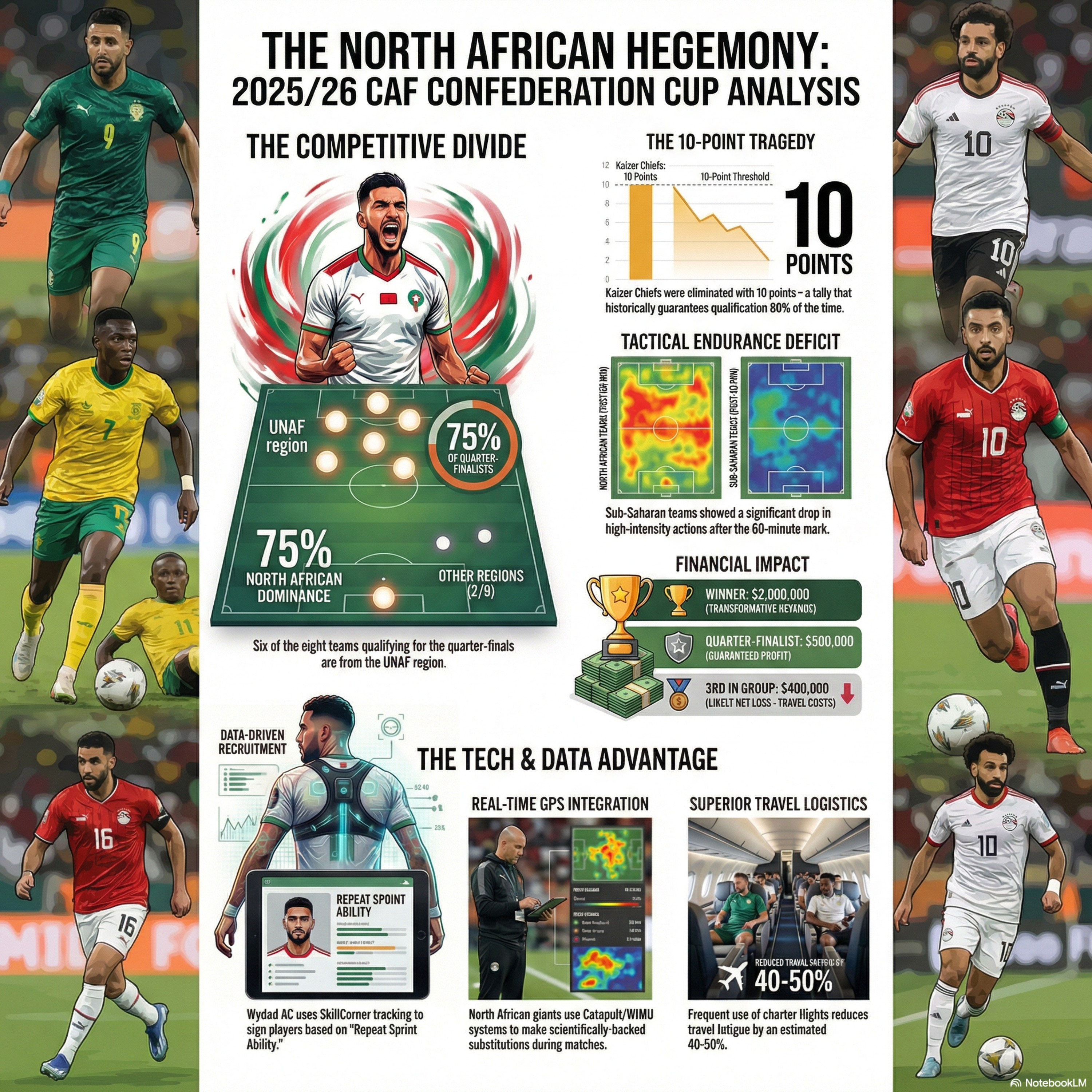
You know, there's this, this unwritten rule in football. I think it's a specifically African football rule, really. It gets passed down through generations of just agonizing qualifying campaigns. And it says that if you survive the group stages, you know, the heat, the travel, the hostile crowds, the lasers in your eyes, and you scrape together 10 points, you're safe. You're in. Yeah. 10 points is the sanctuary. It's the magic number. It is. Historically, it's absolutely the golden ticket. I mean, if you look at the last decade of CFF competitions, something like 88% of teams that hit double digits in the points column are booking hotels for the quarterfinals.
88. Percent. It's a massive number. You get 10 points, you sit back, you just wait for the draw. That's a solid B Plus, I mean, that's a passing grade in any university in the world. But this season, the Confederation Cup just decided to shred the history books. We are looking at a scenario that I think a lot of fans are really struggling to process. We have teams packing their bags with 10 points while others are scraping through with less. It feels just feels wrong, like a glitch in the matrix.
It's not a glitch though. And that's the scary part, right? It's a correction. We are seeing a level of ruthlessness in these group stages that we just haven't seen in years. And specifically, we're seeing a tragedy unfold for one of the giants of southern Africa. The 10 point tragedy of Kaiser Chiefs, we're definitely get into the emotional side of that. But when I looked at the final bracket for the quarterfinals, the emotion just it vanished and I got hit with this cold, hard reality. Read me those numbers again.
The geographical split. It is dark. It's it's really something to see laid out. We have 8 teams left standing in the quarterfinals. 6 of them are from the UNEF region. Six of eight North Africa. Egypt, Morocco, Algeria power base. That's 3/4 of the entire field. 3/4 And then you look at the teams that were eliminated, Chiefs, Vesco United, SI Cocoon, they're all from the Khasafa region or Central Africa. This isn't just, you know, some teams won and some lost. No, this is different. This is a geopolitical annexation of the tournament.
The center of gravity hasn't just shifted, it has completely toppled over into the Mediterranean. OK so the mission for this deep dive isn't just to mourn the losers. I want to know why. And I don't want the cliches. I don't want to hear they wanted it more or bad refereeing. Or home grounded advantage. We are leaving all the cliches at the door. We've got the optical tracking data, we've got the heat maps. We are going to perform a Cyrensic autopsy on these matches. Because when you peel back the skin of this tournament, it's not about luck, it's about a war.
A war between two different ways of existing. You've got the intuition style of football. The vibes based approach is that what you? Mean, basically, yeah, playing on instinct versus the data-driven warfare that the North African teams are deploying. And I'm telling you, the data is winning hands down. OK, so let's get the gloves on. Let's get into the operating room. We have to start with the Group of Death, Group D Zamalek versus Kaiser Chiefs, Suez Canal Authority Stadium, Ismailia winner takes all.
The atmosphere was absolutely electric, but the tactical battle was even more intense. You have Zamalek, the White Knights playing at home and then Chiefs needing a result, any result really. Now on paper, Chiefs set up in a standard 4231. Pretty standard stuff. Yeah, it's a mid block. Yeah, the idea is simple. Contain the pressure, disrupt their rhythm, maybe nick a goal on the counter attack with Pool and Modi speed or the labels finishing. And for the 1st 45 minutes it actually worked. It looked solid.
I was watching and thinking, OK, OK, they've got a handle on this. They absolutely did. But here's where the forensic analysis gets really fascinating. Samlak wasn't just playing a formation, they were shape. Shifting shape shifting. Out of possession, they look like a pretty standard 4411, but the second they got the ball they morphed into a 325. Wait, hold on a second. Explain that shape shift. Who goes where to make that happen because a 325 sounds. I mean, that sounds incredibly aggressive. Oh it is.
It's all out of tack. So what they do is one of the full backs, usually the left back, bombs all the way up to join the forward line. The wingers then tuck inside so suddenly you have 5 players pressing right up against the Chiefs back 4. You're just overloading the defense. Flooding the front line and they were just attacking randomly. They were hunting. Hunting for what they. Were hunting the half spaces, specifically that little pocket of space between the Chiefs double pivot, the two defensive midfielders and their center backs.
Sam Alex Analysts had clearly identified that if they overloaded the left flank, they could drag the entire Chiefs block over to one side. And then snap it back inside and. Then snapped the ball back inside that soft underbelly. It was brilliant. So they're playing this cat and mouse game, but the dam didn't break immediately. There's a specific moment, wasn't there a specific trigger event that changed everything? We have to talk about the injury. The tactical breaking point. George Matlow, or Mcgallo, as you sometimes hear in Cult, he was the anchor, He was the screen, the shield protecting that back for.
When you say scream, describe his job for us. Is he just there to tackle people? It's so much more than tackling. Think of him as the security guard standing right in front of the VIP section and the center backs of the VI. PS. His job isn't always to fight. It's to occupy the space where a playmaker wants to stand. He clogs the passing lanes. He's just there. And when he went down and had to be substituted, the structural integrity of Kaiser Chiefs just it dissolved. And this is where the data just blew my mind.
We aren't just saying, oh, they look more open. We have a number, a specific measurement. We do post match. Telemetry from the tracking data shows that after Matt Liu left the pitch, the average distance between the Chiefs midfield line and their defensive line it increased by exactly 4.2 meters. 4.2 meters. I want to pause on that number piece if I'm sitting in my living room. 4.2 meters is roughly the length of the standard car. In the grand scheme of 100 meter pitch, that sounds like nothing.
Why does that specific distance matter so much? Because in elite football, 4.2 meters is not a car, it's a landing strip. It's a Canyon. You have to understand reaction times. If I am a defender and I am 4 meters further away from you, the attacker, that gives you maybe an extra 1 1/2 seconds of time on the ball before I can even begin to close you down. And 1 1/2 seconds in the final third is an eternity. It's the difference between receiving the ball and having to pass it back immediately because of pressure, or receiving the ball turning, looking up, scanning the entire field and picking a killer pass.
That pocket expansion is exactly what a player like Abdullah El Side waits for his entire career. The veteran, The puppet master. Exactly. He's seen it all before and suddenly he's not receiving the ball with a man breathing down his neck. He's getting it in a pocket of space that is 4.2 meters bigger than it was 10 minutes ago. He has time to turn. He has time to pick a pass. And that led directly to the sequence for the decisive second goal. It's just incredible that we can pin qualification down to a distance of four meters.
But it wasn't only the tactical spacing, was it? There was something physical happening, too. As the game wore on. I was watching the Chiefs players and they looked like they were running in mud. This is the tactical endurance deficit and it's a pattern we see repeatedly with sub-saharan teams playing in North Africa. We track the high intensity actions, you know, the sprints, the pressures, the recovery runs. After the 60 minute mark, the Chiefs numbers just fell off a Cliff. 60 minute wall. Why 60?
Is that psychological? Or physiological. That's usually the point where the initial adrenaline wears off and your glycogen stores start to seriously deplete. If you aren't perfectly conditioned, your body just starts screaming stop and when the body gets tired the brain gets foggy. Which explains the decision making in the last 30 minutes. Exactly. It's not just that they couldn't run, they couldn't think. There's that moment and I know fans were screaming at their TV screens where Chiefs were momentarily playing with 10 men while we were waiting to make a substitution.
Oh that was painful to watch. The ball is in play, you're a man down in a must win game and you're just waiting. It's a lack of game intelligence and it's driven by fatigue. A North African team you a team first in the dark arts or just smart game management. They would have kicked the ball into the stands, they would have faked an injury, they would have forced a stoppage to get their man on the pitch. Anything to stop the clock. Chiefs try to play through it and Zamelek just suffocated them in that moment.
It's naive. Naive. That's the perfect word. And it cost them everything. Because while this is all happening, Al Mazri is beating Zesco 2 nil. So you end up with this insane three-way tie. Zamalek on 11 points, Al Mazreon 10, Chiefs on 10. And because Chiefs couldn't lock it down in Ismailia because of that 4.2 meter gap, they lose them head to head and goal difference tiebreakers. It's just ruthless. Chiefs scored in five of their six games. I mean, their offensive output was actually quite good, but offensive output means nothing if you don't have the tactical discipline to secure a point away from home.
The XG. The expected goals timeline for that match showed Xamala creating consistently higher quality chances. They had an XG of 1.85 versus Chiefs .94. So the data says the better team one. Statistically speaking, yes, the better, more prepared team one. So that's the tragedy of Group D Absolute heartbreak for the Amicosi. But I want to pivot now. I want to go from the heartbreak of chiefs to the absolute cold calculated machinery of why Dad AC in Group BA. Completely different animal, a different species even.
We talked about recruitment in football, usually in terms of, oh, I like how that guy dribbles or he's got a good shot, why dad is doing something else entirely. They are playing moneyball, but with physics. They are. They're using a platform called Skill Corner and it's basically optical tracking data. OK, break that down for me. What is optical tracking? Is this just another scouting platform? How does it actually work? It's all computer vision, so traditionally to get physical data on a player, you know how fast they run, how quickly they accelerate, you need them to wear a GPS vest.
Right, Those little bras the players wear under their shirts, The catapult vests. Exactly. But you can't just call up a club in Tanzania or Congo or Nigeria and ask their star player to put on a vest and send you his confidential data. They'll just laugh at you. So why Dad uses broadcast feeds? The TV field. The standard TV footage of a match, The signal you watch at home. The skill Corner AI identifies every player on the pitch. It builds a digital skeleton for each of them, and it tracks their movement 25 times per second.
It can calculate their Sprint speed, their total distance or acceleration profile, all just from the video. That is, that's slightly terrifying. So you're telling me they can scout a guy playing in the middle of nowhere without ever sending a scout to the stadium and they'll know exactly how fast he runs? Precisely. And that brings us to Waleed Nasi. He's the player who scored the second goal against Azam FC in stoppage time, 90 + 4. Now you watch that goal and you just see a guy sprinting past tired defenders.
Look like a simple breakaway. Right, but why dad didn't just see a fast player, they recruited him specifically for his RSAR. Sai feel like I'm in a physics class all of a sudden. What does that stand? For it stands for Repeat Sprint Ability. It's a metric that measures how many times a player can spread at top speed with very short recovery times, specifically in the red zone of fatigue, which is the last 15 minutes of a game. OK, so they aren't looking for the fastest player overall, they're looking for the player who is still fast when everyone else in the pitch is dying.
Precisely. That is the entire strategy. They wanted a player who could produce high speed running values in the dying minutes of a game. They knew that many African defenders, particularly from teams with less sophisticated conditioning, drop off physically after minute 80. So they bought a weapon specifically designed to fire at minute 90. So when Massey out sprinted those 3 Azam defenders who played 90 minutes and were completely dead on their feet, that wasn't luck. That was a data point manifesting as a goal.
It was a recruitment strategy executing its primary function. It's that simple. They saw the data, they bought the player, he scored the goal that the data predicted he would score. That is the absolute definition of data-driven dominance. And their defense, I mean, we talked about the attack, but they conceded two goals in six matches 2. Two goals and their expected goals against or xga for that specific match was .35. 0.35 that's that's basically 0. It's negligible. It means based on the quality of shots they allowed, they were expected to concede about 1/3 of a goal.
Their goalkeeper, El Medi Benabi, was basically a spectator for most of the game. How do they? Do that. Wydad plays with this incredibly high defensive line that just compresses the pitch. They suffocated Azam Azam's pass completion in the final third of the pitch dropped to 58%. You can't score a goal if you can't complete 2 passes together near the box. It's total suppression. And this leads me to the bigger theme here, doesn't it? We're seeing this massive divide. We have the North African model, Zamalek Wydad, the Kyra Casablanca axis and then we have the sub-saharan model Chiefs, Stellenbosch, Manny, Emma Union.
The gap isn't talent, is that we see incredibly talented players everywhere. No, absolutely not. The talent pool in Africa is incredibly deep and it's very evenly distributed. You look at West Africa, Southern Africa, the raw ability is world class. The gap is the tech stack. OK, let's unpack that term. What does a full tech stack look like for a team like Zemalek or Wydad? And I don't just mean owning a laptop. It starts with the hardware they're using top tier GPS systems, Catapult or Woody IMU.
Every single training session, every match, every movement is tracked. They know a player's player load, their accelerations, their decelerations. They can know if a player is in the red zone for injury risk before the player even feels a twinge in their hamstring. And what about during the game? Because that's where the rubber meets the road. This is the real game changer. They have analysts on the bench, not in the stands writing a report for later. They are on the bench. They have tablets linked to hurdle sports code or Why Scout?
They're tagging events live. So when the coach goes into the halftime team talk, he's not saying, fellas, I think they're attacking our left side. He's not guessing. There's no guessing. He's saying the data shows their right winger has made six runs into the half space and our left back is on average 5 meters out of position. When that happens, fix it. It's precise. It's actionable. That is a massive advantage. It's like bringing a radar system to a knife fight. And you contrast that with the sub-saharan model, Yeah, many teams are relying on basic video and you know, the coach's intuition, maybe they have an analyst, but is that analyst empowered?
Are they affecting real time decisions on the bench? The physical crash we saw from Chiefs after 60 minutes, that suggests a severe lack of advanced load management. They didn't know their own battery life. And then there's the logistics. The hidden killer travel in Africa is not a joke. It's the silent factor that decides so many of these ties. North African teams almost exclusively charter flights for these games. Sub-saharan teams are often flying commercial. Why does that matter so much? Is it really just about comfort?
It's physiological. Think about commercial flight schedule. You have to check in three hours early. You fly to a hub, maybe it's Addis Ababa. You have a six hour layover. You're sitting in a plastic chair. Then you get on another flight. You arrive at 2:00 AM. Your legs are swollen from the cabin pressure. You're eating airport food, which is just a sodium bomb. It's garbage. And your sleep is. Just ruined. Your circadian rhythm is a total mess. Now compare that to a charter. You leave when you want.
You fly direct. You have beds or business class seats. You eat the specific meal your team nutritionist prepared for you. You arrive fresh. We estimate the chartering reduces travel fatigue by 40 to 50%. So when Wydad scores a late goal, it's partially because their legs are literally fresher because they traveled better. Absolutely. They are winning the game before they even step on the pitch. It's the flight, the food, the data, the recruitment. It's a machine. A well oiled machine. And specialized coaching, that's another layer to this it's.
Huge North African teams have set piece coaches, they have throw in coaches. Sub-saharan teams often have generalists. You'll have a head coach and an assistant coach trying to do everything. You just can't compete with specialization using generalists. It's like AGP trying to perform brain surgery while a full team of neurosurgeons is working in the room next door. Let's look at the other survivors then, because it's not just the two giants we've talked about. We have some other really interesting profiles in the quarterfinals.
Let's talk about USM Alger. They topped Group A, but honestly watching them they don't seem that exciting. They are the pragmatists. They are incredibly boring and I say that is the highest compliment. They play a 532 low block. They are completely risk averse. Their PPDA that's passes per defensive action is 18.5. OK, you have to define ppda for me. It's a metric of pressing intensity. It measures how many passes you allow the opposition to make in their own half before you try to tackle them or intercept the ball.
A low number like 6 or 7 means you were pressing like maniacs, like a Jurgen Klopp team. A high number like 18.5 that. Means you're just sitting back and watching. You're letting the other team pass the ball almost 19 times before you even bother to engage. They refuse to press high, they save their energy, they sit back, they absorb pressure and they just say come on, try and break us down. And nobody could. They barely spent any energy, got a 00 draw against Olympic Safi when they needed it and took the top spot.
It's smart, economical, effective football. Then on the complete other end of the spectrum, you have Sierra. Bellois debt? The Overloaders? Yeah, a totally different style. They attack down the flanks, 72% of their attacks are wide and they have the tournament's top scorer, Abdoner Belhicini four goals. Is he the real deal, or is this just a hot streak we're seeing? That is the big question. He is elite at finding blind side space. You know, hiding behind the defender's shoulder so the defender can't see both him and the ball at the same time.
It's a real skill but the analytics suggest he is massively over performing his XG. He's scoring tough chances. Exactly. He's scoring from chances that shouldn't typically go in. Statistically, that suggests A regression to the mean is coming. Meaning the luck is going to run out. Exactly. Gravity eventually pulls you back to Earth in the knockouts. Those half chances might stop finding the back of the net. And then there's the ticking time bomb, Al Masri. The Aggressors is great through but their discipline is a nightmare.
Their midfielder Banner Mugisha has three yellow cards already. They commit a huge number of tactical fouls. Which works in the group stage. Sometimes it breaks up play. But in the knockout rounds, with VAR monitoring every single tackle, it's so dangerous. Relying on fouling to stop attacks is an incredibly high risk strategy when you have cameras watching every ankle tap. They're one clumsy challenge, one red card away from total elimination. Let's talk about the cost of failure, because we opened with the tragedy of Kaiser Chiefs.
And that tragedy isn't just emotional, it's financial. And this is the part that really hurts the development of the game in the South. Let's just breakdown the numbers. For a team like Chiefs, they earn about $400,000 for finishing third, plus maybe $100,000 prelim support grant, so $500,000 total revenue. OK, half $1,000,000. It sounds decent on the surface. Until you look at the costs. Charter flights, if they even use them, or incredibly expensive commercial routes, hotels, logistics for three massive away trips to North Africa and Zambia.
The estimated cost for a campaign like that is also around $500,000. So they broke even after all that. Best case scenario they broke even. More likely it was net loss when you factor in opportunity costs. Campaign drained resources tired of the squad for their domestic league and it yielded 0 financial profit. Whereas if they had just hold on if that gap had been 1m instead of 4.2. The quarterfinalists guarantee $550,000. Semi finalists get 150,000. The winner gets $2,000,000. That is transformative money for a club.
And this is the cycle, isn't it? This is the loop. The North African clubs get to the semis, they get the 750K or the 2 million, they reinvest that money into skill corner and to catapult GPS into charter flights for next season and the gap just gets wider and wider. Precisely. It's a compounding interest of dominance. The rich get richer because they have the infrastructure to win the money to buy more infrastructure. So we have the forensic data, we have the why I want to visualize this for the listeners.
If we were looking at a dashboard right now, a screen with all this data, what are the key images we'd see? Three things would jump out at you. First, you'd see the scatter plot of attacking efficiency. So imagine a graph. On the vertical axis, you have actual goals scored. On the horizontal axis, you have expected goals. See, our Belize dad is way up in the top corner. High efficiency, finishing everything. They're in the bottom right. High creation, so high expected goals, but low conversion, low actual goals.
That's the wasteful quadrant. It's painful to see. Painful to visualize. What's the second image? The puppet master graph. This would be a network graph for Zomalak. Looks like a bicycle wheel. Abdullah L side is the hub right in the center and every single spoke, every pass connects to him. It visually shows you that if you stop him, you stop the entire wheel from turning. And the third. The red zone heat map. This is the scary one. Imagine a map of the pitch, but it's colored by fatigue levels.
For Kaiser Chiefs, after minute 65, their entire defensive zone just turns deep red. Wow. It's a visual warning light of a complete structural failure. It shows you exactly where and when the legs just went. So looking ahead, we have the quarterfinalist who is winning this thing based purely on the data. If I'm betting with my head in the spreadsheet, it's wide at AC. Tier one favorites. Absolute Tier 1 hands down. They have the highest squad depth, they have the best tech stack, they have that data-driven late game power.
The models give them an 85% statistical probability of reaching the semi finals. They are just. They're built for this. And symbolic. Also tier one, but with a slight caveat. They are a creative powerhouse, but they are vulnerable to counter attacks. If a team can bypass their initial press, they can be hurt, but their creative numbers are so high they might just outscore everyone anyway. Who's the dark horse in all this? I put USM Alger in that category. Pier 2. They aren't flashy, they won't entertain you, but in A2 legged knockout tie defense wins championships.
If they can grind out a 00 away from home and then win one nil at their place, they can go all the way. It's ugly, but it works. And for the teams that are out, for Chiefs, for Zesco, for the others, what is the advice? What is Project 2027 to get back on top? It has to be a complete and total overhaul first, a physical audit. That 60 minute drop off is unacceptable in modern football. They need to fix their conditioning, their nutrition, their recovery protocols, whatever it is. And recruitment.
Stop signing players over 30 please. Just stop. Look at what why dad is doing. They're recruiting U23 talent based on physical metrics. You need legs. You need energy. You cannot win Continental titles with a retirement home midfield. And the tech? It's non negotiable. Put an analyst on the bench, not someone writing a report for Monday morning. Someone who can turn to the coach in the 30th minute and say right now that the defensive line has dropped 5 meters too deep. The reactions need to be proactive, not reactive.
This. This has been, well, it's been eye opening. We started with a heartbreak, but I feel like we found a blueprint. And that's the take away, isn't it? The era of intuition is dead. It's over. The era of data-driven football isn't coming. It is already here. The teams treating data as a luxury, as a nice to have, are dying. They were going home in the group stages with 10 points. The teams treating data as oxygen, as essential as the air they breathe. Those are the teams that are lifting the trophies.
That is a powerful thought to leave us with. If you aren't counting the data, you aren't counting the goals. Listeners, when you watch the quarterfinals, don't just watch the ball. Watch the space. Watch the fatigue. Watch for the 4.2 meters because that is where the game is actually being played. Couldn't said it better myself. That's it for this deep dive. We'll be watching the knockouts with our forensic lens, and we certainly hope you will too. Catch you on the next one.
 Apple Podcasts
 Castbox
 Castro
 Goodpods
 Moon FM
 Overcast
 Pocket Casts
 Podbean
 Podcast Addict
 Podcast Republic
 Spotify