How Data Science Runs Youth Football Academies
About this episode
How Data Science Runs Youth Football Academies
Imagine you are sitting in the back of this dimly lit, incredibly high stakes boardroom. Right, very serious atmosphere. Exactly like at a major football club in London, the air in the room is just thick. You've got executives in these tailored suits and they're, you know, whispering to one another, sliding papers across this massive mahogany table. You'd think they're discussing a billion dollar broadcast deal. Yeah, or like a blockbuster transfer deal for some global superstar, maybe a huge stadium sponsorship.
But if you actually lean over and look closely at the paper they're obsessing over, it is something entirely different. It's completely mundane. It's just a job posting, literally a simple online vacancy for a role titled Academy Data Scientist. And this is at Fulham Football Club's Mott 'sborough Park training ground, Right To the untrained, I like maybe. To a casual fan, walking past the stadium on a match day just looks like a routine back office hire. Just, you know, an IT guy to fix the club's spreadsheets.
Oh, but it is so much more than that. Exactly. To those paying attention to the people quietly running the global football economy, that job posting is a glaring neon flare in the night sky. It is this massive signal that the world's most popular sport is undergoing a quiet, almost violent revolution. It really is. We are looking at a total epistemological shift in how human athletic potential is discovered, how it's tracked, and ultimately how it's monetized across the globe. OK, let's unpack this.
Yeah, because the transition happening right now is just profound. We are basically watching the complete tear down of heuristic intuition based talent identification. The old school way. Right, if you think of that old romantic image of a scout you know standing on a freezing touchline on a Sunday morning holding a wet notebook. Drinking terrible coffee. Exactly. And just relying on a gut feeling about a 12 year old kid. That entire paradigm is being dismantled as we speak. It's gone. It is being replaced by an evidence supported, fully dated mediated machine.
That single vacancy notice from Fulham. It's not a staffing update, it is a declaration of strategic doctrine. And I want to figure out how we actually got here, because the mission for this deep dive is to trace the invisible wires of this data revolution. We are going to track it from the incredibly high tech training grounds of England over to the massive talent export factories of Portugal and the Netherlands. The real powerhouses. Yeah. And then all the way down to the immense, just game changing leapfrog opportunities happening right now across the African continent.
It's a truly global shift. It really is, and if you are listening to this, you probably love the beautiful game for its chaos, its unpredictability, its art. But behind that art, there is a system evaluating preteens using software architectures that were originally designed for Wall Street banks. Which is just wild to think about. And that brings us back to the anatomy of that specific job posting. If you analyze the technical stack required for this Fulham role, it reveals the sheer scale of the operation, right?
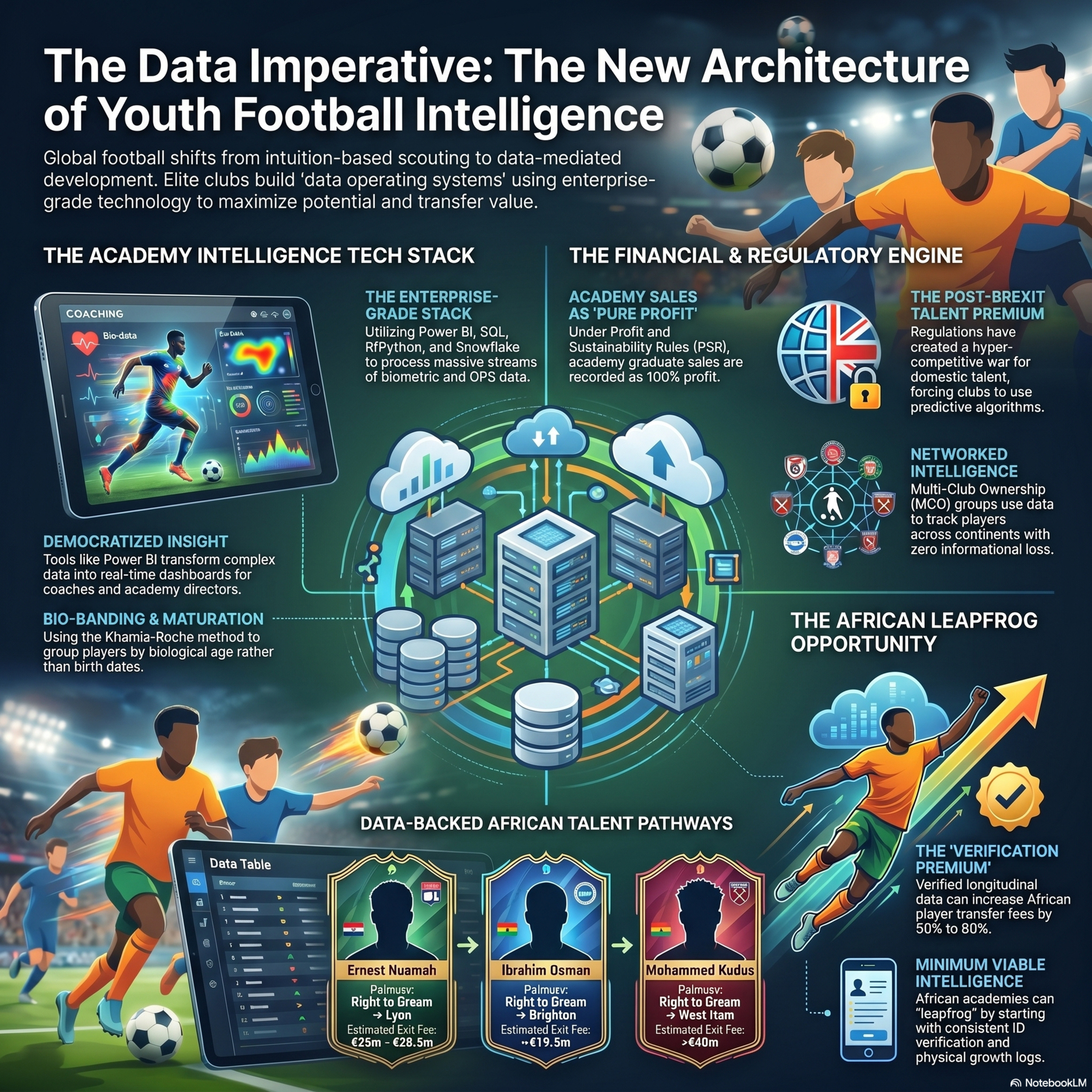
The listing actually demands proficiency in Power BI, Sequel, R, Python, And crucially, these enterprise grade cloud data platforms like Snowflake or Data Bricks. Wait, slow down. I hear those names and I immediately picture a Silicon Valley tech startup, not a youth football Academy. I know it sounds totally out of place. Right, so help me and really anyone listening who doesn't code for a living, understand what those tools actually do. Let's start with Power BI. Isn't that just like a Microsoft tool for making pie charts?
Well, it is a Microsoft tool, but thinking of it as just making pie charts really underestimates its power. In this context, Power BI serves as the democratization layer of a football club. Democratization Layer. Yeah, think about the old dynamic. You might have a brilliant sports scientist who runs these super complex statistical models on player fatigue. That insight just lives in a spreadsheet on their laptop. Nobody else can read in. Exactly. The under 14 coach out on the grass doesn't have the time, or frankly the mathematical background to read a spreadsheet filled with raw GPS coordinates.
Right, they're busy coaching. So Power BI takes millions of rows of complex data and turns it into immediate actionable visual dashboard. Oh, I see. A coach can literally look at an iPad on the side of the pitch and see a real time heat map showing that their star midfielder is currently in the red zone for hamstring fatigue. Wow. It bridges the gap between the mathematician of the basement and the tactician on the grass. OK, so Power BI is basically the translator. It takes the geek speak and turns it into football speak.
That's a great way to put it. But then the job posting asks for Sequel, R and Python. I always thought those were for building search engines or algorithmic trading bots. Yeah, they are. Yeah, but here they are, the keys to the Kingdom for a modern data science pipeline. Think of a football club's data as a massive, completely chaotic library. Every single time a kid takes a step on the pitch, AGPS tracker records it. Every heartbeat is logged. Every pass is tagged on video. That's a lot of books in the library.
Exactly, and Sequel Structured Query Language is the librarian. It is the engine used to reach into these massive relational databases and retrieve specific pieces of information instantly. So how does a club use that? Well, if a sporting director asks, you know, show me every left footed defense under the age of 16 who has played more than 2000 minutes this season. And as a Sprint speed over 30 kilometers an hour, Sequel fetches that instantly. Just pulls it right up. And R and Python, where do they fit in?
So one sequel fetches the books in the library. R and Python essentially read them and predict the future. Predict the future. They are programming languages heavily used for statistical modeling and machine learning. You see, you cannot buy off the shelf software to accurately predict the developmental trajectory of a 14 year old child. Because every kid is different. Exactly, and every club has completely different playing styles and different physical requirements are in Python. Allow this data scientist to build custom, totally bespoke artificial intelligence algorithms.
That learn from the club's specific data. Yes, they learn from the club's specific historical data to spot invisible patterns in youth development. OK that makes sense. You absolutely need custom code to understand unique kids. But the part of that job posting that genuinely confused me was the requirement for snowflake or data bricks. Ride the heavy hitters. Yeah, I've only ever heard those names in the context of massive multinational corporations. Why on earth does a football Academy, which is dealing with maybe a couple 100 kids, need enterprise cloud platforms designed to process terabytes of data?
It comes down to the staggering, almost incomprehensible volume of the telemetry. Clubs aren't just logging who scored a goal or who got a yellow card anymore. They're way past that. They are ingesting continuous live streams. Picture a single training session. You have 22 kids on the pitch. Each one is wearing AGPS vest, logging your spatial coordinates, their acceleration and deceleration 10 times a second. 10 times a second. Every second, Yeah. Plus you have optical tracking cameras recording the balls movement.
You have biometric monitors tracking heart rate variability. That is an insane amount of data for one Tuesday afternoon practice. And then multiply that by 5 training sessions a week plus a match on the weekend across 5 different age groups. We are talking about hundreds of millions of data points a month. My laptop is overheating just thinking about it. Traditional servers would literally melt trying to query that. Platforms like Snowflake allow a club to scale their computing power in the cloud so they can actually run those Python machine learning models on massive data sets without the entire system crashing.
Wow. But you know, when you lay it out like that, it forces a really uncomfortable question. What's that? If I'm a parent bringing my kid to a premier Academy, I have to wonder, is this organization really trying to help my child get better at football, or are they just building an industrial scale data harvesting machine that happens to use children as the raw material? That is the dark side of it. Because the responsibilities of this data scientists role span 4 massive domains, they monitor individual player performance, they analyze team level tactics, they manage the research and development infrastructure, and most brutally.
They manage the pathways. Yeah, they manage the retain and release pathways. They literally decide mathematically who who gets a contract and whose childhood dream is terminated. The tension between developing a child and feeding the system is really the central ethical conflict of modern football right now. And because they're leaning so heavily into the system, they are colliding with severe regulatory realities, right? Collecting this level of granular information isn't just a fun tech experiment, it triggers sweeping legal frameworks, particularly GDPR in Europe.
Because we aren't just talking about a kids math grades here, we are talking about their literal bodies. Exactly. Under the General Data Protection Regulation, the biometric telemetry collected by those GPS vests and heart rate monitors is classified as a special category of personal data under Article 91. Special category meaning highly restricted. Very restricted biometric data used for uniquely identifying a natural person is fiercely protected. It is generally prohibited to process this data unless very specific documented legal exceptions apply.
And we are talking about minors. These are 12/13/14 year old kids. You can't just hand a 12 year old A50 page terms of service agreement and say hey, sign this so we can harvest your heart rate. No, you definitely can't. Which means the legal burden falls entirely on the club to secure ironclad informed consent from parents or guardians, and they have to prove that the data is being stored securely, anonymize where possible, and not used for nefarious purposes. That sounds like a compliance nightmare.
It is any third party software vendor that touches this data, whether it's the company making the GPS vest or the cloud provider hosting the data lake, has to be bound by intense data processing agreements. Because if it leaks. A single data breach exposing the medical and biometric profiles of 100 miners could result in fines that would completely cripple a football club, let alone the reputational destruction. So the infrastructure costs millions, the legal risks are existential, and the technical complexity is staggering.
I just have to push back on the entire premise here. Go for Why would a football club voluntarily take on this massive technological, financial, and legal headache? Historically, clubs did perfectly fine without this. They won Champions Leagues relying on experienced coaches and good scouts with a sharp eye. They did. There has to be a catalyst driving this behavior because nobody builds a wall to wall surveillance state over a youth pitch just for the fun of it. You're absolutely right, the catalyst is survival.
The clubs are not doing this because they suddenly developed a passion for cloud computing. They are doing this because the financial and political rules of the global game have been radically rewritten over the last decade. OK, let's get into the rules. To understand the mechanism driving this data arms race, we really have to look at the foundational architecture established in England back in 2012, specifically the Elite Player Performance Plan or the EPP. Right, let's unpack the EPP as I understand it.
It was this massive initiative by the Premier League to force clubs to standardize how they develop youth. It mandated a complete systemic overhaul. Before 2012, youth development was largely decentralized and honestly pretty informal. Just a bunch of local kids kicking a ball around. Pretty much the EPP forced academies to adopt an evidence LED approach. They implemented the performance management application, the PMA, alongside a national injury surveillance project. So everybody had to start logging everything.
Yes, for the first time, clubs were mandated to log physical, technical, tactical and psychological metrics for players from age 9 all the way to 23. But mandating data collection is very different from actually deriving insight from it, right? If you force a bunch of traditional football coaches to suddenly start filling out digital forms, I imagine that performance management application just turned into a massive useless data graveyard. And for a very long time, it was exactly that. Academies became incredibly data rich, but hopelessly insight poor they.
Didn't know what to do with it. They had hard drives filled with XML files of training loads and match statistics, but they lacked the internal data science capabilities to synthesize it. They were buying generic off the shelf software packages that analyzed a growing 14 year old the exact same way they analyzed a fully developed 30 year old professional. Which makes no sense biologically. None at all. So the shift we are analyzing today, the hiring of specialized in house data scientists, marks the transition from passively hoarding that data to aggressively weaponizing it.
Weaponizing it. Wow. And if the EPP laid the dry brush, the political reality of Brexit was the lightning strike that set the whole thing on fire. Absolutely. Because the rules around international recruitment completely shifted, didn't they? The post Brexit environment changed the entire economic landscape of English football. What's fascinating here is that previously under FIFA Article 19, two UK clubs enjoyed an exception that allowed them to sign 16 year old players from anywhere within the European Economic Area.
They could identify a brilliant Spanish or French teenager, bring them into their world class facilities, develop them for three years, and by the time that player turned 21 they officially qualified as a homegrown player under league quotas. But Brexit severed that pipeline completely. Completely. The new regulations explicitly banned Premier League clubs from signing overseas players until they reach the age of 18. That crucial 2 year developmental window was legislated entirely out of existence.
So think about what happens to the market. You are a Premier League sporting director. You still have rules mandating that a certain number of players in your squad must be homegrown, but the massive European talent pool you used to draw from is suddenly totally off limits. That creates a bottleneck. Exactly. The result is artificial scarcity. You now have 20 incredible wealthy clubs fighting a hyper competitive 0 sum war over a drastically reduced pool of domestic British youth. And the margin for error in domestic scouting evaporated overnight.
You can no longer wait until a kid is 15 to see if they are good. You have to identify their potential at age 10. Age 10. Yes, and your predictive models have to be infinitely sharper than the club down the road. But political scarcity is really only half the pressure cooker. What's the other half? The element that truly elevates the Academy to the most important department in a modern football club is the financial imperative of the Premier League's profit and sustainability rules. PSR If you follow football even casually, you hear these 3 letters constantly.
Clubs are terrified of points deductions for breaching financial fair play. They are petrified. I want to spend some time here because the accounting mechanics actually explain why Academy kids are so incredibly valuable. Can you walk through exactly how an Academy graduate functions on a club's balance sheet compared to a player they just buy from another team? It is the ultimate financial cheat code. OK, explain that. When a club purchases a player, let's say they spend €50 million on an established striker from Italy, that 50 million does not hit the club's financial Ledger all at once.
Right. It is amortized or spread out over the length of the players contract. If the player signs A5 year deal, the club records a cost of €10 million per year on their books. Right, that makes sense. It softens the immediate financial blow. But how does that compare to selling a kid who grew up in the club's Academy? When a club sells an Academy graduate, there is no initial transfer fee to amortize the costs of developping that child. The coaching staff salaries, the bus rides to away games, the cafeteria food, those were already written off as standard operating extenses over the previous decade, right?
So therefore, if the club sells that home grown player for €50 million, the entire 50 million registers on the balance sheet as pure unadulterated profit in the exact year the transaction takes place. 50 million in pure profit instantly. Immediate profit. That is unbelievable. If a club is dangerously close to breaching PSR limits and facing a points deduction, selling 1 elite Academy graduate instantly fixes the balance sheet. It offsets the amortized costs of five different expensive international signings.
Look at the public financial data over the last decade. Chelsea Football Club has generated in the region of €500 million purely from selling Academy graduates. Half a billion. Yes, Manchester City is approaching 400 million euros. So the youth Academy is no longer just a community outreach program or a romantic ideal of local boys playing for the badge. It is a highly optimized financial instrument. It is an asset factory. And that asset factory is being scaled to a global industrial level through the rise of Multi Club ownership models or MC OS.
Oh, right, like the Citigroup. Exactly. Think of syndicates like the City Football Group, which owns clubs in Manchester, NY, Melbourne and Yokohama, or the Red Bull Group, with clubs in Lexig Salzburg in New York. How does the data infrastructure we've been discussing plug into a global conglomerate like that? Within a multi club ownership model, the standardized data architecture acts as the central nervous system of a global empire. When you mandate the exact same data science pipelines, the same physiological monitoring thresholds, and the same algorithmic scouting models across clubs on five different continents, you eliminate the friction of cross-border scouting.
You essentially build your own world. You create a proprietary internal global labor market. I see. So if you are the sporting director in Manchester, you aren't relying on a subjective scouting report from someone you met once in South America, No. You are looking at the exact same Power BI dashboard with the exact same metrics for a 19 year old playing for your sister club in Uruguay as you are for the kid training in your own backyard. Wow. You can track their development, mental velocity, their tactical adaptability and their injury history continuously.
You can move a player from a feeder club in South America to a mid tier European club and eventually to a Champions League squad without ever losing control of their data narrative. Independent standalone clubs simply cannot compete with that level of coordinated, risk free long term resource allocation. They really can't. So we've established that the English clubs are driven by billionaire regulations and pure profit accounting, but if we take a short flight across the English Channel, the environment changes completely.
Totally different world. For clubs in Portugal, the Netherlands and France, this data revolution isn't about exploiting A regulatory loophole. It is about raw existential survival. The continental European approach provides a really fascinating contrast. English Premier League clubs have the luxury of astronomical global television broadcasting revenues. They're insulated by billions of dollars, right? Clubs in the Portuguese Premiera Liga or the Dutch era Divisi operate in commercial realities that are just a fraction of that size.
Which forces them to operate what analysts call the economic engine model. The Academy Is literally keeping the lights on. It is their primary industry. They have systematized player development into an industrial export process. If you analyze the 10 year transfer revenues of an institution like SL Benfica in Portugal, they have generated roughly half a billion EUR by producing and exporting talent. Just staggering numbers. AX in the Netherlands consistently clears 3 to 400 million euros in similar cycles.
For these institutions, hiring data scientists and building machine learning pipelines is not an aspirational tech flex. It's not just to look cool. No, it is the load bearing pillar of a commercial model that must reliably, consistently manufacture transferable athletic assets just to keep the club solvent. But incorporating algorithms into a deeply entrenched football culture is not a seamless process. In these European hotbeds, particularly in Portugal, there is a massive methodological clash happening every day on the training ground.
Oh, huge clash. You have the new wave data scientist pushing for highly isolated biomechanical metrics, running head first into veteran coaches who practice a philosophy known as tactical periodization. Can you explain what that is? Because it sounds incredibly complex, tactical. Periodization is arguably one of the most influential coaching paradigms of the last 30 years. It was heavily pioneered by Vitor Fried, an academic at the University of Porto, and it have deeply influenced managers like Jose Mourinho.
OK, the core philosophy of tactical periodization is the absolute indivisibility of the game. It argues that football is too chaotic and interconnected to ever break down into isolated parts. Meaning you shouldn't separate the physical fitness from the tactical thinking. Exactly. To a tactical periodization purist, you must never train the physical, mental, technical, or tactical elements in isolation. You don't send players to run laps around the pitch just to build stamina. Because running in a circle isn't football.
Exactly. Every single drill, every small sided game, every recovery session must occur within the specific tactical context of the club's overarching game model. I can immediately see the conflict here. If an Academy data scientist looks at their snowflake database and says our algorithms dictate that player X needs to hit 4 high speed sprints over 20 meters today to optimize his hamstring load and prevent injury, a traditional coach is going to reject that entirely. They will view it as a violation of the sport's fundamental nature.
The traditional coach will argue that forcing a child to run in straight, unthinking lines just to satisfy Agps metric strips away the cognitive complexity, the decision making and the spatial awareness of a real football match right to them. External physical load data is blind to the art, the intellect, and the soul of the game. I have to play devil's advocate inside with the veteran coaches here. If you reduce a beautiful game to GPS Sprint targets, don't you kill the instinct that makes it beautiful in the first place?
How do you convince a veteran coach to listen to an algorithm? It is the defining cultural tension inside modern academies, and the way the most successful European clubs resolve this tension is brilliantly subtle. They realize that if the data scientist tries to dictate the play, they will lose the dressing room completely. So what do they do? Instead, they use the data as a subtle, almost invisible regulatory mechanism. Give me a tangible example. How does that actually look on a Tuesday morning practice pitch?
Well, the coach still runs their holistic, tactically complex training session, right? They are focused entirely on the game model, but the data scientist is quietly standing on the sideline with an iPad monitoring systemic physiological fatigue in the background. OK, watching the numbers. Right. If the algorithm flags that a specific player is entering a dangerous physiological peak that precedes a muscle tear, the data scientist doesn't halt the practice and make the kid go stretch on the sideline.
So what do they do to protect him? They approach the coach and suggest altering the physical dimensions of the drill. They might say, hey, let's make the playing area for this drill 3 meters wider. It's just three meters wider. By expanding the space, they implicitly change the physical load and cardiovascular demands on the players, without ever disrupting the tactical context that is. Brilliant. The players are completely unaware they are being physically managed. The data doesn't override the art, it operates in the shadows to protect the artist.
That is fascinating. It's invisible manipulation of the environment. But to get those veteran coaches to truly buy into the system long term, the data has to offer insights that the human eye, no matter how experienced, simply cannot see. Exactly. Which brings us to the science of scouting and something that sounds like it was pulled straight out of a science fiction novel predicting the future shape of a child's body. I want to dive deep into bio banding. By Abandoning is arguably one of the most profound and necessary applications of data science in youth sports right now, it directly addresses a massive systemic flaw in how human beings organize children for competition.
Chronological age. If you think about it, grouping kids by their birth year is incredibly arbitrary. It makes no sense biologically. Any parent who has ever been to an under 14 football match knows that 114 year old might have a full beard and muscular density of an adult, while another 14 year old on the exact same pitch looks like a 10 year old child. This biological reality creates what sports scientists call the relative age effect, which is compounded heavily by biological maturation biases.
The traditional Academy system heavily favors early maturing players. Because they just physically dominate. Exactly because they hit puberty first, they are taller, they are faster, and they are vastly stronger than their peers. Therefore, they dominate the physical duels on the pitch, they get selected for the elite traveling squads, they get the most attention from the head coaches, and they absorb the lions share of the academies resources. But the data is showing that this is a massive false positive.
They aren't necessarily more talented football players, they just got a head start on their hormones. The tragic irony of the traditional scouting model is that longitudinal data proves the late maturers, the small, physically underdeveloped kids who somehow managed to survive in the ruthless Academy system despite being physically bullied everyday, are statistically far more likely to transition to the elite professional tier as adults. Wait, really? Why does the system produce that outcome? Think about the adaptive mechanisms of survival.
The late mature cannot rely on speed or strength to win the ball. To survive against giants, they are forced to develop elite technical control in incredibly tight spaces. Because if they don't, they get crushed. Exactly. They must develop precognitive spatial awareness, knowing exactly where the defender is before they even received the pass. They develop rapid tactical decision making. So it's trial by fire for their brain. Yes, when their physical bodies finally catch up to their peers in their late teens, they possess A cognitive and technical resilience that the early maturer completely lacks.
Cause the early maturer was never forced to solve complex problems, they just pushed the problem out of the way. So if the traditional system is failing the late bloomers and giving the early bloomers a false sense of security, how does bio banding actually fix the problem on a practical level? It fixes it by completely reengineering the developmental environment using non invasive predictive models. The gold standard currently deployed in elite academies is the Camis Roche method. How does that work?
The data science team inputs a young player's standing height, their weight, their chronological exact age down to the day, and critically, the exact final adult heights of their biological parents. So they measure the mom and dad too, Yes. Using this specific combination, the predictive algorithm can estimate the child's maturity offset with remarkable accuracy and predict their final adult stature. So you stop grouping them by the year they were born, and you start grouping them by the percentage of their final adult growth.
For specific developmental training cycles, yes, the Academy will curate a session where they put all the players who are at, say, the 85% maturity mark together on the same pitch, regardless of whether they are physically 13 years old or 15 years old. What happens when you run that experiment? The psychological and technical results are immediate. The late maturers suddenly find themselves in an environment where they aren't terrified of being physically crushed. They can finally breathe. They have time on the ball, allowing their hidden technical skills to flourish and their confidence to just explode.
And the early matures. For the first time in their entire lives, they face genuine physical resistance from kids their own size. Oh, that must be a shock. It is. The crutch of physical dominance is kicked away and they are forced to realize they actually need to learn how to pass, move, and think to survive in the game. It's an elegant solution to a completely chaotic biological problem. But mapping a child's growth isn't just about ensuring fair competition, it is about keeping them out of the hospital.
Absolutely. Let's shift to injury prediction, because clustering kids by biological age introduces a massive physical vulnerability. When a child's bones are growing faster than their tendons can comfortably stretch, their bodies become a ticking time bomb. Yes they do. How does a club protect a multimillion dollar physical asset when it is literally changing shape overnight? Youth bodies during massive growth spurts are incredibly vulnerable to overuse injuries, particularly conditions like osgoode, Schlatter disease, or severe tendonitis.
Continuous granular monitoring is really the only defense. So this is where the GPS vests come back in. Exactly. Academies are feeding millions of data points from the GPS, wearables, heart rate variability monitors, and the players own subjective daily exertion surveys into their cloud databases. But standard linear statistics, like looking at a simple trend line on a graph are completely insufficient to make sense of it. Because the human body doesn't break down in a straight logical line, an injury is the result of 100 tiny compounding variables colliding all at once.
Which is why the elite data science departments deploy highly advanced non linear machine learning architectures. We are talking about models like Extreme Gradient Boosting or XG Boost specifically designed to predict musculoskeletal tissue failure. XG Boost. They are utilizing third party AI platforms like Zone 7 which ingest the daily telemetry streams and search for hidden multi dimensional patterns of fatigue that precede an injury. I want to make sure I understand how XG boost works in this context.
Context. Is it essentially playing a massive game of 20 questions with the data? That is a very act analogy. The algorithm builds thousands of decision trees constantly asking questions of the data. Did the player Sprint over 30 kilometers an hour on Tuesday? Yes. Do they report poor sleep on Wednesday? Yes. Is the humidity over 80% on Thursday? Yes. It's finding the perfect storm. Yes, the AI learns from millions of historical instances, identifying the specific invisible combinations of factors that historically led to a hamstring tear on a Friday.
So the AI can literally tap a coach on the shoulder and say I know player Y looks perfectly healthy to your naked eye, but the invisible telemetry patterns suggest his left hamstring has an 80% probability of snapping in the next 48 hours. Exactly, and the output is an immediate intervention. The response is precise micro dosing of training loads. Micro dosing fatigue. Yes, the data scientist will dynamically adjust the individual's workload for that day, pulling them back just enough to prevent the tissue from failing while keeping their cardiovascular system engaged enough to adapt.
When dealing with a growing youth athlete, this isn't just a cold calculation of performance optimization, it is a fundamental ethical duty of care. We've covered how they map the child's physical future and how they protect their tendons with AI, but the frontier of football data isn't stopping at the neck, it is moving into the brain. This is where it gets really sci-fi. We have to discuss the psychological profiling study that was published in January of 2025. When I read the methodology for this, it felt like we had crossed a threshold into an entirely new era of sports science.
The January 2025 PNAS study is a landmark piece of peer reviewed literature. A global consortium of researchers used an artificial neural network to analyze the cognitive profiles of hundreds of participants, which crucially included over 200 elite contracted professional football players. What the neural network achieved is just staggering. It reached a 97% accuracy rate in distinguishing the elite professionals from the non athletes. 97%. But it didn't do this by looking at their top Sprint speed, or their passing accuracy, or their physical stamina.
What data was the AI actually feeding on? It relied entirely on combined cognitive and personality features. The subjects underwent rigorous neuropsychological testing. The AI discovered that the elite players possessed significantly heightened capacities for executive functions. Like what? Specifically, complex planning, rapid problem solving, and working memory. Above all, they demonstrated extreme cognitive flexibility, which is the ability to instantly adapt their thinking to a rapidly changing environment.
Which is exactly what you need when you receive a pass under pressure and three defenders are converging on you from totally different angles. Precisely and from a personality standpoint, the algorithm identified elevated traits of conscientiousness, extroversion and an openness to new experiences, coupled with significantly reduced levels of neuroticism. So they don't panic. Exactly. The elite mind is highly adaptable, emotionally stable under extreme stress and hyper focused. Let that sink in.
An algorithm could look at a psychological test result completely blind to the person's physical body and say with 97% certainty this specific mind architecture belongs to an elite athlete. It's mind blowing. And the study showed that those specific cognitive traits directly predicted on pitch behaviors like successful dribbles and key assists. Are we heading toward a future where clubs just scan a 12 year old's brand and decide if they're going to make it? I would caution against jumping to that dystopian conclusion immediately.
There is a critical caveat to the research that 97% accuracy differentiates an elite professional from a member of the general public. Oh, I see. The neural network is not currently capable of looking at a room of 20 Elite Academy kids, all of whom have high cognitive function, and predicting which specific one will win the blonde door. So it's a filter, not a crystal ball. Right, The application inside the Academy today isn't about graduation protection, it is about baseline cognitive screening.
How does a baseline cognitive screen actually help a coach on a Tuesday afternoon? It provides the coaching staff with a user manual for the child's brain. If the cognitive profile reveals that a specific player has lower working memory but extremely high visual spatial intelligence, the coach knows that shouting a complex 5 step tactical instruction at them from the sideline will fail. Because they just can't hold all those steps in their head. Exactly. Instead they need to pull the kid aside and physically show them the movement on a tactical board.
It tailors the pedagogical approach to this specific neurological wiring of the child. OK, so they map the body, they protect the muscles, and they decode the brain. But all of this biological, psychological and physical telemetry ultimately feeds into the final boss of football analytics, financial valuation. Because as we discussed earlier, this is an asset factory. If we connect this to the bigger picture, academies are utilizing complex machine learning models, specifically gradient boosting frameworks, to build dynamic real time shadow valuations of their players.
Shadow valuations like a hidden stock price. Exactly, these algorithms ingest the historical match performance, the micro dose injury records, the physiological telemetry, and the cognitive profiles to continuously calculate a player's exact market. Worth and the model knows that different positions are valued entirely differently by the global market. The algorithm isolates the precise metrics that dictate a price tag. It knows the market pays a premium for a central defender who has a high volume of successful defensive actions and elite aerial dual win rates.
What about a forward? For an attacking winger, the algorithm calculates a metric called expected threat, measuring how much a player's dribbles and passes increase the team's statistical probability of scoring a goal. So the sporting director isn't guessing when to sell. They're looking at a dashboard that says Player Z's expected threat has plateaued, his injury risk is rising by 4% this month and his shadow valuation is currently at a market peak of 22 million euros. Sell them tomorrow. It dictates the entire life cycle of the asset.
It tells them exactly when a player needs to be sent on loan to a specific league to boost their valuation, exactly what salary to offer to contract negotiation based on predictive output, and precisely the moment to sell the player at the absolute zenith of their market value. These highly advanced, fully integrated data systems in Europe have created an unbelievably high barrier to entry for talent evaluation. If you want to sell a player to a top European club today, you can't can't just send them a DVD of highlights anymore.
No, nobody is watching a grainy DVD. You have to speak their data language and this reality brings us to what I think is the most exciting high stakes shift in global sports today. For emerging markets, particularly on the African continent, bridging this data gap is the literal difference between systemic exploitation and generational empowerment. The stakes couldn't be higher. Let's move to the African frontier. The African football landscape is currently undergoing A radical technology fueled professionalization that the traditional European establishment is largely under estimating.
There are two distinct developmental models driving this revolution. OK, let's break them down. In North Africa, the infrastructure is heavily driven by state backed sovereign investment. The Muhammad, the 6th football Academy in Morocco, is the prime example of this state back model. It is a breathtaking facility inaugurated by the King with an initial sovereign investment of 140 million dirhams. It sits on a massive 2.5 million square meter campus. That is massive. It is. It is designed to combine elite high performance football training with rigorous mandated academic schooling and their talent identification process does not rely on foreign scouts.
They aren't waiting to be discovered. No, they heavily utilize objective longitudinal data. They conduct massive multi day physical and athletic telemetry assessments to identify the highest potential talent across the entire country. So they are building a sovereign talent pipeline. They aren't waiting for a scout from France to come down and tell them which Moroccan kid is talented. They are proving it themselves with their own infrastructure. And the empirical results absolutely validate the investment.
Look at the Moroccan national team's historic run to the semifinals of the 2022 FIFA World Cup in Qatar. Incredible run. That squad was substantially anchored by players who were identified, nurtured and developed within domestic environments utilizing highly sophisticated data supported infrastructures. But if we look at sub-Saharan Africa, the leapfrog opportunity is being driven by a very different mechanism. It is being fueled by private capital and direct technological integration into the European market.
Right. Let's look closely at the Right to Dream Academy in Ghana because they have built what is arguably the clearest proof of concept for data empowerment on the planet. Right to the Dream operates on a model backed by substantial private investment and crucially, it maintains A symbiotic, vertically integrated link with FC Nordsjaland, a top tier club in Denmark. So they own the pathway. Yes, it operates as a direct data sharing conduit between West Africa and Northern Europe. The value multiplication this data conduit produces is simply astonishing.
We have to list the outcomes of this pathway because the financial numbers attached to these young men are wild. Take Ernest Nuamah. PO Fitch example. He is developed at Right to Dream in Ghana, moves seamlessly to Nord's jail and in Denmark, goes on loan to Molenbeek and is eventually sold to Olympique Leone for a reported fee upwards of €28.5 million. Incredible fee. Ibrahim Osmond follows the exact same data pathway and is signed by Premier League club Brighton for roughly 19.5 million euros.
Kamaldin Suleimana sold to Renis for €17,000,000 and. Then there's Muhammad Kudus. Muhammad Kudus sold to Ax and then makes a massive move to West Ham United. What is the fundamental mechanism allowing this specific Academy to generate these astronomical fees? The common thread running through every single one of those massive global transfers is a concept called verifiability. I think this is the absolute crux of this entire analysis. Explain the verifiability gap. For African academies, the data itself is not the product.
The data is what makes the human product financially credible to a risk averse European buyer, right? Right. Trumer Dream applies the exact same GPS tracking, the same biomechanical performance metrics, and the same developmental curricula in their facility in Ghana that they use in the facility in Denmark. By doing this, they entirely de risk the recruitment process. So it's like buying a used car. If you have the full Carfax maintenance history, you can charge a premium. If you just say trust me, it runs great, the buyer slashes the price in half.
That analogy perfectly illustrates the economic dynamic when a young African player arrives at the negotiating table of a European club, accompanied by a verified longitudinal performance history, documented physiological maturity profiles, and track developmental trajectories spanning 5 years. The European buyer feels secure. They know what they are buying. They're willing to pay a €20 million premium. But what happens to the hundreds of other brilliant academies across the continent that don't have access to this level of technological documentation?
They suffer from severe systemic valuation suppression. Industry estimates suggest that without comprehensive European standard data to back up a player's ability, African academies are receiving transfer fees that are 50 to 80% lower than what that exact same physical talent would command if it had verified evidence attached to it. 50 to 80%. That is an unbelievable amount of generational wealth being siphoned away from local communities simply because of a lack of digital documentation. It is a massive leakage of value.
And it goes beyond just getting shortchange on the initial transfer fee. The lack of data fundamentally compromises the legal rights of the Academy, specifically regarding the FIFA solidarity mechanism. I'd never heard of this mechanism until we dove into this. What is it? The FIFA Solidarity Mechanism is a regulatory framework designed to reward grassroots development. It mandates that whenever a professional player is transferred internationally for a fee, 5% of that total transfer fee must be withheld and distributed back to the specific clubs that trained and developed the player between their 12th and 23rd birthdays.
So if a player is sold for 50 million euros, 2.5 million euros is supposed to trickle back down to the small academies that taught him how to play. Exactly. That could fund a local Academy for a decade easily. But in practice, African academies consistently lose out on this wealth. Why? Because the burden of legal proof lies entirely with the Academy. They have to prove they trained him. Yes, if their records are fragmented, kept in paper notebooks that get lost, or lack vitifiable digital timestamps, they cannot legally prove to a European tribunal that the player was under their jurisdiction during those specific years.
But the Right to Dream model proved that data doesn't just increase transfer values, it literally wins legal cases in international courts. In 2025 there was a significant legal dispute at the Court of Arbitration for Sport, or CAS, regarding the solidarity payments associated with Ernest Nuamas transfer. Right to Dream won the case and successfully recovered over €283,000 from that single transfer dispute. They won because they possessed the ironclad, digitally stamped, documented evidence to legally prove their exact developmental contribution timeline.
The data wasn't just a coaching tool to improve his Sprint speed. It acted as an impenetrable legal shield against financial exploitation. Exactly. It proves that you don't necessarily need the most expensive predictive AI in the world to secure your future. You just need consistent, legible, verifiable documentation. The Generation Foot Academy in Senegal operates on a similar principle. They developed Lamine Kamara, who is eventually sold to Monaco for €15 million. They prove the model works. It definitely works.
Now, if we stop the conversation right here, the argument for building this global data architecture seems utterly flawless. It makes players physically stronger, it prevents devastating injuries, it secures massive financial windfalls for academies and it wins international legal. Battles. It sounds perfect. But it rests on some massive, deeply unstated assumptions. Assumptions that, if they are fundamentally flawed, could bring this entire perfectly optimized billion dollar system crashing down.
Let's look at the dark side of the moon. Let's hear the skeptics case. Any robust analysis must aggressively interrogate its own thesis, and this raises an important question. What if we are measuring the wrong things? The strongest, most fundamental counter argument against this entire data revolution is what we call the predictability assumption. This is the underlying arrogance that a machine can look at a 14 year old child's data points today and accurately predict the kind of adult they will become in 10 years.
It assumes human greatness is a linear equation, but look at the history of the sport's greatest icons. Lionel Messi was literally diagnosed with the growth hormone deficiency as a child. He was dangerously small. Andre Siniesta was extraordinarily slight and lacked physical dominance. Cristiano Ronaldo, as a teenager in Portugal, was deemed by some traditionalist as too physical and direct in a culture that prized technical tiki taka play. If the highly regimented, risk averse data systems being deployed by Premier League academies today had evaluated those players at age 13.
The algorithms would likely have flagged every single one of those generational geniuses as a severe developmental risk. Because human development is inherently chaotic, it doesn't fit neatly onto a standardized bell curve. The environmental, nutritional, emotional, and psychosocial factors that ultimately dictate a child's final adult athletic capacity are infinitely complex. If predictive machine learning models are designed to optimize for efficiency and filter out statistical outliers, academies might be systematically quietly discarding the next generation of footballing geniuses simply because their trajectory didn't fit the algorithm's preferred curve.
Are we so obsessed with efficiency that we're ignoring the fact that human development is chaotic and non linear? Are we building perfectly compliant automatons who lack creative genius? But the second major counter argument goes beyond individual players. It is deeply systemic. It is the accusation of data colonialism which feels particularly relevant to the African academies we just discussed. This is a profound structural concern. Let's say an emerging African Academy pays to license a high end European scouting or analytics platform like Site Sports or Opta.
OK. They are fundamentally paying to evaluate their own Indigenous players against performance benchmarks and developmental models. They were exclusively trained on European populations. So they were measuring a send the least child's physiological development against the average growth curve of a Dutch child. Exactly the problem. Body composition norms, expected Sprint velocity curves, physiological recovery profiles, and even tactical spatial tendencies vary wildly across different global populations.
Because of different diets, genetics. Completely different nutritional, genetic and cultural backgrounds. If an Academy in Kenya uncritically adopts a predictive algorithm built by Premier League club in London, they're using a measuring tape that has the wrong inches printed on it. Wow. They risk internalizing and replicating the biases of old school European scouting, but now it's hidden behind the unassailable veneer of objective sounding numbers. And the third counter argument gets to the absolute core, the very soul of the sport, the fear of killing, intrinsic motivation.
We were talking about the death of street football. If you ask the greatest players in history how they learn to love the ball, they didn't learn by checking their expected goals dashboard on an iPad after practice. No, they didn't. They developed a transcendent, obsessive relationship with the game in unstructured, chaotic environments. Favelas, concrete cages, dirt pitches. That constraint free unsupervised play is what develops deceptive body movement, subconscious problem solving, and pure creative audacity.
If you take an 8 year old kid with raw talent, put them in a sterile Academy environment, strap Agps, monitor to their chest, measure their diet and regimen every single movement they make for a decade, you might successfully engineer a supreme injury free physical athlete. But are you building perfectly compliant automatons who completely lack the creative, unpredictable spark of genius needed to unlock an elite Champions League defense? It is a massive developmental risk. We might be optimizing the creativity completely out of the sport, and this leads directly into what the medical and psychological communities call the unknown unknowns, the systemic shocks to the human system that we can't even measure yet because we are currently running a live, unprecedented experiment on an entire generation of children.
The psychological toll of living a biometric childhood. What does it actually do to a developing human brain? To be quantified, ranked and assessed every single day from the age of 10. We are only just beginning to find out and the early data is deeply concerning. The very first generation of children who grew up entirely inside these fully data instrumented post EPP academies are only now reaching their early to mid 20s. And what are the results? Current Sports. Psychology studies indicate that the prevalence of severe psychological distress, clinical anxiety, and depressive symptoms among elite youth athletes sits between 20 and 35%.
5% / 1/3 of these kids are experiencing severe psychological distress. That is heartbreaking. The psychological bill for maximizing teenage athletic output under constant, unforgiving biometric surveillance has not yet been paid. We do not know the long term impact on their identity and self worth. And beyond the psychology, there are terrifying technological unknowns. Think about the cybersecurity implication. Oh man, we are just talking about a hacker stealing a credit card number here. Not at all.
We are talking about cloud databases filled with the longitudinal GPS coordinates, the intimate biometric profiles, the hidden genetic injury predispositions and the deeply personal psychological assessments of hundreds of minors. It is a completely new, incredibly lucrative category of highly sensitive personal data. What happens when a sophisticated bad actor or rival syndicate hacks that snowflake database? That would be devastating. A breach that publicly releases the psychological vulnerabilities and genetic joint degradation risks of the world's most valuable future athletic assets could literally end a teenager's career before it even starts.
Clubs wouldn't touch them. It could trigger billion dollar market crashes for multi club ownership groups and result in catastrophic existential class action litigation against the clubs. And if the mental toll and the cyber risk weren't enough, there's the physical side, the concept of the epigenetic bill. We discussed how clubs use AI to optimize training loads and micro dose fatigue, pushing 12 year olds to the absolute razor's edge of their physical limits without causing an acute immediate injury.
Right, keeping them just shy of breaking. But maintaining A prepubescent child in a state of perfectly optimized chronic physiological stress for 10 straight years is completely unprecedented in human history. We have absolutely no idea what that sustained stress does to long term epigenetic expression. You mean how their genes actually express themselves later in life? Exactly. Will this generation of highly optimized athletes suffer unprecedented neurological fatigue syndromes or early onset degenerative joint failure in their 30's?
The long term physiological cost is completely unknown. OK, so we are faced with a massive dilemma. Knowing the severe risks, the 35% distress rate, the terrifying data security nightmares, the potential to crush the creative soul of the game, and balancing that against the undeniable benefits of injury prevention, tactical brilliance, and financial survival, how does an organization actually implement this responsibly? It requires extreme discipline. Especially an Academy in an emerging market that doesn't have a billion dollar TV contract to hire a team of ethical compliance lawyers.
It requires discipline, restraint and the implementation of what we call a minimum viable Academy intelligence system. The biggest mistake an emerging Academy makes is trying to copy Manchester City on day one. You don't need to be city right away. You do not need a multi $1,000,000 data bricks cloud architecture to protect your players and secure your value. You need a highly sequenced, disciplined approach. Let's lay out that blueprint for anyone building an Academy today. Stage 1 doesn't involve buying a tactical drone or a biometric heart monitor.
Stage 1 is incredibly basic, almost boring. Stage 1 is identity and attendance discipline. It sounds incredibly mundane, but it is the absolute bedrock of data sovereignty. What does that entail? An Academy was to establish consistent, immutable player ID's, legally verified dates of birth, positional history tracking, and meticulous digital logs of daily attendance and match minutes. Because that's the legal paper trail. This is the unglamorous data that creates the legal foundation for the FIFA solidarity claims we discussed earlier.
If you don't have this, the rest of the technology is entirely useless. Once you have the paperwork locked down, stage 2 moves into the physical realm. Yes, Stage 2 is basic physical and growth monitoring. You don't need continuous GPS, you need a reliable scale and a measuring tape. Keep it simple. Tracking height, weight and utilizing that commis Roche biological maturation method we discussed to protect the late developers. And stage 3. Stage 3 is systematic video and technical coding, recording matches and digitally tagging passes, duels and tactical actions to build a longitudinal transfer record to show to European buyers.
So you establish the legal identity, you track the biological growth, and you film the technical ability. But all of this data collection, even at a basic level, is incredibly dangerous without the most important prerequisite of all governance. Governance cannot be a paperwork afterthought handed to an intern. When you are dealing with the physical and mental data of minors, governance is a core strategic necessity. Who sees what data? You must implement strict tiered access to the data. The under 14 practical coach does not need and should not have access to the sports psychologists clinical welfare notes on a child's anxiety.
Absolutely not. The medical team does. You need clear, codified rules on exactly how predictive data is used to make, retain and release decisions. Ensuring a human being is always the final arbiter, not an algorithm. And I would add, you have to actively teach the kids what is happening to them. Absolutely essential data literacy for the youth, players and their parents must be built into the curriculum. They need to understand what metric is being measured, how it works, and why it is being collected.
Context is everything. If a kid understands that the GPS vest is there to prevent their hamstring from tearing, it feels like a tool for their empowerment. If they don't understand it, it feels like a hostile surveillance mechanism meant to punish them for not running fast enough. Which brings us to the ultimate capstone principle of this entire blueprint, particularly for the academies operating on the African continent, African data sovereignty. This is the most critical geopolitical shift that needs to happen in the sport.
The biometric, tactical and psychological performance data generated by African youth players within African academies must remain A sovereign African asset. It's their data. The massive commercialization of that data, the internal shadow valuations, the predictive scouting intelligence, the physiological benchmarks must financially benefit the African organizations that cultivated it. They cannot allow themselves to merely serve as cheap, unregulated raw material to feed into European machine learning algorithms.
They need to build the internal capacity to define the terms of engagement from a position of power and sovereignty. They can absolutely partner the massive global cloud providers, but they must own their destiny, their data and their financial future. So what does this all mean? The ultimate synthesis is combining objective evidence with deep human empathy. Data should illuminate the path, but the human being must walk it. Exactly. We started this conversation staring at a single, unassuming job posting for a data scientist at Fulham's training ground in London, and we've ended up laying out a comprehensive blueprint for data sovereignty and economic empowerment in Dakar.
The overarching goal of unpacking all this technology isn't to replace the chaotic, beautiful, deeply human soul of football with a cold calculating algorithm. The goal is to understand how we can use the algorithm to protect, nurture, and financially empower that fragile human potential. Well said. As we wrap up this deep dive, let's briefly recap the incredible hidden architecture we've explored today. We've seen how the Premier League's profit and sustainability rules have inadvertently turned local Academy kids into pure profit cheat codes on a balance sheet.
We've seen how European talent factories like Benfica use predictive data to fuel a massive economic export engine. We've explored the wild science of bio banding to protect late bloomers, the use of artificial intelligence to predict injuries before they happen. And we've mapped out the immense leapfrog opportunity for African academies to use verified sovereign data to secure millions in transfer fees and legal solidarity payments. It's a completely new world. But I want to leave you with one final mind bending thought from the very edge of this technological frontier.
Something for you to ponder long after this conversation is over. We spent a lot of time today talking about data profiles and predictive AI, but the near future of the global football economy revolves around a concept called digital twins. Oh, this is fascinating. Imagine a world maybe just three years from now where a massive European football club isn't actually bidding on a physical 16 year old player in South America. Instead, they purchase the rights to that player's data and they run 10,000 virtual AI driven simulations on that player's highly accurate digital twin.
Testing every possible scenario. They test how the kids virtual hamstrings handle a grueling, freezing English winter schedule. They test how their virtual psychological profile reacts to making a mistake in front of 80,000 screaming fans in a Champions League final. What happens to the beautiful game when a young player's synthetic simulated data profile becomes significantly more valuable and more trusted by a boardroom of executives than their actual breathing, physical reality? Think about that the next time you watch a kid step onto the pitch.
We'll see you next time.
 Apple Podcasts
 Castbox
 Castro
 Goodpods
 Moon FM
 Overcast
 Pocket Casts
 Podbean
 Podcast Addict
 Podcast Republic
 Spotify