How Biometrics and Data Beat Sekhukhune United
About this episode
How Biometrics and Data Beat Sekhukhune United
How does a top tier team with a massive budget, a roster just completely full of established international veterans and you know nearly 65% of the ball end up losing a crucial cup match to a second tier squad of kids? Welcome to the deep dive. It is the ultimate question right now, isn't it? It really is. I want you to imagine, just for a second, that you and the two of us are sitting quietly in the back of a closed door boardroom. The projector is humming, casting this harsh blue light across a polished table.
We aren't looking at motivational quotes here. No, definitely not. We aren't looking at a highlight reel of acrobatic goals either. We are looking at a sprawling, intimidating web of biometric tracking, spatial geometry maps and financial forecasting charts. Because that is the reality of the game now. Exactly. Out there on the pitch, a fundamental shift is happening in the game we love the romantic era. I mean, the idea that you can win purely on grit, passion and, you know, just kissing the badge on your chest.
It's colliding violently with the unforgiving reality of Not in sports science. It is a profound structural reckoning. What we're witnessing is the anatomical dismantling of traditional footballing philosophies. I mean, the sport used to be an art form, right? Governed by emotion and sheer willpower. Right, the beautiful game. Yeah. But today it is a highly calibrated ecosystem. It's governed by algorithms, expected threat models, and these really rigid metabolic thresholds. If a club is not adapting to that reality, they're being left behind.
Period. And it does not matter how reached their history is. And we have the perfect, just glaring example of this reckoning. Today we are taking a magnifying glass to a shockwave that recently rattled the domestic football landscape. I'm talking about, say, Kukuni United's stunning elimination from the 2026 Ned Bank Cup by Milford FCA. Lower league team from the Mugcepi Foundation Championship. Right, exactly. But listen to me closely here, because we are not just doing a simple postmortem on one bad night of football.
We are using this match as a definitive urgent blueprint. Yeah, I'm a blueprint for survival, really. The mission today is to answer the biggest question possible. How do we elevate the entire African game? How do we take a continent overflowing with undeniable, breathtaking talent and blend it seamlessly with the ruthless discipline of modern data science? To build that blueprint, you know, we really need to strip away the romance and just look at the raw conditions of the match. So picture this.
March 7th, 2026 Peter Mukaba Stadium. Setting the scene. You have Sycacoon United, a top tier Betway Premiership side. They have incredibly heavy financial backing, a squad full of seasoned veterans, and explicit non negotiable mandates from their board to secure continental football. The pressure is massive. Huge. And then you have Milford FC 2nd tier. Theoretically, quantitatively, a total mismatch. A training exercise, basically. Right, but the end result is a grueling 2 two draw after extra time which culminates in A32 penalty shootout defeat for the top tier side.
OK, let's unpack this because I know the morning papers love to call this the magic of the cup. You know, the classic David slang Goliath narrative. Oh, they eat that up. They do. But when you are sitting in that boardroom looking at the positional data, there is absolutely no magic involved. It is a predictable outcome of systemic flaws. Entirely predictable. So let's look at the opening 4 minutes of that match, the shock that shook the system Sakakun sets up in a 4141 formation. When they get the ball, it hybridizes, shifting into a 4231.
Which, on paper, to a casual fan, that looks perfectly solid. Right. Yet within 240 seconds the entire structure completely collapses. And the collapse happens because of a glaring failure in something analysts call REST defense. OK, let's break that term down for the listener, because honestly, it sounds like an oxymoron. How are you resting and defending at the same time? I know it's it is entirely counterintuitive if you grew up with traditional coaching. Rest defense is essentially how your team organizes its shape to defend what you still have possession of the ball.
Wait while you have the ball. Yes, exactly. You are arranging your players in anticipation of losing the ball. If you are building an attack you cannot just send everyone forward. You have to leave a structural net behind the play to catch any counter attacks. I see. So it's preventative. Exactly in the 4th minute a Stellenbosch Loney playing for Milford. Jessman Flander exposes the fact that Seka Koons net had a massive hole in it. A massive hole. He finds a gaping structural gap in the half space, completely bypasses the high defensive line, and just calmly scores.
Let's pause on the half space for a second. If you were visualizing a football pitch, I want you to imagine drawing 4 lines straight down the field from goal to goal right, dividing the pitch into five vertical lanes. Right, the five channels, yeah. You have the two wide lanes on the touch lines, you have the center lane running straight down the middle, and then you have those two lanes in between the center and the wings. Those are the half spaces. And they are incredibly dangerous. Why are they so deadly?
Because if an attacker stands there, the defending center back thinks, oh, he's too wide, that's the full back's job. And the full back thinks, well, he's too central. That's the center back's job. It creates total hesitation. It does. It's paralysis, but what really gets me here is the sheer naivety of it. If you are playing a lower league team in a cup tie, you know factually that they are going to sit deep and counter attack like their lives depend on. It that is their entire game plan. So how do you let them exploit that blind spot 4 minutes in it?
Reveals a massive analytical blind spot on the bench. Lower league teams playing against top tier opposition universally rely on 2 tactical pillars. 1st A heavily congested low block. Meaning they parked the bus. Exactly, they put all their players behind the ball near their own penalty area to choke out any space. Second. Hyper aggressive lightning fast vertical transitions. The millisecond they win the ball back they don't look to pass sideways, they just Sprint. They Sprint forward and straight vertical lines.
Knowing this SEC cocoon's failure to deploy a double pivot, meaning 2 holding defensive midfielders instead of just one DRAM to absorb that initial frantic pressing energy in the opening 10 minutes is just baffling. You must respect the opponent's primary weapon. It feels like an assumption of superiority, you know? It's like a bank manager leaving the massive steel door of the vault wide open because they assume the robbers will be too intimidated by the fancy marble columns in the lobby to actually walk inside.
That is a great analogy. You're just banking on vibes basically. Right. In modern sports, you cannot rely on intimidation. If you leave the geometric space open, an opponent will simply run into it. The arrogance of status is just a relic now. The days of a top tier African club stepping off a luxury team bus and overwhelming a smaller team purely with the badge on their chest. Those days are over. They really are. Lower tier teams today have access to sophisticated fitness regimens. They use video analysis.
They know exactly where a top tier team's fullbacks leaves space when they push up. So what's the lesson there? The immediate lesson for the African game is that pre match psychological conditioning and preventative marking structures are non negotiable. You have to map out exactly how the underdog plans to hurt you and neutralize it before the whistle even blows. Now they do eventually neutralize the initial shock to be fair. By the 10th minute, Leila Hanolo Bradley Mohela rises up and connects with a cross from their 20 year old defender Vu Yolette Lapa.
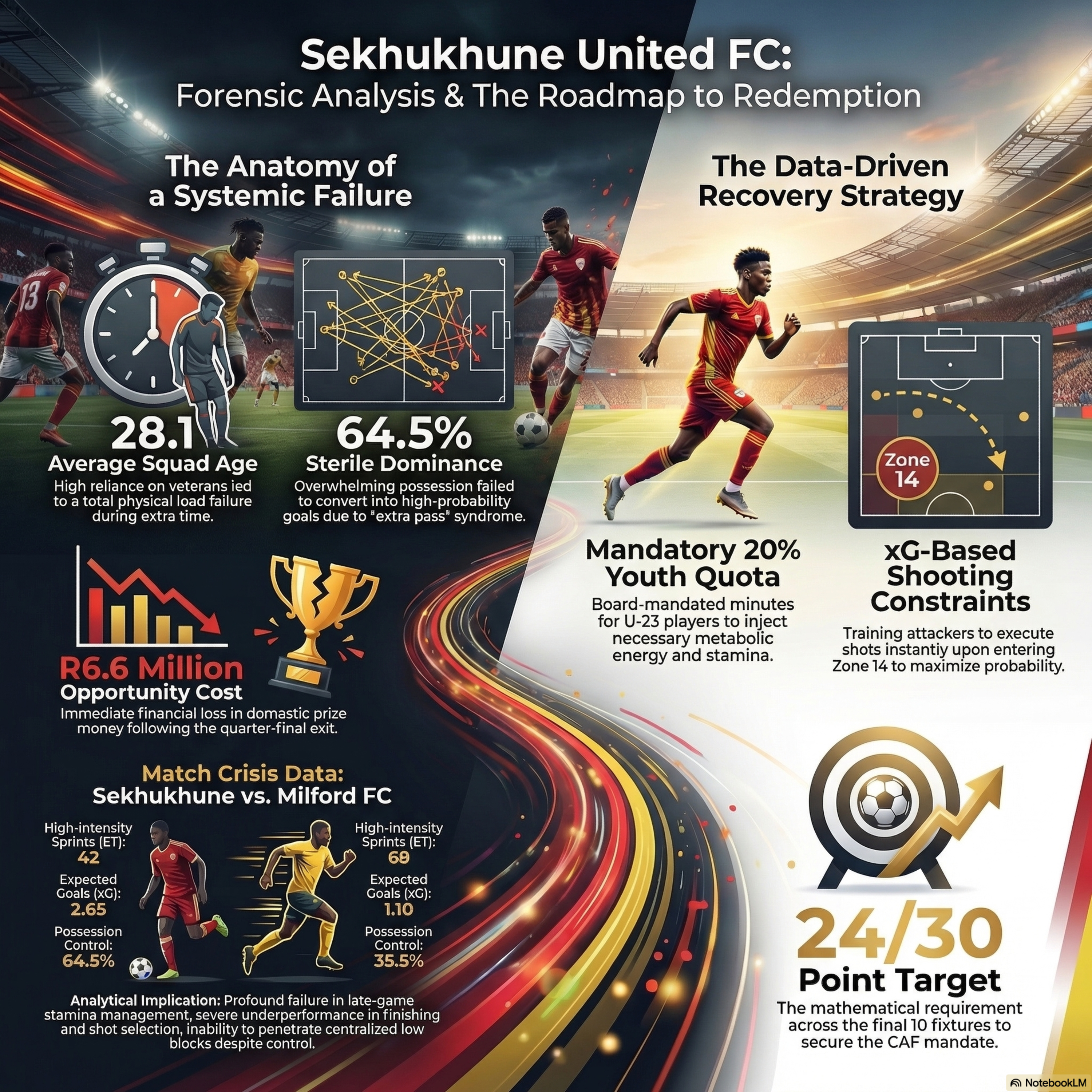
Right, he gets the equalizer. He does. It's 11. The game state normalizes, and from that exact moment, the 15th minute, all the way to the end of regular time, Seiko Kun takes complete, undeniable control of the football. They hold 64.5% possession. Yes, they are practically living in Milford's half. But this this introduces one of the most deceptive traps in modern football analytics. We call it sterile dominance. The illusion of control. Exactly that, because when you peel back the surface layer of that 64.5% possession and look at the underlying metrics, the whole narrative fractures.
We look at expected goals or XG. Let's define XG real quick for those listening who might not be deep into the analytics community. It isn't just a count of how many shots you took. No, not at all. It's a mathematical model that assigns A probability to every single shot taken based on historical data. If a player shoots from 30 yards out with three defenders in front of him, history tells us that only goes in maybe 2 times out of 100. So that shot has an XG of 0.02. Right, but if a player is standing 2 yards from an empty net that might have an XG of .95, it measures the quality of the chances and the.
XG in this match sits at 2.6, 5 for Sekakun against Milford's one point Nero. That's a huge difference. It is. Shots on target are 7 to 3 in favor of Sekakun. Their pass accuracy in the final third, which is the most difficult area of the pitch to complete passes, is an incredibly high 71%. OK, so I have to ask the obvious question. If you were generating nearly three expected goals, completing 70% of your passes near their penalty box and dominating possession like that, why does the referee blow the whistle at the end of 90 minutes with the score still stuck at 11?
What's fascinating here is that it comes down to where and how those passes are happening. Si Cocoon suffered acutely from what analysts call the Extra Pass syndrome. The extra pass. Yeah, they would transition beautifully up the pitch and arrive in zone 14. Zone 14, The Golden Square Imagine a grid on the pitch, folks. Loan 14 is the rectangular block sitting dead center immediately outside the opponent's penalty box. It is prime real estate. Every data model in the world shows that successful actions in Zone 14 correlate directly to winning matches more than any other area on the field.
Because it offers the most legal angles. You can shoot. You can slip a through ball left, or you can slip it right. The defense This is completely pinned. They're trapped. Exactly. But instead of taking high value, decisive shots the second they entered Zone 14, the sink of Coon players over elaborated. They looked for one more cute pass. You know, one more clever flick. Overplaying it. And when you do that against a low block, you are doing exactly what the defense wants. A low block is designed to shift side to side when you take an extra second.
To make an extra pass, you give the defending center backs the 2 seconds they need to reset their feet, shift their weight, and block the passing lane. So you are passing the ball beautifully, but you are completely toothless. Entirely. The crowd might be cheering the tiki taka triangles, but you aren't actually hurting the opponent. But let's dig into the coaching here, because I think there's a contradiction. OK, what do you know? Well, Eric Tinkler is an experienced coach. He has a chief analyst of Usoli Naquali who is highly qualified.
He has a veteran assistant in Andrea Renzi. They have the iPads on the bench. They absolutely do. They know what zone 14 is, They know what XG is. If the technical staff has the data, why are the players on the pitch blatantly ignoring it? What's fascinating here is the disconnect between the video room and the pitch, because possessing data and structurally integrating data into a player's neurology are two completely different things. That's a good point. Tinkler clearly establishes a solid tactical floor.
I mean, he coaches his team well enough to move the ball into those advantageous spatial pockets. The build up play is well orchestrated. So the plan works until the final moment. Yes, the permanent execution is the final decisive action inside the penalty area fails completely. The digital insights generated in the video analysis room just aren't becoming physical habits for the players on the grass. I'm going to push back on the traditional coaching model here. It sounds like the manager is getting the team to the edge of the box and then essentially saying, all right boys, I brought you this far, now use your natural flair to figure out the rest.
It's democratic decision making in the final third. Right, but in the elite modern game, instinct isn't enough, is it? Shouldn't a data-driven coaching staff be rewiring these players through intense, repetitive micro drills? That's exactly what they should be doing. Like if a player has a habit of making an extra pass, you don't just show him a video on Monday, you set up a training drill where the second his boot touches the grass in zone 14A, buzzer goes off and if he doesn't shoot within .5 seconds, the drill stops and he is penalized.
You have to literally beat the extra pass instinct out of the muscle memory. Exactly. That is the exact evolution required. A truly modern manager doesn't just collect XG statistics to read in a post match report over coffee. They use those statistics to design rigid constraints in training that alter player psychology. It changes how they think under pressure. Right. And this is a profound cultural lesson for the African game. Historically, African football has celebrated the maverick. We celebrate the dribbler, the player who wants to entertain the crowd with an audacious extra touch.
Show buzzing, right? It's part of the identity. That flair is our cultural heritage and it is beautiful, but in an elite high stakes competition, aesthetically pleasing but sterile. Possession is a death trap. Because while you are entertaining the crowd with a step over, the opponent is catching their breath and closing the gap. Exactly. African teams have to make a psychological shift. We have to transition from playing for the applause of a completed pass to becoming ruthless XG optimized attacking machines.
It's about efficiency. The final third cannot be a place for democratic improvisational decision making. It must be governed by statistical ruthlessness. You enter the zone, you pull the trigger. Because if you don't pull the trigger, if you don't kill the game when you have 65% possession, you drag your players into a physical war of attrition. You force the game into extra time. And that shifts the battle completely. We aren't talking about tactics anymore. We are talking about the brutal biological reality of the human body.
Yes. This is where the demographic makeup of the squad becomes their absolute undoing. Sekokuna United operates with a very heavy squad age. How heavy are we talking? The average age is 28.1 years. That is a roster built almost entirely on the concept of veteran experience and know how. Coach Tinkler tries to manage this late in regulation time. To be fair, he makes a double substitution, bringing on Chipa Mokuena and Colette Magala trying to inject some vertical running speed. Trying to find some fresh legs.
Right. And at first you think it works. We go into extra time and substitute Alorado Mandi scores this brilliant weaving solo goal. It's 21 to SEC Kukunu. A moment of magic. Now, if you are a tactical purist, the moment that ball hits the net an extra time, the game should be over. You shut it down, you drop into a rigid, unbreakable defensive geometry, implement time wasting protocols, and just bleed the clock. But they do not do that, no. Instead, we reach the 115th minute, 5 minutes away from the final whistle, and a catastrophic biometric breakdown occurs.
Milford simulated kudos scores an equalizer. And when you review the footage and the tracking data, this wasn't a moment of tactical genius from Milford, was it? Not at all. It was a physical class by Sikakuni. Their degraded Sprint metrics and cognitive fatigue just completely betrayed them. Their bodies simply stopped responding to the demands of the match. Here's where it gets really interesting. Let's build an analogy for this because I think people underestimate how sudden physical fatigue can be.
Oh, it hits like a wall. Relying on an aging 30 something midfield in the 115th minute of a high intensity cup game is exactly like trying to run a heavy high power application on a smartphone with a severely degraded 5 year old battery. That is the perfect way to visualize it. Right. The phone might have all the premium apps installed. It has the tactical intelligence, the years of reading the game, the precise positional awareness. The veteran player knows exactly where he needs to be. The brain completely understands the assignment.
But when you force that old battery to suddenly process a massive spike in power, like a 40 yard full out Sprint to cover a counterattack in extra time, it doesn't matter how smart the operating system is. No, the battery can't deliver the voltage. It just abruptly shuts down to a black screen. And in human biology, that black screen is lactic acid flooding the fast twitch muscle fibers. It's agonizing. It is a concept in sports science known as the acute to chronic workload ratio. The lactate threshold of a 32 year old midfielder degrades exponentially faster than a 21 year olds under the exact same load.
That makes biological sense. And here's the critical part. Physical fatigue is not just about heavy legs. It triggers cognitive collapse. Wait, really? It affects the brain. Absolutely. When a player is drowning in oxygen debt, their peripheral vision literally narrows. They forget to scan over their shoulder, they failed to track the blind side runner by just a half second and. That half second is all it takes. That half second widens the gap between the midfield and the defense by two yards and that is all the geometry and opponent needs to put the ball in the back of the net.
Wow. If you look around the rest of the Betway Premiership, the elite clubs already know this, don't they? They are treating youth integration not as a charity project for the Academy, but as a biological shield. Exactly, look at Mamelodi Sundowns. They possess unparalleled financial resources. They could buy any veteran on the continent if they wanted. To They really could. Yet they allocate roughly 12% of their total league minutes to players under 21. They are currently nurturing 18 year old Quiluano Laku within a highly automated WIGO deposition system.
And what about pirates? Orlando Pirates allocate a massive 45% of their minutes to players under 2440. 5% that is huge. It's. Structural They use teenagers like Relabohil, Mofoking and Mohawk and Coda to propel high velocity transitions. Kaiser Chiefs are actively integrating 18 year old Fundo Villa Kazi because they recognize the physical demands of modern pressing structures. And then you look at Sikkun. Seikuni relies almost exclusively on veterans. The 20 year old defender we mentioned earlier, who Yulit Lapa, is a singular reactive outlier.
He is not the product of a systemic youth mandate. He is an exception. So what's the take away here for clubs trying to level up? For the broader African game, the lesson here is absolute. Unyielding loyalty to veteran grit is a physiological liability. It's dangerous. If a club wants to compete at the highest level, they must mandate youth quotas not just for development, but as a biometric necessity for late game stamina. If your squad cannot match the Sprint metrics of a hungry 22 year old opponent in the 115th minute, your entire tactical whiteboard is useless.
Which opens up a completely different, much darker conversation. The finances. Yes, because that biometric breakdown in the 115th minute isn't just a sad sporting moment, it triggers a financial cascade. This is the ripple effect, the economics of tactical failure. It's terrifying when you look at the numbers. If you are sitting in that boardroom, you are not just mourning a lost trophy fee, you are watching millions of rands evaporate in real time. Because in the modern ecosystem, tactics are economics.
Every single movement on the pitch correlates to commercial scalability. Let's break down the immediate domestic cost of that equalizer. The Nedbank Cup winner receives R 7 million in prize money, right? A-Team knocked down the early rounds gets a fraction of that around R 400,000. So the immediate opportunity cost is a minimum of R 6.6 million lost in domestic revenue just like that. Just gone. Furthermore, the transition to the new Betway Premiership means the league winner now takes home R 20 million.
20 million. Losing the cup intensifies the pressure to perform Florida State in the league because the financial margins for error have vanished. But the domestic prize money is just a drop in the ocean compared to the continental stakes, isn't it? The domestic money is almost negligible compared to what was lost continentally. The Sea Cocoon board had a strict explicit mandate for the technical team qualify for the C CAF Confederation Cup. Why is it so critical now? Because the financial landscape of African football has been radically reformed under CF President Doctor Patrice Motsepe.
I want you to listen to these numbers because they reframe everything we've talked about so far. Under the new C CAF structures, baseline participation, meaning you just show up for the preliminary rounds, guarantees a club $50,000. That is roughly R 900,000 just for showing up. Exactly. If you managed to navigate the early rounds and reach the group stage, that guarantee jumps to a minimum of $400,000, or about R 7.2 million. And if you win the tournament, it yields A staggering $2,000,000. That is R 36 million.
Let's connect the dots here. A single structural failure in rest defense in the 4th minute combined with an exhausted veteran failing to track a runner in the 115th minute literally cascades into the loss of up to our 36 million in potential continental revenue. It's a domino effect. The Nedbank Cup is traditionally the backdoor route into C CAF competitions for teams that don't win the league by losing to a lower league side. That door slams shut hard. Now Sakukun is desperately cornered. They absolutely must finish in the top three of the league, fighting against massive clubs like Sundowns and Pirates just to survive their financial forecasting.
It creates A vicious cycle that is incredibly difficult to escape. You lose the cup game because your squad is too old and metabolically fatigued, right? Because you lose the game. You lose out on a guaranteed baseline of over R8 million in combined C CAF and domestic money. And because. You lose that capital infusion. Yeah, your board does not have the liquidity to go into the transfer market and buy the young data scouted high stamina players. You desperately need to fix the structural failure of having an old squad in the first place.
It's a literal arms race. You can no longer separate the action on the pitch from the spreadsheet in the boardroom. If your striker takes an extra touch in zone 14 instead of shooting, he isn't just lowering his XG, he is directly impacting the club's ability to fund the Academy next. Year, Which brings us to the ultimate Crucible of the sport. Shootout. The exact moment where psychology, bio mechanics, and statistical probability violently intersect the penalty shootout. The game ends, 22 extra time is over, we go to penalties, and we need to dissect this 32 shootout loss because it serves as a perfect microcosm of everything we've just discussed regarding the myth of veteran experience.
It really does. Sekocoon steps up first. Captain Daniel Cardoso takes it. Very composed. He scores. Milford responds immediately, 11. Then veteran striker Bradley Grobler steps up for Sekocoon. He's a player who has seen it all, but his shot is saved by the Milford keeper Sifamandla Jleza. Jleza was phenomenal in that moment. He showcased elite reactive reflexes under immense psychological pressure. Milford then scores their next penalty, making it 21. Sekakun's Sean Mogaila steps up and again he is thwarted by Jleza.
Another massive save. Milford's Sickacilla Joy takes his turn and Sekakun's goalkeeper Ronaldo Leiner manages to make a vital save. It offers a fleeting lifeline. A tiny window of hope. And this sets up the defining moment of the match. The Bond Linari, a veteran midfielder with vast domestic and international experience, steps up to the spot. He's the definition of a seasoned pro and he completely blazes his penalty over the crossbar. It's not even a great save by the keeper. No, he misses the target entirely.
Now, if you are an analyst in that boardroom, you don't write that down as a missed kick, do you? No, absolutely not. You categorize it as a biomechanical failure under psychological stress. Break that down for us. What happens in the body? It is a complete degradation of technique. When severe psychological stress floods the system with adrenaline, fine motor skills are the first thing to compromise. So the body just forgets how to do what it's done 1000 times. Essentially, yes. The foot placement is off by a fraction of an inch, The body leans back slightly too far and the ball goes into the stands.
Now Calessa McGowan does manage to score his penalty for Sekakuni afterward showing high level emotional regulation to momentarily level it. But then comes the ultimate agonizing, poetic justice. The keeper, Milford's goalkeeper, Sifaman Bletheza, the man who has already made vital says against top tier strikers, steps up to the spot himself. He calmly, confidently buries the winning penalty. A lower league goalkeeper stepping up to take the winning penalty against a massive club. It's cinematic.
It is cinematic, but again, we are not here for the romance, we are here to ask the hard questions. Why did Secacoon's keeper Leaner struggle to replicate Les's heroics during the shootout? It highlights a massive variance in quantitative preparation. Leaner is a highly competent shot stopper in open play without a doubt. Sure. However, the lack of data-driven dive probability models from the goalkeeping code Johann Absalon leaves these high leverage do or die moments completely to guesswork and intuition.
So they were just guessing. Basically, in elite modern football, top teams possess comprehensive league wide databases. A data integrated goalkeeping coach knows that if player X steps up in the 80th minute or later under high stress, he will open his hips and aim for the bottom left corner 74% of the time. The goalkeeper isn't just guessing, he is playing the statistical probability. Exactly. If a club fails to provide their goalkeeper with that algorithm, they are leaving their financial future to a literal coin flip.
I want to paint a picture of how stark this contrast is, watching the established, wealthy, highly paid stars of SEC cocoon crumble under the pressure while this fearless lower league keeper thrives. It's like watching a highly trained classical musician freeze up on a grand stage the moment they drop their sheet music. That's a great way to look at it. They know all the deep theory, but in the chaos of the moment, they panic. Meanwhile, the street busker, who plays entirely on raw rhythm and feeling, effortlessly improvises a mind blowing solo to win the crowd.
But the lesson here isn't that you should rely on buskers. No, definitely not. The lesson is that talent dictates your ceiling. Talent gets you into the top lead in the 1st place, but preparation, rigorous data and psychological resilience dictate your floor. That is perhaps the most vital take away for the African game. Set pieces and penalty shootouts can no longer be left to natural instinct or the deeply flawed myth of veteran composure. It's a myth, right? It is. Historical data shows us that veterans miss under pressure just as often, if not more, than youth players because the psychological weight of expectations and the fear of failure is actually heavier for them.
They know exactly what's at stake, right? These scenarios must be obsessively automated through league wide databases and clinical repetitive psychological resilience protocols. So the damage is done, the Cup is gone, the direct route to CF money is lost, and the locker room confidence is shattered. If you are the technical director, what do you do on Monday morning? How do you salvage this? You pivot to the blueprint. The club faces a massive 10 game recovery matrix stretching from March to May 2026.
And the mathematics of this recovery are brutal. To secure that non negotiable 3rd place finish for continental qualification, they require 24 points from a possible 30. That is championship winning form required instantly. And the strategic gauntlet they have to run is deeply complex. They face Poliquin City, who utilize A relentless high press. They play Golden Arrows, who possess defensive fragility but are highly unpredictable in transition. They face Stellenbosch FCA team defined by their incredibly intense Under 24 running metrics and they have to find a way to manage the per digits unpredictable talent of an 18 year old ofundo Villa Kazi when they from the Kaiser Chiefs.
You cannot just walk into the dressing room and yell at the players to try harder. No, passion won't win 24 points out of 30. You need a systematic multi layered strategy. First and foremost. The board has to intervene at the managerial level and implement A mandatory 20% match minute quota for under 23 players and that starts tomorrow. It is an absolute physiological shield. You have to rest those older legs. You have to. If you force a 30 year old to play 90 minutes twice a week against high pressing teams like Stellenbosch and Poliquin, you will suffer a cascade of muscular injuries.
Hamstrings, calves, groins. The youth quota absorbs the metabolic shock of the congested fixtureless. OK, what's the second? Step second, the workflow of the technical staff has to be revolutionized. Chief Analyst Snoquali cannot be sitting up in the stands taking notes on his iPad for a Monday morning debrief. He must establish a live real time communication link directly to the bench. Let's explain what he is communicating. He needs to feed live expected threat or XT data to the coaching staff.
Right. For the listener, XT is a relatively newer metric than XG. While XG measures the quality of a shot, Expected threat measures the probability of a possession eventually resulting in a goal based purely on where the ball is on the pitch and how it is moving. It assigns a value to every single pass, even if it's 40 yards away from goal. Precisely if no quality software shows that over the last 15 minutes the left wing is generating a 40% higher expected threat than the central channel, he relays that to the bench instantly.
And the coach then immediately alters the attacking focus to overload the left side. It takes the emotion and guesswork out of substitutions and tactical shifts. It transforms the bench from a reactive entity into a proactive, probabilistic and. Then you have the off pitch economics, which is just as critical to the 10 game matrix, the player trading model. You have Violet Lapa, the 20 year old defender who assisted the equalizer. He's shining right now. He is a premium asset in a squad of aging players.
If you are the sporting director, you have to manufacture a bidding war for him immediately. You leak interest to the press. Exactly. You get Kaiser Chiefs, Orlando Pirates and European scouts fighting over to signature, you sell them at a massive premium, and you use that sudden influx of liquidity to instantly fund the scouting and acquisition of three new data identified youth prospects. You sacrifice 1 premium asset to build 3 high stamina engines for the next season. It's brilliant. The final imperative of the blueprint is structural discipline, the implementation of a rigid, unbreakable rest defense.
Regardless of the game state, regardless of how desperately you might need a goal in the 88th minute, you lock a minimum of three defenders plus a holding defensive midfielder behind the ball at all times. You engineer the geometry so that you do not get caught in a vertical transition ever again. Synthesizing this 10 game road map, it really comes down to letting go of ego. Letting go of the ego of wanting to control a game through beautiful tiki taka possession that goes nowhere. Instead, you focus entirely on controlling the probabilities of the game right?
You rely on asymmetric attacking, isolating your best dribbler like Magalwa in a one-on-one situation on the wing, rather than crowding zone 14 with unnecessary players trying to make cute passes. It means a fitness coach looking at a live GPS tracker on an iPad, seeing a 30 year old veteran's top Sprint speed drop by 15% and subbing him off instantly before the opponent's manager even notices he is tired. This 10 game road map is not just about saving one season for Sekakuni United. No, it's much bigger than that.
If you scale this up, it is is a perfect microcosm of how an entire African club transitions from a reactive, old school management style reliant on aging stars to a proactive, sustainable, highly profitable player trading model deeply integrated with sports science. For the technical benches across Africa to truly thrive on the global stage, they must fully integrate real time probabilistic decision making. The laptop in the stands and the grass on the pitch can no longer be viewed as separate worlds.
They must become one seamless ecosystem. The apprehension is always that data will somehow rob the game of its soul. I hear that all the time. But Data doesn't play the match, the players do. The heart, the flair, the improvisational skill of the African player is still the beating core of the sport. Data simply helps us understand exactly where the edges of the battlefield are. It shines a high-powered light on our blind spots. Embracing these metrics does not mean abandoning the beauty of African football.
It means protecting it, it means ensuring our teams have the physiological capacity and structural foundation to express their absolute brilliance in the 115th minute, not just the first 15 minutes. Let's pull ourselves out of that boardroom for a second and take a deep breath. We have covered immense ground today. We dissected the geometric failure of rest defense. We unpacked the dangerous illusion of sterile dominance and the mathematical importance of pulling the trigger in Zone 14. It's been a lot.
We looked at the brutal biological limits of the human body and how lactic acid degrades cognitive function. We mapped out the staggering financial cascade of CAF mandates and we explored the psychological bio mechanics of a penalty shootout. The crisis we examined today is a brilliant, flashing Crimson warning light for the entire continent. It really is the raw material of African football. The talent, the passion, the natural athleticism is abundant. It is truly second to none in the. World, absolutely.
But talent is only the raw material, the biometric data, the physical conditioning, the unyielding structural discipline. That is the refinery. That is how you turn crude oil into rocket fuel. The clubs that understand how to build that refinery will dominate the next decade. The clubs that cling to the romance of the past will find themselves consistently beaten by teams with a fraction of their budget but double their analytical rigor. I want to leave you with a final lingering thought to Mull over long after you finish listening.
Today we started this deep dive by picturing the clash between the romantic era of pure grit and and the cold reality of biometrics. Right. If a second tier team armed with nothing but boundless youthful energy, simple ruthless transition tactics and a fearless mentality can systematically dismantle a multi million Rand tactical setup, are we vastly overvaluing the price of experience and status in the transfer market? That is the $1,000,000 question. And conversely, are we entirely undervaluing the raw currency of stamina and fearless youth?
Next time you sit down to watch your favorite local team play, I challenge you don't watch the ball. Watch the space. Watch the. Geometry of the players off the ball. Watch the heavy legs in the 85th minute. Watch the empty spaces, because the answers aren't hidden, they are right there on the grass, waiting to be measured.
 Apple Podcasts
 Castbox
 Castro
 Goodpods
 Moon FM
 Overcast
 Pocket Casts
 Podbean
 Podcast Addict
 Podcast Republic
 Spotify