Hacking the Football Scouting Funnel
About this episode
Hacking the Football Scouting Funnel
Listen now on Spotify, Apple Podcasts, Amazon and other streaming services! Don’t forget to subscribe, share, and leave a ⭐⭐⭐⭐⭐ review to help more players and coaches discover the power of Techne Futbol and Data Technology in the beautiful game.
#TechneAfricaFutbol #TechneFutbol #TrainWithTechne #Playermaker #TraceFutbol #Hudl #FootballTech #FootballInnovation #PlayerDevelopment #CoachTools #SmartFootballTraining #AfricanFootball #CAFOnline #FIFA #FIFAYouth #CAFDevelopment #YouthFootballAfrica #NextGenFootball #FootballScouting #TalentIdentification #DigitalScouting #EliteYouthDevelopment #FootballJourney #FootballAnalytics #FIFAForward #FutebolAfricano #TrainTrackCompete #FootballExcellence #FootballAfrica #TheFutureOfFootball
Welcome back to the Deep Dive. I want to start today with a picture. It's a scene that I think is just, you know, it's burned into the collective mind of every single football fan on the planet. I think I know where you're going with this. It's maybe from a movie or an old commercial, or maybe it's just a story we tell ourselves because it feels good. You know the one I'm talking about. It's the dusty pitch, isn't it? It is exactly the dusty pitch. We're somewhere in Accra, or maybe the back streets of Rio, a village outside Nairobi.
There's a kid, he's probably barefoot and he he's kicking this, this ball that's made of rags and plastic, right? And he's doing things with that ball that just they defy physics. He's sweating, he's laughing. He is pure uncut talent. The dream, the dream. And then on the sidelines, you can almost hear the music swelling. A black car pulls up the. Man in the trench coat, the Savior Scout. Exactly the European scout. He lowers his sunglasses, he sees the magic, He makes 1 phone call and boom, the kid is on a plane to the Premier League.
Golden Ticket. It's the ultimate golden Ticket story. It's romantic, it's inspiring, and based on everything we're about to unpack today, it is a complete and total lie. It's worse than a lie. It's actually a dangerous myth. It's a trap. We call this the industrialization of hope. The industrialization of hope. Wow. Because if you are a player or a parent or an Academy coach in Africa right now, and you were just waiting for that man in the sunglasses to show up, you're not just playing a game, you are playing a lottery.
And the odds are so, so small. You'd have better luck striking oil in your backyard with a teaspoon. That is a heavy way to open the show, but I think we need that, that splash of cold water right in the face because today we're not really talking about football as a sport, are we? No, not at all. We are talking about the global transfer market as a as a sophisticated multibillion dollar financial ecosystem. That's it exactly. A supply chain. It's no different from the global trade in diamonds or oil or, you know, tech talent.
It has rules, it has metrics, and it has absolutely zero room for romance. So our mission for this deep dive is to decode this machine. We're going to shatter that lucky break myth and replace it with a manual. A manual on how to actually navigate the system. Exactly. We want to move the African game from what you said, begging for a chance to negotiating a business transaction, because that's the real shift, isn't it? That is the fundamental shift. You have to stop looking at your son or your player as a charity case or some dreamer.
You have to start looking at them as an asset class. In an asset class it. Sounds cold. I know I can hear people flinching at that, but the market is cold. The market is about asset valuation, risk mitigation and data. If you don't treat yourself like a business, the business will eat you alive. Asset valuation and risk mitigation. I mean, these are terms you hear on Wall Street, not a football pitch and Legos, but that's the reality. So let's start with the architecture of the system itself. Let's understand the machine so we can figure out how to hack it.
We're talking about the scouting funnel. The funnel. This is the mechanism. This explains why so many talented kids fail. And you know, it has nothing to do with how good they are at football. Nothing at all. Very little at the start. It begins with the truth. That's kind of counterintuitive and it usually shocks people. We assume scouts job is fine talent right? To find the next Dragba to unearth that gem. Yeah, that seems like the job description. I mean scout to look for something. It's not. In a modern game, a scout's primary job is not to find talent.
A scout's primary job is to eliminate risk. Eliminate risk. They are not hunters, they are filters. You have to look at the sheer volume of players to understand why this has to be the case. Just in the English youth system alone, just in England, there are roughly 1.5 million boys playing organized football. One and a half million, that is. That's a massive labor pool. It's a population of a small country. It's huge. Now out of those 1.5 million boys, how many do you think will ever sign a professional Premier League contract?
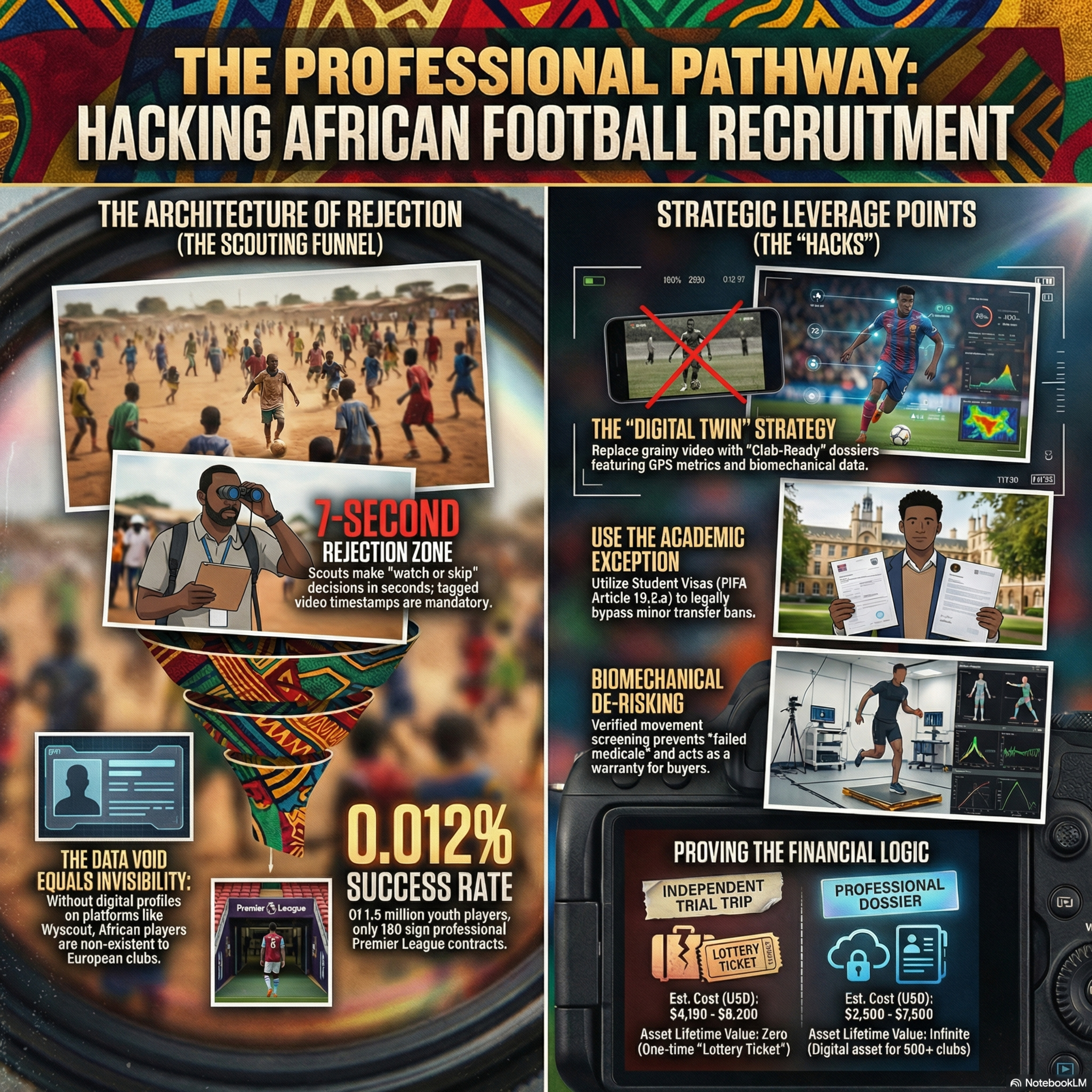
OK, I know it's competitive. I know it's brutal. Maybe, I don't know, a few thousand 5000. About 180. Wait, wait one eight at 0 out of 1.5 million. That's a success rate of .012% and you have to remember that's for kids who are already inside the English system. They speak the language, they have the right passports, they are literally in the backyard of the clubs. Now imagine you were in Lagos or Kampala or Abidjan. You've got visa restrictions, huge travel costs, adaptation risks, language barriers.
The funnel just gets tighter. The funnel for you is infinitely tighter. The entire system is designed to say no. So the system is effectively an engine of rejection. It's a machine that's built to find reasons to just delete your name. Exactly. And it operates in stages. If you don't understand the criteria for each stage, you get filtered out before a human being ever really, truly looks at you. You're fighting a battle you don't even know you're in. OK, so let's walk through these stages systematically.
I want everyone listening to really picture this funnel at the top, the widest part we have stage 1, the long list or identification. How does a kid from anywhere, but especially from Africa, get on that long list? This is the very first door a big European club, let's say a mid table Bundesliga team or a top team in Belgium. They might start a season tracking 2000 names globally for one position. 2000 names for just say a left back. Exactly. Now here is where the African disadvantage kicks in immediately.
How do clubs find these 2000 names? They don't have 2000 scouts on 2000 airplanes. They can't possibly afford that. So what do they do? They use global databases. OK. We're talking about the digital platforms here. We are talking about the Bloomberg terminals of football platforms like Why Scout Transfer from Eyeball Sea Sports? These are massive digital libraries of players. Now here's the point. If you were tearing up your local league in Ghana, scoring a hat trick every single weekend, doing amazing things, but you are not registered on one of these digital platforms.
It doesn't matter. You don't exist. You're. Literally invisible to the market. It doesn't matter how good you are if the camera isn't rolling and the data isn't being uploaded. You are a ghost, you aren't unscouted, you are non existent. The days of a scout just wandering past a park and feeling a vibe about a player, those are over. Completely gone. If you aren't data, you aren't there as the very first cut. If you are not on the server, you are not on the list. End of story. OK, so. Step one is digitization.
You have to become data. Let's say you manage that. You're on the database, you're one of the 2000 names. You've survived the first massive cut. What's Stage 2? Stage 2 is the shortlist or filtration, and this is where we encounter what we call the Seven second rejection Zone 7. Seconds. That's barely enough time to read a name and look at a photo. And that's. All the time you get you have to try and empathize with the scout here. These guys are overwhelmed. They have hundreds of recommendations hitting their dashboards, their Whatsapps, their emails every single week.
It's. Just a flood of information. It's a fire. Hose they have to cut those 2000 names down to maybe 400. They do not watch full matches at this stage. They simply don't have the time. They click a clip and. What are they looking for in that 7 second click one? Thing verification if the key attributes for that position aren't instantly immediately verifiable. If they can't see the explosive speed, the first touch, the physique right away, they click next so. It's not about nuance, it's about an immediate wow factor.
It's. Ruthless. You know, it sounds like a cliche, but it's like Tinder for footballers. Swipe left, swipe left, swipe left and if. You don't grab them in those seven seconds with something that just screams pro standard you're. Discarded. You don't get a second look, it's over. Wow. OK, so you have to survive the swipe. You make it into the pile of 400, You're getting closer. Then comes stage 3, the deep dive, Correct. Stage 3 is assessment. This is where the real work begins for the club and this is where a player's preparation, what we'll call the dossier, becomes critical, Which we'll.
Get into in detail later. Exactly. At this stage they start looking beyond the physical. They look for tactical intelligence and what they call pathway, risk pathway. Risk what does that mean they're. Asking a series of questions. Is this kid a risk? Does he understand the game on a deeper level? Is he mentally resilient? What's his family background like? Is he going to get home sick and want to leave in six months? All these off pitch factors. This is what cuts the list from 400 down to maybe 50.
Real Contender 50. Names that are now being seriously discussed and. I want to clarify something here because this this part really blows my mind. Up to this point, Stage 3 has a single scout boarded a plane yet? No. Absolutely not. Not a single flight has been booked. Not one. That's just. Wild. We are three stages deep in this funnel. We've eliminated 19150 players and nobody has even left their office in Europe. That's the. Cost barrier and it brings us to stage 4 live scouting. This is the real bottleneck European clubs rarely, and I mean rarely, fly to Africa on a whim.
It's. Too expensive it costs. Thousands of dollars. The flights, the hotels, the perdemes, insurance, security sometimes lost time for that staff member, visa hassles for them, it's a huge expense. So they will only travel to confirm what they already feel they know from the data. So they're. Not going there to discover talent? No. They're going there to verify an investment. Precisely. Sending a scout is an investment decision. The Hescat has to go to the finance director and justify that trip.
He has to say I need $5000 to go to Ebba John for a week. He needs a mountain of evidence to get that money. If the data from the previous stages hasn't already sold the player internally, that trip never ever happens. And then finally, stage 5 is the acquisition, that's the signing or the paid trial. But to get there, you have to survive a funnel that eliminates what, 99.9% of players before they even get a chance? And. This really it just highlights the central problem that we call the data void.
The core issue isn't that African football lacks talent. We all know the talent is there. We see it every World Cup, every AFCON. The problem is that African football is rich in talent, but it's poor in structured information Which. Brings us directly to the solution if the problem is a void, we have to fill that void and the concept here is something you call the digital twin. I love this term. It sounds a little bit sci-fi, like we're in the metaverse. What? What does it actually mean in this context?
It's a. Very practical business concept. Actually think about it like this. The player is physical, he's a person, he's fixed in one location, let's say a field in Senegal, right? He is expensive to move because of flights. He is legally difficult to move because of visas. He is what we'd call in business, high friction and. Friction is the enemy of any deal. It's the. Enemy of the deal? Exactly. So what you need is a digital proxy, a twin made of bits and bytes. That's video stats, medical data, site profiles, documents.
They can travel instantly and for free. OK, so the digital twin can be in multiple places at once the. Digital Twin can be on the desk of a sporting director in Belgium, a head scout in Sweden and an agent in Portugal all at the same time, all within 5 minutes without buying a single plane ticket. You're. Essentially cloning yourself into a format that the market can understand and consume without any friction and. More importantly, you are shifting the power dynamic. This is the sychological flip that is so, so important for African stakeholders to understand.
When you resent a club ready decision pack, which is just a rofessional dossier, you stop asking for a favor. You're not. Saying please, Sir, look at my son. He is a good boy, which is. The old way it's the begging way it's. A position of weakness. It's the. Beggars mindset. Instead you are saying here is a fully vetted investment opportunity. We're literally doing their homework for them. You are outsourcing their entire deep dive stage. So. You're saying I've already done the risk assessment for you.
I've done the background check. Here is the GPS data. It's all here ready for you to make a decision. You're. Making it easy for them to say yes. In any business, the easier you make it for someone to buy your product, the more likely they are to buy. You're removing all the barriers to entry You. Are handing them the deal on a silver platter. Precisely that. Makes I mean, that makes perfect logical sense. But I can hear the listeners right now. I can hear the parents, the Academy owners. I can almost feel the tension.
They're saying this sounds great. You guys sitting in your studio talking about digital twins, but professional data services, detailed dossier cameras, GTS vests, that sounds expensive it. Does we're? Talking about families who might be struggling just to put food on the table or buy a decent pair of boots and. We have to address this head on. This is Section 3, the financial blind spots, and we call it the too expensive fallacy. OK. Let's break that down because a professional scouting pack, what the industry calls a Tier C or D dossier, can cost anywhere between what, 2 1/2 thousand to $7500?
That's the. Range yes, for a. Family and Legos or Dakar that is a fortune that's life changing money it. Is a lot of money. No one is denying that. It is a massive, massive sacrifice. But we have to look at it not as an expense, but as an investment and we have to compare to the alternative. What is everyone doing right now? The. DIY trial the. Do it yourself. Trial trip. This is the trap. This is where the money really gets wasted. A family saves up for years. The village chips in. An uncle sells a plot of land.
The grandmother gives her life savings and they send the boy to Europe for two weeks to try his luck. Let's. Do the math on that trip. Let's break down the real total cost of ownership. Let's. Do it. So a flight from West Africa to London or Madrid, you're looking at 800 to $1200 easily depending on the season. Check visas, if you can even get one, which is a whole other nightmare. That's 150 to $300 plus administrative costs, travel to the embassy, maybe, let's be honest, maybe some bribes along the way.
OK, check accommodation for two weeks in a major European city, London, Paris. You're not staying for free. That is going to be 1000, maybe $2000 minimum for a decent, safe place where the boy can actually rest and prepare. So. We're already at what, three, $4000 plus? Food, local transport, insurance and very often these families are paying what are called trial fees to these pop up private academies that are basically just revenue generators. They charge you to let you play so. They're selling the dream, not the reality.
We're. Monetizing hope. So you tally all of that up, you're looking at a cash cost of between say 4000 to over $8000. One trip for a single attempt. And here is the kicker. And this is the part that just. It breaks my heart every time I see it happen. It is a binary event. It is a lottery ticket, meaning. It's all or nothing, win or lose. Exactly. If the boy gets injured on day one of the trial, the money is gone. If he gets the flu because he's not used to the cold, damp weather, money is gone.
If the coach just doesn't like his style of play, or is having a bad day, or favors local players, all that money is gone. There's. 0 Residual value 0. You come back home with nothing that empty pockets and often a deep sense of shame. The family's in debt and the boy is emotionally broken. Where's? The dossier, the. Dossier is a permanent asset, at least for that season. It's a marketing campaign, has an infinite shelf life and unlimited reach. You can send it to a club in Belgium. If they say no, fine, you send it to Sweden, then Portugal, then Austria.
You have unlimited chances to get a yes and. Here's the probability adjusted ROI as you call it. This is the. Absolute key if the data, if the dossier convinces the club, the club pays for the flight, the club pays for the trial that's. The pivot, that is the entire game right there. If the dossier works, the trial becomes club funded you. Shift the financial risk of the travel from your family's shoulders back onto the club where it belongs. So the question isn't can we afford the dossier? The real question is can we afford to waste 567000 dollars on a tourist trip that will almost certainly fail?
It's. Moving from gambling to investing, it's the. Difference between buying a lottery ticket and buying a billboard. 1 is hope, the other is marketing that. Is a massive, massive paradigm shift. It's scary, but it's completely logical. OK, so let's get into the weeds of it. We've sold the idea of the dossier. What actually goes into it to make it effective? This brings us to our first leverage point optimization of attention. Attention is the scarcest currency in the world right now, especially for a scout.
I have seen so many videos, hundreds of videos from African players that get deleted within seconds, instantly. What? Are they doing wrong? What's the fatal flaw in those videos? It's the. Techno highlight reel. You know the ones I'm talking about. Oh, I know. Them, well, heavy. EDM music star wipes explosions a 32nd intro graphic with her name spinning in 3D it. Looks like a trailer for a Marvel movie but with way worse graphics. It's just. Noise. A professional scout hates it. It screams. Amateur, It screams.
I don't understand the industry. They instantly click away. The fix the professional approach is what we call tagged video breakdowns with timestamps. OK. So what does that mean it? Means we need to invert the needle in the haystack problem. Usually the scout has to watch the whole video to find the good moments. They're searching for the needle, right? And they hate searching. They don't have time, so you need to hand them the needle. How? Does that look practically? If I'm a young player or a coach editing a video today, what do I do it?
Means your video has a menu. If a scout is looking for a center back who is good at say breaking the lines with his passing, your dossier should have a section labeled breaking the lines. He clicks A timestamp and boom he sees 5 perfect examples in 20 seconds. So. He doesn't have to search you. Are guiding his eye. You are serving him the exact information he needs. You are respecting his time, which is his most valuable asset. And it implies that you understand the game on a deeper level, right?
If you tag a clip as breaking the lines, and you actually show a pass that breaks the lines exactly. That's metadata as intelligence. This is huge. If you tag a clip as great defense and it shows you making a reckless 2 footed tackle where you just got lucky you didn't break someone's leg Scout. Sees that and the. Scout thinks this kid doesn't know what good defense is. He's a liability. He's dangerous. How you label your video is a direct test of your football IQ. So the metadata is actually a part of the interview, and that connects to the language you use too.
Let's talk about objective versus subjective language, yes? This is another really common mistake that immediately gets you filtered out. An agent sends a message. I have a player, he is very fast. That's. Subjective, it's total. Noise fast compared to who? Your neighbor, the local league champion and Antelope the scout just ignores it. It means nothing. You need to switch to objective language. Top speed 34.2 kilometers per hour. GPS verified that's. A benchmark. It's undeniable. There's no opinion there now.
The scout can compare that data point, he can say, OK, 34.2 is comparable to our current winger, it's faster than our backup. This is real data. You have to convert that qualitative praise into quantitative metrics to even enter the European conversation, OK? So that's optimizing attention. Let's move to something that I think is the biggest, most concrete barrier of all the law We hear about these incredibly talented 16 year olds who just can't go to Europe because of FIFA rules. This is Leverage .2, the regulatory hack, Yeah.
We have to talk about FIFA Article 19, The wall. It's the wall. Article 19 strictly prohibits the international transfer of minors. That's anyone under 18. And it was designed for a very noble and necessary reason to prevent child trafficking. Of course, we don't want kids being shipped across the world and abandoned if they don't make it so. We agree. With the spirit of the rule 100%, but the. Unintended consequence for genuine talent is the. Consequence is that a brilliant 16 year old in Ghana is locked out of European academies until he turns 18.
By the time he's 18, he has missed 2, maybe 3 crucial years of elite development. He's already behind his European counterparts who have been training in top facilities since they were 12. So. How do you hack that? Is there a way around it that's, you know, legal? You don't break the rule, you use the exception that's built into the rule, Article 19.2 dot E, we call it the student athlete pathway. The rule says a player can move internationally if the move is primarily for academic reasons and football is secondary football.
Is secondary. That's the magic phrase that. Is the legal key that unlocks the door the strategy is this you do not apply to a football Academy you will get a visa rejection and FIFA will block the transfer you apply to a school or university in Europe that partners with an Academy you are going there as a student first so you're. Pursuing A Tier 4 student visa in the UK or a Schengen student visa, not a sports visa. Exactly. Yeah, And for the parents listening, this completely changes the priority.
School isn't the backup plan anymore. It's not the distraction from football. No, and this is the cultural shift we need. This is the hardest part to get across. School is not a distraction from football. School is the visa mechanism that makes the football career legally possible. So if. Your kid has bad grades. He can't. Get into the school. If you can't get into the school, he can't get the student visa. If you can't get the visa, he can't play in Europe until he's 18. It's a direct chain of events, so.
Literally grades equal visa, visa equals access and. A in math becomes a football tool. It's as important as a new pair of boots. We see world class academies like Right to Dream doing this brilliantly. They send kids to top US high schools or UK boarding schools and IT. Works it. Works. There are private Spanish academies that use 6 to 10 month Spanish language courses as the academic anchor. You get a student visa to learn Spanish and you train with the Academy in the afternoons. That gives you a full season of development in Europe compared to the two week tourist visa your friend got for that failed trial.
It's. Brilliant. It turns the entire education system into a Trojan horse for elite football development. It. Buys you time. It buys you time in the market, and development needs time. You can't rush it. OK, that's a huge one. Moving on to leverage .3. We've got the data package, we've got the visa strategy. Now let's talk about the body itself. You mentioned earlier that clubs are incredibly risk averse. What is their single biggest fear when it comes to the player's physical body? Damaged goods The cost of uncertainty is massive.
European clubs are terrified of signing a player, paying a transfer fee, bringing over, and then he fails the medical or worse, or he signs and blows out his ACL in the first month of training because of an underlying issue that nobody ever caught. That's $1,000,000 mistake and. This must be a bigger concern for players coming from systems with less formal medical documentation. They don't have 10 years of hospital records like a kid in Germany might. Exactly. The medical history is a blank page, which is a red flag.
So we need to proactively de risk the player's body. We call it biometric de risking. We're talking about proper biomechanical screening using things like force plates and motion capture technology, it sounds. Very high tech. Is this sort of thing actually available in Africa? It's. Becoming more available and it's a crucial investment. It's about prehab, not rehab, so preventing injuries before they happen. Let's take a common example, something called knee valgus, OK? What's that? It's when a player's knee buckles inward when they land from a jump or change direction.
It looks a bit like being knocked knee for a split second. To a trained European physio, that is a giant flashing red light. Why? It is a huge predictor of ACL tears, one of the worst injuries in football. If they see that on a video or in a trial, they panic. They see ACL risk surgery, lost money, stay away it's a. Ticking time bomb in their eyes. Absolutely. But here's the thing. If you do a proper screening at age 15 or 16, you identify that movement pattern and you give the kid a six week corrective exercise program, strengthen the hips, teach better landing mechanics.
You can fix it. You can align the mechanics so you. Fix the car before you try to sell it precisely. It's the certified pre owned car analogy. If you buy a used car off the street, you're worried it might break down, but if the dealer gives you a 100 point inspection report and a warranty, you feel safe. You'll even pay a premium for that safety, so. By presenting a clean bill of biomechanical health in your dossier, you're giving the club a warranty. You're. Telling the club this player is not a gamble.
He is mechanically sound. We've done the inspection. You are removing the red flags before they can even wave them. And you? Can use it for performance projection too, right? Yes. You can prove athleticism scientifically. You can say, look, his technique might be a bit raw, but his vertical jum force output is in the 99th percentile. He has the engine of a Ferrari. He just needs a better driver. Yeah, that is scientific proof of potential, not just a coach's opinion. This. Is this is a complete picture?
We're really building a full business case for a player. We have the digital profile, the academic visa, the biomechanical warranty. Now let's talk about the academies back home, the grassroots clubs, because they're the ones doing the hard work of developing this talent for years. There's a pot of gold at the end of this rain. Where to them too? If they do it right, yes. The training compensation jackpot. This is the financial lifeblood that should be fueling the entire ecosystem and yet so many African academies miss out on it because they are disorganized.
OK. Explain how it works for the listeners who might be running a local club in their community. Why should they care so much about paperwork? FIFA? Has two key mechanisms, training compensation and solidarity payments. Basically, if you train a player between the ages of 12 and 21 and that player signs his first professional contract with a club in a different country or is transferred for a fee later on, you are owed money. The system says you must be paid for the training you provided. How? Much money are we talking about here?
Is it pocket change or is it significant? No. The numbers are very significant. If one of your players moves to what's called a category one European club, like a Premier League team, it can trigger around €90,000 per year of training and compensation per. Year So if an Academy has a kid from age 14 to 18, that's four years you were. Talking about €360,000, that is a transformative amount of money that. Could fund an Academy for a decade it buys. A bus. It builds a proper pitch, it pays coaches a real salary, it buys equipment.
It transforms an entire community. But I'm. Guessing the big European clubs aren't just rushing to write these checks. They're not mailing them out of the goodness of their hearts. Not a chance. They will fight you on it. Their legal teams will try to avoid it. They will claim the African Academy was amateur, or that the records are messy or that there's a gap in the registration timeline. They'll. Look for any loophole they will. Say oh, for the year 2022 you have no official registration forms for this player.
Well, we don't owe you for that year. And just like that, €90,000 is gone. They exploit the lack of paperwork every single time. This. Is where the dossier comes back in. Again, it serves. As your legal proof, a professional dossier signal sophistication from day one. It establishes a paper trail, It tells the European club we are a professional entity. We have his player passport, we have his match logs from 2022, we have his medicals from that year, so. The dossier isn't just a marketing tool for the player, it's an asset protection document for the Academy.
It. Is the title deed to the house? You wouldn't buy a house without a clear title deed. Why would you try to claim financial ownership of a player's development without the paperwork to back it up? If you want professional money, you need professional processes. It's that simple. IT. All comes back to that same word, professionalism. Wow, we have covered so much ground here. We've gone from the romantic image of the dusty pitch all the way to the legal department of a European club. As we wrap this up, let's just summarize this new value chain.
What is the main message we want to leave with everyone listening today? The. Main message is that the era of the diamond in the rough is over. We are now in the era of the polished diamond. Verified, measured and certified exactly. And so the choice for African parents, for players, for academies is actually quite simple. You can continue playing the lottery, buying those expensive plane tickets for DIY trials, and just hoping for luck. Hoping that man in the trench coat shows up one day. Exactly.
Or you can start playing the market. You can use data, you can use the legal pathways, you can use biometrics to your advantage and when. You really look at the costs, it's almost a no brainer the. Cost of a professional dossier is a fraction of the cost of one wasted trip to Europe. It is a fraction of the lost training compensation that you are legally owed. It's not an expense, it's an investment in visibility I. Love that visibility is the key because you can be the most talented player in the world, but if no one sees you, it doesn't.
Matter, So I'll leave you with this one provocative thought. The greatest risk in modern football isn't the cost of professionalizing your profile. It's not the two or $3000 you might spend on data and video. The greatest risk by far is the cost of invisibility in this game. If you are not data, you simply do not exist. You are a ghost and ghost don't get signed if. You are not data. You do not exist. That is that is going to stick with me. Friends, listeners, parents, coaches. This is the reality of the game today.
It's cold, it's hard, but as we've laid out, it is navigable if you have the right map. And hopefully today we gave you a crucial piece of that map be. Data or be invisible. Stop. Hoping start planning. Treat the career like a business, not like a lottery ticket. Thanks for diving deep with us. We'll see you on the next one.
 Apple Podcasts
 Castbox
 Castro
 Goodpods
 Moon FM
 Overcast
 Pocket Casts
 Podbean
 Podcast Addict
 Podcast Republic
 Spotify