GPS Data Shatters Kenya’s Football Blind Spot
About this episode
GPS Data Shatters Kenya’s Football Blind Spot
So I want you to just sit back with us for a second, close your eyes and really feel the environment we're in right now. Like you, me and our expert here, we're basically sitting together as a silent audience on the sidelines of a football pitch. Yeah, right on the edge of the action. Exactly, and you can just feel that intense mid morning heat radiating right up through the soles of your shoes. The air is it's incredibly thick, it's dusty and it carries this really sharp scent of dry earth. It's unmistakable.
It really is right in front of us. There's that rhythmic crunch of football boots digging into the dirt and the grass. You can hear the heavy, I mean almost desperate breathing of teenagers pushing their absolute physical limits. Punctuated by the coach's whistle, of course. Right, sharp blast of the whistle. And The thing is, we aren't in the pristine, manicured, multibillion dollar Academy grounds of London or Madrid. We are in Cajado County, Kenya. Machiro to be exact. A totally different world from those European academies.
Totally different. Everything we are looking at right now looks on the surface like your quintessential African grassroots football camp. Yeah, but if you look closer, beneath the red jerseys these kids are wearing, they are carrying technology that is about to completely shatter a century old blind spot. It's a really remarkable juxtaposition, honestly, because you look out at this pitch and you see the raw, volcanic talent that has, you know, defined African football for generations. The flair, the athleticism.
Exactly. The sheer willpower. But historically, well, that's where the analysis stopped. We romanticized the mystery of it. We just called it natural talent and left it at that. Right. We just accepted it as a given. Yeah. But what we are witnessing on this specific pitch today is a hard pivot away from that romantic mystery. We are watching the African grassroots game forcefully enter the performance era. Which basically means the days of guessing are over. Yeah, I mean, we're on a mission today for this deep dive to really unpack.
Yeah, that's a critical mission. It is, But before we get into the shiny new hardware these kids are wearing, I feel like we need to systematically establish the dire baseline of how African youth football currently operates. Yeah, Like why is this such a massive shift? We have to understand the void before we can appreciate the light, so to speak. Well said. I was looking at the operational realities of the football ecosystem here in Kenya and the numbers are so stark they almost don't make sense.
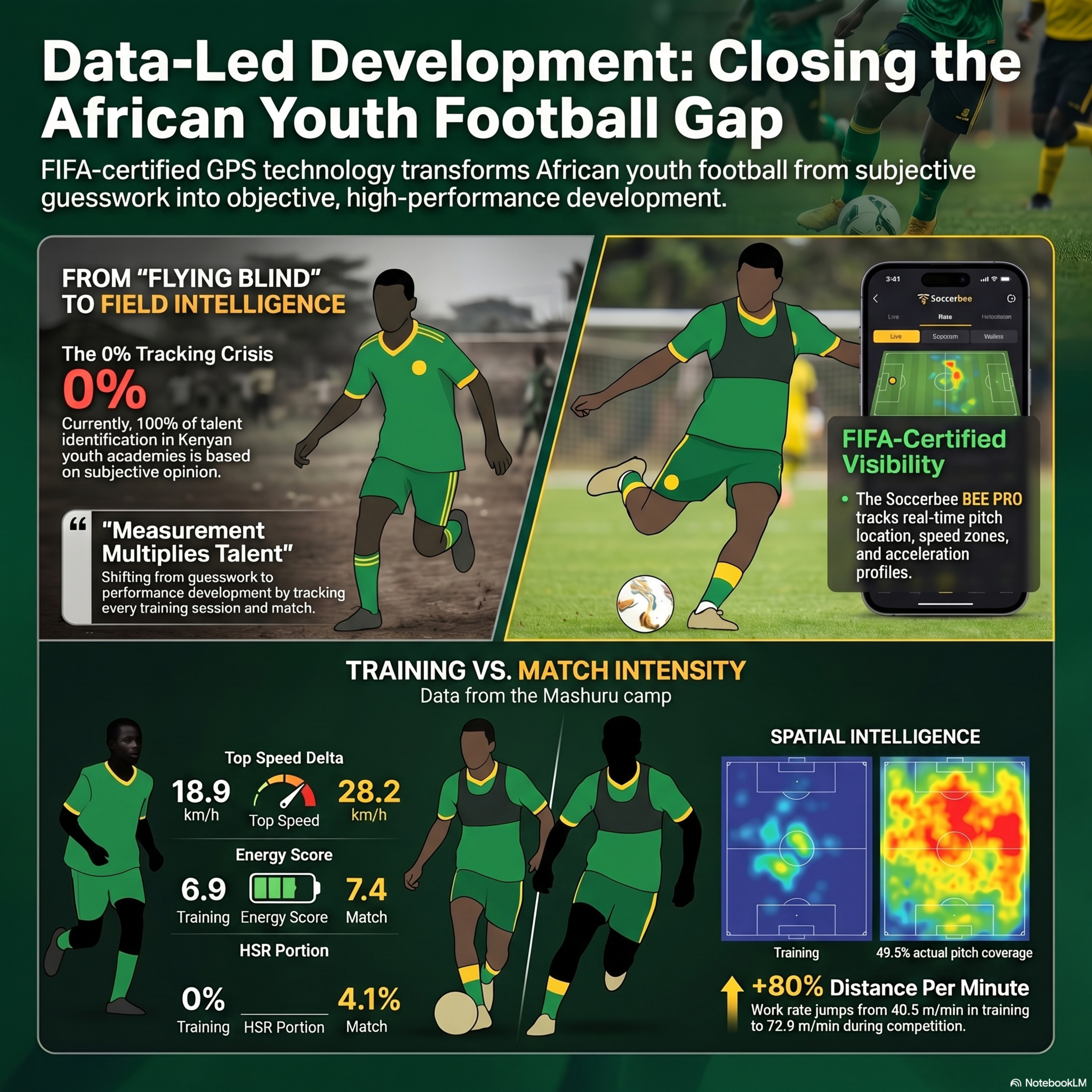
Like the percentage of Kenyan youth Academy is currently utilizing electronic performance and tracking systems. EPTS or any form of GPS tracking is 0. Zero. And you know that void isn't just limited to the underfunded grassroots level, which might be expected. Wait, it gets worse. Oh absolutely. If you look at the Kenya Premier League, which is the highest tier professional football in the entire country, the number of GPS data points collected per average training session is still 0. OK, wait, let me push back on that for a second.
Because if the tracking is literally 0% across the board, how on earth has the African continent consistently produced world class explosive talent for decades? It's a fair question, right? We are talking about DDA, Dragba, Muhammad Salah, Sadio Mane, Yaya Toure. These guys definitely didn't grow up with GPS nodes strapped to their backs. No, they certainly didn't. They became global icons in the exact system you're saying is fundamentally broken. So doesn't that suggest that maybe we are just, I don't know, overcomplicating a beautiful raw game?
Like if the talent is there, cream rises to the top, doesn't it? That is the classic argument, right? But it relies entirely on survivorship bias. Survivorship bias? How so? Well yes, the absolute extreme genetic and technical outliers, your drug buzz and your solas. They will find a way to breakthrough the concrete. They are undeniable. Right, they're freaks of nature in the best way. Exactly. But for every one of those superstars who makes it to Europe, there are literally 10, 1000 incredibly gifted kids who fall through the cracks.
10,000 Well. Yeah, and they suffer chronic injuries because their workloads are mismanaged or they get overlooked because they just don't fit a specific physical mold that a scout is looking for on a given day. Oh, I see, because there's no data to prove otherwise. Precisely when you have zero data points, the entire system relies on pure chance and the subjective eye test of whoever happens to be standing on the sideline. Which brings us to the actual mechanism of scouting. I guess it's kind of like I thought of this analogy earlier as like a master chef trying to run a Michelin star kitchen without ever being allowed to taste the food.
That's a great way to put it, right? Or like a pilot flying a commercial jetliner completely blindfolded. You have the raw ingredients, the talent, but you literally have no instruments to measure the execution. And if I'm a scout standing on the sideline without a tablet, I am making life altering decisions about these kids based solely on what my brain is processing in real time. Which has to be incredibly difficult. It's actually physically impossible. The human eye cannot accurately calculate speed differentials, total distance covered, and high intensity deceleration events simultaneously for 22 moving bodies.
Yeah, when you put like that, it sounds absurd that we even try. So what does the brain do? It creates shortcuts. It relies on heuristics and, unfortunately, implicit bias. Like what kind of bias? A scout will unconsciously favor a player who is taller or who may be matured physically at an earlier age. They completely miss the late blooming tactical genius who might be a few inches shorter but is creating massive structural advantages on the pitch. I can totally see how ball watching factors into this too.
Like a kid could be playing out of his mind right? Making relentless, perfectly timed off the ball runs, creating space, dragging defenders out of position and hitting elite Sprint speeds. But if he never gets the ball? Exactly. If his midfield teammate is having a bad day and just never passes in the ball, the scout's eye naturally follows the ball and completely misses the effort. And then the scout jots down in his notebook #14 was quiet today doesn't impact the game. Meanwhile #14 just ran the equivalent of 1/2 marathon and executed flawless tactical movements that simply evaporated into the hot Kenyan air.
The real tragedy of eye test isn't just that it's inaccurate, it's that it allows fatigue, mood and human error to dictate the economic and professional future of a child. Wait, so if a scout is just having a bad morning? Yes, if a scout is tired or hungry or distracted by a phone call. Critical development developmental insights are lost forever. You are leaving millions of dollars of potential global value and thousands of human dreams up to unquantifiable chance. That is so wild. It's literally like trying to run a complex financial market on vibes.
On vibes exactly. You wouldn't invest $1,000,000 into a tech startup just because the CEO like looked like he was working hard when you walked past his office. No, you'd want to see the balance sheets, the user acquisition metrics, the churn rate. Right, give me the hard data. Or to look at it from a physiological standpoint, consider sports medicine. A doctor doesn't assess a patients cardiovascular health by just watching them walk down the hallway. They measure blood pressure, resting heart rate, oxygen saturation.
Exactly. And in African football, every training session currently operates without those Heidel signs. Every physical adaptation, every tactical execution is completely unmeasured. Every training session without data is a development insight that never reaches a coach, a scout, or a decision maker. OK, so that perfectly establishes the massive systemic blind spot, the dark ages of grassroots evaluation, basically. But let's bring our focus back to the dirt, right in front of. US. Yeah, April 2026, the B6 Elite Sports Complex, we got 20 players out here today and they are all in that 14 to 16 age range, which from what I understand is the absolute Crucible for development.
It really is the most critical physiological window in European academies. The 14 to 16 age bracket is where players are transformed into structural athletes. Structural athletes? What does that mean exactly? It's where raw growth spurts are harnessed. It's where high speed running capacity is deeply embedded into their muscle fibers. I see. So it's foundational. Completely foundational and in traditional African setups, this is ironically the exact window where players begin to fall behind their European counterparts, not in talent, but in structured physical conditioning.
So this camp they are running today, it's built around 2 highly specific tracked sessions, exactly 100 minutes each. And the magic, the thing that is bringing this camp out of the Dark Ages, is the hardware. The hardware is everything here. I mean, just watch coach Anthony Mwangi over there. He is physically helping these boys slip into these tight red and yellow tracking vests. They say be fit right across the chest. And tucked right into a small pouch between the shoulder blades, sitting completely flush against the spine, is a tiny black node.
That's the soccer BB Piro, right? Yes, and we need to be very, very clear about what this hardware represents. This isn't a commercial fitness tracker or a basic smartwatch that guesses your step count. Oh, no, definitely. Not the BE pro Pro is FIFA certified EPTS technology. Meaning it actually passes the regulatory and scientific standards of the global governing body of football. Exactly. The data integrity is absolute. It utilizes advanced satellite triangulation to provide highly accurate spatial and temporal data.
It meets the threshold required for professional, legally binding athletic assessment. That is just the capabilities streaming off. These tiny notes right now are wild to think about. First off, you have the GPS positioning. Right, it is pulling their real time location on this dusty pitch multiple times per second. So we are talking about the generation of live heat maps and movement direction histograms. You can see exactly where a player spends their time, which channels they're dominating, and where they are structurally accent.
It also segments their movement into speed zones, which is crucial. It goes far beyond a simple average pace. How granular does it get? Very. It breaks down their locomotion into walking, jogging, running and sprinting. Specifically isolating zone 4 and zone 5 high speed thresholds. It tracks their absolute top speed down to the decimal point. That's incredible. Then there's the acceleration profile, which I find fascinating because it tracks the micro movements. It counts every single high intensity acceleration and crucially, every deceleration event.
The decelerations are huge. Yeah, like every time a kid plants his foot in the dirt and explodes past a defender ping, that's an acceleration. Every time he slams on the brace to change direction and attendance, take the shock ping. That's a deceleration. And finally, the algorithm synthesizes all these complex multi variable inputs into a proprietary energy score. Energy score? What does that tell the coach? This gives Coach Anthony a composite objective metric to evaluate total physical output.
He can look at an energy score of 7.2 today and compare it to a 5.4 tomorrow and instantly understand the players day over day fatigue levels. I have to pause for a second because the sensory reality of watching this happen is so compelling. We have this ingrained, almost cinematic mental image of what elite sports science is supposed to look like. Oh for sure, the pristine labs. Right, we picture the Eddie had campus in Manchester or Lumazia in Barcelona. We picture scientists in quarter zips looking at massive monitors while players run on climate controlled, perfectly watered grass.
The European monopoly on data, basically. Exactly. But look at this. Look at the actual human application happening 10 yards away from us. Coach Anthony is communicating in this rapid fire mix of Swahili and English to get the tech calibrated. It's very hands on it. Is I was listening to him a few minutes ago. He pulls a kid aside and says Sawazaku in Weza Recon Valicia Direct, basically explaining how the data feeds straight to the tablet. Making sure they understand the why, yeah. And then he taps another boy on the back.
We got Sikosawa making sure the node is hitting perfectly straight against the spine so the gyroscope calibrates correctly. The placement is critical for the data integrity. He even tells the winger Tola to Jesia Masama Troju, physically adjusting the fabric of the jersey so the tracker has a totally unobstructed line of sight to the GPS satellites orbiting in space. It is incredibly gritty, authentic grass roots coaching facilitating absolute elite data collection. And I think that challenges the idea that this technology belongs only in pristine stadiums.
It does more than challenge it, it completely reframes it. What you are observing is a fundamental shift in the economics of sports science. How so? Well, for the last decade the operating assumption globally was that to capture world class FIFA certified data you required a massive permanent infrastructure. Like cameras rigged to the stadium roof, local server networks. A dedicated team of data scientists. Exactly. But what this single pitch in Cogieto County proves is that elite tracking has been entirely decentralized.
So the barrier to entry has just dropped entirely. The technology has shrunk in physical size, the cost barrier has plummeted and the accessibility has risen to the point where a local coach in Mushuru has the exact same data fidelity in the palm of his hand as a manager in the Champions League. That is just wow, OK, the 100 minute whistle just blew. The boys are walking off the pitch grabbing water. Let's actually look at what the tablet is saying about one of these players. Let's do it. Let's pull up the baseline metrics for one of the U-14 boys who was out there for the entire drill.
What are we seeing? Looking at his dashboard, we get a complete physiological narrative of his morning. Out of the 100 minute session time, his total active play time was 69.9 minutes. So roughly 70 minutes of continuous work. In that time, his total distance run was 2.8 kilometers. And his absolute top speed peaked at 18.9 kilometers per hour. OK. I would have had his sustained work rate. His sustained work rate is measured in distance per minute, or DPM. He averaged 40.5 meters per minute across the entire session.
Down in the movement profile, he registered 25 hard accelerations and 16 hard decelerations. That works out to an accelerations per minute an APM of .6. And all of that rolls up into a composite energy score of 6.9. OK, so those are the numbers, but what is the critical take away here? Well, there is a specific metric on the screen that drastically alters the narrative of his performance. It is a massive physiological red flag A. Red flag. Which one? If we look at his HSR portion, his high speed running percentage, it sits at exactly .0.
Percent hold on .0%. If he's at 0% high speed running, that means he's never actually sprinting. Not once. Let's. Contextualize this because to the untrained eye, like if I have a parent sitting in the stands or an old school scout relying on the eye test, I see a kid who was on the pitch for 70 minutes. Right, he was moving the whole time. I see he covered nearly 3 kilometers. He is dripping with sweat. He looks exhausted. My brain says that kid put in a massive shift. He worked incredibly hard today.
It looks like hard. Work, but you were looking at the tablet and calling it a red flag. What is the actual difference between a 40.5 DPM work rate and high speed running? The difference is the fundamental distinction between volume and intensity. OK, break that down for us. The metrics we see the 6.9 energy score, the 40.5 meters per minute, the 2.8 kilometers. They tell us that this U-14 player had a moderate, continuous workload. He was jogging constantly. He. Was active. He was very active. He was moving to receive the ball, he was participating in the flow of play.
But modern elite football is not an endurance jogging event, right? It is a sport defined by explosive, violent, high speed physical transitions. Yes, not a marathon is 100 consecutive 20 20m strengths interspersed with active recovery. Exactly. And that explosive capacity is precisely what high speed running measures. HSR is The percentage of a player's total distance that is covered at velocity is typically exceeding 19.8 kilometers per hour. And those are the critical moments. They're the match defining moments, breaking the defensive line to reach a through ball, sprinting 40 yards back to cover a counter attack, or making a rapid, dynamic run into the penalty.
Box and this 14 year old peaked at 18.9 kilometers per hour, so he just missed that threshold entirely. He never once crossed it for 70 straight minutes of football. His body did not experience high velocity stress. Wow this completely changes how we evaluate effort. I mean, before we had this data, the coach's eye test sees a sweaty, exhausted kid and thinks great session, we are building a. Footballer The coach checks the mental box that developmental progress was made. But the reality is the player is building a massive aerobic engine like a tractor, but he has absolutely no Top Gear.
If we look at the underlying Physiology, the human body operates on the principle of specific adaptation to impose demands. Which means what exactly? It means the body only adapts to the exact stress it is exposed to. When young player sprints, they engage fast twitch muscle fibers. They place heavy structural loads on their hamstring tendons and they force their neuromuscular system to fire rapidly. So if a kid never hits high speed running zones in training. Those fast twitch favors remain dormant.
The hamstrings do not build the tensile strength required to handle high velocity eccentric loads. So data shifts the paradigm from measuring subjective effort to measuring objective efficiency. Or intensity. Intensity. You could theoretically run 10 kilometers in a single training session, completely draining your energy reserves, but if 0% of that distance was high speed, you are physically under prepared for the realities of the modern game. You are quite literally training for the wrong sport.
That is a staggering realization. Which brings us to the ultimate proving ground. I think, because if training provides the baseline, the match environment is the ultimate physiological stress test. Yes, we have to look at the match data to see the full picture. OK, let's jump straight to that. We just looked at the U-14 training session. Now let's look at the data from an actual competitive match played right here at the B6 Elite Sports Complex, featuring a 16 year old player in the same program.
The contrast here is genuinely mind bending. It really is. I mean from a traditional surface level scouting perspective, this 16 year old had a phenomenal game. The stat sheet shows he scored two goals and provided 2 assists. Any scout watching that match writes his name down immediately. Sign him up. Definitely, but let's look at what the BEP row captured beneath the surface. His total distance covered during the match was only two point O kilometers. Which is actually less volume than the 14 year old ran in training.
Right. His pitch coverage was 49.5%, meaning he was highly efficient, mostly dominating his specific half or channel of the field. But the intensity metrics, they are completely different. The intensity spikes are violent. Give us the numbers. During this match, his top speed reached 28.2 kilometers per hour, his work rate, his distance per minute skyrocketed to 72.9 meters per minute. Wow, and his composite energy score jumped to a 7.4. And most importantly, the high speed running metric activated.
It went from the flat 0.0% we saw in the training baseline up to 4.1% of his total movement. This specific comparison reveals the most critical developmental insight we can extract today. We must focus on on the delta, the vast mathematical chasm between the physical demands of the training environment and the physical demands of the match environment. Let's actually do the math on that delta, because the numbers are terrifying if you are a coach who doesn't know they exist. They really are. We are looking at a 49% increase in absolute top speed.
The baseline training pace was a casual 18.9 kilometers per hour and suddenly in a match, the players forced to hit a blistering 28.2 kilometers per hour. It's an entirely different physiological demand. And we are seeing an 80% explosion in work rate jumping from 40 meters per minute to nearly 73 meters per minute. And the high speed run requirement goes from non existent to over 4%. It is vital to understand that managing this exact gap, this acute to chronic workload ratio between training Tuesday and match day Saturday is the primary obsession of modern European academies.
Really. The primary obsession. Absolutely. It dictates their entire physical periodization strategy. I have to use an analogy here because thinking about an 80% jump in intensity, it makes my own hamstrings hurt just sitting here. It's a massive shock to the system. Right, It's like structural engineering or weightlifting. Imagine you have a kid in the gym and every single day at practice you only let him bench press a 10 LB dumbbell. His body gets really good at lifting 10 lbs. He can do it for 70 minutes straight.
But then on match day, you suddenly drop a 200 LB barbell on his chest and scream at him to lift it. He's going to fail. Exactly. His muscles, his tendons, his central nervous system literally have not built the structural integrity to handle that violent load. And the biological consequence of that delta is injury. Right, the body just breaks down. If your training sessions are consistently flatlining at 40 meters per minute with 0 high speed running, you are effectively detraining the athletes explosive capacity.
Detraining well. Yes, when that same athlete is thrown into a competitive match where the opposition forces them to run at 73 meters per minute and Sprint at nearly 30 kilometers an hour just to survive. Well, you are taking a car engine that has only ever been driven in second gear through a school zone, taking it out onto the highway and redlining it in 6th gear. The engine blows, the hamstrings snap, the groins pull, the Acls tear. Yes, exactly. The mechanical stress during a 28 kilometer per hour Sprint, particularly during the deceleration phase when the foot strikes the ground and absorbs the kinetic energy, is immense.
It's a huge amount of force. Huge. If the muscle hasn't been conditioned to to absorb that force during training, the tissue fails. And even if they don't get injured, their performance has to suffer, right? Furthermore, yes, even if they don't suffer an acute injury, their performance collapses. If training does not replicate or ideally exceed the physical demands of a match, the player will fatigue rapidly. And what happens when they fatigue? As their legs go heavy, their tactical decision making deteriorates under the physical strain.
Wait, this explains so much. This completely reframes a conversation we constantly have about the global game. Which conversation? We are always asking why incredibly talented African players sometimes struggle so profoundly to adapt during their first six months in the English Premier League or the German Bundeslip. Oh, absolutely. Right. We blame culture shock or the weather or tactical misunderstandings. It's always something external. But look at this 80% intensity gap. How can local youth coaches in Kenya or Senegal or Ghana possibly prepare prepare these kids for the relentless, suffocating pace of global professional leagues if they're completely blind to this delta happening in their own daily sessions?
They cannot. It is a biological impossibility to prepare an athlete for a stimulus you cannot measure. A coach's naked eye just can't see it. A coach's naked eye cannot calculate a 49% increase in top speed, nor can it accurately gauge a jump from 40 to 73 meters per minute. They just see a kid running fast. So data is the bridge. Data is the only the objective bridge between raw local potential and elite global standard preparation. OK. So we have established the Boyd, We've seen the hardware in action.
We've unpacked the physiological baseline of training versus the explosive reality of the match. We've covered a lot of ground. We really have, but now we have to pull the lens back. We need to synthesize what this all means. Big picture. Exactly. We have to look at the macro level vision for how deploying this technology permanently rewrites the future of the African game. This transformation is going to occur across 3 distinct interconnected levels. OK, what are they? The psychological development of the player, the tactical empowerment of the coach and the macroeconomics of the global transfer market.
Let's start with the player, because I'm super curious about that. Consider the profound psychological shift that happens when evidence finally replaces opinion. I am trying to put myself in the boots of a 15 year old kid in this camp. For your entire life, training has just been this abstract and. Just run. Yeah, you. Run until your chest burns or until the coach yells at you to stop. You have no idea if you were actually getting better, you just know you were tired. It's a very disempowering feeling, honestly.
But today, after the 100 minutes are up, you walk over to the sideline, the coach hands you a tablet, and you actually see your own physical reality quantified. It's all right there in front of you. You see your top speed was 18.9 kilometers per hour and you see the kid standing next to you hit 25. It fundamentally gamifies their physical development. Training ceases to be a chore of blind obedience and guesswork. It becomes a competition with yourself. Exactly. It becomes an interactive, objective pursuit of performance.
A young player can look at the data and say my objective today isn't just to work hard. My specific objective is to hit a zone 5 speed burst at least four times during this transition drill. Which creates instant neurological feedback. They take ownership of their own Physiology. And protects them too. Protects them from what? From the old school mentality of just grinding kids into dust, if a player is genuinely fatigued, if their central nervous system is fried and their energy score drops from a 7.4 on Monday to a 5.1 on Wednesday, the data acts as a shield.
Oh I see, the coach can't just accuse the kid of being lazy and punish them with more running. Right, the data objectively states this athlete requires recovery. Which perfectly transitions us to the coaches. How does this level of visibility practically empower a grassroots coach like Anthony Wang? Well, the interface of the Soccer B app is specifically designed for immediate tactical intervention. It bridges the gap between raw numbers and pitch reality. So it's not just a spreadsheet. No, a coach isn't just staring at a sterile spreadsheet.
They are looking at load patterns. They can review movement replays, heat maps, and spatial intelligence that shows exactly how their tactical instructions are manifesting or failing to manifest on the grass. I was playing around with the session timeline feature on the tablet earlier and it is a complete game changer. It's incredibly intuitive. You can literally drag your finger across the entire 100 minute timeline of the session. As you drag, the app shows you exactly when the aggregate intensity of the squad spikes, and exactly when it drops off a Cliff.
Think about the practical application of that timeline. Suppose a coach designs a specific small sided drill that is intended to replicate high intensity match day counterpressing. OK, but when they review the timeline playback, they see that for a solid 15 minutes, the squad's average DPM dropped to a slow crawl and no one registered a single acceleration. Then the coach instantly knows the drill is structurally flawed. Precisely. Perhaps the grid they set up is too large, allowing players to jog into space.
Or perhaps the rules are too complex, causing cognitive overload that slows down physical movement. That makes perfect sense. Better visibility undeniably instantly leads to better, more efficient coaching decisions. Without a doubt. This brings me to the absolute most exciting part of this entire deep dive. This is where the macroeconomics of global football fundamentally shift. We have to talk about the African export market. This is the real paradigm shift. Because for decades, the primary currency used to transfer African youth talent to Europe has been trust.
And trust is a highly volatile, highly subjective currency. Sorry, I mean, you are entirely right about the volatility. Let's look at how a transfer usually works. A local scout or agent calls a sporting director at a European club and. What do they say? The agent says you have to trust me, I have a kid here in Nairobi. He is an absolute phenom. He's the next Sadio Mane. Or at best, the e-mail over a grainy, shaky smartphone video of a 16 year old doing a few step overs and scoring a goal on a dirt pitch against unknown opposition.
Which carries an astronomical level of financial and developmental risk for the purchasing European club. Huge risk. They're being asked to invest hundreds of thousands, sometimes millions of EUR into acquiring an entirely unknown physical entity based on subjective evaluation and out of context video highlights. But the introduction of EPTS at the grassroots level completely upends this power dynamic. It changes the conversation entirely. There's a saying that perfectly encapsulates this. Talent matters, absolutely.
You need the raw ingredients, but measurement multiplies talent. Measurement changes the currency of the entire market. You are transitioning from the volatile currency of subjective trust to the gold standard of objective mathematical proof. Instead of a grainy Webs app video, an Academy operating out of a dusty pitch in Coggieto County can now send an e-mail to the sporting director of AX or Barucha, Dortmund or Arsenal and attach a certified FIFA approved data dashboard. They can say here is the proof.
Exactly, They can confidently say do not trust my eyes. Look at the raw data. I have a 16 year old who can hit 28.2 kilometers per hour under competitive match pressure. He actively covers 50% of the pitch, and he can biologically sustain a work rate of 73 meters per minute for a full half. And the European club receives that dashboard and immediately overlays those specific metrics against their own Academy players currently training in Germany or the Netherlands or England. Also they do a direct comparison.
Instantaneously, they can instantly see with mathematical certainty that this teenager in Kenya physically matches or perhaps significantly exceeds the output of their own highly funded $1,000,000 prospects. The physical risk of the acquisition is almost entirely mitigated, yes. The valuation of the African player skyrockets because their athletic capability is no longer a rumor whispered by an agent. It is a certified, undeniable fact. It is the ultimate market equalizer. We are looking at the democratization evaluation.
Beautifully put. By bringing this level of scientific light to the previously dark corners of youth football, you aren't just improving a Tuesday morning training drill. You are fundamentally changing lives. You are fundamentally changing the socio economic trajectory of these players lives, their families and their local communities. You were ensuring that maximum value is returned to the grassroots clubs that developed. Them which brings our focus right back to where we are sitting right here on the sidelines in Mushuru.
Yes, look out of the pitch. The session is over, but the dust is still kicking up in the. Wind The kids are resting, taking off their vests. The sun is still beating down on the grass. The physical reality of the African grassroots game is still gritty, hard and unforgiving. But the operational reality of what is happening out there has changed forever. The raw volcanic talent has always been here for generations. It was the only thing we could rely on, but today the technology has arrived to capture it.
And that reality leaves us with a highly provocative realization derived directly from the undeniable success of this single 20 player camp. What's that realization? The debate is over. The question is no longer whether this caliber of high end granular tracking belongs in African youth football. We are watching it work. The proof is in the data. The teenagers adapt to it instantly. The local coaches thrive on the insights it provides and the data streaming to the tablets is world class. So if this level of sophisticated biomechanical tracking is already operating seamlessly on a dusty pitch in Cajatto County analyzing the Sprint mechanics of 14 year olds, the only question left to ask yourself is how fast are we willing to scale?
This How quickly can we get this on every pitch? Imagine a future not ten or 20 years from now, but tomorrow, where the vast, historically untapped potential of an entire continent is mapped, measured and mathematically undeniably presented to the world. It is a beautiful, deeply exciting and frankly terrifying thought for the rest of the global footballing establishment. Thank you so much for joining us on the sidelines today, sitting in the heat and taking in this massive paradigm shift with us.
Keep your eyes on the data and we'll see you next time.
 Apple Podcasts
 Castbox
 Castro
 Goodpods
 Moon FM
 Overcast
 Pocket Casts
 Podbean
 Podcast Addict
 Podcast Republic
 Spotify