Football Data Sovereignty and Global League Wealth
About this episode
Football Data Sovereignty and Global League Wealth
Listen now on Spotify, Apple Podcasts, Amazon and other streaming services! Don’t forget to subscribe, share, and leave a ⭐⭐⭐⭐⭐ review to help more players and coaches discover the power of Techne Futbol and Data Technology in the beautiful game.
#TechneAfricaFutbol #TechneFutbol #TrainWithTechne #Playermaker #TraceFutbol #Hudl #FootballTech #FootballInnovation #PlayerDevelopment #CoachTools #SmartFootballTraining #AfricanFootball #CAFOnline #FIFA #FIFAYouth #CAFDevelopment #YouthFootballAfrica #NextGenFootball #FootballScouting #TalentIdentification #DigitalScouting #EliteYouthDevelopment #FootballJourney #FootballAnalytics #FIFAForward #FutebolAfricano #TrainTrackCompete #FootballExcellence #FootballAfrica #TheFutureOfFootball
Welcome back to the Deep Dive. Today we're doing a forensic analysis on the global game, but we are looking far beyond the tactics board in the referee calls. We are going deep inside the server rooms analyzing what is probably the greatest structural metamorphosis football has seen in maybe 2 decades. Yeah, that's not an exaggeration either. We're witnessing A fundamental strategic pivot, right? I mean, this isn't just about buying standard statistics anymore. You know, the passes, the shots, the simple possession metrics that we've all gotten used to.
We are tracking the move toward building true sovereign intelligence architecture. It's it's transforming the league office into a massive centralized R&D unit. That's it exactly. We've got a mountain of research here, a complete global forensic look at how football leagues are modernizing their football intelligence and performance departments. And this shift isn't about consumption. It's about establishing what the report we're looking at brilliantly terms intelligence, sovereignty. That term is perfect.
It's the difference, you know, for a league commissioner or a senior technology director, between paying rent on 3rd party data and actually owning the intellectual foundation of your core product. OK. So it's ownership? It's total ownership. You become the master architect of your own knowledge base, rather than just being a customer of some you know, global data aggregate. So our mission today is pretty clear. We are going to unpack this new sovereign model, which was pioneered primarily in Europe but is now being cloned globally, right?
And we're going to conduct a comprehensive audit. We want to know who is adopting it successfully, who is resisting it, and, crucially, why. That resistance is almost always political and infringed, and rarely ever purely technical. And to really understand the gravity of the shift, you have to look at the historical context. I mean, for roughly 2 decades, major leagues operated primarily as passive data consumers. Just buying feeds off the shelf. Exactly. They purchased standard data feeds from the big aggregators Opta Sports, Radar, Genius Sports and Look.
These feeds were functional. They allowed networks to run basic graphics during broadcast, but they were, I mean they were totally generic. So they were just spicing up the broadcast a little bit, but they weren't fundamentally changing how the club operated or how the league managed its physical assets. Not at all. The core product, the on pitch performance analysis, talent identification, physical load management, all of that was completely untouched and unregulated by the central league body.
So if you were a club, you were on your own. Completely on your own. If a club wanted advanced optical tracking or wearable data analysis, they had to go buy it themselves independently. And this this structural fragmentation meant the league was just not maximizing its own value. And that's what this new approach is designed to fix. It is the paradigm shift is what the report calls the strategic pivot, the new sovereign model which was PION eared most effectively by Lalgia in Spain and adopted similarly by the German DFL.
It redefines the league organization. In what way? They move from being a simple administrative body to becoming this incredibly sophisticated centralized technology consultancy. For their own clubs. For their own clubs and in sourcing this intelligence, meaning owning the tracking hardware, the raw data pipeline and all the analytical tools, that is the critical distinction. It's about asset creation that benefits the entire ecosystem, not just just, you know, isolated service consumption. OK, let's unpack this then.
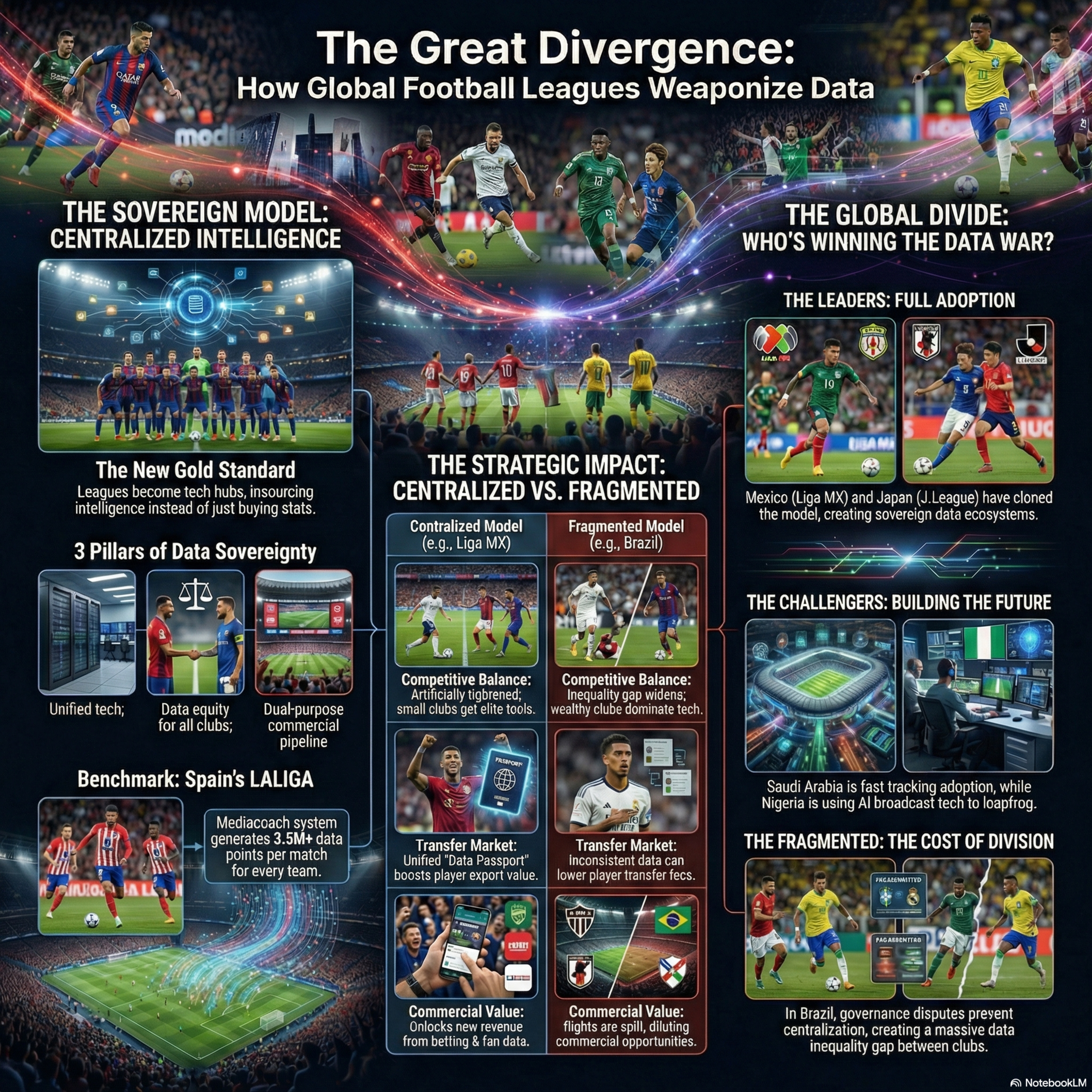
If La Liga's implementation of what they call media coach has become the undisputed benchmark globally, what are the non negotiable requirements of this sovereign model, right? I mean, what did they build that every ambitious league is now attempting to clone? So the lack of a model when you really distill it, it rests upon three non negotiable pillars, OK. And as we conduct our global audit, you will see that every single league that has failed to centralized has stumbled either legally or financially on one of these three fundamental points.
Let's start with the hard stuff, then the physical investment. Hit us with pillar one. Pillar one is infrastructure sovereignty. This is all about absolute physical ownership and control. The league centrally procures, installs and maintains all the specialized hardware and we were talking about the fixed optical tracking cameras installed high in the stands and also the wearable technology like GPS units used in training. So wait, Lolly Job, the central entity, is buying and maintaining the cameras at Real Madrid, but also at a second division club like, say, SD Westcott.
Precisely that is the key. This infrastructure has to be uniform across every single stadium and, in an ideal world, every training ground within the professional ecosystem. And the goal there is what? Standardization. The goal is twofold standardization and quality. If every single piece of raw data from the champion all the way down to the relegation candidate is captured by identical, centrally maintained equipment, you eliminate all the variables. This ensures absolute, rigorous, standardized, high quality data across the entire league.
So if the physical output of a player at Real Madrid is measured exactly the same way as a player at CDCF, you achieve what you could call methodological parity in the source material. So it's not just about getting data, it's about eliminating the noise that comes from having all these disparate data collection methods. Absolutely. Noise reduction is key to scientific legitimacy, which brings us to Pillar 2. This is the strategic innovation, and this is what makes the model commercially revolutionary democratization of intelligence.
Once you have established this unified central asset, this incredibly clean, rich data set on professional football, you distribute it equitably. How does that distribution actually work in practice? Well, the raw telemetry, so the XY coordinates, the processed video and the advanced analytical dashboards are all provided uniformly and without any additional cost to every club in the professional pyramid. Wow. And the report makes a fantastic point here. This actively and artificially tightens the competitive balance.
How so? By ensuring that a club fighting relegation possesses the exact same analytical firepower and tactical insights derived from the data as the league champion, you just raise the flair for everyone. But wait a minute, If the league is distributing these advanced analytical dashboards equally, doesn't that just raise the floor? You know, meaning the wealthy clubs will still win because they can afford better staff, dozens of data scientists and coaches to interpret that data faster or better.
That is a critical challenge, and it's where the model transitions from, let's say, utopian to pragmatic. OK, yes, of course. Wealthy clubs will always have more resources. However, without the standardized, centralized data asset, the smaller clubs can't even begin the conversation. They can't even get in the door. Right, they're not even in the game. They're not. Democratization forces smaller clothes to professionalize. They're essentially given a world class IT backbone for free. The data asset is the foundation, and the consultancy layer, which we'll get to, is the mechanism iliga uses to help bridge that final interpretation gap.
OK, so they help them use the tools. They ensure every club can at least utilize the tools effectively, Which brings us to Pillar 3. And this is where the data truly becomes a commercial product. Right, the money. Pillar 3 is commercial and technical integration. The data pipeline cannot be the single use tool. It has to be dual purpose and perfectly aligned. I see. The same precise coordinate data generated by those centralized tracking cameras. The data used by a club fitness coach to track high speed running metrics and manage deceleration load for injury prevention must simultaneously be used by the league's commercial team.
To sell what exactly? Like what are they selling? They're selling advanced predictive graphics, things like goal probability models, attacking threat indices or pressing intensity heat maps that they can then sell to broadcasters and betting partners. Ah, so that's where the monetization comes in it. Makes the data immediately monetizable externally, and this creates the perfect self-sustaining virtuous cycle. OK, break that down. The investment in data improves performance and competitive balance, so the product gets better and then the improved data sells the product to media and sponsors, which is substantially increases the media rights value.
It transforms the intelligence department from a deep cost center into a substantial revenue driver for the league office. That's it. And that context sets up our global audit perfectly. The forensic scope of this report summarizes the global situation as a great divergence. Yeah, and we see three really distinct categories emerging worldwide. First, you have the centralizers. So that's Liga MX, the J League, even the Saudi Pro League who have successfully cloned or you know, just purchased the sovereign model logic.
Second, the fragmented giants Brazil and Portugal are the prime examples here where governance paralysis means they can't even agree on a unified Technology Strategy. And 3rd, the federation LED ecosystems. So places like Morocco, where the National Association rather than the league structure, drives the technology investment, often to boost the success of the national team. And that divergent, as you pointed out, is the difference between maximize global value and literally billions in lost opportunity.
So let's delve into the mechanics of the benchmark. OK, let's get technical and operational. The heart of a Liga system is media coach. For someone out there who might be overseeing the roll out of a similar system, we really need to understand the nuts and bolts of how a Liga achieved this infrastructure, sovereignty and maybe more importantly, one over the clubs. Right. So we start with a technical foundation. Aliga made a foundational decision early on a complete refusal to rely on broadcast camera feeds.
Why not? They're already there. Because broadcast feeds are variable. They're biased, they follow the ball, they don't capture crucial off ball movement, and they're prone to latency. It's just not clean enough. So what do they do instead? Instead, they implemented A proprietary dedicated grid of fixed optical tracking cameras. Why fixed cameras and how does that technology actually work? So the initial implementation, which originally used Karen Haygo's TASAI technology and is now evolving with Sportion, involved installing these arrays of cameras high up in the grandstands, usually centered on the halfway line across every stadium.
OK. And these cameras don't follow the action, they just observe the entire field continuously. Then, specialized computer vision software analyzes all the pixel changes, identifying every player and the ball frame by frame based on their kit color and their shape. That is a colossal infrastructure investment covering every single professional match in the country, 1st and 2nd divisions. What's the output? What do you get from that? The output is immense. This infrastructure captures player positions, so XY and Z coordinates, which gives you depth and elevation at a staggering rate of 25 frames per second.
25 times a second. 25 distinct measurements every second for all 22 players and the ball. That continuous stream generates over 3.5 million distinct data points per match. This isn't just event data, you know a pass or a shot. This is truly digitizing the entire physical reality of the match. You capture every single run, every subtle off ball movement, every shift in defensive shape, even if the ball is on the complete opposite flank. But the clubs, I mean the notoriously skeptical club fitness and performance coaches, they have to actually trust this data.
If they already have their own GPS vests, why should they adopt and trust the league's video tracking data? This is probably the most crucial step a Liga took to ensure adoption. Crucial validation. The report highlights that they spent significant time and capital conducting these rigorous validation studies. They didn't just tell clubs the data was good, they sound typically proved it. How did they do that? They compared the media Coach video based system against the wearable GPS units that clubs were already using, so catapult, WMU and so on for critical physical metrics.
And what were the results they were looking for? What did they need to show? They needed to show reliability and agreement. The standard measure for this in sports science is the intraclass correlation coefficient or ICC, and the validation study showed extremely high ICCS consistently above .75 and often pushing .90 when comparing media coach data against the club GPS units for metrics like total distance covered and high speed running. For the listener who might not be familiar with complex statistics, what does an ICC of .75 mean in practical terms?
Like what does that feel like? Think of it this way. An ICC measures the degree of agreement. A1 Point O is perfect agreement. So if the league's optical system measured a player running 10 kilometers in a match, and the club's GPS vest measured, say, 9.8 kilometers, that's very high agreement. Achieving .75 or higher is basically scientific proof that the league system is not generic filler. It's rigorous, verifiable scientific truth that is measuring the same physical reality as the equipment the club already trusts.
And that legitimacy was vital for winning over those skeptical performance departments. Oh, absolutely proved the league was serious about the science. Here's where it gets really interesting strategically, what the report calls the socialist approach to tech. We touched on equity, but let's dive into why this investment philosophy is so strategically innovative and not just, you know, a feel good gesture. Well, if you look at leagues like the Premier League where clubs are autonomous tech buyers, the financial disparity is just enormous.
And that wealth gap translates directly into a massive knowledge gap. Manchester City can afford proprietary algorithms and dozens of dedicated data scientists that a newly promoted club just cannot. So that intellectual edge just structurally reinforces the dominance of the wealthy club. It does, and Alicia deliberately inverted this by centralizing that massive initial high risk infrastructure investment. So they essentially socialize their cost of the foundational data, making sure everyone from the top club to the bottom starts with the same high quality data set.
Exactly. A club like Granada, you know, potentially fighting relegation, has access to the exact same tactical telemetry, the same sophisticated video tagging tools and the identical physical performance metrics as Real Madrid. So it's a deliberate structural subsidy. It is. It's designed to flatten the intellectual playing field. What does that look like in practice, say for a coach who is under pressure mid match? So Oliga formalized the deployment of this knowledge. They partnered with Microsoft to equip every single technical bench in the league with specialized Surface Pro tablets running the Mediacowac Live application.
And this isn't just showing a score. Oh no, It's allowing coaches and their analysts to pull up real time tactical review. A successful high press sequence. A defensive shaped collapse just seconds after the event actually occurs on the field. So the feedback loop moves from a post match review on Monday to an immediate actionable tool on Saturday afternoon. That's it. It accelerates tactical evolution across the entire league. But providing the tech is one thing, making sure clubs use it effectively is a whole other problem.
Right. If a smaller club doesn't have the internal expertise, the technology is just a shiny, expensive toy. And that's where the most sophisticated part of the model comes in, the consultancy layer. Oliger recognized that simply dumping high tech infrastructure on clubs without training is a recipe for failure. So what did they do? They created a dedicated centralized football intelligence and performance department staffed by UEFA qualified analysts, so coaches and performance scientists who deeply understand the game.
So these analysts aren't just IT support, they're not just fixing the tablets. Far from it. They are consultants. They actively visit the clubs, they spend weeks embedded with the staff, and they hope the smaller clubs interpret the complex data, connecting the speed of the data to the speed of the game. They ensure the technology actively impacts on field decisions, turning sophisticated data into practical tactical action, and that high level, bespoke expertise is subsidized and shared across the entire league.
So it ensures the technology investment truly achieves its democratizing goal. It does. It's a complete system where the expertise follows the hardware. But as you emphasize with Pillar 3, the department is not just designed to make football better, it's designed to make the league richer. Right. We have to circle back to commercializing the brain, the beyond stats loop, the massive technical infrastructure Elijah built had to justify its colossal cost. It did. So how does that raw coordinate data the XYZ figures, how does that translate into bankable broadcast value?
So the infrastructure includes A partnership with Microsoft Azure Cloud cloud and this cloud operates in parallel streams. Stream one processes the raw data for the coaches, that's the performance side. Stream 2 simultaneously runs advanced machine learning models that are designed to generate fan facing broadcast rating metrics and this is the Beyond Stats initiative. We see these graphics all the time now in broadcasts. Exactly. Metrics like goal probability, which is based on player positioning in shot location, or attacking threat, which quantifies ball progression, and pressing intensity, which uses the coordinate data to measure how aggressively A-Team closes down space.
I see. These translate complex performance data into engaging digestible metrics for the viewer at home, and then the strategic loop closes perfectly. Aliga uses this performance data to ensure the product is better and more competitive via democratization. Then they use the exact same data, branded and verified, to market the product, which substantially increases the value of their media rights when they're negotiating with major global broadcasters and betting partners. It's clear the Liga set the gold standard of architectural completeness.
So now let's audit the centralizers, the leagues who successfully cloned or I guess purchased this complex model. Latin America in particular shows a stark divergent, But Mexico's Liga MX has executed a strategy that is arguably the most direct and successful successful mirror image of Spain's model outside of Europe. Yeah, Liga MX is without question the most advanced intelligence apparatus in the Americas. And they didn't just license a Spanish vendor, they created a core institutional body called C Tech, the central the innovation Technologica back in 2018.
So C Tech is the centralized clearinghouse, mirroring the functions of media coach. Precisely. It serves as the physical and operational hub for the entire Mexican football ecosystem. So that's Liga MX, the expansion league, the women's league and even the national teams. And their logic was the same as a Ligas. Their strategic logic was identical. They understood that centralization reduces costs for everyone and, critically, it enforces technical standardization across a very diverse group of 18 competing clubs.
So what did that standardization look like in terms of hardware on the ground? Well, they invested massively in standardized infrastructure and they cleverly used automation to manage the scale. They partnered with a company called CA Play and utilized automated pixel lot AI camera technology, installing these automated camera systems in every stadium and training ground. Every single one. Everyone the report knows they have over 110 active systems and these automated cameras capture over 2000 professional games and 40,000 minutes of training sessions annually.
And that ensures standardized video and data capture without the enormous cost of what human camera operators in every venue. Exactly. But let's talk about the physical data layer. This is often the hardest part to unify because of club resistance. The wearables. Yes, this is what they call a physical passport, and it's perhaps the most impressive feat of standardization. We get MX mandated and distributed one AMU Pro GPS tracking devices, which are developed by Real Track Systems to every single club in League MX, the Women's League and even the referee committee.
Wow, why mandate WIBI Wimi pro specifically? What's the advantage there? By mandating a single piece of hardware for physical metrics across the entire league, instead of allowing 5 different clubs to use five different brands, they ensure that the physical performance data is completely standardized, right? So think of the physical passport as a player's immutable league verified credit score for physical performance. That's a great analogy. When a player moves from one league of MX club to another or, and this is crucial when they're sold overseas, the physical data, the sprints, the deceleration load, total volume, all of it is instantly validated by the league, removing any club specific bias or, you know, lack of rigor.
And that unified hub must provide enormous benefits for just day-to-day efficiency. It creates what they call the League Exchange capability because all the video, all the performance data, both optical and the YMU GPS, and all the match files are centrally owned and stored by Cytech. The coaches don't have to do that work themselves. Right, they don't waste time on redundant scouting or analysis. A coach at Club America can access a centralized cloud that contains over 3000 hours of opponent footage, video clips and the granular YMU physical data directly from the Scitech Hub.
It eliminates the need for expensive, time consuming travel and manual scouting. And we saw in the report that this centralized purchasing power is now extending into new extremely high cost technology. Absolutely, they're committed to future proofing through continued central investment. Liga MX is set to implement Semi Automated Offsite Technology or SAOT for the Claw Zura 2026 season. That's a huge commitment. It's a huge financial commitment. They're investing over $1.4 million and installing 28 additional high speed cameras in each stadium leveraging the Genius IQ platform.
An the strategic signal there is what? It's unmistakable The League, acting as the owerful centralized technology purchaser, dictates the infrastructure standards, ensuring uniform application and quality across all 18 top flight venues, just like Elige. OK, let's move east now and look at the J League in Japan. They are philosophically aligned with Eliga and Liga MX, but their strategy has a a really unique cultural flavor to it, emphasizing shared knowledge. They do. Their philosophy is embodied in what they call the Furoshiki Asset Hub.
Furoshiki. Yeah, Furoshiki is the traditional Japanese wrapping cloth and the strategy is literally about bundling all their digital assets, all video, all images, all stats for collective shared value across the entire professional ecosystem. And how does that architecture compare technically to something like Scitec? Well, the Furushiki is a cloud based digital asset hub that they launched in 2019 and it meticulously covers J1J2 and J3. They partner with a company called Data Stadium Inc, which effectively acts as the national beta Center for Japanese sports.
So they also capture everything centrally. Everything It ensures unified standardization from the source. And just like Aliga, they prioritize democratization by providing a specific tool called Live Scouter to all club coaches. And let me guess, this is another one of those bench side tablet applications? Yes, you got it. It's functionally identical to Aliga's Surface Pro Tools. It allows coaches and analysts on the bench to view real time tracking data and video replay during the match, enabling instant tactical adjustments.
But you said they're different. Where does the J League truly distinguish itself? Through academic integration. Interesting, How does integrating research and academia support a commercial football intelligence department? So the J League actively supports Football Lab, which is a public facing analytics site to engage the fans. But more profoundly, their centralized data contract includes A provision that grants university researchers highly granular, non identifiable access to massive historical data sets.
So they're crowdsourcing R&D in a way. You could say that they're fostering a deep scientific culture around advanced metrics that no single club could ever afford to develop on its own. Can you give us an example of the kind of research they're developing using this centralized data? Certainly the report highlights research that his proposed new metrics like expandable decision making states or EDMS to quantify complex off ball movements. And how do they do that? Researchers use techniques like principal component analysis, PCA and canines clustering.
For instance, PCA is used to identify the underlying non obvious patterns in player movement. So maybe realizing that three different runs are actually the same tactical movement and then K means clustering takes massive amounts of data and groups teams or players with similar tactical styles, which is I mean invaluable for scouting and match planning. That's fascinating. It's structurally embedding a scientific moneyball culture into the game, and it's being subsidized by the league itself. It is.
They're developing intellectual capital for the entire league, making sure they are not just consuming metrics developed elsewhere, but are generating their own proprietary understanding of the game. And finally, in this tier of centralizers, we have the Saudi Pro League. Now this isn't a slow build like Japan or Mexico. This is accelerated acquisition. This is a direct capital intensive strategy and is driven by the goals of Vision 2030. They just bypassed the multi year development cycle and essentially purchase centralization.
They expanded their existing partnership with Stats Perform, focusing very heavily on their advanced computer vision suite. And what was the key technical mandate they bought? They expanded the deal to include Optivision and the Optipro Hub. Optivision is stats performs highly advanced computer vision system that merges optical tracking with broadcast video to provide comprehensive performance metrics. And the mandate was to give it to everyone, yes. The critical mandate was making this available to every single club's performance analysis department immediately.
This enforces immediate top down standardization and democratization via a vendor supplied league mandated system. What's the most immediate, practical, strategic benefit they gain instantly by centralizing this scouting intelligence? It is the recruitment centralization aspect. The SPL recognized that to succeed rapidly, they needed to equip their clubs with world class due diligence capabilities for foreign acquisitions. Right? So the Opta Pro Hub provides access to deep recruitment data from dozens of overseas leagues, all cross referenced with Optivision data.
This effectively gives every SPL club a sophisticated external scouting department in a box. And that instantly improves the quality and rigor of their foreign player signings. Immediately, it raises the overall competitive level and increases the league's legitimacy on the global stage overnight. So this brings us to the inevitable question. If the blueprint is so clear and the commercial upside is so immense, why have some major football powers, with all the talent and market valuation to justify it, failed to centralized?
The report insists the failure is overwhelmingly political, never technical. That is the core inside of this deep dive. I mean, the technology to leapfrog traditional infrastructure like the AI cameras will discuss. It already exists, but governance is the ultimate bottleneck, and nowhere is that failure more painfully apparent than in Brazil. The Brazil Iran presents the most devastating example of the cost of fragmentation. Despite being arguably the world's most productive talent factory, the Brazil, Iran lacks A centralized intelligence department entirely.
Why? This is truly a chronic failure of governance, and it leads to a massive systemic loss of commercial value. The failure stems from the governance war. That's a consuming Brazilian football. Governance war. Yes, the league structure is politically fractured between two powerful rival blocks fighting for control over the future league structure and, critically, the revenue distribution. Who are these warring factions and what is their core disagreement? So the two blocks are Libra, which is generally led by historical giants like Flamingo and Palmaris, who often favor a distribution model that rewards their massive fan bases more heavily, of course.
And then Leo Forte Union or LFU, which generally comprises the smaller clubs who are pushing for a more egalitarian distribution system, something similar to the centralized models in Europe. And if they can't even agree on how to split the TV money, they certainly can agree on a shared unified data vendor or some multimillion dollar technology mandate. Exactly this political fracture makes the implementation of the La Liga model, which requires unanimous commitment and shared investment, structurally impossible.
And there's a legal barrier too, right? There is and it reinforces the conflict. It's the Lado Mandante or the home team law. This law allows individual clubs to negotiate their own media rights piece meal. So without a unified rights owner, there is no one single entity who can go to a vendor and say, look, we own the rights to all 380 matches and we want a single centralized data stream. Precisely no single entity owns the entire data landscape. A centralized Brazil or on Datahub cannot exist because the legal and commercial rights are fragmented match by match.
And the result is what? The result is a total inequality gap. The wealthy clubs Flamingo, Palmiras, they build their own elite decentralized apartments, purchasing their own expensive Catapult or Trey A cab systems. And the smaller clubs are left behind. They're left relying on basic cheaper third party feeds or even just manual analysis. There is 0 structural democratization which ensures a wide reinforcing knowledge and wealth gap just persists year after year. The strategic verdict in the report is harsh, but I guess it's understandable.
Brazil risks remaining a raw material supplier of players because this political paralysis prevents them from owning and verifying the data that would maximize the value of their export product. Now let's look at Portugal. The contradiction here is fascinating. Portugal produces these elite, tactically sophisticated coaches who deely value data. They often chamion highly structured methodologies like tactical eriodization. Yet centralization is blocked. This is the legal hurdle in action. So they have the intellectual capital, but not the physical centralization.
That's spot on. They established the League of Portugal Lab, which is a center of excellence for testing new technologies, refining VAR protocols and developing fan engagement concepts. So it creates the atmosphere of a smart league. It does, but critically, the Lab is a testing ground. It does not centrally distribute a standardized league wide tracking feed to the clubs. And why not? The barrier is the identical legal and political issue that plagues Brazil. The giant clients like Benfica, Porto and Sporting sell their meteorites individually.
So same problem. Same problem. Until meteorites are unified and centralized, the underlying data rights remain fragmented. This legally blocks the deep tactical democratization necessary for a media coach style system. Is there a path out for Portugal? Is there any hope? There is a legislative pathway, but it's slow. Full rights centralization is mandated by law, but only starting with the 202829 season. So until then, they're stuck. Until that point, they are stuck in this transitional, fragmented phase, despite having the coaching culture that's ready to embrace the intelligence revolution immediately.
Now let's turn to the African models, which are driven by very different political and financial structures, federation LED versus leapfrogging. Yeah, Morocco provides A potent example of the federation LED powerhouse model. It proves centralization doesn't always have to come from the league office. So it's top down. It's completely top down, driven by the Royal Moroccan Football Federation, the FRMF, specifically to support national team ambitions. It lifts the entire pyramid vertically. And how did the Federation achieve this vertical lift?
Through immense state investment, they built the Muhammad the 6th Football Complex, which is a spectacular centralized high performance Center for all the national teams. And this center centralizes intellectual capital, data analysis and high level scientific rigor. And this expertise is then effectively shared, trickling down to lift the quality of the top Batola clubs who function as feeder teams for the national project. So the federation acts as the nation's intelligence department, setting standards for the entire domestic game.
Exactly, and the report highlights the level of scientific scrutiny they apply. They're utilizing advanced studies using techniques like principal component analysis and K means clustering, things you often see only in elite European clubs, to analyze tactical profiles and optimize player conditioning. That's incredible. This commitment to scientific rigor, centrally funded, provides an artificial boost to the domestic league's competence. Let's contrast that with Nigeria, the NPFL, which is still in its embryonic stage but has adopted a far more pragmatic strategy, broadcast as the gateway.
Nigeria is a master class and leapfrogging traditional infrastructure. The NPFL signed a landmark deal with Propel Sports Africa to stream matches using Pixel Lot AI automated cameras. And these are the same automated systems used in the Liga MX. The very same the technology is designed to automatically track the ball and player movement to produce a broadcast stream without needing human camera operators. So the primary goal for Nigeria right now is just monetization via streaming and visibility, getting the product viewable to fans and sponsors.
Correct. But here is the critical strategic opportunity that a good technical director has to recognize. The Pixelot hardware is inherently capable of generating the tracking data layer, the XYZ coordinates we talked about in Section 2. So the infrastructure is physically laid. The infrastructure is there. The data layer is the next logical and relatively inexpensive software upgrade for an NPFL intelligence department. They skip the multi $1,000,000 fiber optic cabling and jump straight to AI cloud production.
Which significantly lowers the barrier to achieving intelligent sovereignty. It does. And finally, you have Kenya, which illustrates the decentralized vacuum model showing what happens when centralization simply doesn't exist at all. In Kenya, there is a total reliance on private sector innovation and goodwill. There is no centralized league infrastructure. So a local tech company to Cini steps in to provide analysis for individual clubs as a vendor. So it's just a vendor client relationship, not a league wide standard.
That's it. There is no evidence of centralized optical tracking infrastructure, meaning they rely on manual data or fragmented expensive third party feeds, placing them firmly in tier 5 and just limiting their strategic growth. We've established the architecture, we've audited the global landscape, and we've detailed the political hurdles. So what's the ultimate conclusion? Beyond simply making and coaches lives easier? What are the massive commercial and global consequences of owning and democratizing this data?
The first major consequence is what the report labels the competitive balance paradox. You might assume that only the lower tier leagues benefit, but centralized intelligence departments are most critical for what we might call the middle class leagues globally. The middle class. Why specifically them? Because the elite leagues, the Premier League for instance, they don't really need central assistance. Clubs like Arsenal, Liverpool, Brighton and Brentford are already spending hundreds of millions on proprietary, bespoke data science departments that will generally outperform anything a central league body could provide.
Right, the gap is closed through massive decentralized private investment. It is but a Liga. Liga M and the J League are using centralization to achieve that same tightening, but they do it via subsidized confidence. They use centralization to artificially inflate the quality of their lower tier teams. By giving a small club the same advanced analytical tools and consultancy as the Giants, they raise the tactical literacy of the entire league. And this ensures matches are strategically tighter, reducing the number of predictable blowouts.
Yes. And the crucial ripple effect of that is commercial. This subsidized competence drastically increases the entertainment value and competitive unpredictability of the broadcast product, which is absolutely vital when you're negotiating global media rights contracts. That makes perfect commercial sense. The second major commercial consequence hits the balance sheet directly data sovereignty and transfer fees. Centralized, verified data makes a Leagues players demonstrably more valuable on the global market.
Absolutely. Leagues with centralized tracking data own the verified physical passport of their players. European buyers from the Brenna's league into the Premier League are now extremely sophisticated. They demand detailed physical data before they finalize a major transfer. Sprints, acceleration metrics, deceleration capacity, distance covered in high intensity zones. They're buying a physical asset. They are buying physical asset and they need rigorous verified data validation that can stand up to their own internal performance analysis departments.
And this is where Liga MX's YMU mandate pays huge dividends compared to Brazil's fragmentation. It is the single biggest commercial advantage Liga MX, via SAY Tech and its YMU data mandate, can provide a unified, standardized, verified physical data set for a player being bought by, say, a German club. And that standardizes the data currency. It standardizes the data currency and builds immediate trust with the buyer. Conversely, Brazil relies on fragmented club data. While a buyer will trust data from Flamengo state-of-the-art department, they might legitimately doubt the rigor of data coming from a smaller, less sophisticated club in the interior.
And that doubt creates friction risk and I assume negotiation leverage for the buyer. Friction is the enemy of transfer value. That doubt either lowers the transfer fee significantly, or worse, it kills the deal entirely for talented players coming from smaller, non elite clubs within that fragmented system, right? The strategic insight here is vital. Centralized intelligence departments are not just internal coaching aids. They are sophisticated export bureaus that standardized the currency of physical data, thereby maximizing transfer revenue for the league as a collective entity.
They are literally putting money in the league's pockets. And finally, let's revisit monetization. The second, second screen economy, The modern fan, particularly the one engaging with fantasy sports and betting. They demand highly granular data. They do, and League is beyond stats and the J Leagues Football Lab show the perfect high margin monetization path. Leagues that centralized this rich prietary data can then act as sophisticated tech vendors selling advanced stats packs and predictive metrics exclusively to their own broadcasters and official betting partners.
So they're monetizing fan attention? They're monetizing fan attention by providing the granular, engaging data modern viewers crave. And this creates an immense opportunity for the Tier 3 and 4 leagues, especially a place like Nigeria. It provides A tremendous opportunity highlight for leads like Nigeria's and PFL. They have already installed the core infrastructure, those pixelate AI cameras to stream the product. We talked about this. If they add the data extraction layer to that existing hardware, they unlock the bedding and fantasy data market overnight.
And given the massive enthusiasm for sports betting across Africa, the report suggests that the value of this advanced data market could easily exceed the value of traditional sponsorship deals in the region. It offers a powerful, fast and relatively low cost path to increase commercial revenue and legitimacy. This has been a truly comprehensive audit of global football intelligence, and the strategic verdict, to me, seems unavoidable. The sovereign model is the future of league governance. Mexico, Japan and the Saudi Pro League are positioning themselves as smart leagues, building these unified, validated data ecosystems that maximize both performance and commercial return.
Yeah, well, the fragmented giants, chiefly Brazil and for now Portugal, they risk remaining merely raw material suppliers, just exporting talent but sacrificing the immense commercial value that comes from owning, verifying and selling the performance data attached to that talent. And the primary challenges for those leagues are not technical. Not at all. They are political, centered around rights ownership, historical power structures and governance alignment. The technology exists today for nearly any league to leapfrog traditional infrastructure.
And that brings us to our final provocative thought for you to Mull over today. Considering the massive commercial value unlocked by centralized data impacting media rights, betting revenue and transfer maximization, what happens when a fragmented giant like Brazil finally resolves its debilitating political stalemate? Yeah. When it's two warring governance blocks, Libra and Liga Forte Union, were finally forced to unify and create that single sovereign data entity, how quickly could that newly unified data market the verified data attached to perhaps the world's most desired pool of raw talent?
How quickly could that reshape the global transfer economy? That is a financial and strategic earthquake waiting to happen. Thank you for joining us for the Deep Dive.
 Apple Podcasts
 Castbox
 Castro
 Goodpods
 Moon FM
 Overcast
 Pocket Casts
 Podbean
 Podcast Addict
 Podcast Republic
 Spotify