FIFA's 2026 Agent Exam Excludes African Agents
About this episode
FIFA's 2026 Agent Exam Excludes African Agents
Listen now on Spotify, Apple Podcasts, Amazon and other streaming services! Don’t forget to subscribe, share, and leave a ⭐⭐⭐⭐⭐ review to help more players and coaches discover the power of Techne Futbol and Data Technology in the beautiful game.
#TechneAfricaFutbol #TechneFutbol #TrainWithTechne #Playermaker #TraceFutbol #Hudl #FootballTech #FootballInnovation #PlayerDevelopment #CoachTools #SmartFootballTraining #AfricanFootball #CAFOnline #FIFA #FIFAYouth #CAFDevelopment #YouthFootballAfrica #NextGenFootball #FootballScouting #TalentIdentification #DigitalScouting #EliteYouthDevelopment #FootballJourney #FootballAnalytics #FIFAForward #FutebolAfricano #TrainTrackCompete #FootballExcellence #FootballAfrica #TheFutureOfFootball
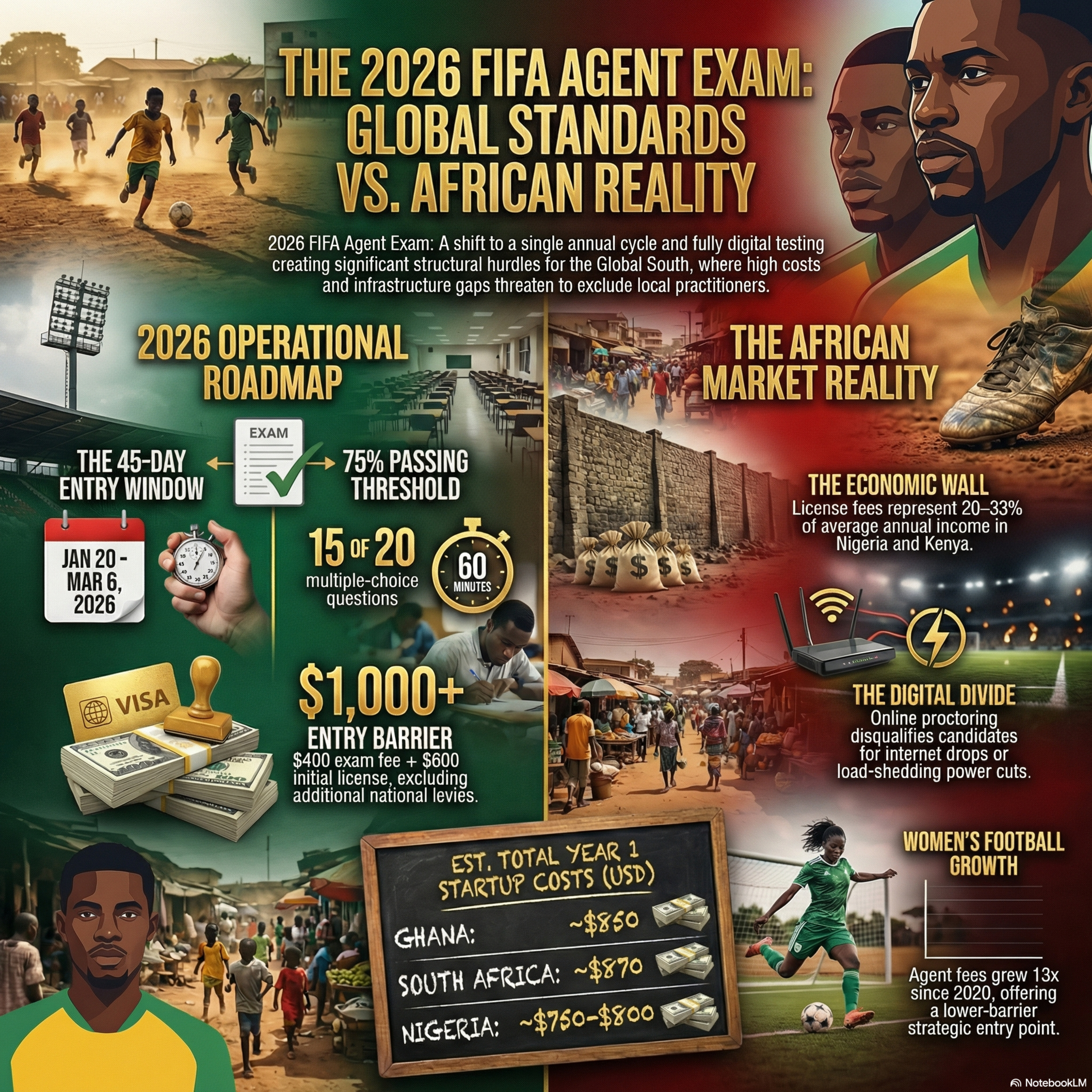
Welcome back to the Deep Dive. It is Tuesday, January 27th, 2026 and if you are breathing, living and sleeping football, specifically the the business engine that drives the beautiful game, you know exactly why the air feels a little different. Today. Oh absolutely. There's a real charge in the air. You can almost feel the static electricity. The application window for the 2026 FIFA Football Agent exam is officially open. It kicked off on January 20th, and that countdown clock is already ticking, and ticking very loudly toward March 6th.
It is absolute crunch time. I think for a huge segment of our listeners. This date hasn't just been circled on the calendar. It's been, you know, burned into it. We are entering the most critical six weeks of the year for the entire higher industry. And the stakes have, I mean, they've never been higher. We were looking at the numbers this morning and explosion doesn't even quite cover it, not any close. We're talking about an industry where global agent service fees hit what, $1.37 billion in 2025?
1.37 billion and that's a 90% jump from the previous year. 90%, that's just you can't even get your head around that kind of growth. The cash is flowing like Niagara Falls. It is a gold rush, plain and simple. When you see a sector nearly double its its revenue in just 12 months, it completely changes the psychology of everyone involved. Everyone wants a seat at that table. Of course, but. And this is the massive but that we are going to wrestle with today. While the champagne corks are popping in London, in Munich, in Paris, the reality on the ground in the global South, and specifically in Africa, is, well, it's radically different.
And that is the mission for today. We aren't here to give you a generic how to guide for the exam. We're here to talk about battle for the soul of the African game. The rules have been completely rewritten. Entire playbook's been thrown out. FIFA has changed the game. And for African agents, for Academy owners, for those mentors on the sidelines, this is a moment of, I'd say, existential danger. But, and this is the key, if you know how to read the defense, it might also be a moment of massive opportunity.
That's the key. That's the whole conversation. We are seeing what I call invisible walls going up on the surface. You know, FIFA talks about standardization, one set of rules for everyone. It sounds great on a PowerPoint slide in Zurich. That's fair. Right. But when you apply a rigid, expensive, and culturally specific standard to a deeply unequal world, that standardization, it just it morphs into exclusion. It's designed, whether intentionally or not, to push the little guy out. So today we're going to dismantle those walls brick by brick.
Yeah, we need to figure out how African stakeholders can survive in this 2026 landscape. And we're stripping away all the corporate speak. This is the locker room pep talk before the championship final. Because if you miss this window, you aren't just missing a test. Yeah, You were sitting on the bench for a very, very long. Time. Exactly. Let's not waste any time. We have to start with the beast itself, the exam architecture for 2026. OK, so let's do it. The first thing that really hit me when I look at the new schedule was the scarcity.
It used to be that if you messed up or you weren't ready, you could just try again. In a few months, that safety net is gone. Completely gone. This is the new reality, and it's a brutal 1A single annual exam cycle that is a massive psychological shift. How so? Well, previously if you were sick on the day, or you had a bad day or your Internet cut out, which believe me we will get to, you could just recalibrate and aim for the next window. Six months later, no big deal. Right, a minor set back. Exactly.
Now, if you miss this application deadline of March 6th, or if you sit the exam in April and you fail, you are locked out until 2027. You are legally unemployed as a football agent for a full calendar year. Wow, that ramps up the pressure to an insane degree. It's do or die. It's a final, not a league game. It creates A bottleneck. It's an intentional bottleneck. And look at the logistics. The exam dates are locked in April 28th, 29th and 30th. Yes, there are contingency dates in May. May 5th, 6th and 7th.
Right, but don't bank on those. Seriously, those are only if the April slots are completely oversubscribed globally. You have to be ready mentally and physically for the end of April. That's your window. So let's walk through the actual test itself, because on paper it sounds almost harmless. 20 multiple choice questions, 60 minutes, open book. The Open Book. Trap. I mean, back in university, open book meant party time. You just bring the textbook and you look up the answers. It's a memory test, but with an external hard drive.
That open book label is the biggest, most dangerous trap in the entire industry. It lulls people, really talented people, into a false sense of security. Yes, you can access the materials, but think for a second about what those materials are. It's not a short pamphlet, I take it. We aren't talking about a pamphlet. We are talking about a syllabus that spans over 800 pages of dense, interconnected and often confusing legal text. So what are we actually looking at here? What's in that 800 page stack?
OK, so you've got the foundational documents like the FIFA statutes, then you've got the code of ethics, the disciplinary code, the guardians, Safeguarding Essentials, all critical. And then you get to the big one, the monster, the regulations on the status and transfer of players, the RSTP. This is the Bible of player movement. And now you also have the new FIFA Clearinghouse regulations, which is a whole other world of financial compliance. And these aren't just like simple rules, they're legal frameworks.
They are legal frameworks. They have articles, subarticles, annexes, definitions that refer back to other definitions. It's a web. It's designed like a legal statute book. So if I get a question on, say, training compensation for a minor, I can't just flip through 800 pages in the three minutes I have to find the answer. Musically cannot do it. It's impossible. The clock is your enemy. You have exactly 3 minutes per question. That includes reading a complex scenario which might be paragraph long, identifying the specific legal issue, knowing instinctively which of those 800 pages contains the relevant article, finding that article, maybe doing a calculation because yes, there is math involved, and then selecting the correct answer from 4 very similar looking options.
If you are searching for the information during the exam, you have already failed. You have to know it cold. The open book is just there for confirmation, not discovery. Precisely, and the data, the hard numbers prove that this is just wiping people out. I was looking at the pass rates and the drop off is genuinely terrifying. OK, lay it on me. Back in 2023, the first exam under the new rules, the global pass rate was around 52%. So a coin flip tough, but you know, seems fair for a professional qualification.
Right, it was a challenge, but achievable. But then you look at the June 2025 online edition, the pass rate plummeted to roughly 19%. 1919. 19% Let that sink in for a moment. That means if 5 aspiring agents walk into that virtual exam, four of them are walking out without a career. That's brutal. So what happened? Did the candidates suddenly get worse, or did the test itself change? The test has fundamentally shifted its philosophy. It's no longer testing for football intelligence, and that is the critical distinction we need to make today.
What? Do you mean by that? You could be the greatest scout in Lagos. You could spot a future balloon door winner playing barefoot in the mud. You could have an incredible eye for talent. You could know how to navigate the ego of a club president or calm down an angry parent. The actual skills of being an agent. The real world skills, none of that, absolutely none of it helps you pass this exam. So what are they testing for then, if not football IQ? They are testing for compliance officers, They are testing for what I call euro legal memory.
The questions are structured and phrased in a way that is designed to see if you can parse complex European legal syntax. It favors lawyers. It favors people who are good at academic standardized testing. And it penalizes the other kind of intelligence. It actively penalizes the street competent agent, the guy or the woman who learns by doing, by building relationships, by understanding human nature, the person whose value is in their network and their intuition, not their ability to recall. Article 19, paragraph 2B.
That feels incredibly backward for a sport that is built on instinct, on passion, on human connection. It is. It's like testing a brilliant race car driver on the thermodynamics of the engine rather than on how to take a corner at 200 mph. That is a perfect analogy. That's exactly what it is. And for the African market, this is a disaster. The African game has always, always been driven by the mentors on the ground, the community coaches, the guys who are the first point of contact for a talented kid.
These guys aren't lawyers. We aren't sitting around reading 800 pages of statutes from Geneva. They are out there finding talent, nurturing it, and FIFA is effectively saying to them your entire skill set is irrelevant, your life's work doesn't matter. Unless you can pass our legal exam, you don't exist in our system. So you have this massive intellectual wall, the exam itself. But let's say I'm a genius. Let's say I memorize the statutes. I'm ready. I could do this. Then I hit the next wall. The economic.
Wall and this one is just as high. This is where the exclusion stops being theoretical and starts being very, very tangible. It's about cold, hard cash. Let's break down the cost of entry right now, in January 2026 for someone in, say, Ghana or Nigeria. OK, walk me through the receipt item by item. First up, you have the FIFA exam fee. That is 300 U.S. dollars. You pay that just for the privilege of sitting the test. If you fail. If you're in the 81% who fail, that money is gone. Poof. Ouch. OK, so $300 is the entry ticket?
Then if you are one of the lucky 19% who pass, congratulations, now you immediately have to pay the license fee that is another 600 U.S. dollars. Do right away. So before you even earned a single dollar in Commission, you're already $900 in the hole to Zurich. $900 straight to fee. But wait, there's more. We haven't even talked about the local fees. You have the National Association levies. These are the fees charged by your own country's Football Association. Exactly. And in Africa, these are not small amounts, they are significant.
In Nigeria, for example, we're seeing administrative and application fees in the range of 200,000 to 250,000 naira. In Ghana, application fees are around 3000 CDs. In South Africa, you're looking at something like 5000 RAN for admin fees. When you do the conversion and stack the FIFA fees on top of these local fees, you are pushing well past $1200, maybe even $1500 in total startup costs. No, I can hear a listener in London or Berlin thinking, well, $1500, that's not, I mean, that's not that bad.
That's the cost of doing business. And that is the entire problem. That's the blind spot. In Europe or North America, $1500 is a business expense. You write it off, it's a nice dinner for a top agency, but we have to talk about purchasing power parity. What it's actually worth on the ground. Precisely. In many African nations, $1500 represents 6 months, maybe a full year of the average salary for a person. It is a massive life altering capital outlay. It's not a business expense, it's a family's life savings.
And it's not just the amount, is it? We've talked about this before. It's the currency itself. That is the hidden tax, the currency barrier. FIFA wants U.S. dollars. They don't want naira, they don't want CD, they don't want the kwacha, they want greenbacks. Now tell me, how easy is it to walk into a bank in Lagos or Addis Ababa and say I'd like 900 U.S. dollars at the official central Bank rate please? It's virtually impossible for a regular person. No chance you have to have special clearance or you're on a waiting list for months.
Exactly. So where do you go? You're forced onto the parallel market, the black market, and the rate there isn't the rate you see on Google. No, it's much higher. It can be double, sometimes even triple, depending on the country and the economic situation at the time. So that $900 fee in real terms in terms of what it actually cost you out of your pocket in local currency could be closer to $1800 for the African agent. Precisely. The real cost skyrockets. The African candidate is paying a premium that the European candidate doesn't even have to think about.
And the consequence of this, the logical endpoint, is what I call the gentrification of the profession. Gentrification impact that for me. We are systematically pricing out the grassroots mentor, the guy who discovered the talent in the village, who coached him, who believed in him, cannot afford to take the financial risk on the license. So who gets the license? The wealthy, the politically connected, the people who already have money. Or even worse, the European stranger, the guy who flies into Abuja or Accra from London or Paris, pays the fee with his corporate credit card without blinking, and then scoops up all the talent that the local guys have been nurturing for years.
It creates A2 tiered class system. You have the licensed agent who sits in an air conditioned office and does the paperwork, and you have the sub agent, the local guy who does all the real work. All The Dirty work finds the player, drives them to training, talks to the parents, but because he doesn't have the official badge, he has to hand over his discovery to the license holder. And guess who takes the lion's share of the Commission? The badge holder. It is a structural extraction of value. The wealth generated by African talent leaves the community, leaves the country and goes to the person who could afford the test.
It's a neo colonial dynamic right in the heart of football. That is a heartbreaking dynamic, it really is. But we're not done with the barriers yet. Let's talk about the technology, because you call this digital apartheid. And when I read the specs for the 2026 exam, I realized you weren't exaggerating. It sounds like a harsh term, but I stand by it. It is the only accurate way to describe what is happening. Let's just look at what happened in June 2025. It was a complete and utter meltdown. The online exam.
The online exam, the software they use, it's called safe Exam Browser, is designed to prevent cheating. It locks down your entire computer, but it's incredibly resource heavy. It's a beast and it kept crashing people's systems. Candidates were getting kicked out mid exam. I. Remember seeing the outrage on social media? People who had paid their money, studied for months and in a bot piece of software just said no, you're done. It was a disaster. It was chaos. And instead of simplifying the tech for 2026 to make it more accessible, FIFA has doubled down on surveillance.
The new requirements are intense. What are they? You need your laptop, obviously, but now you also need a smartphone, and that smartphone has to be set up behind you on a tripod or propped up somehow to provide a constant 360° video feed of your room. Wait wait, so you have to stream high definition video from two separate devices at the same time for the entire hour? Yes, you are effectively running a live broadcast studio from your bedroom. And here is the real kicker. There is a 0 tolerance policy on connectivity.
Meaning what? If your Internet connection drops even for a moment, the proctoring stream cuts out. The moment that happens, you are automatically disqualified. No appeal. No, my neighborhood transformer blew up. No, the Internet service provider had an outage. You are out. End of story. That is, I mean, that's just assuming a level of infrastructure stability that simply doesn't exist in large parts of the world. Even in developed cities my Internet drops from time to time, but in regions with load shedding.
Exactly. Think about South Africa, think about Zambia, Nigeria, Ghana. You are dealing with daily power grid instability. A connection drop is not a sign of incompetence, it is a sign of where you live. It's a daily reality. It turns your national infrastructure into a career ending event. It's. Blatant infrastructure discrimination. And think about the mental state of the candidates. Compare the two. The candidate in Zurich is sitting in a quiet university library connected to a Gigabit fiber optic Internet.
Yeah, his only worry is do I know the answer to question 12? The candidate in Lagos is staring at his modem, watching the lights flicker. He's praying the diesel in the generator holds out for one more hour. He's worrying that his phone battery is overheating because it's been streaming video for 30 minutes. His cognitive load is split. He's fighting the test and he's fighting his entire environment it. Creates what I call a technical debt. Only those with high end hardware, because remember you need a powerful modern laptop to run the surveillance software smoothly and Starlink level Internet can even attempt to join the profession with any confidence.
It filters out the poor, regardless of their football knowledge. And then on top of all of that, there is the language. We talked about the 800 pages, but what language are those pages actually in? English, French and Spanish. That's it, full stop. So if you are in Angola, Mozambique, Guinea Bissau. You are out of luck. The entire Lucifone world, the massive, passionate, football crazy Portuguese speaking part of Africa, is completely and totally sidelined. And that's just bizarre when you think about it.
Brazil is the biggest exporter of footballers on the planet. Portugal is a massive gateway into Europe. The fact that the official FIFA agent exam isn't available in Portuguese feels deliberate. It feels like a snub at best and willful exclusion at worst. It forces a brilliant candidate in Luanda, who might be the next Jorge Mendez, to take a complex legal exam in their second or third language. It adds yet another layer of difficulty that the native English or French speaker doesn't have to even consider.
And the same applies to the huge swaths of Arabic speaking North Africa, unless they also happen to be fluent in French from the colonial era. Correct. We are leaving entire linguistic and cultural regions out of the conversation. And the implication, the unstated assumption behind all of this, is that academic testing equals professional competence. FIFA assumes that if you can pass this very specific, very European test in English, you are a good agent. Which creates what you call the textbook agent.
Exactly. You get guys who are great at passing tests. They know the statutes backward and forward, but they might panic the first time a player calls them at 2:00 in the morning. With a real life crisis, they might not have the street smarts to actually negotiate a contract. Versus the street competent agent. Versus the street competent agent who can manage a career, navigate the politics of a dressing room, build a life plan for a young player, but can't pass a multiple choice standardized test in a foreign language about legal statutes.
Who would you rather have managing your career? It's an easy choice, so we've established that. The good guys, the genuine local mentors, are being systematically blocked by cost, by tech, and by language. What happens to an ecosystem when you remove the good guys? You create a vacuum. And nature abhors a vacuum. This is the dark side of all this exclusion. When you make legitimate access to the profession impossible for the honest man, the illegitimate market explodes. We are seeing a terrifying rise of the fake agent and a massive corresponding spike in human trafficking.
The stats here are genuinely horrifying. I saw one that said 70% of young African players report being contacted by people claiming to be agents. 70% and we estimate based on data from organizations like Foot Solid Air that around 15,000 young players are trafficked from Africa to Europe and Asia annually. 15,000 I want to just pause on that number for a second. That's not just a statistic. That is 15,000 kids, 15,000 families. It's a generation of shattered dreams let's talk about. What that actually looks like on a human level.
How does does the scam work? It's the Instagram agent. It's become a playbook. A guy creates a slick looking social media profile. He slides into a young players DMS. His profile has photos him at a big stadium in Europe. Maybe a badly photoshopped picture with a famous *? He looks the part. He builds a perception of legitimacy. Absolutely, he tells the kid. I've been watching you. You're the next big thing. I have a trial for you in Portugal or Belgium or Turkey, but I need $5000 for the visa, the flight and the accommodation.
And the family, this is their lottery ticket. This is their one chance to escape poverty. So they create a pot. They sell land they borrow from the entire village. They go all in. They scrape together everything they have. The boy flies to Lisbon or Istanbul or Dubai. He gets to the airport full of hope, and of course no one is there to meet him. The agent's phone number is dead. The WhatsApp number is dead. The Instagram account is deleted. The boy is stranded in a foreign country. He has a tourist visa that will expire in 30 days.
He has no money, he speaks maybe a few words of the language, and he can't go home. Why not? Why can't you just fly back? Because of the shame, the immense, crushing shame, he lost the family's entire savings. He failed the village. So he stays. He becomes an undocumented migrant. He starts playing in Sunday leagues for a few dollars, works under the table in construction, and becomes vulnerable to every other kind of exploitation imaginable. And your argument is that if the local mentor, the trusted community coach, was a license agent, this wouldn't happen as often?
It would happen so much less because the family could go to the local coach they trust and say coach, this guy on Instagram wants $5000 from us. And the coach, if he was part of the official system, could say, hold on, let me check his FIFA ID in the database, let me see his license number. But he can't. He can't because he's locked out. He doesn't have the authority or the access, so the scammer becomes the only game in town. The paradox is staggering. So the regulation which is specifically designed to stop these bad actors is actually removing the policeman from the ecosystem and making it easier for the criminal.
Exactly. It's a textbook case of unintended consequences. By making the wall too high for the honest local guys, you leave the entire field wide open for the criminals who don't care about rules or licenses anyway. That is a heavy, heavy reality, but I want to pivot to another paradox because it's not just about the dangers, it's also about the money that is supposed to be there for the grassroots, the FIFA clearing house. This was sold as the savior, right? The theory was brilliant, absolutely brilliant.
Automate the payments. When a player is sold for €50 million, the clearing house automatically calculates the 5% solidarity contribution and training compensation and sends it directly to the bank accounts of the small clubs that trained him between the ages of 12 and 23. No more chasing payments. No more hiring lawyers to get what you're owed. Exactly. It was meant to be a direct pipeline of cash from the rich European clubs to the global grassroots. And looking at the latest report, there is a success story here to be told.
Something like $350 million has been allocated and $156 million has actually been distributed. That is a lot of cash hitting the grassroots. We have to give credit where it's due. When it works, it is is life changing. A sudden, unexpected check for $50,000 showing up in the account of a small Academy in Senegal that can keep the lights on for five years. It buys boots, balls, nutrition. It pays for pitches. It is genuinely transformative. I sense a butt coming. There is a massive butt. There's a bottleneck.
The same report shows that $120 million is currently sitting in a backlog. It is classified as allocated but undistributed. Allocated but undistributed. So the money has been assigned to a club but the club hasn't received it. Why is FIFA just holding onto it? It comes back to one word compliance. To receive that money from the FIFA clearing House in Paris, the small Academy needs to be onboarded into the international banking system. They need an IBAN number for their bank account. They need to provide audited financial statements.
They need to show proof of beneficial ownership. They need to have corporate incorporation documents. And let me guess, the Neighborhood Stars FC in Acro or the Community Academy in a Lego suburb does not have an audited financial statement from a BIG4 accounting firm? They might not even have a formal bank account in the club's name. They might operate out of the coach's personal savings account because the monthly fees for a commercial bank account are too high. They are informal institutions.
They did the hard work. They train the player for 10 years, but they can't do the paperwork. So the money leaves the buying club in England, it goes to the clearing house in Paris, and then it just sits there in purgatory. It sits in purgatory. Yeah, it is tantalizingly close. The Academy can see it's been allocated to them on the system, but they can't touch it because they don't have the keys to the compliance lock. It feels like there is this fundamental clash of cultures. Here you have the Davos world of FIFA, Digital, audited, transparent, corporate and then you have the grassroots world, relational, cash based, informal and the rules are written entirely by and for the Davos world.
Correct. And this brings us right back to why we need licensed African agents on the ground. Because who is going to help that Academy get compliant? Who is going to walk them through setting up a corporate entity and getting their books in order? It should be the local agent who represents their players. But if he can't even get a license? The cycle of exclusion just continues. The Academy stays poor, the agent stays unlicensed and the money stays in a bank account in Europe. Exactly. It's a closed loop, but people aren't taking this lying down.
This leads us to the legal and political land escape, because while we're sitting here stressing about the exam for African agents, the big boys in Europe or in court fighting the system. It is A2 speed world. It's deeply hypocritical in Europe, specifically in places like Germany, the UK, France, Spain. The biggest agencies in the world have money and they have lawyers. They sued FIFA over the new regulations, specifically the agent fee caps. And they want, and in many cases they want injunctions.
So right now, as we speak in Germany, the fee caps are suspended. In the UK, the rules are blocked by the courts. The regulations don't apply to them. But in Africa, in Africa, the rules are often applied in full force. We don't have the same litigious environment or the judicial leverage over Zurich. So you have this bizarre, deeply unfair situation where the richest, most powerful agents in the world are exempt from the restrictions, while the agents in the global S who the rules were supposedly meant to help, are facing the full brunt of them.
That is just it's wild. The people who supposedly need the protection aren't getting it, and the people who have all the power are just opting out. But there is a crack in the armor, a big one. We have to talk about the Deira precedent, the Lasana Deira case that went to the European Court of Justice. The ruling in essence suggests that FIFA's transfer rules might be anti competitive under EU law. It challenges the very authority of FIFA as a private body to restrict trade and the free movement of workers.
So the legal ground is shifting, even if it's slow. It's shifting and closer to home we are seeing real political organization, the robot declaration. This is something everyone needs to pay attention to. What is that about? This is significant. The African Football Agents Association, or AFA, is finally waking up and organizing. They held a major conference in Rabat, Morocco in April of 2025. This was a hugely strategic move. Morocco is positioning itself as the new leader, the diplomat of African football.
They're hosting the AFCON Co hosting the 2030 World Cup. And by hosting the agents, they are giving a powerful, unified platform for resistance. Exactly. The demands that came out of that Rabat conference were clear, practical and reasonable. One, fee waivers for developing nations don't charge the Nigerian agent the same as the Swiss agent. It's simple Equity makes sense 2. Regionalize the exam. Forget the unstable online test, let us take it in physical centers in major cities with guaranteed Internet 3 language equity.
Add Portuguese and Arabic to the exam materials at a minimum. These aren't radical demands. They're not asking to scrap the system. They're just asking for a fair playing field. They are asking for the basic tools to do their jobs, and the very fact that they are organizing, that they're meeting in Rabat and Johannesburg and creating a united front shows that the era of passive acceptance is over. Africa is starting to negotiate as a bloc, not as 54 individual nations. So we have painted a pretty intense picture here.
High costs, tech walls, language barriers, legal battles. The listener might be sitting there thinking, why even bother? This game is clearly rigged. But we promised a pep talk, we promised a playbook. So let's pivot to strategy. If you are an African stakeholder in 2026, how do you survive this? How do you win? We adapt. We get smarter. If the rules of the game are designed to favor the organized, then we must be the most organized people in the room. OK, let's get into it. Strategy number one.
You call it compliance pooling. I love this term. What does it mean in practice? It means you stop trying to be a lone wolf. The days of the one man agency operating out of the boot of his car are numbered. They're over. You simply cannot afford the back office required to navigate the Clearinghouse and FIFA's compliance regime on your own. You can't hire a compliance officer, a lawyer and an accountant on a single agent's Commission. It's impossible. So you merge, you team up. You merge or you form strategic alliances.
Imagine 10 small independent agents in Accra. Individually they are vulnerable. They're struggling. But what if they come together and say let's pull 10% of our revenue to hire one top class compliance manager who handles all the paperwork for all ten of us? Suddenly they are powerful. They create a shared services model, a super agency at the local level. Exactly. You see the big global agencies like CAA, Stellar and Wasserman consolidating and buying up smaller firms. African agencies need to do the same, scale up or team up.
If you want to unlock that $120 million sitting in the clearinghouse, you need a corporate structure. Build it together. I like that it's practical. OK, strategy #2 the women's football frontier. This is one of the brightest spots in all the data isn't. It it is a massive, massive opportunity. Women's agent fees grew 13 times over recently, hitting about $6.2 million. Now, in the grand scheme of things, that is still small compared to the billion dollar men's game, but the growth curve is vertical.
It's hockey stick growth. And the barriers to entry are presumably lower. The competition is much lower. The Sharks, the established super agents, haven't completely infested those waters yet. The relationships are still being formed. The market is not yet saturated. For a new African agent, this is a massive open lane. The women's game on the continent is growing so fast. Just look at the investment CF is making in the Women's Champions League. I love that. Don't fight for the scraps in the overcrowded men's market.
Go where the blue ocean is. Build your reputation and your business there. And you can actually build genuine human relationships there. You can be a true career manager, a trusted advisor, not just a transaction broker. It's a chance to build something from the ground up. Great point strategy #3 technical infrastructure accountability. This one sounds a little more confrontational. It's a demand, it has to be. The agents in the national associations need to start putting pressure on their local FAS.
If FIFA requires a stable, high speed Internet connection to take the exam, then the local FA has a responsibility to help provide it. So what does that look like? It's simple. Open up the Media Center at the National Stadium on exam day. Open up a hotel conference room. Buy a generator and a couple of Starlink dishes. Create a guaranteed stable environment for your aspiring agents. That is such a simple, practical fix. Don't make every single candidate rely on their fragile home wifey. The FAA should say come to our headquarters.
We guarantee the power will stay on and the Internet will not drop. Exactly, it's about providing collective infrastructure. It solves the digital apartheid issue at the local level. If the FAA wants to have more licensed agents bringing money and players into their country, they have to help them take the damn test. Couldn't agree more. And finally, the most important one, maybe strategy #4. Education. This is the foundation for everything. We have to move our mindset beyond just scouting. You can't just be a challenge spotter anymore.
That's not enough. You have to become a legal expert. You have to become a compliance expert. And that means preparing for this exam years in advance, not cramming for a few weeks. You have to treat this like a lawyer treats the bar exam. It's a multi year commitment to study. You have to read the 800 pages, then read them again. You have to do mock exams. You have to know the statutes better than the guys who wrote them in Zurich. Knowledge is the only weapon that can truly defeat a structural disadvantage.
It's the ultimate equalizer. If the test is designed to be hard, then you must become undeniable. If they want legalese, you give them legalese. You beat them at their own game. That brings us to our final synthesis. Then we have looked at the walls and we have looked at the ladders you can use to climb them. The 2026 framework is without a doubt a survival of the most organized The blind spots, the tech, the cost, the language. They are real. They are profoundly unfair, but the opportunity that clearing house money, the ever expanding global transfer market is simply too big to ignore.
We can't afford to walk away from the table and protest. It really feels like a turning point, a fork in the road for the entire continents footballing future. It is, and here is the provocative thought I want to leave the listener with today. If the current system continues down this path, if it continues to exclude the very people on the grand who discover and nurture the talent, are we heading toward a future where African football is played by Africans but owned entirely by foreign entities?
Wow, say that again. Played by us, but owned by them. That is the trajectory. We're on a continent of talent managed, monetized and controlled from offices in London, Paris and Dubai. That is the end game of the system if it goes unchecked. Unless the robot spirit forces a change. Unless the collective organization of African agents, associations and FAS forces FIFA to recognize that, you cannot govern the global game by excluding the continent that provides so much of its most precious resource, the talent.
That is the question, and the answer depends entirely on what the people listening to this deep dive do next. Don't just learn the rules. Master them, hack them, and then change the game from the inside. The whistle has blown. The game is on. One last thing before we go, because I really can't stop thinking about the psychological aspect of this. We've talked about all the practical barriers, but imagine the sheer guts it takes to click submit on that application right now. It's courage. That's the only word for it.
Pure and simple. Courage when you know the odds are stacked against you. Maybe an 80% chance of failure. When you know the cost is 6 months of your family savings. When you know the technology might betray you through no fault of your own to still step into that arena. That's something else. That is the warrior spirit of African football. That's the hustle and the belief that defines the continent. It really is. It's not just applying for a test. It's a statement of intent. It's an act of defiance.
And that, you know, that is why I'm ultimately optimistic, because despite all the barriers, despite all the invisible walls we've talked about, people are still applying. They are still fighting to be a part of this industry. And as long as that hunger exists, the game will find a way. The talent will find a way. The game always finds a way. Good luck to every single person applying. Study hard, check your Internet connection twice and go get that license. Absolutely. Go get it. Thanks for listening to the deep dive.
We'll see you on the other side.
 Apple Podcasts
 Castbox
 Castro
 Goodpods
 Moon FM
 Overcast
 Pocket Casts
 Podbean
 Podcast Addict
 Podcast Republic
 Spotify