FIFA Talent Identification Guide African Perspective
About this episode
FIFA Talent Identification Guide African Perspective
So I want to start this deep dive with a scenario. Imagine a highly controlled study. OK, they bring 80 professional football scouts into a facility and they asked them to evaluate the exact same group of 12 year old players. And we should clarify these aren't just, you know, casual weekend coaches. No, absolutely not. These are veterans of the game. I mean people whose entire livelihoods, whose mortgages literally depend on their ability to spot future superstars. Exactly the absolute elite. Right.
So they sit there, they watch the kids play, they take all their detailed notes, and then they submit their evaluations on, you know who the most talented players are. Do you want to know their rate of agreement? It's it's a genuinely staggering piece of data. It was almost 0. Yeah, I mean 80 trained eyes looking at the exact same physical events on the pitch. The. Exact same passes. The exact same dribbles, right? And they walk away with 80 completely different conclusions. Which is just wild to me.
And you know, for you listening, that single fact right there completely dismantles the biggest myth in global football. The famous eye test. The eye test. Yes, this whole romantic idea that some grizzled old scout can just stand on the touchline with a cup of coffee, watch a kid play for 20 minutes, and justice intuitively know if they have the magic. Right. It's a great story, but today we are completely tearing that myth down. Completely. And the reason we are so fired up today to bring this to you is because while we recently had the immense privilege of sitting in on a gathering of the absolute elite.
It is incredible. It really was. I mean, imagine sitting completely silently in this massive, strictly confidential room. You could literally hear a pin drop. Yeah, the tension was palpable. Up on the stage and just scattered all throughout the room were the greatest strategic minds in the sport about the architects behind World Cup winning nations. The directors of those mega academies that just churn out generational talent after generational talent. Exactly. And the data scientists who like, literally see the matrix of the beautiful game.
And they were up there furiously debating, you know, ripping apart these old dogmas and revealing this ultimate blueprint for building a world class football ecosystem. And you realize very quickly in an environment like that just how far behind the rest of the world actually is. Oh man, it's sobering. It is because what separates the good from the great isn't just passion. Right. No, we have plenty of that. Exactly. And it certainly isn't just having millions of kids playing in the streets. It's it's a systematic, highly rigorous approach to human potential.
And we sat in that room furiously taking notes, just absorbing every single tactical shift and, you know, psychological profile. And we did it with one burning mission. Right, because we didn't absorb this absolute master class just to marvel at European or South American success stories. No, not at all. We took this in to distill it specifically for you right here today, because our ultimate goal, the whole point of this deep dive, is to take these global secrets and apply them to elevate our African game to unprecedented heights.
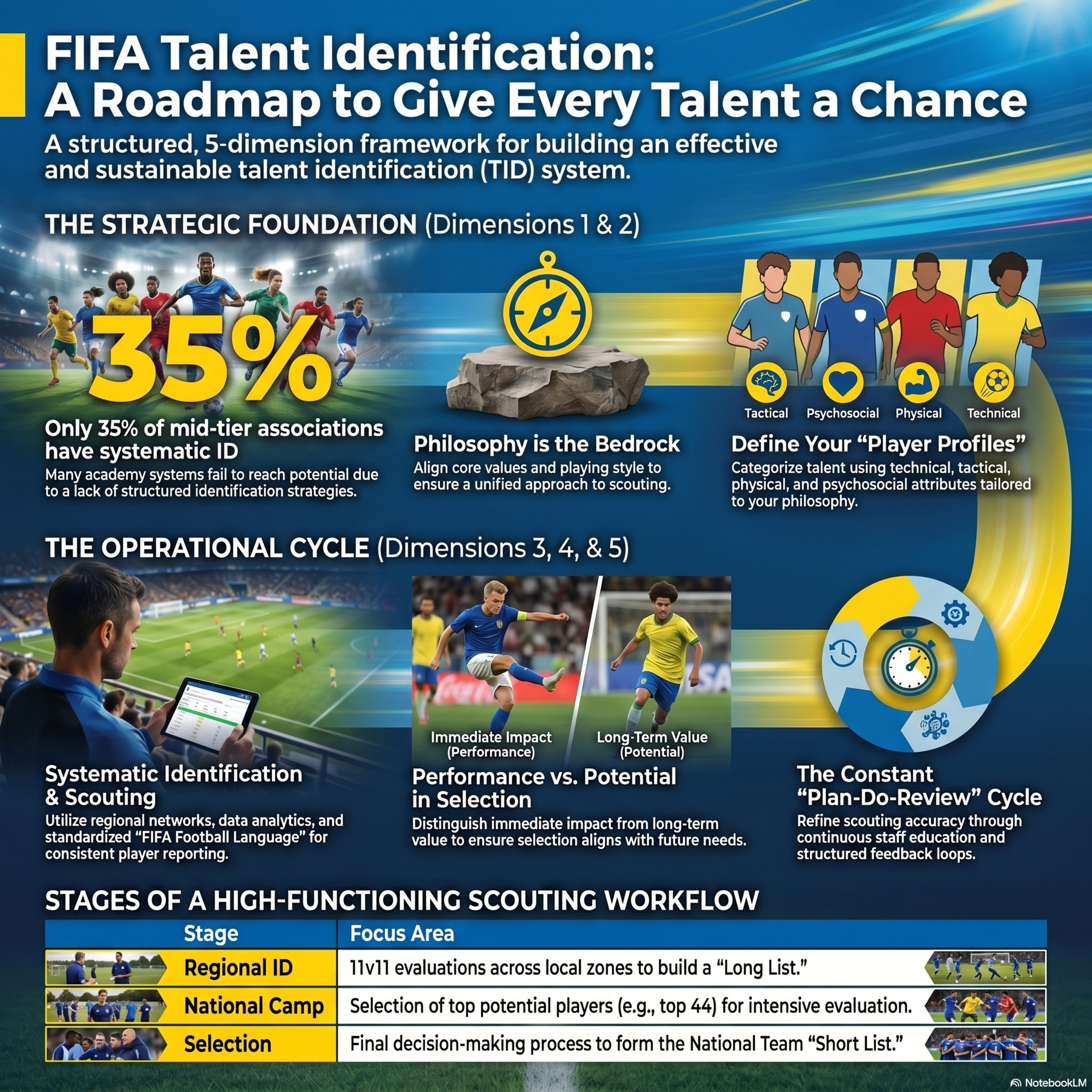
Because Africa has the raw material. I mean, no one disputes that, right? Not a single person in that room would dispute it. Exactly. The raw talent pool on the continent is arguably the deepest on earth. The passion is totally unrivaled, but raw material without a refinery is just potential energy. Oh, I like that. Yeah, you need the blueprint to actually convert it. And the blueprint we are unpacking for you today is A5 dimension model. We are going to walk you through philosophy profiles, identification, selection, and finally constants.
And what is totally crucial to understand right from the jump is that true talent identification is not just about spotting some kid kicking a barefoot marvel in the dust and, you know, handing them the club shirt. Right, it's not a movie. No, it's a rigorous, bias free, step by step system designed to ensure that absolutely no talent is left behind. It's an entire ecosystem. OK, let's ground this. If you're trying to build a skyscraper, you don't start by picking out the interior curtains, right?
Certainly not. You don't even start by pouring the concrete. You need an architectural foundation, and in this blueprint that foundation is dimension 1, which is philosophy. Which is, quite frankly, precisely where almost every failing football institution goes completely wrong. Yeah, they just skip it entirely. Exactly, they skip the philosophy and just immediately start scouting players. But how can you possibly scout if you haven't defined what you're actually looking for? It's impossible. It is.
Dimension 1 dictates that you must deeply understand what it takes to win, and not just in today's game, but in the game of the future. It's the soul of the organization. But wait, let me jump in here because when we talk about a quote UN quote football philosophy, I think the mind instantly goes to tactics, right? Sure, formations pressing. Right, like are we playing a high pressing 433 or are we sitting deep in a low block? But the masterminds in that room made it incredibly clear that a true philosophy goes vastly deeper than formations.
It starts with the human being. It absolutely does. The absolute non negotiable bedrock of any successful football philosophy, and this was stressed with intense urgency. In that room is the child before the player mandate. The child before the player. Exactly. This means prioritizing the psychological well-being, the holistic development, and the ethical responsibility toward the young athlete above absolutely everything else. We're talking about safeguarding here, child protection. Always, without exception, safeguarding must always precede performance considerations.
Which is a huge shift in mindset. It is, but the logic is brutal and undeniably true. If your foundational philosophy doesn't start with protecting and nurturing the human being, the entire high performance structure built on top of it will eventually fracture. It'll just collapse under the pressure of elite sports. That shifts the entire paradigm for me. We aren't just mining for physical resources, we are developing human beings. And you know, to see how a philosophy actually shapes the destiny of a whole nation.
The case studies they presented were just mind blowing. Oh, the global case studies were fascinating. Let's break down the Welsh way. Wales is a pretty small nation, right? Geographically and by population. Yet they punch wildly above their weight on the international stage. How do they do it? In a word, unification. OK, unpack that. The Welsh model is a perfect case study in the power of a unified syllabus. The Welsh Football Association looked at their relatively small population and realized a fundamental truth.
They literally could not afford fragmentation. Because they just don't have millions of players to waste. Exactly, if every local club played a different style, the talent pool would be constantly resetting every single time a player moved up a level. So they created the Welsh way. A national coaching syllabus. Yes, they codified their core principles of play and mandated that those principles trickle down to every single level of the pyramid. So meaning a grassroots under 8 coach in a tiny little village speaks the exact same tactical language as the manager of the senior national team.
The exact same language. So when a 15 year old player gets called up from their local provincial Academy into a National Youth camp, they aren't forced to learn a completely new sport. Right, they don't have to figure out some totally new pressing trigger or a weird defensive shape. No, they are just playing the Welsh way, just at a higher cognitive and physical intensity. It removes all that friction from their development. It creates total synergy, I love that. And then contrast that with the Finnish model, which I thought was amazing.
They approach philosophy from a slightly different but equally powerful angle. Yeah. Finland rooted their entire football philosophy and their broader national culture. Right, because their society heavily emphasizes equality, education, and, you know, social welfare. So their football philosophy literally translates to giving every talent a chance. Which sounds like a great PR slogan, right? Right. Like something you'd put on a billboard. But it's an actual operational mandate for them. It dictates exactly how they allocate their financial resources.
Tell them what that means on the ground. It means that a child growing up in a remote freezing town in the north of Finland receives the exact same standard of coaching, the exact same facility access and the same developmental opportunities as a kid living in the affluent suburbs of Helsinki. Their national values are their football values. Exactly. And this is where we have to forcefully pull this back to our context, because applying this to the African game is where the magic happened. Absolutely, because we cannot and really should not simply copy and paste the Welsh way or the Finnish model.
No, a rigid, low block European structure might completely suffocate African talent. It would. But we absolutely must replicate their alignment. So here is the multimillion dollar question for you listening. How do we take our rich, vibrant, wildly diverse, community centric cultures across the African continent and distill them into a unified playing philosophy? It's a massive challenge. Huge. I mean we have nations with immense geographical spread. Think of the DRC or Nigeria. We have these deep rooted traditions of street football, relentless flair, rhythm and improvisation, right?
How do you build a philosophy that honors that Ubuntu spirit that I am? Because we are mentality while still integrating the ruthless high performance demands of the modern champions. League Well, that is the exact architectural work that African federations must undertake right now, right? And African nations football philosophy might be defined as, say, relentless physical dynamism paired with technical improvisation. It might lean heavily into the chaotic brains of how the game is learned in the streets.
OK, I see. But. Whatever that identity is, it cannot just live in the minds of a few older coaches. It has to be codified. It must be written down rigorously, taught in coaching courses and deeply understood by every single scout on the continent. OK, but hold on. Let me push back on this a little bit because this sounds slightly dangerous to me. Well, football is an art form as much as a science, right? If our philosophy dictates exactly what kind of talent we are looking for, does that mean a brilliantly gifted player might be considered quote UN quote untalented just because they don't fit the local mold?
Oh, I see where you're going. Are we inadvertently building a machine that just filters out pure geniuses just because they play to a different rhythm than the national syllabus? It's a very valid fear, honestly, and it's a trap that rigid, overly bureaucratic organizations fall into all the time. But the distinction made by the experts in that room was incredibly clear. OK, what was? It a strong philosophy, does not limit talent. It provides a shared framework so scouts know exactly how to evaluate what they're seeing.
It's a unified vision, not a straight jacket. OK, explain that. How does a highly structured syllabus not become a straight jacket? Because a truly world class philosophy defines the what and the why, but crucially, it leaves room for the how. OK. Right. If your national philosophy is built on dynamic, aggressive, attacking football, you aren't rejecting a highly creative, unorthodox genius. You're just giving them a context. Exactly. You are actually giving your scouts the mandate to find players who can execute that aggressive vision, even if they do it in a totally unpredictable way.
So what does the philosophy actually do then, functionally? What it does is prevent a scout from dismissing a small, technically brilliant player simply because that particular scout personally prefers tall, physical players. The philosophy replaces the Scouts personal bias with an objective national standard. The philosophy becomes the shield against individual prejudice. Yes, perfectly said. I love that. And you know that transition perfectly bridges us into the second dimension of this blueprint, dimension 2, which is profiles, right?
Because once you have defined the abstract soul of your game with your philosophy, you actually have to figure out what the real human being executing it looks like. We are moving from the philosophical to the tangible biological blueprint of the future player. And you really can't have one without the other. No philosophy absolutely dictates profiles. Profiling is the rigorous process of defining the exact technical, tactical, physical, psychological and social attributes required for success in your specific system.
Right, so a scout isn't just walking out onto a dirt pitch in Accra looking for a generic good player. No, they have a hyper specific blueprint. And this involves both subjective and objective benchmarking, right? The room got incredibly granular. Here we are talking about profiles that are gender specific, age specific and position specific. Because obviously you don't judge a 14 year old female fullback using the exact same athletic and tactical metrics as an 18 year old male center midfielder.
Right, the Physiology is different, the cognitive developmental stage is totally different. Exactly. Let's look at some real world examples that they presented from top tier global tournaments to illustrate this level of specificity. The profiling of Sophie Amrabat during his phenomenal World Cup run. Oh, Amrabat is the ultimate case study here. It's a perfect example of profiling for a highly specific positional need within a tactical philosophy. Because when a top scouting department looked at him, the profile wasn't just defensive midfielder.
No, that's way too broad. The specific profile required by the system was the playbreaker to Playmaker playbreaker to. Playmaker. I mean, just think about what that implied. It implies 2 completely different phases of the game happening within milliseconds of each other. Precisely. And that requires a very specific, rare cocktail of attributes. Physically, to be the playbreaker, you need lead endurance, massive shielding, strength, and a really low center of gravity. You have to be an absolute tank.
Right. And tactically, you need the aggressive anticipation to read passing lanes and literally break up the opposition's play. But then the second the ball is 1, the profile completely flips. Exactly. Technically and psychologically, you instantly need the composure, the spatial awareness, and the passing vision to transition the team from a defensive posture into a devastating counterattack. The very moment the ball is secure. Right. If your national philosophy demands devastatingly quick transitions, you don't just look for a big guy who tackles hard.
You profile for an amrobot. And on the women's side, they talked about the profiling of Sama Paralluelo, which was equally fascinating. Oh, absolutely. They didn't just profile her as a generic winger, they defined her role as the rater of the final third. Could rig you with the final third. I love that term. Way too think about the psychology embedded in that title alone. Her profile isn't just about straight line speed, it's about the psychological audacity to isolate defenders and just relentlessly take them on.
Yes, it's the technical precision to deliver crosses or shots while under immense physical pressure, and the specific physiological bursts of acceleration required to shatter defensive lines. So when a scout goes out with that specific profile, they aren't just watching a game, they have a checklist of measurable attributes. But the profiling isn't just about analyzing the game as it is played today. Right. No. And this is where Arson Wenger's perspective became a huge focal point of the master class.
Wenger emphasized that when you are scouting a 12 year old today, you are not recruiting them to play in today's game. You were recruiting them for the game a decade from now. The player of the future. Yes, you have to anticipate the evolutionary trajectory of the sport. The data clearly shows the game is getting faster. Much faster. The physical distances covered at high intensity are increasing every year and the space afforded to players is rapidly shrinking. So what does that mean for scouting?
It means the demand for incredibly precise passing under duress and deliberate high speed dribbling in confined spaces is going to skyrocket. So if we are profiling a 10 year old in a local African Academy right now, we have to look for the cognitive processing speed and a tight space technical ability that will be absolutely mandatory in the year 2036. We must profile for tomorrow Exactly. Which means looking past the kid who is just currently outrunning everyone on a massive open pitch, because those open spaces simply won't exist at the elite level when they are 22.
Spot on, but profiling isn't just individual, it's also macroscopic. They talked a lot about squad profiles and gap analysis. Oh, this is crucial for Academy directors and national team selectors. You have to map out what you already have in your system to realize what you are fundamentally missing. Right. You employ depth charts and SWOT analysis, and you're analyzing the strengths, weaknesses, opportunities, and threats within your current talent pool. Let me use an analogy here. Think of your national talent pool like an ecosystem on the Savannah.
OK, I'm with you. You don't just breed apex predators if your National Academy system accidentally recruits and develops 30 incredible number 10s. You know, the flashy creative lions of the pitch, but you utterly fail to develop any dominant, physically imposing center backs. Your ecosystem starves. Your team will lose. Exactly, Gap analysis is looking at your Savannah and realizing you have an abundance of predators but absolutely no herbivores to sustain the actual structure. Without a squad profile, you operate completely blindly.
Gap analysis tells you exactly where your developmental pipeline is dry. If you realize your U15 national pool has absolutely no naturally left footed left backs with elite stamina, you can direct your scouting resources specifically to find that profile rather than just passively waiting for one to magically show up. It fundamentally changes the mandate and in our African game, this is a massive, massive paradigm shift. Why is that? Because historically, the sheer volume of raw, sensational talent has almost been a curse when you have hundreds of naturally gifted kids playing in a single Township.
Are we just looking for the quote UN quote best athletes? The kids who score the most spectacular goals and make the crowd roar. Usually yes. Right. But are we actively profiling for the specific, nuanced roles our tactical philosophy demands? Are we diligently searching for the quiet orchestrator, the relentless disruptor, the Raider of the final third? And that overabundance of obvious talent is exactly what makes systematic profiling so vital in Africa. It is so easy for a scout to just pick the kid who stands out physically in a moment.
Because it's the path of least resistance. Exactly. But true profiling forces you to look deeper. It forces you to look past the physical dominance and assess the psychological resilience, the tactical adaptability. It forces you to build a cohesive team, not just assemble an All Star squad of individual St. performers. OK, so you've cast this massive net. You know your philosophy, you have your highly specific futuristic profiles. The theory is locked in the. Theory is the easy part. Right. But now we hit the hardest part of the entire operation Dimension 3 identification.
The actual muddy booths on the ground science of spotting this talent. How do we physically find these players across an entire nation? This is where we must transition from theory into hard systems and processes. Identification requires structured scatting environments, comprehensive live observations, and increasingly sophisticated data analytics. You need a literal dragnet that covers every corner of your territory. But as the experts in the room made abundantly clear, before you can build a new system, you have to aggressively tear down the old one.
We have to deeply understand why the traditional model of Scouting is irreparably broken. This was the absolute aha moment of the entire summit for me, The utter dismantling of the eye test. They brought out the scientific receipts and it was just devastating. Let's talk about Doctor Tom Bergkamp's study. Oh, Bergkamp's study is a classic. He conducted A comprehensive study of 125 Dutch scouts. Now remember, the Netherlands is globally revered as a Mecca for youth development. Ajax, PSV, Fionor, these are institutions.
The best of the best. Yet Bergkamp's study revealed fatal systemic flaws. Firstly, the data show that these elite scouts were frequently and very confidently assessing players at an age where it is scientifically proven to be totally unreliable to predict future senior performance. They were writing definitive, career altering reports on kids who hadn't even gone through puberty yet. Exactly. They were essentially judging a biological Caterpillar and declaring confidently that it would never be a fast butterfly.
It's madness. And secondly, and far more worryingly, the study revealed that these scouts heavily mixed objective criteria with their own highly subjective gut feelings. The famous gut feeling. Right. And when impressed, the criteria they used were totally vague. They couldn't consistently articulate what they were actually measuring. Like what? Well, one scouts definition of good game intelligence was completely different from another. 'S and if the Dutch study showed cracks in the foundation, Doctor Dennis Luden's study was the literal Wrecking Ball.
This is the study we opened the show with. Yes, the 80 Swiss professional scouts. Their entire professional existence revolves around spotting talent. He had them look at under 12 players and the result was just a shocking, almost comical lack of consistency. There was virtually 0 agreement among the 80 scouts on which players actually showed the most promise. It's absolutely terrifying from an organizational standpoint. I mean, if 80 experts look at the same kids and give you 80 different answers, you do not have a scouting system.
What do you have you a lottery? Wow, a lottery. And the reason for this massive discrepancy was that the scouts were relying on intuitive, holistic impressions. They were just watching the flow of the game and going with what their gut told them, rather than following structured, rigorously objective guidelines. It proves definitively that relying solely on one human being's interpretation of a game is a massive liability. So what is the antidote here? How do you cure the bias of the eye test? The antidote is standardization.
Organizations absolutely must use a common, standardized language. During the master class, they introduced the concept of the FIFA football language, right? So this is a highly regulated, standardized vocabulary designed to analyze actions both in possession and out of possession. Which is so needed because if an African scout in a rural province writes in a report that a player has, you know, great vision, that could mean they saw the kid hit one lucky 40 yard diagonal pass. Exactly. But a scout in the capital city might define great vision as the ability to constantly scan the field and execute 5 yard line breaking passes under extreme pressure.
The words are the exact same, but the reality is entirely different. Standardized language completely removes the ambiguity. It forces everyone to define exactly what they're seeing using the exact same metrics. Makes total sense. Furthermore, they introduced A framework that completely revolutionizes how we view young players. It's called the Performance and Potential Matrix. This was huge. It's critical because it formally separates the here and now from the future trajectory. Let's break that down.
Sure. Performance is defined as the current technical skills and current physical attributes. Yeah, it is how good they are today in this exact moment. But potential is a completely different access on the graph. Entirely different potential measures. Adaptability, Work ethic. The cognitive capacity to learn new concepts. Psychological Resilience. Give me an example of how that plays out. Well you can easily have an early maturing 15 year old who just dominates physically. Their performance is off the chart today.
Right, they just run past everyone. But maybe they are arrogant, they don't listen to coaching, and they totally crumble when a team scores against them. Their potential is effectively 0. And conversely, you might have a much smaller, physically undeveloped kid whose current performance is just moderate. They get muscled off the ball easily. Right. But they constantly scan the pitch, they ask intelligent questions, they adapt to new tactical instructions instantly. So their potential is exceptional.
Exactly. The matrix forces the scout to evaluate the trajectory, not just the snapshot. And to see a system that truly operationalizes this matrix. The room was presented with the Honduras case study and I found this profoundly relevant for us. Honduras is a fascinating example. It is because Honduras is a developing football nation, right? Not some European superpower with infinite money. But they completely restructured their talent identification. What do they do? They established 6 regional development centers across the whole country and here is the absolute genius part.
Instead of just watching players in one off chaotic weekend matches, they bring them into these centers and train them in two to three month micro cycles. That time factor is everything. It really is. Because a one off match only shows you performance, but a three month micro cycle gives you the actual time to observe their capacity to learn. It reveals their potential. And during these microcycles, the Honduran coaches use a highly specific methodology known as the three V's to test the players adaptability.
3V's We need to define these clearly so you're listening can apply them. The three V's are variety, variation, and variability. Let's run through them. These are basically levers, a coach poles to induce controlled chaos and measure cognitive response. OK, so what's variety? Variety means changing the fundamental type of drill, moving from a passing Rondo directly to a physical one-on-one dual. The coaches are watching to see how quickly the player shifts their mindset. OK. Got it and variation.
Variation means keeping the exact same drill but radically altering the constraints or rules. For example, playing a small sided game but suddenly imposing A strict 2 touch limit. So you're looking for who panics and who instantly solves the new puzzle. Exactly. And finally, variability means changing the external environment itself, playing on a wet, uneven, muddy pitch versus playing on pristine artificial turf. By shifting these three levers constantly, the coaches aren't just looking at who has the best first touch, they are scientifically measuring who adapts the fastest.
Right. But you know, the most staggering part of the Honduran model is tell me they assess absolutely everything they do not just look at what happens between the white lines. Really. Yes. They evaluate a player's home life, their social environment, their nutritional access, their psychological stability. It is a true 360° holistic evaluation of the entire human being. Wow. OK, so bringing this massive weight of information back home to Africa, in massive African countries with incredible raw talent just hidden in remote, often under resourced rural areas, how do we physically implement this?
It's the ultimate logistical question. Right. How do we avoid the trap of the Swiss and Dutch scouts? How do we stop relying on one local scouts biased gut feeling about a kid playing barefoot on a gravel pitch? The answer is systemic technological coverage combined with deeply standardized education. Explain the education piece. Well, you cannot have a scout in a rural district using a totally different metric than the head scout at the national headquarters. Every single person tasked with identifying talent must be rigorously trained on that standardized FIFA language and the performance and potential matrix.
It means implementing clear, unforgiving grading systems, for example using a rigid 1 to 4 numerical scale ranging from below level to exceptional. But you don't just give them the numbers. No, you provide highly specific video backed definitions for exactly what a three looks like in terms of, say, spatial awareness for a 12 year old. And crucially for the African continent, where early physical maturation often heavily, heavily skews the outsomes of youth tournaments, we must structurally force our scouts to heavily weight the psychological and social factors.
The potential axis of the matrix. Exactly. Rather than just being blinded by immediate physical performance, we have to stop selecting the biggest, fastest 13 year old and start identifying the smartest, most adaptable 13 year. Old. That is such a vital pivot, but identifying the talent you know, putting their name into a massive database is only dimension 3. Right, you're only halfway there. You've cast this massive net across the continent. You've got a spreadsheet with 10,000 kids who look promising.
And now the math becomes your biggest enemy. Exactly. You can't invite 10,000 kids to a national training camp. The sheer volume forces us into the most ruthless phase of the funnel Dimension 4 selection. The hardest part? It's the art and the science of the decision. Identification gets you into this system, right? But selection is the brutal reality of who actually gets to put on the jersey. It is a filtering process that must be ruthlessly objective, yet entirely human at the same time. And it operates fundamentally on the transition from the long list to the short list.
OK, define the long list. For us, the long list is the wide net. You scan your entire ecosystem, pulling in all the data from your scouts who are using the standardized language, and you build a massive database. Right, you ensure that the players on this list meet the basic physiological and technical requirements and fit the broad profiles we establish back in dimension to. The long list basically ensures you have positional balance and aren't missing anyone blatantly obvious but the shortlist.
The shortlist. That's where the magnifying glass comes out. That is where dreams are realized or deferred. And to manage that transition without bias, the elite organizations at the master class detailed an incredibly precise 8 step decision making framework. This is the highly confidential inner circle of how a top tier organization actually decides who stays in the Academy and who was released. Let's unpack all 8 steps because this is the operational core. All right, step one. It must be collaborative.
You gather diverse input from field scouts, the coaching staff, the medical team and the technical directors. So it is never under any circumstances a dictatorship of 1 managers. Isolated opinion. Never Step 2. It must be systematic, meaning it is a defined unvarying step by step approach. You don't skip steps just because a player scored a hat trick on Saturday. Love that Step 3 is comparative, meaning you aren't just looking at the player in total isolation. Right, you are heavily weighing them against the specific metrics of positional profiles defined in dimension 2 and comparing them directly against their peers in the system.
Step 4 is evaluative. This is the synthesis phase. You're taking the Ross scouting reports, the GPS data, the live observations from the microcycles, and synthesizing them into a coherent narrative about the player. Then Step 5 requires balancing the quantitative and qualitative, and this is really the art of it. How do you balance those? You look at the hard quantitative data, the top speed, the past completion percentage. But you must balance that with the qualitative traits. Their character, their leadership in the dressing room, their visible reaction to making a critical error in a big game.
Right. TE 6 is holistic, which echoes the Honduran model we just talked about. You look at the human being. What is their family background? Do they have a support system? What is their psychological profile? You're investing in the person, not just the athlete on the grass. Exactly. Step 7 is continuous. You rigorously monitor their trajectories over time. It's not just a snapshot evaluation at the end of the season. And finally, step 8, rounding it all out, is longitudinal tracking. Let's explain this clearly for everyone listening.
Please do. Think of a supremely talented kid who hits a massive biological growth spurt at 14. They grow 4 inches in a single summer. Suddenly their coordination is completely shot. They look clumsy. They trip over the ball. They lose their speed. A scout taking a snapshot in that exact moment cuts them immediately. Because their performance has plummeted. Yes, but longitudinal tracking means we look at the entire three-year arc, we realize it's just a temporary biological phase altering their bio mechanics, and we keep them in the system.
Because their potential hasn't changed. Exactly, and holding that entire eight step process together is an outer framework of five guiding principles. Let's run through those principles. The entire process must be transparent, meaning the player and their family understand exactly why decisions are made. It must be objective, utilizing the matrices to neutralize bias. Be developmental, focusing relentlessly on what the player will become, not just what they are today. It must be dynamic, possessing the agility to adapt when new medical or tactical information is presented.
And finally, strategic. Every single selection decision must align with the overarching dimension 1 philosophy. So it's the exact difference between buying a financial stock just because it had one really good day in the market versus analyzing its five year trajectory, digging deeply into the company's management structure and understanding the macro market trends. That's a perfect but. I have a serious pushback here, specifically for our African context. OK, let's hear it. In the high pressure, incredibly volatile environment of African youth football, winning local and regional tournaments is frequently prioritized by federations to secure critical funding, sponsorships, or even political capital, right?
The pressure to win right now is immense. So how do we force selectors to pick for long term potential over immediate physical dominance? It's tough. I mean an under 15 coach knows that if he picks the massive physically mature 14 year old who has 0 technical ceiling, he wins the tournament on Saturday, he gets his bonus and he keeps his job. How do we structurally break that toxic cycle of short termism? It is a profound challenge, but what's fascinating is that the Blueprint already anticipates this exact human flaw.
This is precisely why step one, the multi department collaborative review process is absolutely mandatory. If the U15 coach is the only person making the selection, human nature dictates they will act in their own short term self-interest to win the weekend. Because their livelihood literally depends on it. Exactly, but if the structure mandates that selection requires a formal decision making board. A board. Yes, a board that includes the technical director, the head of scouting, the data analyst and the safeguarding officer.
It completely neutralizes the bias of that single coach. Because the coach is outnumbered. Right. The board's performance is judged on the long term strategic philosophy, the eventual graduation of players to the senior team, not the U15 weekend tournament. That is brilliant. You use organizational design to protect the philosophy from the immense pressure of the moment. You engineer a bureaucratic structure that physically prevents any one individual from sacrificing the future of the national team for a present victory.
OK, so we have laid the foundation with our philosophy, we have drawn up our futuristic profiles, we have cast our net through scientific identification and we have ruthlessly filtered the talent through the selection board. Are we done? Do we just sit back, watch the system hum and wait for the World Cup trophies to roll in? Not even close. I didn't think so. If you build this system and walk away, it will be totally obsolete in three years. Building this architecture is not a one and done implementation.
This is a living, breathing, constantly evolving Organism. Exactly. And that brings us to the final piece of the puzzle, dimension 5 Constants. Constants. This is the operational heartbeat of the entire ecosystem, is the engine of continuous improvement. If you don't aggressively maintain the engine, the vehicle stops. And the core combustion cycle of that engine is the plan to review process. It's a cyclical, never ending feedback loop that drives. Excellence. Walk us through it. The plan phase is where the technical directors define their macro objectives based on the shifting demands of the global game.
They allocate their scouting resources, they map out the geographical coverage, and they schedule those Honduran style microcycles. And the do phase. The DO phase is the rigorous execution, getting the scouts out on the grass, collecting the data strictly without bias, and actually applying the standardized FIFA methodology we discussed. But the true magic, the place where organizations actually evolve, happens in the review phase. This was emphasized so heavily in the master class. The review phase is where you implement brutal 360° feedback.
You bring everyone back into the room. Yes, you bring the scouts, the coaches, the data analysts and the Academy directors back into the room, and you analyze the errors without assigning personal blame. You have to ask the hard, uncomfortable questions. Like did the glowing scouting report we wrote on a player three years ago actually match the real world outcome of the player today? And if the player failed, why? Where did our standardized matrix fail to see the truth? Did we miss a psychological red flag?
Did we completely misjudge their physical ceiling? And this relentless questioning leads to perhaps the most powerful paradigm shifting concept we absorbed at the summit. And what's that? Feed forward. Feed forward. We are all incredibly familiar with feedback, right? Right, looking backward at what went wrong. Exactly. Feedback is historical, but Feed Forward is taking that painful historical data and proactively implementing strategies to refine your evaluation methods for the future. It's anticipating new trends before they happen.
Give me a tangible example of feed forward in action. OK, let's say you review your academy's data over the last five years. You realize that your system consistently undervalues and releases players who are late biological bloomers. Kids who don't hit their grasper until 16. Right, feedback is saying, wow, we've messed up. We lost some really good players. OK. And feed forward. Feed forward is the act of structurally changing your scouting matrix tomorrow morning to correct that bias. It means adding a new biological maturity multiplier to the grading scale so the next late bloomer gets mathematically protected by the system.
So it's not just apologizing for a mistake, it's literally evolving the artificial intelligence of the system. Yes, but to do that you're human beings have to be constantly evolving, which leads directly into talent, ID, education. They contrasted the footballing cultures of Finland and England here. They did. On the pitch, they play vastly different styles. But off the pitch, both nations mandate continuous, rigorous, highly formalized education for their scouts and coaches. There is no one-size-fits-all playing style, but relentless education is absolutely non negotiable.
The role of the Talent ID manager is elevated to a vital position here in the modern game. The head scout isn't just a former player in a tracksuit who watches a lot of games and trusts his gut. Right, the days of the eye test are over. Completely over this is a highly trained specialized professional. They must be educated to evaluate everything from complex bio mechanics and neurocognitive processing to a players cultural background and psychological resilience under trauma. Upscaling our local African coaches and scouts with these formal science backed qualifications is the ultimate game changer.
It is we already possessed the innate I for talent. We just need to arm that I with scientific rigor and academic discipline. But you know, I have to ask the practical question here. I'm thinking about the actual reality of the African football landscape if we invest all this time in reviewing and feed forwarding, if we force our coaches to sit in classrooms and fill out complex standardized matrices on iPads. Do we risk analysis paralysis? That's a fair concern. How do we balance the absolute mountain of bureaucratic paperwork and data collection with actually being out on the dirt pitch, feeling the rhythm of the game, and forming A genuine human connection with the players?
It's a vital point of friction, and the answer is that the system must serve the football, not the other way around. Explain that the data, the matrices, the structural boards, they are not meant to replace the human element of scouting. They are designed to guide it and protect it from its own inherent biases. The rigorous education ensures that when a scout is standing on the side of a dusty pitch, feeling the rhythm and emotion of the game, they are interpreting what they see through a lens of objective scientific truth rather than subjective prejudice.
So the system does the heavy analytical lifting in the background so the scout can fully focus their attention on the human nuance right in front of. Them. Exactly. The paperwork isn't a distraction, it is just the formal documentation of the brilliance they are already witnessing. OK, let's pull all of these massive concepts together. We have absorbed a monumental amount of strategic world class architecture today. We really have. We start by building the unshakable foundation with a unifying philosophy, ensuring the child always comes before the player and that our national values are reflected on the pitch.
Then we design the future by defining specific, objective, futuristic profiles. We scientifically hunt for that precise talent through identification, casting a massive net, and utilizing A standardized language to avoid the fatal trap of the eye test and gut feelings. And then we ruthlessly filter that talent via a collaborative, multi layered, bias free selection process. And finally, we keep the entire machine razor sharp through the constants of relentless review, feed, forward evolution, and continuous education.
And if we apply this rigorous, bias free blueprint to the incredibly rich, vibrant and deep raw talent pool of the African continent, the implications are genuinely staggering. Totally game changing. We wouldn't just be competing to get out of the group stages on the global stage, we could completely, fundamentally and permanently shift the global balance of footballing power. Because the raw talent is already there. It's waiting in the villages and the cities. The system is just the key that will finally unleash it on the world.
It's an incredibly exciting prospect, and it feels entirely within our grasp if we just do the work. But before we leave you today, I want to plant a final lingering thought. Oh, let's hear it. We've spent this entire deep dive meticulously constructing the perfect, objective, data-driven, highly regulated system to spot talent, right? We want standardized matrices. We want longitudinal tracking. We want feed forward loops. Yes, all of the structure. But I want you to close your eyes for a second and think about the most magical, breathtaking players you've ever seen in your life.
The ones who completely defy physics. The real artists of the game. Exactly The ones who don't fit any physical benchmark. The pure, unadulterated St. footballers who do things with a ball that absolutely cannot be quantified on a spreadsheet or predicted by a matrix? Does a flawless, highly standardized scientific system inherently risk filtering out the beautiful, chaotic unpredictability of raw genius? That is the big question. Or is a true, enlightened system designed to recognize exactly that chaos, protect it, and harness it?
It's something for you to Mull over next time you're watching a game, looking for that spark of magic?
 Apple Podcasts
 Castbox
 Castro
 Goodpods
 Moon FM
 Overcast
 Pocket Casts
 Podbean
 Podcast Addict
 Podcast Republic
 Spotify