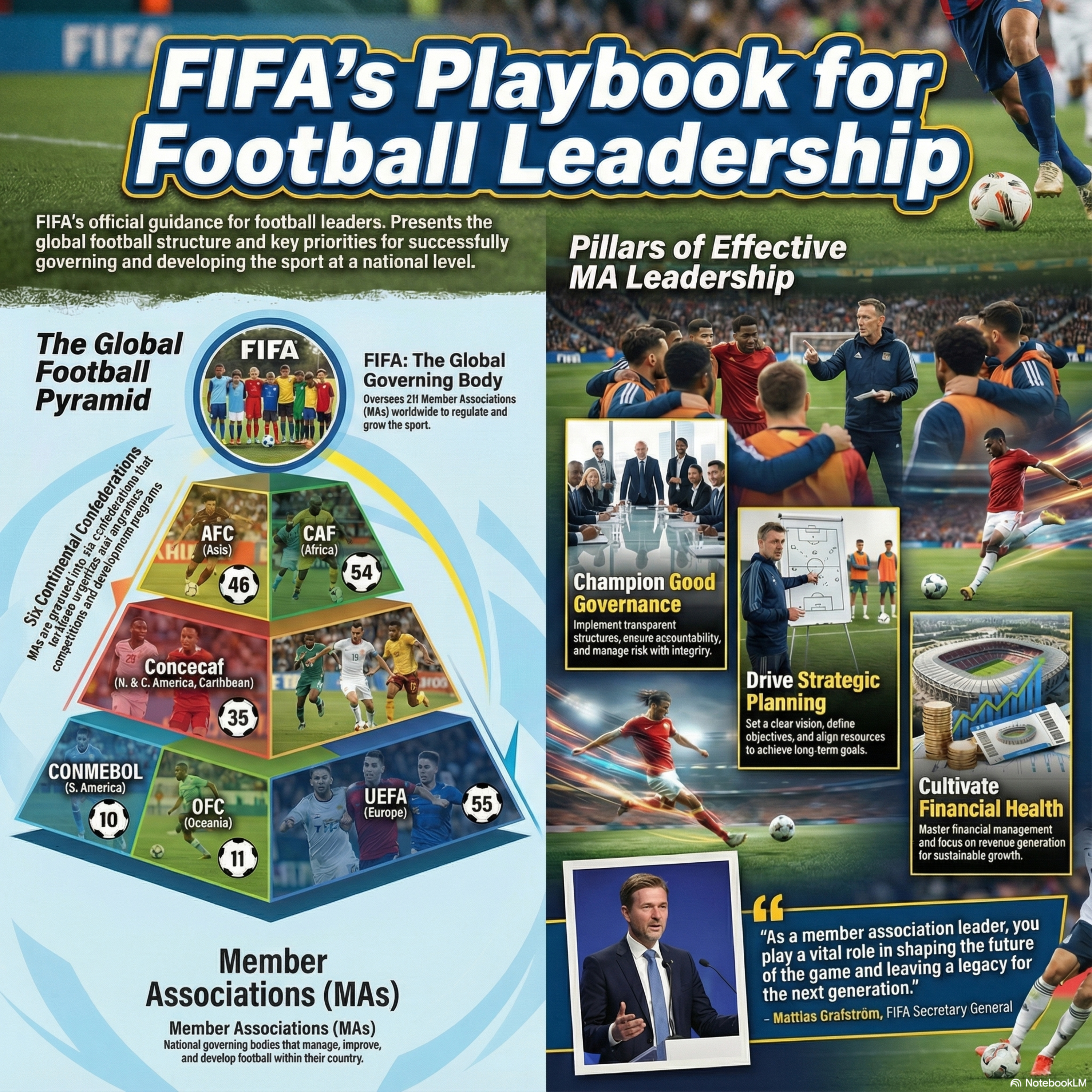
FIFA Based African Football Governance and Leadership Blueprint
About this episode
FIFA Based African Football Governance and Leadership Blueprint
Listen now on Spotify, Apple Podcasts, Amazon and other streaming services! Don’t forget to subscribe, share, and leave a ⭐⭐⭐⭐⭐ review to help more players and coaches discover the power of Techne Futbol and Data Technology in the beautiful game.
#TechneAfricaFutbol #TechneFutbol #TrainWithTechne #Playermaker #TraceFutbol #Hudl #FootballTech #FootballInnovation #PlayerDevelopment #CoachTools #SmartFootballTraining #AfricanFootball #CAFOnline #FIFA #FIFAYouth #CAFDevelopment #YouthFootballAfrica #NextGenFootball #FootballScouting #TalentIdentification #DigitalScouting #EliteYouthDevelopment #FootballJourney #FootballAnalytics #FIFAForward #FutebolAfricano #TrainTrackCompete #FootballExcellence #FootballAfrica #TheFutureOfFootball
Welcome back to the Deep Dive. Today we are strapping in for one of the most vital conversations shaping the future of African sport. We are not just talking about the thrill of a Derby or the roar of the crowd. We are diving deep into the engine room, the operational machinery that makes African football globally competitive, right. I am talking about the National Member Association, Yeah, the MAS. It is absolutely bursting with potential and you see it every time a young African player makes that global leap you do.
But that success on the pitch, you know, securing those glorious moments requires structure, professionalism and world class performance. Off the pitch, it's exactly the insights we have distilled today. Layout a systematic a non negotiable blueprint for how M as can move away from being reactive administrative bodies that simply manage today's fires putting out fires yeah, and become proactive strategic institutions ready for sustained success. That is the mission for this deep dive. We are translating the global playbook, packed with detailed standards on governance, strategic leadership and operational structure, directly into actionable knowledge that benefits our game, securing financial and technical sustainability across the entire continent.
We're looking for those aha moments that shift an organization from good intent to consistent excellence. Precisely. We're going to systematically unpack how to establish the foundational governance guardrails defining what separates a modern football leader from a traditional administrator. We will then get into the necessary professional operations, that's HR, finance and the critical need for digital transformation. And finally, we'll explore how to maximize technical growth and master those high stakes relationships with governments, sponsors and of course, the indispensable fans.
OK, let's unpack, starting at the bedrock. Why is governance, which can sound, you know, bit bureaucratic? Why is it the absolute first priority for an MA? What is its constitutional mandate? Well, governance is the framework of rules, relationships and processes by which authority is exercised. And if that framework is weak, everything else, from fair competition to financial integrity, it just collapses. It's the foundation of the whole house. It is, and the core global objectives Ma's must uphold are essentially fourfold.
First, you've got constantly improving the game, 2nd, organizing credible competitions, Third, drawing up and enforcing clear regulations, and 4th, maintaining control over all forms of association football within the territory. So those global mandates, they translate directly into operational requirements for the African MAS. They do. It means they must set objective membership standards, govern the association through statutes, manage all competitions professionally. Not just on an ad hoc basis.
Not at all, and they must provide the educational and capacity development support that their members, the leagues, clubs and regional bodies required to grow these functions are really the non negotiable duties of a modern MA. That complexity suggests a clear organizational shape is required. I mean, you can't have everyone doing everything, right? What is the consistent blueprint for the Ma's organizational structure? Well, we see the Ma's competence segmented into four primary domains. You have governance, which is making the rules OK.
You have compliance, which is making sure the rules are followed, then competition, running the leagues and tournaments, and finally education, which is developing players, coaches and referees. And structurally, how does that breakdown? Structurally, you have a consistent hierarchy designed to separate legislative, strategic and operational functions. OK, so walk us through that hierarchy top to bottom right. At the apex is the General Assembly or the Congress. This is the legislative body consisting of representatives from the membership your clubs, your leagues.
The ultimate authority. Ultimate authority. They approve the statutes and and they elect the leadership. Beneath them is the Executive committee, the Exco, which is the supervisory, strategic and financial oversight body. Then you have the necessary judicial bodies and standing committees that handle specialist tasks like club licensing, finance or disciplinary matters. And finally, you have the operational core, the General Secretariat or GS, led by the General Secretary, which runs the day-to-day business with the permanent staff.
This sounds very neat on paper, but here is the critical governance guardrail that, well, it also breaks down in the real world. It does the separation of powers between the political side, the EXCO, and the administrative side, the GS. Why is this distinction so vital to efficiency and avoiding conflict? This is the single most important lesson in MA leadership. The distinction must be absolute. Absolute. The President chairs the EXCO and leads the strategic direction and political engagement. That is a supervisory, non operational role.
The general Secretary, conversely, is the CEO. They lead the effective and efficient day-to-day administration, staff management and budget execution. So the exco approves the map and the budget, and the GS drives the car down the road. But where does the friction happen? Because in the African context, we often see exco members trying to micromanage. The friction arises when EXCO members confuse supervision with operation. Their mandate is to supervise the GSS performance, approve high level policy and manage the MAS strategic direction.
The danger point is when EXCO members start dictating specific operational decisions. Who gets hired? Which vendor wins a small procurement contract or which staff member handles a minor task? And what happens when they cross that line? What are the consequences? Two things happen immediately, and both are fatal to professionalism. First, they undermine the general secretary's authority, paralyzing the staff because they don't know who to listen to. 2nd, and most dangerous, they create a conflict of interest.
How so? Well, think about it. If an exco member is involved in an operational decision, say the purchase of new training equipment, and that purchase fails, how can they impartially supervise the investigation of that failure? They can't. They're investigating themselves. They can't, exactly. Good governance demands they supervise the process, not operate it. That clear line ensures accountability rests squarely with the paid administration. Understanding that Clear Line is so powerful, it sounds like moving the MA from a personality driven organization to a system driven 1.
That's it exactly. When the system is strong, it can survive a change in leadership without collapsing. Now moving from internal structure to external requirements, statutory compliance, what are the key non negotiables every MA must adhere to to maintain standing and credibility? 3 pillars really stand out. First, financial transparency. Every MA must conduct annual independent audits of their accounts. And independent is a keyword there. It's the whole game. The audit must be genuinely independent and its findings must be presented openly.
Second, democratic standards. Their statutes must align with representative democracy principles, ensuring fair regular elections and active consideration of gender equality in their legislative bodies. Yeah, and 3rd dispute resolution. Every MA must recognize the jurisdiction and authority of the Court of Arbitration for Sport or CAS. That CAS recognition is critical. It provides an impartial international forum for disputes, right? It removes the internal politics from the resolution process. It gives all parties, clubs, players, coaches, regional associations confidence that disputes over results, elections or contract issues will be resolved professionally and neutrally.
It takes it outside of the MAS internal and often factional politics. It is a fundamental stamp of quality governance. And beyond these internal structures, M as also hold the regulatory duty to manage essential areas like integrity, anti doping, child protection, player registration. They are the ultimate custodians of the sport in their country. They hold the primary responsibility. They must ensure that all relevant stakeholders, down to the smallest club, agree to respect the laws of the game and the MA statutes.
Without a robust and enforceable regulatory framework, you simply cannot run credible fair competitions or ensure the long term health of the game. Now that we've built the house, let's talk about the person leading it, the general secretary. We hear the term leader constantly, but what does modern football leadership actually require? How is it different from simple management? That is the core distinction. Management is about creating goals, achieving targets and keeping the lights on. It's operational and transactional.
Right, checking boxes. Exactly. Leadership is transformational. It's about creating a compelling long term vision and inspiring and aligning other staff, exco and stakeholders towards that common purpose. It's the engine of change. And the currency of that leadership has to be trust. Absolutely. The bedrock of any leadership is ethics and values. A leader must act ethically, genuinely and consistently in line with their own and the M as stated values. Trust is not a soft skill, it's a consequence, the direct, hard result of genuine, ethical and consistent action.
If leaders are not transparent, or if there's even a hint of self-interest or cronyism, trust dissolves rapidly and credibility with staff, sponsors and the public just evaporates. Looking specifically at the general secretary role, I mean, they're often dealing with huge political pressure, limited resources, intense media scrutiny. What skill set is truly demanded? It's an executive role that requires extraordinary resilience and diplomacy. I can imagine. Resilience to withstand the almost constant pressure from clubs, political figures and international bodies.
Diplomacy to navigate those competing agendas and maintain impartiality. And on the business side? On the business front, they are essentially the CEO of a multimillion dollar, multi stakeholder national organization. They need a proven track record of running a substantial business, a profound knowledge of football is both a sport and a commercial entity, highly developed leadership skills and crucially, expertise in commercial negotiation and sound financial management. So they need the tactical savvy of ACEO coupled with the diplomatic patience of an ambassador, as you said.
But none of that matters if they are only focused on the next three weeks. They need true strategic thinking. How does the GS cultivate that crucial ability to look far ahead? Well, strategic thinking is the ability to anticipate market trends, anticipate risks, and plan for the future, which leads to better, more informed decisions today. It requires a big picture mindset, right seeing beyond the immediate administrative firefighting to the long term political, commercial or technical implications of every decision they make.
Give us a practical example of how that foresight benefits in African MA right now. OK, think about digitalization and MA focused only on the present is still printing paper tickets. An MA with foresight anticipates that mobile penetration is exploding, potentially bypassing traditional infrastructure. They immediately start prioritizing mobile first, fan engagement, data collection, and payment solutions. So it's about seeing where the world is going, not just where it is. Precisely that foresight doesn't just improve the fan experience, it provides a competitive commercial advantage by positioning them to attract digital forward sponsors before their competitors catch up.
It is about calculated risk taking in pursuit of long term goals. That makes strategic thinking of financial imperative not just an academic exercise. Speaking of decisions, this is where pressure hits hardest. How do effective football leaders maintain sound judgement and most importantly, de risk major decisions avoiding common pitfalls like personal bias? The primary guardrail is continuous vigilance against personal bias. OK. Every major decision must pass the MA benefit test. Is this genuinely what is best for the MA as a whole, or is it influenced by my relationship with a specific person, a club, a supplier or a political faction?
This requires a lot of self-awareness. That internal check is vital, but what practical steps can a general secretary take to formalize good judgment? Well, first they must automate or delegate the basic internal processes like expense approvals or simple administrative tasks to protect their time. Re up their headspace. Exactly. A practical tip is scheduling dedicated thinking time, maybe 2 hours weekly, specifically for strategic consideration, major decision evaluation, and learning from past mistakes.
Second, they must utilize benchmarking, checking how other successful M as or organizations approached a similar issue. You don't have to reinvent the wheel. And 3rd and most effectively consult the senior management team. They are your intellectual diversity. I love the idea of using a formal preparatory paper for EXCO approval, especially given the history of poor oversight in some Ma's. It forces due diligence. It is the gold standard for DE risking major decisions. For any big strategic decision, a major commercial tender, a facility construction, or a significant change to competition rules, the general secretary must require a detailed preparatory paper.
And what's in that paper? It formally outlines the background, lists the key facts, presents clear options with detailed pros and cons for each, forecast the associated costs, and concludes with a considered recommendation for the Exco to approve or reject. So there are no surprises. No surprises, this process forces detailed pre analysis, ensures transparency and elevates the decision from a single person's instinct to a collective informed choice. It professionalizes the decision making process instantly.
If the general secretary is the conductor, the staff is the orchestra, and without them the music stops. If people are the M as greatest asset, how does a leader effectively harness that asset and build a winning internal culture? It starts with clarity and structure, not just motivation. The leader must establish a clear organizational chart with explicit reporting lines. Every staff member must know exactly who they report to and through formalized job descriptions and key performance indicators, or KPIs, what is expected of them.
Ambiguity breeds inefficiency. And when managing those teams, there's an efficiency limit, isn't there? The concept of the span of control. Absolutely. The span of control is the ideal number of direct reports a leader can effectively manage. If the number is too high, say 15, you become a transaction manager. You're just putting out fires again. You are for a leader to ensure meaningful engagement time, proper support and individual development. The optimal number is usually 7 to 9 direct reports.
Anything more and you are sacrificing quality supervision for quantity. Moving beyond structure, how does the GS build morale and a professional culture in a sector often known for high pressure and low resources? It requires high touch engagement. Leaders need to move past the corner office. They must walk the floor, speak to the team and no staff members by their names. Ask about their jobs, their daily challenges and their aspirations. Recognizing achievements personally through a written note or a public mention builds immense.
Loyalty, that personal touch. It's huge and crucially established regular mini forums where staff from various departments and job grades can offer honest, even anonymous feedback about the organizational challenges. Listening actively is the fastest route to improving internal culture. That leads perfectly into a Dare's Action Centered Leadership model, which uses a brilliant analogy to describe the three often competing needs a leader must constantly juggle. It's an invaluable tool for self-assessment.
The leader must constantly balance 3 overlapping spheres simultaneously. The needs of the task, the needs of the individuals and the needs of the team. Explain that three-way juggle, because focusing too heavily on one sphere is really dangerous, right? So if we use the MA context, managing the task means securing a major broadcast deal, setting specific deadlines for infrastructure projects, defining the strategic goals, and monitoring progress. The what? The what managing individuals means understanding that Jay needs more training and finance, that John needs flexible hours for family reasons, and that Sarah needs mentorship to reach the next level.
This involves one-on-one reviews and specific guidance. The Who, The Who and managing the team means resolving the conflict between the marketing and finance departments over budget allocation, setting the M as overall standard of professional conduct and fostering collaboration during a major event, ensuring everyone feels valued. The how? So? The moment you only focus on the task, for example winning the bid for a tournament, you risk burning out your individuals and fracturing the team due to stress and lack of support.
Exactly. The leader's failure isn't always tactical. It's often a failure to balance those 3 spheres. If staff attrition is high, you're failing the individual sphere. If internal conflicts are paralyzing departments, you're failing the team sphere. The great leader keeps those circles intersecting smoothly. Let's pivot now to delegation, which you flagged earlier as a critical tool for creating that protected thinking time. But how does delegation also become a powerful strategy for staff development?
Well, delegation is not just offloading unwanted work. It is formally assigning authority and resources to another person to accomplish a goal. When done correctly, it tests staff capability, develops their competence, builds their confidence and prepares them for future senior duties. For the leader, it is the most efficient way to free up time for strategic high value work. So how do we decide what to delegate without delegating the truly important stuff? That's where the Eisenhower decision matrix comes in, right?
Correct. We use the matrix to categorize tasks based on importance. Does it contribute to the strategic goal and urgency doesn't need to be done right now. The leader needs to focus their personal energy on the important urgent tasks, which is do it now. And crucially, the important not urgent tasks that's schedule, which is your strategic planning and relationship building. And the tasks that are prime for development and delegation, where do they fall? You look to the quadrant of not important but urgent.
These are tasks that must be handled immediately, but do not require the G's unique skill or strategic oversight. Can you give an example? Sure, for an MA, this might include managing the ticket allocation process for a minor friendly match, overseeing a routine facilities inspection, or handling A predictable but high volume administrative cycle. These tasks are urgent, but they are not strategically important to the GS. They are perfect for capable senior managers to handle with the GS providing oversight.
Once a task is delegated, it can't just be abandoned. What is the necessary process to ensure accountability and growth? Delegation must be disciplined. There is an effective eight step process. First, plan what needs to be done, who is best to do it, and the deadline. Second, assign the formal briefing, setting the context. OK. Third, provide resources, budget and direction. 4th, discuss confirming expectations and accountability. Fifth, assist Be available for strategic guidance, but not for doing the work yourself.
That's a key distinction. It is sixth track. Request regular brief progress reports, 7th. Report the staff issues a final report on completion and 8th and this is crucial, provide constructive feedback for their development. If you skip the feedback step, you lose the development opportunity. That disciplined approach is the difference between dumping work and developing talent. Let's talk about the formal mechanisms that Dr. professionalism, the HR cycle, and performance management. Right, The HR motorcycle dictates the journey of every employee recruitment, selection, onboarding, pay and rewards, performance management, promotion and finally exit.
For performance, the leader must ensure that job descriptions link directly to key performance indicators, KPI's that are explicitly aligned with the MAS four year strategic plan. This connects the daily work of a junior staff member to the national Vision. How should performance reviews be structured to be genuinely developmental, not just, you know, disciplinary? It needs to be continuous. There should be quarterly, informal 1 to 1 discussions focused on progress, challenges and immediate. Feedback, so no surprises at the end of the year.
Exactly. These discussions ensure that the formal annual performance review, which typically uses a rating scale, say 1 to 5, is never a surprise. The annual review measures actual output against those strategic KPIs, providing an objective basis for compensation and promotion decisions. And for the real master class tool, succession planning and specifically the 9 box grid. This sounds like an essential process for systematically building the Ma's long term talent pipeline, especially in an environment where talent frequently leaves for better opportunities abroad.
It is a vital systematic tool for leadership team meetings. The 9 box grid forces objective conversations by applauding every staff member against two axes. Performance disappointing, on target or exceptional and potential? None, some or lots? So it moves MA talent decisions away from just personal preference. And towards systemic analysis, yes. Let's focus on how we use the data from the grid. Who are the stars we need to protect and develop? The serious high Flyers fall into the exceptional performance and lots of potential box.
These individuals should be immediately identified, prioritized for advanced development opportunities, and moved into the next available senior role. They are your internal pipeline for replacing the General Secretary and other senior managers. And what about the solid, reliable people? Those are your valued contributors. Exceptional performance, but perhaps none or some potential. These are reliable, consistent performers who are the institutional memory and backbone of the MA. You retain them, you reward them fairly, and you use them as internal coaches and mentors for the high potential staff.
And the trickiest third group? The talented, troublesome. The people who show promise but aren't delivering the results yet. Yes, they fall into the disappointing performance, but lots of potential box. You must dedicate time to finding out why, right? Are they new and overwhelmed by the MA culture? Are they struggling with a specific skill or are they genuinely disruptive? They require careful monitoring and intensive coaching. The decision here is critical. Invest and potentially unlock a future leader or recognize the cultural mismatch and transition them out.
The grid forces that tough strategic decision rather than letting underperformance drag down the entire team. Sounds like organizational health insurance. Finally, on the people front, conflict. Where does it come from in a football setting and how should a leader choose the right resolution strategy? Conflict is inevitable, particularly in high stakes environments. It is usually caused by personality clashes, fundamental differences of opinion over strategic direction, or resource competition. Like who gets the marketing budget?
Exactly who gets the marketing budget or which department gets priority use of the IT resources? A vigilant leader spots the early indicators crossed arms, passive aggression, regular public disagreements or departments actively avoiding joint meetings. And the strategy has to fit the conflict, moving past the idea that we must always go for a win, win. Exactly. The Thomas Killman model helps here by looking at the balance between assertiveness, your concern for yourself, and empathy, your concern for others.
If urgency is paramount, say a security threat requiring immediate action, the leader might use competing. That's high assertiveness, low empathy. I decide we move now. And the other end of the spectrum. If a critical external stakeholder, like a major sponsor, has a valid minor complaint, you might use accommodating. That's high empathy, low assertiveness. You win this one. The relationship is more important. And what about the ideal high stakes option when you really need everyone on board? That's collaborating, high assertiveness, high empathy.
This is the win win approach that is necessary for major strategic issues like redesigning the league structure or forming a National Youth strategy. It requires trust, time, and vulnerability from all parties, but it results in the most sustainable solution because everyone owns the outcome. The leader needs the flexibility to move between these styles based on the context, always prioritizing the long term strategic benefit of the MA. Let's move to the operational side, starting with the strategic planning cycle.
How M as turn that long term vision into measurable funded action. We talked about the roles Exco owns, the strategy that GS owns, the implementation that. Handoff is crucial. The strategy must be a minimum of four years aligning with the football cycle, and it must start by defining smart objectives, specific, measurable, achievable, realistic and time bound. Right. If your objectives are vague, like improve youth football, they are meaningless. Utterly so. Give us some tangible, measurable KP.
Is that an MA should target over that four year cycle, moving beyond simply winning the next match? OK, we need both performance and structural KPIs. Performance examples Qualify for the confederation's premier tournament, increase female participation in youth football by 50% or train a minimum of four FIFA accredited referees. And structural ones. Structural Examples Launch a senior women's league of minimum 12 professionalized teams. Secure a long time commercial sponsor equivalent to X value or build a national training center.
Those are enormous goals. How do you stop a massive 4 year goal like facility construction from paralyzing the annual business plan? You must break it down into annual bite sized accountable chunks and you have to adhere to the absolute necessity of the what who when principle. What, who, When? For that training center, year one is location scouting, design approval, and securing government guarantees. Year 2 is tender documents, partner selection and contract finalization. Year 3 is commencing construction, and year 4 is completion testing and occupation.
Every single annual task must have an identified task owner who is held accountable in the annual business plan. This systematic planning leads directly into financial discipline. African MAS must achieve financial sustainability, which means reducing reliance on the traditional comfort blanket of centralized grants. Revenue diversification is absolutely critical for autonomy and growth. MAS must align their four year budget with the strategic goals and set realistic but ambitious targets for commercial revenue growth.
And that means? You must capitalize aggressively on sponsorship broadcasting rights, especially those new OTT platforms and merchandise. Reliance on a single funding source, particularly one external to the Emmys direct commercial activity, leaves the association incredibly vulnerable. And once the budget is set, how does the general secretary maintain rigorous control and ensure resources are used efficiently, not just hoarded by departments? Budget control must be continuous and targeted. The finance department produces monthly management accounts comparing performance against the budget and the previous year.
The GS and the EXCO should then utilize a powerful tool, the exception report. The exception report? They focus only on budget lines that are over or underspent by more than, say, 10%. The 10% rule. Why is that specific threshold so powerful? It ensures the leader focuses on what truly matters. If a department is consistently underspending by 15%, that budget is locked away and the resource needs to be reallocated immediately to a priority area that can use it now, like youth development or coach education.
And on the flip side. Firstly, if a department is significantly overspending, immediate corrective action and investigation are required. This targeted approach prevents the GS from wasting time reviewing every single budget line that is on target and ensures efficient resource allocation across the entire MA. That brings us to modernization, digital transformation. Many MAS are still struggling with basic paper processes. This is a massive area for competitive advantage. It is the future, and we must first distinguish between digitization and digitalization.
What's the difference? Digitization is the first step, converting paper and analog content like archived files, player registrations, or manual payment processes into a digital format. This makes things cheaper and faster to retrieve. But the true operational leap is in digitalization. Yes, digitalization is using that newly digitized data to fundamentally change how the MA operates. It's integrating digital technology into all aspects of the organization, from staff payroll to fan engagement. This maximizes efficiency, professionalizes internal processes, and, crucially, generates new revenue streams.
How does digitalization directly translate to new money for the MA? Well, first, by leveraging data analytics, when you digitize your ticket sales and fan membership, you gain clean data on who your fans are. You can then sell that lawful, anonymized data to sponsors who are increasingly demanding deep digital engagement. Second, by using platforms like Over the Top or OTT Streaming for direct content distribution, you can monetize matches or exclusive content directly, bypassing traditional broadcasters or reaching rural audiences efficiently.
So it's a huge opportunity A. Huge one, but African MAS must proactively invest in staff training, IT equipment and critically ensure full compliance with local data protection laws to protect their new asset, the fan data. This relentless drive for efficiency is encapsulated by process management. Why are clear, documented processes for everything from paying a referee to selling a ticket so vital for a modern MA? Because without clear, documented processes, staff members default to what they think is the right way, leading to massive variations in quality, inefficiency, wasted time, high costs, and low morale due to confusion.
Every MA function ideally should follow a clear mapped procedure. The benefit is massive. Reduced time, reduced cost, enhanced staff morale because expectations are clear, and a greater ability to delegate. So how does an MA leader initiate that process cleanup? What is the modernization cycle? It follows a six step cycle. First, identification, pinpointing a poorly performing process, like why are our referees always paid late. Second discovery, mapping out the process as is to understand every bottleneck and step.
Third, analysis determining why the bottlenecks exist. For instance, payment requires 4 physical signatures and one signatory is always traveling. A classic. 4th improvement redesign using technology like digital signatures or simply reordering steps to eliminate waste. 5th implementation Carefully launching the new process, training staff and communicating changes, and finally monitoring, ensuring the new process works and intercepting any new problems quickly before they become embedded. This cycle ensures old, outdated working practices are continuously modernized.
We've established the robust governance and achieved operational excellence. Now let's move to maximizing impact, which means success on the pitch and success with external partners. On the technical side, there is a crucial distinction between the technical director and the national team coach in terms of assessment. This is a critical distinction for the MAS long term Health. The national team coach is measured on short term results winning matches. The technical director or TD, however, should not be evaluated in the short to medium term.
Why? Not their goal is to develop the pipeline of players and raise the overall quality of the game in the entire country. Incredible indicators of the TD success, like the strength of the national system, the number of professionalized clubs, or the quality of the coaching pool take 5/8 or even 10 years to measure fairly. That requires a lot of patience and long term vision from the Exco, which is often in short supply when fans demand immediate results. It is So where should the technical director focus their energy to build that system strength?
First, they must develop the coach education and development pathway. This means establishing minimum standards and ensuring that continuous professional development or CPD is mandatory for all qualified coaches to maintain their licenses. This must include establishing women only courses to foster female coach development, which often goes ignored. Second, the TD must drive the development of the youth player pipeline, ensuring national Age grade teams are well funded and well structured as they are the feeder system for the senior team.
And the third major lever for development is club licensing, which often feels like a painful bureaucratic hurdle for. It can feel that way, but it is an essential tool for development and professionalization. Club licensing sets mandatory standards for facilities, financial management, governance, structure and youth development. The basics of being a professional. Club exactly, including the necessity of having a system for homegrown players. African M AS must tailor the criteria to the reality of their leagues, setting high standards for the top tier and slightly of captive progressive criteria for the lower leagues.
This forces professional standards on the clubs, which in turn benefits the entire football ecosystem and strengthens the national teams. Now we step outside the MA walls to deal with the stakeholders, starting with the most politically sensitive relationship of the government. What is the fundamental principle here? The relationship must be viewed as one of mutual reciprocal benefit. Football offers huge socioeconomic development. It promotes health, education and national unity, which serves the government's political and social agenda.
And in return. In return, the government can offer crucial funding, facility support like land grants or infrastructure investment, and help with security and visas. And the MAS core principle must be absolute political neutrality, which can be challenging in a dynamic political landscape. It is nonnegotiable. The MA must engage and invite key figures from both the ruling government and the opposition parties. This ensures that major projects like National training center construction or youth development grants secure multilateral cross party support.
So if the government changes. If the government changes, the Ma's stability and funding pipeline remains secure because of the projects are seen as national assets, not assets tied to a single political party. Moving to the commercial side, sponsors, what are they looking for now that they weren't looking for 10 years ago? And how should MAS approach negotiations? Sponsors are moving away from purely static advertising, you know, just logos on jerseys. They increasingly seek deep engagement with fans, clean digital data access and a transparent governance structure.
The MA must be able to deliver these digital rights and data insights. And in terms of timing? Crucially, commercial negotiations for broadcasting rights are sponsorship must start 6 to 12 months before the expiration date of the existing contract. Why is that time window so critical? Because leaving it until the last month shifts all the negotiating power to the commercial partner who knows the MA is desperate to sign before the cash flow dries up. Starting early maintains the M as negotiating strength, allows for competitive bidding, and ensures business continuity.
Let's discuss the fans. The enthusiast. Yeah, high interest, low direct influence, yet totally indispensable to the MA's existence. How does the MA respect and engage this critical group? Fans are essential because they provide the revenue through tickets, merchandise, and attracting sponsors, and their passion creates the atmosphere. The MA must tangibly acknowledge their collective contribution and more importantly, provide formal platforms for feedback. This means regular fan surveys, formal forums or digital feedback portals.
The MA must address concerns regarding safety, affordability, and facilities. If you ignore the fans, discontent quickly spreads and can lead to damaging boycotts or protests. And finally, media and crisis management. The high public profile of the GS means they must cultivate trust and transparency daily. They must and this requires proactive communication. The GS needs to cultivate strong rapport with key media representatives and ensure that the Communications Director is pre briefed on the consistent key messages for all announcements.
Especially during a crisis. Especially then, during a crisis, whether it's a disciplinary matter or an international incident, speed and control are paramount. The MA must instantly take control of its own media channels, its website and social media accounts to manage the narrative, ensure message accuracy, and prevent the spread of harmful misinformation. Let's end this section with the ultimate external objective, tournament hosting. Why is hosting a major regional or global tournament so transformative for an MA and a nation?
Hosting is a massive catalyst for change, often accelerating national development by decades. It forces national infrastructure enhancement, sporting facilities, transport systems, IT networks and generates significant economic impact through tourism and job creation. And there's a skills benefit too, right? A huge one. Critically, it provides immense knowledge transfer and skills acquisition for the local workforce in areas like event management, security and logistics. African MAS bidding to host must conduct early honest assessments of requirements, secure essential written government financial guarantees, and set up a multi stakeholder local organizing committee early in the process.
We have truly mapped the journey here. This deep dive is shown that building a football powerhouse is not about luck, it is about establishing a system. We've moved from the foundational separation of powers and the necessity of independent audits right through to advanced strategic thinking using the Eisenhower Matrix to protect the leader's time and managing the potential of staff using the 9 bucks grid. We covered financial rigor, commercial strategy that extends far beyond grants, and the importance of using digital data to unlock new commercial value.
Success in football administration is absolutely a system. It is not accidental. For African football to reach its full deserved potential, member associations must transition from simply administering the game. Dealing with today's fires. Exactly dealing with today's immediate problems to governing it with transparency, professional rigor and long term vision. Structure must follow strategy and the right people must be in the right roles. That structural and professional maturity is the key differentiator.
It is. And that professional maturity leads us to a necessary final provocative thought for you to consider. We know that increasing commercial activity, sponsorship, broadcasting, digital revenue is necessary and generate significant profit. However, we also know that the distribution of this new income can cause significant internal conflict between the highly professionalized segments like the top leagues and the essential grassroots segments that feed them. So if you were implementing this systematic framework today, what specific governance mechanism or transparent agreement would you establish upfront to define precisely how the profit generated from major commercial deals, the value minus the real cost of delivery, will be shared across the entire football family, ensuring long term unity and stability rather than internal division.
That is the ultimate challenge, ensuring unity follows success. Question of structure, finance and internal diplomacy all rolled into one. Food for thought as you look to build your future powerhouse. That was the deeest of dives. We'll talk to you next time.
 Apple Podcasts
 Castbox
 Castro
 Goodpods
 Moon FM
 Overcast
 Pocket Casts
 Podbean
 Podcast Addict
 Podcast Republic
 Spotify