Capturing Africa's Missing Football Transfer Billions
About this episode
Capturing Africa's Missing Football Transfer Billions
Imagine, if you will, that you and I are standing in a a heavily secured glass walled room. The lights are low, and right in front of us is this massive illuminated war board spanning the entire length of the wall. Like a command center. Exactly like a command center. And on this board, you have these blinking lights and intersecting glowing lines, and they're tracking the flow of billions, literally billions of dollars, EUR and pounds moving across the globe at the speed of light. It's a it's a constant, massive flow of capital.
Right. We are pulling back the curtain today on the multibillion dollar global football transfer market. Welcome. You are part of a very silent, very exclusive audience right now. We're talking high level elite football strategy and we are speaking directly to you because what we're about to uncover today, it fundamentally alters the reality of our sport. It's a reality that honestly, most fans, and frankly A frightening number of executives completely misunderstand. They they watch the game on the pitch on a Saturday afternoon, but they're entirely blind to the invisible financial architecture that dictates every single pass, every Sprint, every goal.
The game you see is just the the final output. Right. Yeah, the localized output of a massive, unseen global supply chain. And that brings us to the massive glaring paradox right at the center of the board. The big reveal for today's deep dive. Our continent, Africa, produces the most breathtaking, game changing, raw athletic talent on the planet. I mean, we are the foundational resource for global football. Without question. Yeah, when you look at the actual math, the African football ecosystem captures a microscopic 1.1% of global transfer income, 1.1%.
It's staggering when you actually isolate that number. It's insane. The geographic origin of the talent and the ultimate destination of the financial capital are completely divorced. We're exporting diamonds and getting paid for the dust. How on earth do we get to a point where a continent so rich in the primary resource is capturing basically a rounding error of the profit? Well, that 1.1% is a symptom of a much larger systemic failure. For decades we've been operating on the extreme periphery of this economy.
We've relied on intuitive relationship based trading. You know a scout knows a guy who knows a coach who recommends a player. It's all handshakes and favors. Exactly. It's entirely informal. But transitioning from the periphery of this global market to its absolute center requires entirely abandoning that old school gut feeling. It requires a shift toward ruthless digital precision. You cannot capture billions with handshakes. You capture it with data, legal frameworks and structural engineering.
OK, let's unpack this because that is the exact mission of this deep dive. We were fundamentally shifting the paradigm. Today, we are going to decode the labyrinth of global football finance, breakdown advanced data science and navigate international sporting law and. We need to be clear this isn't just theory. Right. We aren't just doing this as some dry academic exercise. We are applying every single ounce of this intelligence directly to benefit our African game. We're going to show you how we anchor the wealth we generate right back into our own communities.
O Let's start with the anatomy of a megatransfer because the public is being sold a massive illusion right? If I see a headline that says a Premier League club just bought a player for £35 million, I assume a giant briefcase of cash was just wired over. Which is exactly how the clubs want the public to perceive it. It's a very clean, simple narrative for social media. You see the tweet, you see the player holding the shirt, and you assume a unilateral transaction just occurred. But it didn't. You know, to operate effectively within the upper echelons of this industry, you must separate yourself entirely from that consumer perspective.
That 35 million headline figure is just the opening hand in a highly complex poker game. First of all, it is almost never a liquid capital injection paid upfront. Wait so they aren't just sending 35,000,000 on a Tuesday? How does it actually work? It's an installment game. The buying club is going to stretch that 35,000,000 out over 2-3, sometimes four years. And those installments are strictly managed by the buying clubs internal financial metrics, specifically something called the squad Cost ratio or SCO.
OK, let's break that down for a second. What exactly is a squad cost ratio? Let's ground this for the listener. Is it like a salary cap? Think of it as a hybrid between a salary cap and a corporate credit score imposed by Financial Fairplay regulations. European regulators dictate that a club can only spend a certain percentage of its overall revenue, say 70%, on player wages, transfers and agent fees. So if they just drop 35 million all at once. They might breach that ratio and face severe point deductions.
So to protect their own balance sheets and stay compliant, they amortize or spread out the cost. They pay 8 million this year, 9 million next year and so on. They are protecting their compliance while our selling clubs are left waiting for their money. And if you're an African selling club or a local development Academy, accepting A4 year payout schedule feels like a massive macroeconomic danger. I mean, think about domestic inflation. Think about the volatility of local African currencies, the Rand, the CD, the naira, the Kenya shilling against the pound sterling or the euro over a 48 month horizon.
Precisely. You've hit on the exact hidden cost of the installment game. A deal that looks highly lucrative on paper today could lose a massive percentage of its actual purchasing power by the time the final installment clears in Year 4. Because the currency shifted. Exactly. If inflation in your home country is running at six or 7% annually and your currency is depreciating against the euro, that final 8 million installment is worth significantly less in real terms when it finally arrives. You are essentially providing the European club with an interest free loan while absorbing all the currency.
Risk yourself. A financial tightrope. And on top of that installment nightmare. The selling club isn't even getting the full 35 million anyway. There are massive slices taken right off the top before the net receipt is even calculated. What happens to the money before it even reaches the African club's bank account? What's fascinating here is the sheer volume of mandatory and contractual deductions that occur instantaneously. First, you have debt set offs. A local club might have already borrowed capital against the future sale of this specific player just to keep the lights on.
So the lender just takes their cut immediately. Right off the top then you have sell on entitlements negotiated directly into the athletes contract or historic sell on clauses owed to previous clubs. But the most crucial elements for our grassroots ecosystem are the compulsory regulatory deductions. The training, compensation and the solidarity mechanism. This is the part that drives me crazy because it is the lifeblood that our clubs are consistently missing out on. Walk us through how these two mechanisms actually work.
There are two distinct pillars of FIFA's financial redistribution model. Let's start with training compensation. This is a separate payment triggered when a player under the age of 23 moves internationally or signs their first professional contract. So it's essentially an invoice. An invoice for the cost of developing that player. It's calculated by multiplying the Buying clubs established training category, which reflects their financial power, by the number of years the player was trained between the ages of 12 and 21.
OK, let me make sure I'm getting this. So if a wealthy European club buys an 18 year old from a small Academy in Senegal, the European club has to pay a fixed rate for every year that Senegalese Academy trained him. Correct, And because the buying club is wealthy, the rate they pay per year is significantly higher than what it actually cost the Senegalese Academy to train him. It is designed to be highly lucrative for the grassroots developers. That's the training compensation and then the second pillar.
The solidarity mechanism this is different. This dictates that exactly 5% of the total transfer fee of any international transfer, regardless of the players age, must be distributed pro rata to every single club that contributed to the players education and development between their 12th and 23rd birthdays. So 5% of every major international transfer is legally mandated to flow back to the developers. But let's flip the perspective for a second because this blows my mind. The selling club gets their net receipt chipped away by these rules, but for the buying club in Europe, that 35 million transfer fee is actually just a fraction of what they are really spending.
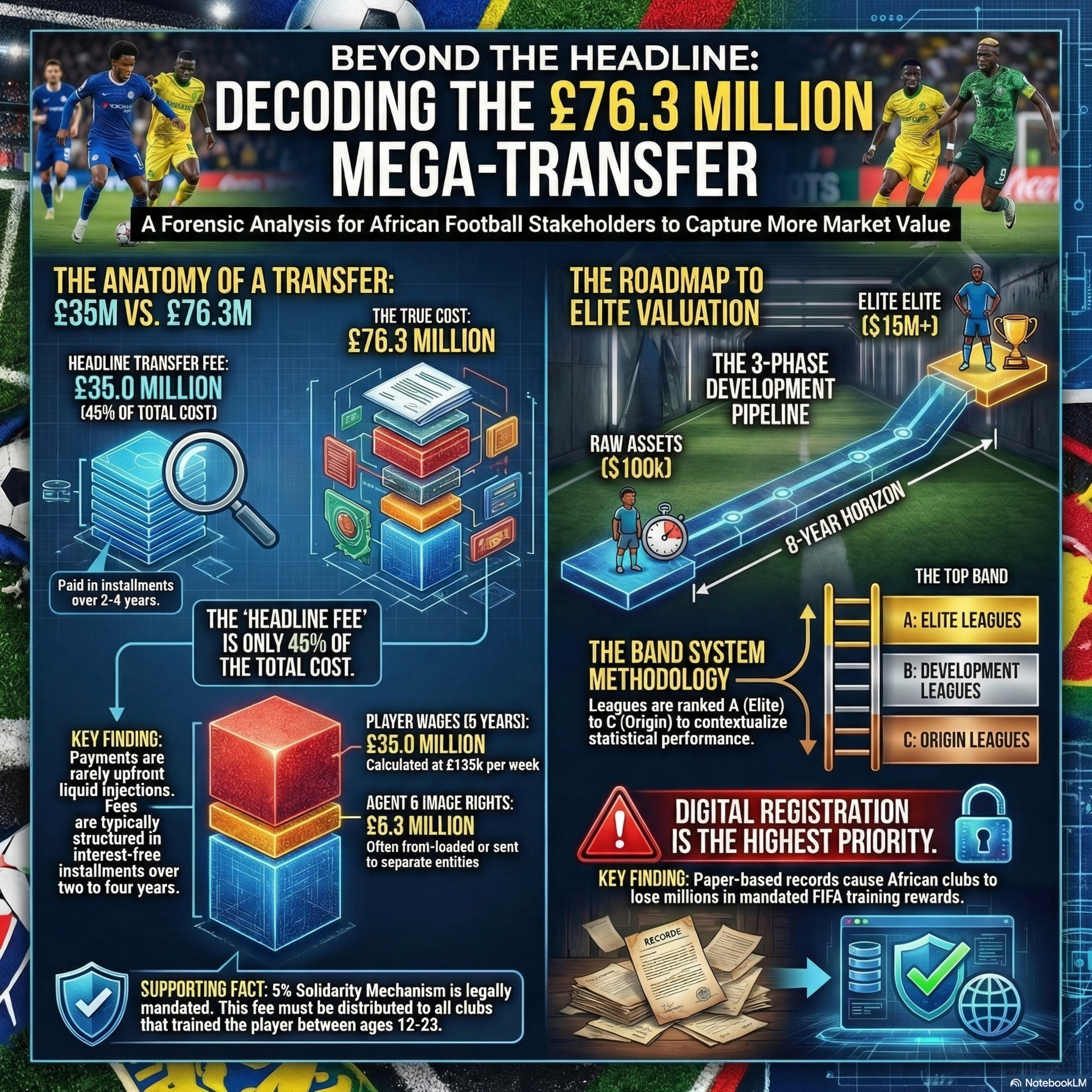
I was looking at the breakdown for a hypothetical 35 million player and the real cost is a staggering 76.3 million. How does a 35 million player costs 76,000,000? It is a 76.3 million reality. Let's breakdown that architecture because understanding this is what separates sophisticated market participants from your fans. You have the 35 million principal fee. That is just the right to register the player. It does not include the cost of actually employing him. Because you still have to pay him every week.
Next you add player wages. A standard 100,000 per week salary projected over a typical five year contract adds 26,000,000 right there. Okay, so we're already at 61 million. What else? Then you have image rights. Modern players are highly marketable brands. A club isn't just buying the athlete, they want the right to use his face to sell shirts, energy drinks, sponsorships. And that's not cheap. That's easily another 5 million over the contract, typically remitted to a separate corporate entity controlled by the player or their family, which requires complex offshore tax structuring.
So we were at 66 million. And then there are the add-ons, right, the conditional bonuses. Precisely add in conditional add-ons, say 5 million, contingent upon the club qualifying for the Champions League or the player hitting specific international appearance thresholds. So the selling club gets those if the player does well. The selling club demands these to inflate the potential fee, and the buying club accepts them because they only pay if the player succeeds. Then you have signing and loyalty bonuses, usually around 3 million.
What's the difference between those two? The signing bonus is paid annually at the start of the season just for showing up, while the loyalty bonus is a massive carrot dangled at the end of the year to incentivize the player not to demand a transfer mid contract. And we can't forget the agents aren't working for free, not at. All agent commissions are usually calculated at roughly 5% of the total contract value. That includes the wages, the signing bonuses, everything. Even with new capping regulations attempting to rein this in, you are easily looking at another 1.3 million often demanded upfront.
Unbelievable. Throw in. Another 1,000,000 for dynamic performance based bonuses, specific payouts for a certain number of goals, clean sheets or starting appearances. You add it all up and the European Club is committing 76.3 million of total financial liability to acquire the single human asset, the sheer. Macroeconomic weight of that asset is staggering. When you say it like that 76.3 million of total financial liability, it completely changes how you view a 21 year old running down the wing. For African stakeholders, looking at that 76,000,000 architecture highlights the immense, almost incomprehensible capital flowing through the global market.
It's an entire. Economy built around one person, right? The take away here is undeniable. African clubs must position themselves structurally and legally to capture their mandated fractions of this wealth, because this kind of value isn't arbitrary. It isn't an accident. It is engineered. Engineered. Is the exact right word. A 35 million player is not simply born on a pitch in Nairobi or Johannesburg, discovered on a Tuesday and sold on the Thursday. They are meticulously designed and developed over an 8 year timeline.
Let's walk. The listener through this, let's introduce a hypothetical high potential prospect, we'll call him Joseph Wanjango, a brilliant young talent from Kenya. He's got all the raw attributes. How do we build his value from raw potential to a 35 million megatransfer? Because it clearly doesn't happen overnight. We. Execute a highly structured 3 phase developmental master plan. Phase one is incubation. We are looking at Joseph when he is just 16 years old. At this stage, he is classified purely as a raw asset, with a baseline market valuation somewhere between 50,000 and $100,000.
So what's the strategy for a 16 year old raw asset? Because if I'm an African Academy director, I might look at him and think I'm going to call Chelsea right now and sell them. But you can't do that, can you? No, you. Absolutely cannot, and this is where many well-intentioned African academies hit a brick wall. FIFA rules, specifically Article 19 of the Regulations on the Status and Transfer of Players, strictly prohibit the international transfer of minors. So you're just. Stuck you? Cannot simply sell a 16 year old to an English club.
The rules are designed to prevent child trafficking and the exploitation of young players, which makes. Total sense So if sending him straight to the Premier League is legally impossible, what is the actual strategic imperative? How do we build his value while staying compliant the? Strategic imperative here is academic placement in a European jurisdiction. You do not move him for football, you move him for education. For example, placing Joseph in a specialized academic Spartan program in Spain.
So it's a legal workaround it. Legally circumvents the stringent FIFA minor transfer regulations by utilizing academic exceptions. He enrolls in a legitimate school and he plays in their affiliated Academy. I want to dig. Into that daily reality for a second, we are talking about taking a 16 year old kid from Kenya and dropping him into Spain. That's not just a football transition. That is a massive cultural shock. It is. An immense psychological load. He has to learn Spanish, he has to adapt to a different climate, a different diet, and he has to perform academically to maintain his visa status, all while undergoing A rigorous European football education.
And he's just a. Teenager. Exactly. And during this incubation phase, you also pair this European acclimatization with aggressive accumulation of youth international caps. You are constantly slying him back to get regular minutes for the Kenya U 17 national team. Why? Are the youth caps so important at this stage? Is it just for exposure? It is for. Exposure yes, but more importantly it is for work permit points. If his ultimate destination is the English Premier League, he will need to pass a strict governing body endorsement point system to get a visa.
Playing youth internationals starts banking those points early. OK, so. We're building his profile, bypassing red tape through education, banking, work permit points, and preparing him for Phase 2, the professional phase. He hits 18 to 20 years old. His valuation explodes here, right? It goes from that 100K incubator stage to anywhere between 1,000,000 and three million. Why the massive jump this is? The critical inflection point at 18, the minor protection rules lift, and he is legally permitted to sign his first European professional contract.
But the valuation multiplier isn't just about the contract. It is about what happens on the pitch. He begins acquiring vital European tactical experience. What does it? Actually mean though, European tactical experience? What is he learning at 18 in Spain that he wouldn't have learned back home in Kenya? The game. In Europe is structurally different. It requires precise technical correction, often utilizing advanced cognitive motor tools. In Kenya, his sheer pace and raw dribbling ability might have allowed him to dominate matches single handedly.
He could just run. Past everyone, right? But in the Spanish second division, that pace is neutralized by incredibly rigid, organized defensive structures. He has to learn spatial awareness. He has to learn exactly when to trigger a press, how to maintain a low block, and how to scan the field before receiving the ball. That's about his. Football IQ by. Proving he can adapt to this extreme tactical rigor. That he isn't just a fast athlete but a high IQ to footballer. His value experience is an exponential multiplier which sets.
The stage for phase three elite age 25 to 28 physical maturity tactical maturity. He enters a top five European league and his valuation hits its absolute peak. 5 million to 15,000,000 plus which when you factor in market inflation and the premium buying clubs pay for proven talent creates the exact conditions for that 35,000,000 total package negotiation. But hearing you lay this out, an 8 year timeline that requires unbelievable patience if we. Connect this to the bigger picture. This eight-year horizon proves A fundamental truth of the modern market value is not created at the moment of sale.
It is built through continuous, verified and heavily documented progression. You can't just. Stumble into it if an African. Academy wants to generate generational wealth. They cannot simply hope a scout randomly discovers their player at age 20 in a local tournament. They must systematically emulate this exact incubation, professionalization and elite placement timeline. You are not hoping for a lottery ticket, you are building an asset and that. Brings us to what I think is the most exciting part of this deep dive.
The death of the eye test. I am enthusiastically declaring it dead right now. We all know the stereotype. The old European scout maybe chomping on a cigar, coming down to our continent with a notepad, a stopwatch and a gut feeling. A classic. Image He watches the. Kid play on a dusky pitch for 20 minutes, decides he has good potential and offers peanuts. That ERA is dead and. It needed to die. That eye test approach was an asymmetric dynamic that inherently undervalued our players. It allowed European intermediaries to buy our top talent at basement prices, Polish them up in a European Academy for two years, and then pocket the exponential markup themselves.
They were just. Acting as middle men, they were capturing. All the arbitrage value. We are killing subjectivity today because subjectivity is what keeps African football poor. So if. We are killing the old scout with a clipboard. What replaces him to? Counter that old dynamic eating African institutions are now deploying highly structured methodologies to evaluate and price their own talent. Objectively. We've moved away from subjective opinion and into the realm of decision grade intelligence. The foundational structural concept of this new era is the band system.
OK, let's. Breakdown this global ecosystem for the listener. The band system essentially categorizes every single professional league on earth into specific strata to contextualize a player statistics. Walk us through the bands we start. At the Foundation, Band C represents the Origin and Development leagues. This includes our domestic powerhouses like the South African Bet Way Premiership, the Kenyan Premier League or even developmental leagues outside Africa like Brazil's Siri B or the Swedish Alzvenskin.
Then you move. Up A tier to band B. What defines a band? B League Band. B leagues are the intermediary finishing schools. These are highly competitive, heavily scouted leagues with vast financial resources. But they aren't the absolute pinnacle. We are talking about Major League Soccer in the US, The Portuguese Premier Liga, the Dutch Arabesi or the Saudi Pro League. Yeah, they're the bridge. They act as the perfect bridge between raw potential and elite performance. And finally. You have Band A, the elite destination, the absolute peak of the sport, the English Premier League, French League One, the German Bundesliga, the Spanish La Liga and the Italian Serie, the absolute highest sporting ceilings and maximum commercial resale values.
Now, the genius of the band system, as I understand it, is that it forces you to use mathematical and tactical discounting. Because if a player is putting up crazy MVP numbers in a Band C league, scoring 20 goals a season where maybe the defensive structures are a bit looser and individual brilliance is allowed to flourish, you can't just assume he'll do that in the Premier League. Exactly. Analysts project that his elite output in Band C will immediately regress to merely good or average upon transfer to a Band B league, let alone Band A. The transition across these bands involves immense friction.
What kind? Of friction. Are we talking about here? There is. Physiological adaptation required to handle a noticeably faster speed of play and increase travel demands. But more importantly, there is severe psychological adaptation required to cope with tighter marking, more physical center backs, and tactical systems that ruthlessly punish turnovers in the middle third of the pitch right the margin. For error vanishes a trick. That beats a defender in band C might result in a counterattack goal against you in band A, so to.
Remove all the bias and account for this friction. The modern methodology uses a strict S to E grading scale. How does this work? It is A. Rigid standardized framework to evaluate every measurable attribute of a player. S stands for world class MVP ready immediately. A means excellent top tier quality for that specific band. B is above average. C is average. Pretty straightforward, but AD that's a noticeable limitation. It's a liability in high leverage situations that requires immediate coaching intervention and an E is fundamentally broken by locking attributes to this rigid scale.
African clubs can accurately price their players. I have. To admit, if I was graded on the S to E scale for my footballing ability, I think I'd invent a new letter. I'd be a solid Z, A total liability. But seriously, this grading system prevents the disaster of overvaluing a player. You avoid sending a band C player directly to band A, watching them fail miserably because they had AD in tactical awareness, and seeing their transfer value collapse, which happens. Far too often. But how? Do we actually arrive at these grades?
We aren't just trusting a guy with a notepad anymore, no. We are not. The preparation and performance evaluation of the modern African player is now governed by Python scripts, machine learning and massive speciotemporal data sets. Here's where. It gets really interesting because the modern African data scientist is no longer just a guy watching VHS tapes in the backroom. They are armed with Python programming libraries like pandas, Numpy and Sychitlearn. What are they actually doing with these tools?
They are. Managing and cleaning massive amounts of data. They are pulling in application programming interfaces or API's from global data giants like Statsbomb and Y Scout. Every pass, every tackle, every millimeter of movement on a pitch is logged as a data point. And then they. Analyze that to predict success our data. Scientists are taking millions of these points and running multivariate analysis to isolate the exact performance metrics that guarantee success in a, Band B or Band A league. They aren't asking is he good, they are asking does his progressive passing metric map onto the requirements of a mid table Bundesliga team it.
Basically means you don't need a millionaire's budget anymore to be smart. Yeah, but the true game changer, the ultimate equalizer for African clubs, is computer vision. We're talking about machine learning models like Yolo of Eight, which stands for You Only Look Once and platforms like Roboflow. Can you explain computer vision like I'm 5? Why is this so revolutionary? Historically, to get elite tracking data to know exactly how fast a player was running or the exact distance between the four defenders in a back line, a club needed to install multimillion dollar optical tracking cameras in the rafters of their stadium, which is just.
Impossible for most teams that. Kind of physical infrastructure is financially prohibitive for the vast majority of African clubs, right you're. Installing a $2,000,000 camera system at a local municipal stadium in Accra? Exactly. But with open source computer vision, an African data scientist can take a standard normal television broadcast of a local match just a video file, run it through the Olaf 8 algorithm, and automate object detection from just a. Normal broadcast the software. Literally draws a digital box around every player, the referee, and the ball on the screen.
It can track real time player positioning, calculate defensive shape compactness, and identify pressing triggers just from a YouTube video of a match. They're extracting high fidelity spatiotemporal data using just a standard laptop and an Internet connection. It completely democratizes scouting. It is. Mind blowing. The barrier to entry has been totally obliterated and you combine this software tracking with physical proof from wearable technology. African clubs are now integrating GPS tracking devices like Catapult or Field Wiz.
You see the players wearing those little sports bras under their shirts during training, those vests. Contain high frequency GPS units, accelerometers, and heart rate monitoring. This is huge because when you can hand a European buyer a digital dossier that empirically proves, using GPS data, that your 18 year old prospect can sustain a top speed of 33.5 kilometers per hour, cover 12 kilometers in a match, while operating at a heart rate of 180 beats per minute, you completely destroy their perceived risk.
That is the. Crucial phrase removing perceived risk. European buyers historically used risk as their primary excuse to lower the transfer fee. They say he's from Africa. We don't know if he has the tactical discipline. We don't know his physiological baseline. It's a gamble. And now you. Just hand them the data when you. Present irrefutable quantitative data bridged with qualitative video observation. You change the power dynamic. You dictate the market value. You are telling them there is no gamble here.
Here is the proof of his physical durability. Pay the premium. OK, the. Math makes sense on paper. The theory is brilliant, but is anyone in Africa actually doing this successfully right now? Let's talk about a real world master class, because execution is everything. There are several. But the prime example right now is TS Galaxy in South Africa. Operating under the leadership of their chairman Tim Sukazi, they have built an absolute pipeline by strictly adhering to these principles. TS. Galaxy is killing it TS.
Galaxy provides the perfect modern African export model. They identify regional talent, give them a platform in the Betway Premiership which remembers R Band C, and they make strict promises to export them overseas. But the real test of their resolve, the moment that proved they were serious about the methodology, was the transfer of their 21 year old winger Puso Dithejane. This is. A brilliant case study. Let's set the scene. Ditha Jane was tearing it up in the domestic league. Naturally, the massive domestic giants with incredibly deep pockets, Kaiser Chiefs and Mamelodi Sundowns, came knocking with highly lucrative offers.
The easy thing to do, the traditional thing to do, is take the local cash. It solves your cash flow problems instantly. But TS Galaxy rejected the domestic wealth. Why? They protected their international pipeline. If TS Galaxy sells their best players to Mamelodi Sundowns, they become known simply as a feeder club for the domestic monopoly. They lose. Their leverage by. Rejecting the local cash and pushing for an international transfer, they ensure they maintain credibility as a legitimate stepping stone to Europe and the Americas.
They are signalling to every ambitious 16 year old in the country. If you come to us, we will get you to the global stage and they. Delivered by declining that domestic money, they facilitated a brilliant Bambi transfer. Daitha Jane moved to the Chicago Fire and Major League Soccer for an estimated fee of €1.3 million, or about 1.5 million U.S. dollars. Now I have to play devil's advocate here for a second. We all do respect to MLS. Isn't that a massive step down for a top African prospect? Why not hold out for a team in France or Germany?
Why Chicago? It is not a step down. It is a calculated trampoline. You have to understand the specific moneyball aspect of how Major League Soccer operates. Major League Soccer has a notoriously complex salary cap system. To circumvent this and bring in massive global stars, they invented the Designated Player rule, often called the David Beckham rule, which allows teams to pay a few star players whatever they want without it crushing their salary cap. Right, that's. How you get Lionel Messi to Miami exactly?
But recently, MLS introduced something called the U22 Initiative. This is a specific roster rule that allows a franchise to pay the transfer fee and the full salary of an elite young international player like Daitha Jane, while capping his official budget charge against their strict salary cap at a minimal amount, usually around $200,000. Oh, that is. Incredibly smart. It frees up their cash to spend vast sums on those older, established designated players while absorbing elite African youth at virtually no salary cap penalty.
It's a massive incentive for American general managers to buy African talent. It's. Financial engineering at its finest. It makes a player like Daitha Jane incredibly attractive from an accounting perspective. But accounting only gets you in the door. Tactically, he was also the perfect fit. He graded as an A in burst acceleration on our S to E scale. Chicago plays a high pressing vertical system under their current setup. And crucially, Dithe Jane possesses incredible tactical duality. Explain.
Tactical duality. Why does a manager love that tactical? Duality means a player can perform 2 highly specialized roles at an elite level. Primarily Dithe Jane operates as an inverted right winger, meaning he is left footed, playing on the right side naturally drifting into the center of the pitch. The half spaces to shoot, he cuts. Inside but. Because his GPS data proved he has a sustained aerobic engine and elite recovery speed, he can transition seamlessly into a modern overlapping right wing back.
Which means. The coach doesn't have to burn a substitution to change tactics. He can fluidly shift formations in game from a 433 to a 352 just by telling Dithe Jane to drop 10 yards deeper. Exactly. And the attacking stats backed up his valuation. He was hitting .70 to .79 goals and assists per 90 minutes. 75% of his shots were taken from inside the penalty box, with the 16.6% conversion rate highly efficient. He wasn't. Just shooting wildly from distance. He was a highly efficient weapon getting into dangerous areas.
But the data methodology demands brutal honesty. And the data also showed a glaring red flag, didn't it? It did. Let's talk. About the flies His defensive dual metrics were inverted. In his final season in South Africa, he won 43 defensive duels but lost 64. That suggests A propensity to be physically bullied off the ball, or maybe a lack of positional discipline when tracking back. Which means. If you send him straight to the Premier League, straight to Band A, he gets eaten alive. The physical demands of the Premier League would expose that weakness instantly.
His confidence would shatter and he would end up on the bench. So. Sending him to MLSA Band B finishing school is actually a protective measure. It allows for a targeted 6 month physiological adaptation program where he can build the core strength required for elite European football without the crushing media scrutiny of a top five league. He can work on those defensive duels in an environment that is slightly more forgiving. Precisely. But player valuation isn't just about stats and tactics. The modern market has realized that psychological resilience is now a massive valuation multiplier.
Elite clubs are terrified of buying a player who looks great on a spreadsheet but crumbles mentally when things get tough. Let's look at Dive Jane's past, because it's a fascinating study in psychological it, really. Is when he was a highly touted youth prospect at Kaiser Chiefs. It was actually released from the club for a disciplinary incident. He refused to be a ball boy for a senior match because supposedly he believed his talent was above menial tasks. Under a traditional scouting model, an incident like that is an immediate, fatal red flag.
The old scout with the cigar writes bad attitude, arrogant, uncoachable in his notebook, and moves on forever. But modern analytical frameworks view psychology dynamically, not statically, because he. Didn't spiral. Instead of fading away into obscurity, he rebounded. He moved to TS Galaxy, he publicly apologized, took real accountability for his immaturity, and then went out and performed at an absolute MVP level. That. Trajectory transformed what could have been a career ending behavioral red flag into undeniable proof of supreme self belief and extreme mental resilience.
Elite clubs know that migrating across continents, learning a new language, and dealing with immense pressure causes profound psychological trauma. You have to be. Tough to survive that they need. Players who can survive hostile environments, tactical benching and cultural isolation. Daitha Jane proved he could take a massive public hit, recalibrate his ego and dominate. That resilience makes him an exponentially safer investment. And Chicago. Fire didn't stop there. They didn't just trust his resilience, they actively engineered an environment for him to succeed.
They utilized a brilliant clustering strategy. They didn't just buy Daitha Jane at the exact same time. They bought his 20 year old South African compatriot defender Mbekazeli Bokazi from Orlando Pirates for 2.5 million euros. Moving to. Compatriots simultaneously engineers a built in cultural support system. It insulates their multi $1,000,000 investments against homesickness and isolation. They can speak their native language together, share meals and navigate the culture shock of moving to America as a unit.
It's insurance. Policy. The financial projection suggests that if Difa Jane masters the tactical discipline in this MLS environment, his valuation will triple. He's establishing A resale ceiling of 6,000,000 to $10 million for his inevitable final move to abanda league in Europe. It's an. Incredible blueprint for success. TS Galaxy executed it perfectly. But while clubs like TS Galaxy are operating at a world class level, we have to address the massive elephant in the room. The broader African grassroots ecosystem is suffering from a massive tragic financial hemorrhage.
Let's go back to that 5% solidarity mechanism we discussed earlier. Millions of dollars destined for African academies when their alumni make big moves in Europe are simply vanishing into the ether. Why is this happening? It is a. Tragedy of administrative negligence. The majority of these legally mandated solidarity payments have historically remained unpaid by European clubs, and it isn't always malicious. Often it is because across too many African federations, player registration systems remain poorly organized, highly informal and disastrously reliant on physical paper documentation paper.
We are talking about billion dollar global supply chains and people are relying on paper in the 21st century. If you don't have a digitized, verifiable, harmonized registration record proving you trained a player from their 12th birthday, you cannot establish a legally binding claim for that 5%. You're completely. Locked out and if an. Academy Director tries to fight an elite European club in the Court of Arbitration for Sport with a stack of fading handwritten paper receipts from 2015. They will lose the cost of litigation alone.
Hiring Swiss sports lawyers renders justice completely inaccessible for a small African club. So what does this all mean? How do we stop this hemorrhage? We. Rely on the regulatory renaissance currently transforming the landscape, the game has changed. We are talking about the rollout of the electronic player passport or the EPP and the newly implemented FIFA clearinghouse. This is a centralized digital counterparty designed specifically to automate the payment of training rewards. It. Completely takes the power out of the European club's hands.
Tell me how the EPP works. The EPP. Consolidated a player's entire career registration history into a single immutable digital Ledger. When a transfer occurs, FIFA can now independently calculate the exact solidarity and training compensation owed based on the contract values entered into the transfer matching system, the TMS. The TMS is the mandatory digital platform where both the buying and selling clubs must upload all transfer agreements. So FIFA. Looks at the TMS, sees a 35 million transfer, looks at the EPP, sees the player was at a Nigerian Academy from age 12 to 15 and automatically calculates the cut.
But what? If the European club just ignores FIFA, what if they just refuse to pay the Nigerian Academy? That is where the FIFA Clearing House shows its teeth. Real sharp teeth. Once the calculation is verified, the clearing house issues a legally binding invoice directly to the European buying club. If they fail to pay within the strict deadline, the system automatically applies a 2.5% administrative levy on top of the debt. And if they? Still don't pay if they. Continue to withhold the funds, It triggers severe mandatory disciplinary proceedings.
We are talking about transfer bans, meaning they cannot sign any new players and actual points deductions in their domestic league. They will. Literally dock points from a Premier League club if they don't pay an African Academy its rightful share. That is incredible leverage. Is it actually working? Is the money flowing the system? Has already allocated over $350 million in training rewards globally, with 156,000,000 already distributed. The wealth is there. It is sitting in a vault in Paris. We just need to claim it.
Give me an. Example. Give me proof that an African club can use this to secure the bag. The landmark. Case that proves this beyond any doubt involves Ghana's Right to Dream Academy. It's centered around their young star Ernest Nuoma, who transferred for €25 million. Now, initially the system failed. FIFA actually misallocated the development compensation to a defrunct grassroots club because the National Federation records were outdated. Oh wow. So the money almost went to a ghost club. What did right to dream do right to dream?
Didn't back down. They took it to the Court of Arbitration for Sport because they are a highly professionalized organization. They possessed impeccable digital records, school transcripts, and time stamped match logs proving they were his primary exclusive training center from age 10 to 18. They sued, they won the CS arbitration, and they secured approximately €283,919 from just the first leg of that transfer. Almost. €300,000 injected straight back into a Ghanian Academy and that's just the first leg.
They will get a cut of every future transfer he makes. It is absolute. Proof that the wealth is legally enforceable. But the overarching mandate for every single African club, Academy, and federation right now is this. Digitize your records from a player's 12th birthday today or you are literally forfeiting millions of dollars. The cost of inaction is no longer a theoretical concept. It is guaranteed financial ruin. OK, let's. Crystallize everything we've talked about into strategic leverage points.
If I am an ambitious sporting director at an African club, what is my playbook tomorrow morning? Leverage .1 Outsourcing development to Band B Stop trying to sell straight from the bet Way Premiership to the Premier League. It is a. Massive strategic fallacy to aim straight for the top. We've discussed the friction, the jump in tactical complexity and media scrutiny crushes the players confidence and consequently destroys their long term transfer value. Instead the strategy must be to sell them to a band B lead, MLS, Portugal, Scandinavia, Belgium for a slightly lower initial upfront fee.
But, and this is the vital part, you demand a massive 20 to 30% sell on clause in the contract this makes. So much sense you intentionally sacrifice a little upfront capital to capture outsize returns in the back end. You essentially let the American or Portuguese clubs use their elite coaching, their incredible facilities and their global visibility to inflate your players value from 1.5 million to 35 million. They do the. Heavy lifting for you? Exactly. You outsource the final stage of asset appreciation to them because they're better equipped to do it, and then you sit back and collect 25% of that 35 million move three years later.
That is how you build a financial empire without carrying all the risk. Exactly. You are leveraging the global system to work for you. Auditing the alumni. African clubs must employ dedicated administrative or legal personnel whose sole job is to comb through their history, find every single player whoever wore their youth jersey and log them into the EPP system it creates. A passive lifetime annuity. Think about it. If you trained a kid for four years when he was a teenager and you log him in the system, you get a fraction of that 5% every single time he moves internationally for his entire career.
Whether he moves for 10 million, 20 million or 35 million, that money hits your account automatically through the clearing house. It is outsized capital injection, requiring zero additional sporting output from your club. You don't have to win a game on the weekend to get a check for $100,000 on Monday, however. While we build these robust frameworks and dream of these annuities, we must ruthlessly acknowledge that they are not perfect. We are dealing with human beings, not just data points. This raises an important question.
What are the methodological blind spots we are failing to see? If we rely purely on the algorithm, where does it fail? The reality? Check. I'm glad we are doing this because data and algorithms can only tell us so much. Let's talk about the first big blind spot, non linear tactical friction. We touched on friction earlier, but how does this break the data model? The. Analytical methodology inherently assumes that a player producing elite metrics in an African band C league has the underlying cognitive processing speed to seamlessly translate those numbers to Europe.
The algorithm says he completes 85% of his forward passes here. He will complete 85% there. But this assumes football is universally standardized. It critically fails to account for severe tactical friction, right? You have an incredibly gifted African winger who thrives in a loose, open, transition heavy league where individual brilliance is celebrated, the game is end to end and there is vast open space. If he statistically dominates there, it does not mean he will succeed in a rigid, highly choreographed possession based European system where he's expected to stay exactly 2 yards from the touchline at all times if he.
Lacks the spatial cognitive awareness to understand complex positional play. His statistics will not scale mathematically. Systemic context is everything. Assuming stats scale automatically across entirely different footballing cultures leads to disastrous recruitment failures. You buy an MVP and you end up with a player who looks completely lost on the pitch because the geometry of the game has changed around him. And what? About the flaw in the clustering strategy, we praised Chicago Fire earlier for buying 2 S Africans Day to Jane and in Bokazi to help them settle.
That sounds great on paper, but that has a huge blind spot too, doesn't it it? Operates on an overly simplistic sociological assumption. The clustering strategy presumes that just because two players share a passport, they will automatically be psychologically compatible and provide emotional support for one another. It completely ignores the nuanced realities of human nature. It ignores varying socioeconomic backgrounds within the same country, differing religious beliefs, or even internal competitive jealousies.
That's a great. Point you might buy 2 guys from the same country who actually resent each other. Maybe they played for rival youth clubs and hold a grudge. Or conversely, even if they are best friends, you might inadvertently create an isolated clique. They only hang out with each other, they don't integrate into the broader locker room culture. They don't feel the need to learn the new language as quickly because they can just speak to each other and it actually hinders their holistic adaptation to the new club.
You build a wall around them instead of a bridge. Exactly. Human psychology cannot be neatly predicted by shared nationality. But the most heartbreaking blind spot of all, and the one that requires the most urgent attention, is what we call the grassroots ghost town. Let's spend. Some time on this, because this gets to the absolute soul of African football. The entire FIFA clearinghouse compensation formula we praised earlier relies entirely on formalized training categories. It requires official registration dates, digital stamps and organized academies, but the.
Reality of African football. It's chaotic, it is beautiful, and it is largely informal. So many of our elite players do not start in pristine academies with digital ledgers. They spend their early, highly formative years from age 8 to 14 playing on community dirt pitches, in unregistered St. setups, or in highly informal academies run by local coaches who buy boots for the kids out of their own meager salaries. They only join a professional, formalized club at 16 or 17, when their talent becomes undeniable.
And because. They lack globally recognized registration during those crucial early years. They are effectively invisible to the FIFA algorithm. The system looks at the EPP and sees a blank space from age 12 to 15. The earliest, most vital developers of that talent, the community coach who taught them how to strike a ball, who fed them when they were hungry, are completely excised from the wealth chain, the digital. System assumes formalization where none exists. It inadvertently punishes the most vulnerable tier of the ecosystem.
While the professional academies get rich from the clearinghouse, the true grassroots developers are left with nothing, watching the kid they raised sign a £35 million contract on television while they still struggle to buy footballs for their local pitch. It is a. Profound injustice. Which is why the next phase of this revolution isn't just about the elite clubs. We have to bring that formalization down to the dirt pitches. We have to democratize the data and the registration. We have to empower those local coaches to register their teams digitally, even if they don't have a grass field.
We have to. Close that gap we are. Bringing all the threads together, now African football is standing on the precipice of a financial revolution. By enforcing digital compliance across all levels, deploying low cost computer vision to empirically prove our players worth, and strategically manipulating the band system with intelligent sell on clauses, our continent can finally anchor the immense wealth it generates within our own communities. We don't have to be victims of this 76.3 million machine anymore.
We can be the architects of it, the tools. Are finally in our hands. The legal frameworks are established, the open source technologies are freely available and the strategic blueprints have been proven by clubs like TS Galaxy. It is no longer a question of capability or resources, it is purely a question of execution and administrative discipline. And I want to. Leave you, our listener, with a final lingering idea to chew on as we wrap up this deep dive. Think about the massive trajectory we've just mapped out over the last hour.
If open source technology and digital registration are entirely democratizing the scouting and financial capture process, if we are finally keeping the capital on the continent and reinvesting it into better facilities, better coaching and better infrastructure, what happens in a decade? What happens when African clubs stop acting merely as their raw material exporters and evolve into the apex predators of the global transfer market themselves? Could we see a future where an African Super League retains its best talent and becomes the ultimate Band-Aid destination?
Could the next 35 million megatransfer be between 2 clubs in Johannesburg, Nairobi or Cairo rather than London or Madrid? The game is changing and you now have the blueprint to understand exactly how. Thank you so much for joining us in the room today, for tracking the board with us and for taking this deep dive. Keep questioning the headlines, keep looking past the illusions, and we will see you next time.
 Apple Podcasts
 Castbox
 Castro
 Goodpods
 Moon FM
 Overcast
 Pocket Casts
 Podbean
 Podcast Addict
 Podcast Republic
 Spotify