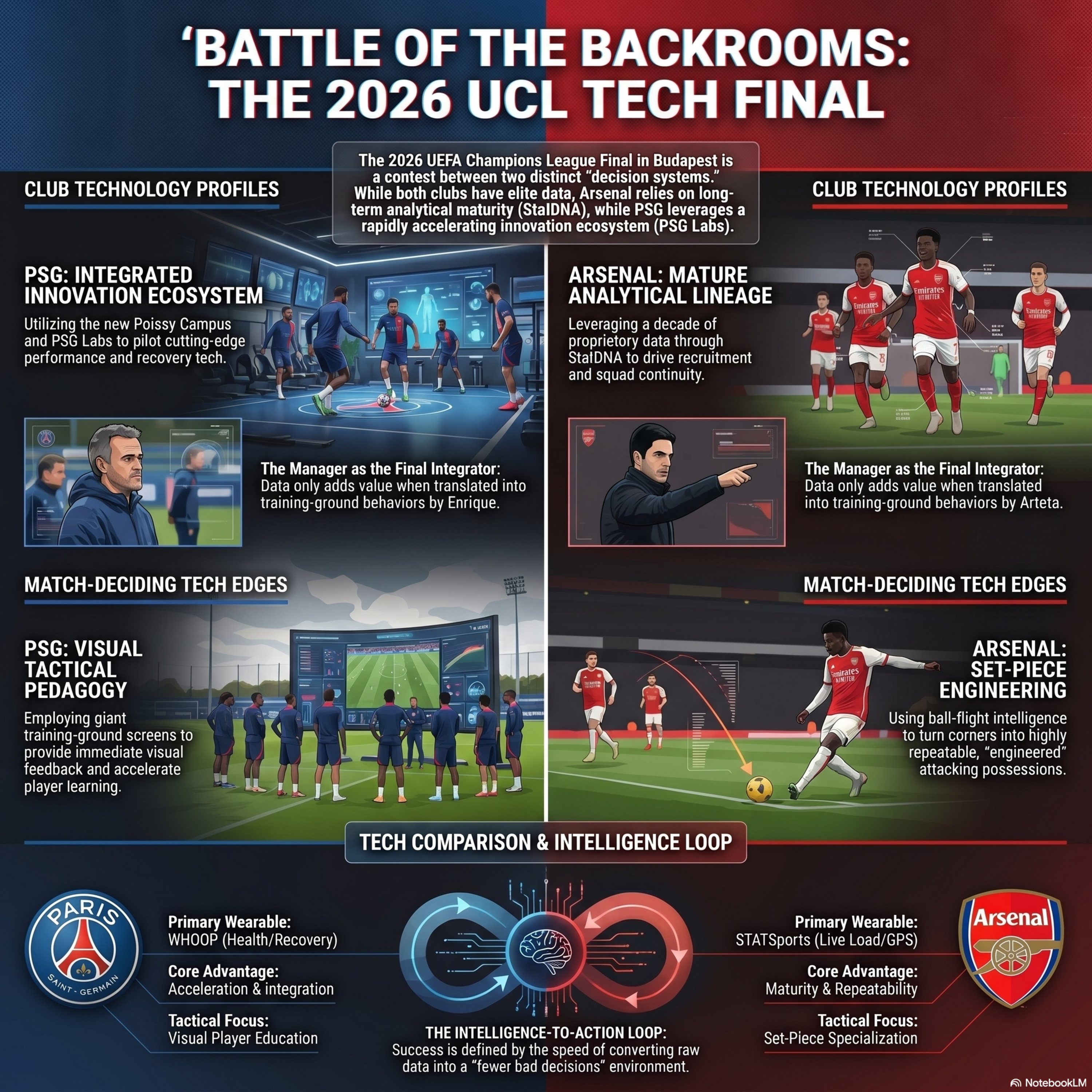
Arsenal vs PSG Champions League Final Data War
About this episode
Arsenal vs PSG Champions League Final Data War
Imagine you're sitting in the silent, spellbound audience of like an elite master class on the future of human performance. That's a great image. Right. The room is completely dark and the air is thick with that. Well, that specific kind of anticipation you really only get right before something historic happens. Yeah, that electric feeling. Exactly. And on this massive screen in front of you, a date just flashes in stark white text. May 30th, 2026 Then a location pops up, the Puskas Arena in Budapest, the UEFA Champions League final.
Huge, massive. We are looking at Paris Saint Germain versus Arsenal, but I want you to do something totally counterintuitive right now. OK, what's that? I want you to completely forget about the players on the pitch. Just ignore them completely. Yeah, forget the global superstars, forget the deafening fan chance and, you know, forget the broadcast cameras panning across the stadium. Because that's not the real story here. No, it's not, because what we're diving into today is this invisible, incredibly high stakes war happening entirely behind the scenes.
We're going to show you how these $2 billion sports institutions have essentially, well, they've mutated. That's a. Good word for it. There aren't just football clubs anymore, they have turned themselves into cutting edge, ultra sophisticated intelligence agencies. Literally. So we aren't looking at this final as a football match, we're looking at it as this violent, beautiful clash of two entirely different decision architectures and technological ecosystems. It is a it's a fundamentally different way to view the sport at this elite tier of European football.
The final is no longer just a contest between two managers standing on the touchline, right? Or even, you know, the 22 players on the grass. It is a contest between two massive invisible systems that are just running continuously in the background. Like an operating system. Exactly like an operating system, the core questions have evolved. Now how do you collect millions of data points a second? How do you protect player Physiology so they don't just completely break down in month 10 of a brutal season?
Which happens all the time. All the time. And most importantly, how do you convert an absolute avalanche of raw data into a split second tactical decision under the highest pressure imaginable? And that is our exact mission for you today. In this deep dive, we're going to unpack precisely how Arsenal and PSG take this chaotic just endless flood of GPS tracking coordinates. And autonomic nervous system Wellness signals. Yeah, and drone footage and these insane spadeiotemporal mathematical models and somehow, somehow filter it down into actual match winning football actions.
It's basically a translation problem. Right. Which clubs underlying philosophy is actually going to conquer Europe? Well, to understand how these two clubs operate differently, we have to start by establishing the ground rules of what we call the invisible battlefield. Let's laid out. Because here is the harsh reality of the 2026 Champions League final. Simply owning the technology that does not give you an edge anymore. Not at all. Everyone at this level has GPS vests tracking their players top speeds.
Everyone has high definition drones filming every single angle of training. Yeah, it's a standard issue now. Exactly, Everyone has massive data lakes and you know, optical tracking software mapped to the stadium rafters. That is literally just the table stakes to get your team bus into the stadium parking lot. Right, so if every single club has the exact same gadgets, the gadget itself is completely useless as a weapon. Yeah, exactly. It's kind. Of like like having a library full of books you don't actually know how to read.
That's a perfect analysis. The real differentiator is what the industry calls translation. Translation. OK, Yeah. It's the ability to take raw tracking data, which let's be honest, is just X&Y coordinates mapped 25 times a second, and blend it with event data, wearable physiological metrics, tactical video, medical risk indicator. It's so much information. It's too much information, so you have to take that overwhelming mass of stuff and turn it into fewer of bad decisions. Elite clubs actually organize this massive undertaking into an 8 stage loop.
The intelligence to action loop, right, Let's actually walk through this loop because it frames everything we're about to talk about. OK, so stage 1 is capture. That's physically gathering the data via cameras and sensors. Easy enough. Stage 2 is integrate that's taking those completely isolated data streams, like a sleep tracker and a tactical camera, and syncing them into one centralized system. OK, making them talk to each other. Right. Stage 3 is interpret. This is where the data scientists step in and build the analytical models to find patterns.
Stage 4 is translate. That's turning the complex mathematics into digestible human language. Crucial step. Extremely crucial. Stage 5 is decide. The manager uses that translated information to make a tactical call. Stage 6 is train physically rehearsing that specific decision on the training pitch. Stage 7 is execute, doing it in the actual match against a live, unpredictable opponent. Hardest part? For sure. And finally, stage 8 is learn feeding the match results back into the system to evaluate what worked and what failed.
Wow. Capture, integrate, interpret, translate, decide, train, execute, learn. That's the loop. When you lay it out like that, it's this massive, really fragile operational chain. Where does a system like that usually breakdown? Because I'm assuming it doesn't always run perfectly. Oh, it breaks down constantly and the biggest bottleneck is almost never stage 1. Gathering the data is easy now. Exactly. Gathering data is the easy part. The massive bottleneck occurs at stage 4. Translate OK. The most valuable person at a modern elite football club is no longer the smartest data scientist sitting in some windowless room building complex algorithms.
Really. Who is it then? The most valuable person is the translator. This is an individual who is entirely fluent in two very different languages. Like math and football? Precisely. They can read complex spadeiotemporal modeling, but they also know how to speak the raw emotional language of a locker room. That is a rare skill set. Very rare. They basically have to filter out 99% of the statistical noise to hand the manager the 1% that actually changes a decision. It makes me think about it like a human nervous system.
Oh, how so? Well, your football club's tech stack is basically the human body, right? The cameras on the stadium roof and the GPS vests on the players backs, those are the sensors. They are like your eyes or the nerve endings in your fingertips. But those sensors are completely useless if the brain, which is the manager, gets overwhelmed with billions of signals all at once. Or brain just short circuits. Exactly. The brain will panic and it won't be able to tell the muscle, which is the player to fire at the precise right moment.
So information overload isn't just an annoyance, it is a literal performance risk that can freeze a team on the pitch. It leads straight to decision paralysis when a manager is standing on the touchline with 80,000 people screaming they cannot process a 3D scatter plot of their opponent's passing network. No, they look insane trying to do that. They'd be paralyzed. They need what we call Manager Ready stories. Manager ready stories. I like that, but with the sheer volume of data flowing in simultaneously, I mean, we're talking about a star player sleep architecture from the night before, the microscopic variations in their heart rate.
Yeah, combined with the exact passing angle of the opposing midfielder over the last five matches. Exactly. So how does a club actually filter that noise successfully to build those stories? Well, to see what that successful filtering looks like in practice, we have to look at the team with arguably the longest running, most mature analytics engine in European football. Arsenal. Yeah, their entire ecosystem is built on a philosophy of the long game. It's built on maturity, deep institutional integration, and above all, repeatability.
Arsenal's approach to the invisible battlefield is fascinating because they were one of the earliest major clubs to realize they couldn't just buy off the shelf solutions. No, they wanted to go deeper, right? Years ago, they quietly acquired an entire data analytics company called Stat DNA. They brought it entirely in house. Which was a massive move at the time. Huge. They didn't just want to rent a data subscription from some external vendor, they wanted to own the dictionary. Owning the dictionary is the perfect way to describe it because when you rely on 3rd party data providers, you are using the exact same metrics as your opponent's.
You don't have an edge. Exactly. Yeah, you look at a generic stat like pressing intensity, which is defined by an external company, but when you own the analytics capability internally, you define what a press actually means for your highly specific tactical model. That makes total sense. Arsenal spent years building proprietary tools that seamlessly connect their sporting director, their medical staff and their coaches in one unified language. It's the difference between using a translation app to awkwardly order coffee on vacation and actually being fluent in the local language so you can negotiate a complex business deal.
Right. And Arsenal is fluent and you see this fluency in how they handle the day-to-day physical monitoring of their athletes. Like with their live physical tracking. Yeah, they use a system called Stat sports, and this isn't just checking a spreadsheet after training. They are tracking high speed running, total distance and biomechanical load live while the players are actively running drills. While they are literally on the grass. Yes, and this is where that translator role we talked about becomes highly visible.
Let's look at a typical Tuesday training session before the Champions League final. OK, set the scene. Arsenal's sports science and performance departments are absorbing massive continuous streams of data. They look at daily Wellness questionnaires. They measure heart rate variability, or HRV. Let's actually pause on HRV for a second, because a lot of people have this on their smartwatches now. Right, the aura rings and Apple Watches. Yeah, and they probably just ignore it. Why is HRV so critical to a football club?
It is arguably the single most important metric for recovery because HRV isn't just your heart rate, it is the microscopic time difference between your heartbeats. So wait, you want it to be variable? Yes, exactly. If your heart beats like a perfectly rigid metronome, exactly one second apart, that is actually a sign of severe physiological stress. Really, I would have thought, a steady heartbeat is a good thing. It's a common misconception. A healthy, fully recovered heart has high variability between beats, meaning the automatic nervous system is relaxed, adaptable and ready to react.
Oh wow, If a player's HRV drops it means their nervous system is chronically stressed, even if they look at the coach and claim they feel fine. So Arsenal staff combines that HRV data with the live GPS load on the training pitch. Yeah, they know they're preparing to face PSG, a team with just devastating world class transition speeds. Unbelievable speed. Right, so Arsenal staff maps out a training microcycle for the week if a key defender hits his precalculated high speed running threshold at, let's say 10.1 Teen AM on a Tuesday.
The sports science staff doesn't wait to write a report for Wednesday. They act right then. They intervene live, they pull the manager aside, show the data, and literally pull the player out of the drill right then and there. Just yank him off the pitch. Yeah, they modify the session in real time to ensure the player gets just enough physical exposure to adapt to PSG speed on on Saturday, but not a single Sprint more. Because if they overdo it. If they overdo it, the player carries residual fatigue into the final.
Their reaction time drops by 1/10 of a second and PSG scores. And margins are that tight. They really are. That live intervention is filtering thousands of complex data points into a single actionable narrative for the manager. Right, it's just telling the manager like this player has maxed out his required load to handle Saturday's pace. Resting him now increases our probability of a clean sheet. But you know, that level of systematized control is incredible, but there is a massive inherent risk here.
Where do you see the risk? Well, if Arsenal relies so heavily on a deeply embedded legacy data model to dictate their physical workloads, their tactical patterns, and even when a player is literally allowed to Sprint, doesn't the highly systematized team become incredibly predictable? Like if the computer model always says do X, in this situation you've actually become a robot, and a dynamic chaotic opponent like PSG can scout a robot. You've identified the exact vulnerability of a mature, heavily structured system.
It's called model inertia. Model inertia. Yeah, a mathematical model is built entirely on historical data, right? It learns from what has already happened. Which means it's looking backward. Always, if an algorithm worked beautifully to win you matches in 2023, the institution might blindly trust it in 2026, completely ignoring the fact that the tactical landscape of European football has shifted. So the game moves on, but the math doesn't. Exactly. The risk for Arsenal is that their rigid adherence to the math makes their patterns recognizable.
If an opponent maps out Arsenal's highly structured buildup play, they can set traps and dismantle. Them. But Arsenal knows this, yeah. I mean, they know they are heavily structured, so how do they counter the risk of being predictable? They actually lean into it. Really. Yeah. They apply that incredibly rigid mathematical structure to the only predictable, controllable part of the game, which is what set pieces. If you want to see the ultimate expression of Arsenal's embedded analytics, you have to look at what happens when the ball stops moving.
OK, this is fascinating. At this elite level of the sport, open play is incredibly chaotic. It's fluid, high variance, and frankly very difficult to entirely control no matter how good your models are. Because. Humans are running everywhere. Right, but a corner kick or a free kick, that is a closed loop scenario. It is a controlled environment where you can apply immense systematic edge creation. Arsenal doesn't view a corner kick as a hopeful punt into the penalty box, they view it as an engineered attacking possession.
Engineered attacking possession. That is wild. It sounds like something out of an aerospace lab it. Basically is. And to execute this, they have a highly specialized coaching structure spearheaded by a dedicated set piece coach and they integrate something we usually associate with golf or baseball track man style ball flight intelligence. The sheer number of variables they optimize for a single corner kick is just staggering. Like what? What are they measuring? They aren't just looking at where the ball lands, they are measuring the exact exit velocity of the ball off the players boot.
They're measuring the spin rate, the dip, the aerodynamic curve and the hang time. That is insane. It gets crazier. They even run simulations to map out the opposition goalkeepers intervention corridors. OK, you have to unpack goalkeeper intervention corridors for us. How does an algorithm map a human jumping in the air? OK, so by using historical optical tracking data, Arsenal's analysts can mathematically determine a specific goalkeeper's exact physical reach and reaction time. They map out this 3 dimensional geometric zone in the penalty box where that specific keeper has a 90% probability of successfully claiming the ball like A. Heat map in the air.
Yes. Then they map the zones where that probability drops to 10%. Arsenal's objective is to engineer a ball flight that mathematically bypasses the keeper's high probability intervention corridor, dropping the ball precisely into a high value attacking zone. This is genuinely like watching an intricate Formula One pit stop. Or a heavily rehearsed NFL playbook. Yeah, every single Arsenal player's movement in the box, every decoy run designed to drag a specific PSG defender away, every physical block on the goalkeeper, It is all choreographed down to the millimeter to manipulate the opponent's defensive structure.
And they take it a step further by connecting that physical choreography with physiological data. They measure what we call delivery variance under fatigue. Delivery variance under fatigue. How does fatigue actually change the math of a corner kick? Bio Mechanics As a player accumulates distance over a match, lactic acid builds up in the quadriceps and hamstrings. This microscopic fatigue subtly alters the mechanics of their leg swing. Arsenal's data scientists know mathematically which players crossing accuracy drops off a Cliff after running 10 kilometers.
Oh wow. And they know which player maintains their precise ball flight mechanics even when their legs are entirely gassed in the 89th minute. That is such a specific advantage. It's. Massive A difference of two degrees in a lake swing might mean the ball misses the target zone by three meters. So if Arsenal wins a crucial corner in the 90th minute of the Champions League final, the data dictates exactly who takes it, informed by their live physical load. So they combine the biometric load data, the ball flight physics, and the video scouting of PS GS defensive setup to design A highly specific high probability scoring event.
It is a masterpiece of embedded historical data. But while Arsenal relies on this deeply entrenched machinery to engineer specific moments, Paris Asherman is operating on a completely different frequency. Radically different. I mean if Arsenal is a mature legacy tech giant, PSG is operating like a hyper agile Silicon Valley tech incubator. To understand PSG, we have to look at how drastically they've transformed. For years, their public reputation was built on the Galactico model. Buying the superstars.
Right. It was all about buying the biggest, most expensive global names. It was a brand first philosophy, but under their current management, specifically with Luis Enrique, that identity has been entirely dismantled. Torn down to the studs. Yeah, they have rebuilt themselves into a high intensity collective performance institution and their technological ecosystem relies on four major pillars. Let's walk through those. First, they built the state-of-the-art Boise campus. Second, they established A deeply integrated health and performance partnership with the wearable tech company WHOP.
Third, they built a dedicated massive internal football data insights department. And 4th, they created an innovation pipeline known as PSG Labs. Let's start with the physical infrastructure the Boise campus. You look at aerial photos of this place and it looks like a luxury resort crossed with a NASA facility. It really does. But the architecture itself serves A technological purpose, doesn't it? Yeah, the physical layout of the campus actually acts as an operating system for the entire club. How so?
Well, historically, football clubs operate in silos. The medical team works in one building, the sports scientists in another, the Academy coaches down the road and the tactical video analysts are locked in an office somewhere. Else right, everyone is separated. And data gets trapped in these silos. By consolidating every single department into one ultra modern open concept physical space, PSG forces data standardization. Oh, I see. The medical director literally sits next to the tactical analyst.
The information flows without friction, which drastically speeds up the translation process we talked about earlier. And a massive part of that data flow comes from their second pillar, the WP partnership. Yes. This is way beyond wearing AGPS vest during a 90 minute match. We are talking about continuous 247 physiological monitoring. They are tracking the players when they go home, when they sleep, when they travel. The Holy Grail for this kind of continuous monitoring is the discovery of what sports scientists call hidden fatigue.
Hidden fatigue. Explain that. Think about the psychological reality of a Champions League final. If Luis Enrique asks his star midfielder how he feels three days before the biggest match of his life, that player will look him right in the eye and say he is 100% ready. Of course he will. Right adrenaline and ambition completely masked biological exhaustion. The player genuinely believes he is fine. But the data tells a totally different story. Exactly. The continuous biometric data might reveal that the player's autonomic nervous system is severely suppressed.
It might show that their deep sleep architecture, which is the specific phase of sleep where the body releases human growth hormone to repair muscle tissue, has completely collapsed over the last three days due to travel anxiety. So instead of the traditional football approach, if the manager just says OK, the whole squad has a light training session today, PSG tailors the recovery to the individual biology. Highly tailored. One player whose central nervous system is firing perfectly might need a high intensity tactical activation session.
Another player whose data shows hidden fatigue might be prescribed complete sensory deprivation, an ice bath and 0 physical exertion. It allows them to manage periodization and travel recovery at a microscopic, personalized level. You aren't treating a squad of 25 players. What are you treating? You are managing 25 distinct biological systems. Now I look at the 4th pillar, PSG Labs, their innovation pipeline, and I have to ask the hard question. Go for it. We see elite sports clubs partner with shiny tech startups all the time.
They put out a flashy press release, the players pose for some photos wearing a new VR headset, and then we never hear about it again. Happens every season, right? How do we know PS Key Labs isn't just marketing noise? What is the actual threshold for a piece of experimental technology surviving the lab and making it into Loose Enrique's tactical game plan for the Champions League final? That is the ultimate test of any innovation lab. Innovation without strict governance is just noise that distracts the coaching staff.
Exactly. If you have 50 different pilot projects running simultaneously, the manager will just tune all of it out. The threshold for integration at PSG relies entirely on that football data insights department. The third pillar. Yes, they act as the bouncers. A new piece of tech only matters if the analysts can take the experimental data, overlay it onto their spatial temporal models, and hand it to the coaches in a format that physically alters a training session. They have to prove it's worth on the pitch.
Exactly. The bridge between collecting millions of data points and actually executing it on the grass relies heavily on the managers unique pedagogical. And this brings us to the PSG edge. Luis Enrique has instituted a system of tactical translation that is incredibly direct. He famously utilizes a massive digital screen directly on the training pitch. Yes, right out there on the grass. We are talking about a whiteboard in a stuffy meeting room inside the facility. We are talking about visual pedagogy brought directly out into the elements.
To understand why this is such a massive competitive advantage, you really have to understand the cognitive science behind spatial memory. OK, lay some cognitive science on. Us think about how professional players have traditionally absorbed tactical analysis for the last. 50 years they watch tape. Right. They sit in a passive, dark meeting room. They look at a video screen or a spreadsheet. Then, 20 or 30 minutes later, they walk out of the building, step onto the pitch and try to physically recreate the spatial relationships they saw on the screen.
But there's a delay. A huge delay. There is a massive cognitive translation gap between the passive visual absorption in the room and the active motor system execution on the pitch. You lose the physical context, right? It's like reading a book on how to ride a bicycle, then waiting half an hour before actually getting on the bike. Yeah, the muscle memory hasn't linked up with the visual instruction. That's a great way to put it. By rolling a giant digital screen right to the edge of the training pitch, PSG entirely collapses that translation gap.
O How does a drill actually work with the screen? Let's say a 22 year old winger is struggling with his pressing angles against Arsenal's buildup structure. The coach pauses the drill. The player walks over to the screen. The analyst instantly pulls up the drone footage of the mistake the player made literally 10 seconds ago. That's immediate. Immediate. The player sees the exact error in their body orientation. Then they turn around, walk 5 steps back onto the grass and their cleats, and physically rehearse the corrected movement right then.
It provides instantaneous closed loop feedback. Imagine a golfer struggling with their drive. They take a swing, immediately look at an iPad mounted next to them to see the biomechanical flaw, adjust their grip, and swing again. Exactly the same principle. It drastically increases tactical absorption because the player is linking the complex visual data directly to the physical sensation in their muscles. This method creates spatial memory faster and more deeply than any traditional meeting room ever could.
When you are preparing to play a team like Arsenal A-Team that utilizes incredibly precise positional rotations and highly structured rest defense spacing, PSG's players need to instantly recognize those complex patterns on the fly. They can't stop and think. No visual learning on the pitch ingrains those patterns so deeply into the motor cortex that the reaction becomes instinctual rather than conscious. But wait, the brain has limits. Oh, absolutely. If visual learning on a giant screen is so effective, is there a danger of cognitive overload?
We know the prefrontal cortex can only hold so much information at once. That's the danger if you. Force feed a young player 10 different complex visual scenarios on that screen about what Arsenal's midfield might do. Could those PSG players actually freeze up under the lights in Budapest like? They just blue screen, yeah. Like the match starts, the balls moving at 100 miles an hour and instead of reacting naturally, the players mentally scrolling through a filing cabinet of drone footage. That is the existential risk of this pedagogy.
If you show players too much information, you strip away their natural flow state. The working memory hits capacity and the player begins to think rather than act. And if you're thinking. In football, if you have to think about your next step, you are already a step too late, right? A Champions League final is absolutely not the moment to overload players with every possible opponent tendency. The technology must be used by the manager to simplify the game, not complicate it. Give them less to think about, not more.
Exactly. The mark of a world class analyst isn't showing the manager everything they found, it's subtracting the irrelevant data so the player only has to focus on two or three key visual triggers. And that very real fear of players freezing up under the weight of information brings us to a massive pivot point in this deep dive. Yeah, we have to talk about the blind spots. We have spent all this time marveling at Arsenal's engineered set pieces and PSG's visual pedagogy. But we have to address the elephant in the room.
We have to talk about the ultimate limitation of all these billion dollar technological systems. The uncontrollable human element. Exactly. This is the critical counter argument to everything we've discussed. We can talk about speiotemporal modeling and central nervous system tracking all day, but we must acknowledge the massive, unavoidable blind spots in the data. Let's ground this in reality for a second. Football is a notoriously high variance, low scoring sport. Anything can happen. Anything you can have the most advanced data lake on the planet.
You can execute the perfect physiological microcycle leading up to the final. You can choreograph your corner kicks down to the centimeter, but a single deflection off a defender shin, a sudden torrential downpour of rain making the pitch slick, or a referee waking up in a bad mood and handing out an early red card. It's all out the window. Exactly. Those random events can overwhelm months of data science in exactly 3 seconds and. It happens constantly. A mathematical model might correctly identify that one team entirely dominated the pitch.
The data might show they had higher territorial dominance, superior expected threat and perfectly optimized physical output. But they still lose. Right. The actual trophy is frequently decided by a singular chaotic moment that sits entirely outside the parameters of the algorithm. But beyond the inherent randomness of a bouncing ball, there are deep psychological challenges to these technology ecosystems that clubs rarely talk about publicly. What kind of psychological challenges? Let's take player compliance with all this data collection.
We talk about wearable tracking data and daily Wellness questionnaires as if they represent pure, objective biological truth. But they involve humans. Exactly. If players begin to suffer from surveillance fatigue, meaning they feel constantly watched and judged by the algorithms, they will change their behavior. Oh, that makes sense. If a player believes there's slightly elevated stress data or a poor sleep score is going to be used against them by the executives in contract negotiations. Or used by the manager to justify dropping them to the bench for the Champions League final.
They will absolutely manipulate the system. That makes total sense from a self preservation standpoint. If answering a questionnaire honestly costs you a starting spot, you lie. People will always protect themselves. A player will literally wrap their sleep tracker around their dog to show 10 hours of perfect, undisturbed rest. Honestly, it happens, and the moment the players start strategically hiding their discomfort or manipulating the sensors, the data quality, it collapses. The whole system is compromised.
Trust is literally the foundational infrastructure of data analytics in sports. If the players don't explicitly trust how the information is being utilized, the multi $1,000,000 algorithm is being fed absolute garbage and the outputs will be dangerously wrong. There is also a psychological risk for the coaches and executives themselves, right? The data can become a comfort blanket. Massive comfort. It makes every decision look highly rational and mathematically sound, which is a fantastic way to avoid personal accountability.
Exactly. If a club's recruitment committee spends €100 million on a striker who ends up failing, the executives can just point to the spreadsheet and say, well, as expected, threat scores are perfect. The model was right, the human failed. Shifting the blame to the player. Right. If a manager loses the final, they can point to the GPS trackers and say look at the high speed running data. We physically dominated them. It was just bad luck. So the danger isn't that data is useless. The danger is that data becomes an institutional shield used to avoid taking responsibility for flawed human judgement.
That is the dark side of analytics, and it raises an incredibly profound question about the crux of elite management. It really brings up a deeply philosophical question about the soul of the sport itself. Imagine Luis Enrique standing in the dressing room in Budapest. Just minutes before kickoff. Right. The dashboard on his iPad says his star player is biologically in the red. The HRV is tanking, the biomechanical strain is maxed out. The model clearly states playing him is a massive risk. The math says sit him down.
But the manager looks up from the screen, looks that player directly in the eyes, and sees a human being who is ready to run through a literal brick wall to lift that trophy. Who's the manager? Listen to the algorithm or human instinct. Because a Spadeo temporal model cannot measure courage. It cannot measure pain tolerance. It cannot measure the sheer force of will a player summons when the game turns into absolute, unpredictable chaos. That scenario is the defining test of a world class manager.
The data must be viewed as a force multiplier, never as a substitute for deep football judgment. A force multiplier. Yes, the manager must have the emotional intelligence to combine the mathematical evidence with their own eyes if the algorithm is screaming red. But the player's historical character, their locker room leadership and their psychological resilience are screaming green. They have to make the call. The manager has to make a lonely high pressure call. That technology is designed to support the judgment.
It is not there to replace the courage required to make the decision. Technology supports judgment. It doesn't replace courage. I love that. It's the core of modern management. Knowing the massive strengths and the inherent limitations of both Arsenal's deeply structured machinery and PSG's highly visual innovation, we have to see how these two philosophies will actually collide on the pitch in Budapest. Let's run through the real time scenario planning. This is where all the invisible systems we've talked about suddenly become incredibly visible.
Right now in Paris and London, the data scientists and the backroom staff are aggressively running through precise, high stakes tactical scenarios for the final they are building the failure protocols. Let's breakdown scenario A. Scenario A Arsenal scores early, it's the 12th minute, they win a corner, their Trackman engineered set piece works. Florida State. They bypass the goalkeepers intervention corridor and they go up one nil. What happens in the PSG backroom? OK, the second that ball hits the net, PSG's technology ecosystem must instantaneously shift from pregame theoretical preparation to live frantic.
Adaptation. Fast Arsenal with a lead will likely drop into a highly organized, mathematically optimized defensive block. PSU's live video analysis team and their tracking data algorithms must rapidly identify Arsenal's new transition vulnerabilities. What are they looking for? Are Arsenal's fullbacks pushing 3 yards too high after retaining possession? The data has to find that micro flaw, but critically, the translation bottleneck we discussed earlier comes into play here. Right, they can't just throw raw data at the players.
Exactly. The analysts must feed the coaches a surgical solution without the team succumbing to emotional overpressing. If PSG's players panic, abandoned the visual patterns they learned on the screen and just blindly throw bodies forward, Arsenal structured data models will ruthlessly exploit the gaps left behind. PSG needs data to find the scalpel, not a sledgehammer. Exactly. It's live crisis management. OK scenario. BPSG's wide attackers operating with all that explosive WHE monitored freshness because they're hidden fatigue was perfectly managed managed to isolate Arsenal's defenders on the wings.
A nightmare for any defense. It becomes a series of terrifying one-on-one nightmares for Arsenal's back line. What does Arsenal do? In the scenario, Arsenal's live video analysis team cannot be trying to invent a solution on the fly. That is way too slow. They get carved up. They must have pre built algorithmically verified adjustments ready to deploy immediately. The analysts must instantly relay a binary message to the touchline. Like an if then statement. Exactly. Do we alter the full back support angle by 5°?
Do we trigger and earlier double team? Do we change the pressing angle of the central midfielders to cut off the passing supply line entirely? They need to know the answer before the questions even asked. Arsenal's entire edge relies on having those structural adjustments rehearsed, standardized and ready to trigger the absolute second the data confirms the isolation pattern is occurring. It's a game of high speed, high stakes chess played at 20 miles an hour. It truly is. OK, Scenario C, the ultimate Crucible.
The game goes to extra time. It's the 110th minute. The tactics board is basically useless now. This is where physical monitoring meets intense psychological breakdown. This is the exact moment where the live GPS and high speed running exposure data becomes the most vital information in the stadium. Because everyone is dead on their feet, right? As glycogen depletes in the muscles, the manager needs to know mathematically which players actually possess the biological reserves to make a 40 yard recovery Sprint.
But tying back to our philosophical point, this is also where data becomes less predictive than real time observation. The manager has to combine the season long physiological load data with the psychological reality of the exhausted humans in front of them. And if it goes to penalties? Oh man, penalties. That is the absolute purest intersection of everything we've discussed. It is data. Knowing the opponent goalkeeper's exact dive probabilities. Knowing the penalty takers. Biomechanical tendencies colliding with pure unquantifiable psychological execution under the crushing weight of the world.
But I have to ask you the ultimate red team question for both of these clubs. Hit me. We've laid out these beautiful, logical, data-driven scenarios. What happens if the entire model completely fails? It happens. What if the referee decides to allow incredibly heavy physical blocking in the penalty box, completely negating the math behind Arsenal set piece algorithms? Do these heavily systematized teams have the composure to simply abandoned the math and win a chaotic street fight? That is the defining question of a final, and the truth is every elite model must possess a failure protocol.
What does that look like? If Arsenal's precise set piece math is negated by the referee's whistle, or if PSG's visual pressing triggers are completely bypassed because Arsenal decides to play uncharacteristically long, chaotic balls, the team that lifts the trophy will be the team whose leaders on the pitch can self organize without the dashboard. 6 is back to the humans. Always. Technology prepares A-Team perfectly for the expected scenarios, but human grit is the only thing that navigates the unexpected.
So what does this all mean for you, the listener? Whether you are analyzing a football club, running a business, or trying to optimize your own high performance team, the ultimate take away from Budapest is this. Do not just copy the gadgets. Copy the operating principles. Exactly build a robust intelligence to action loop Arsenal clearly possesses the edge in mature, deeply embedded analytics and absolute set piece engineering because they own their foundational data language. They own the dictionary.
Right, and Pierce and Roman has the edge in rapid institutional innovation, continuous autonomic tracking and brilliant spatial learning on the pitch. But the winner of the Champions League won't be the club with the largest data lake. No it won't. It will be the club that filters that massive intelligence into calm, precise action when the pressure is at its absolute highest. The translation is the victory. The team that filters the noise best wins the match. I want to leave you with a final mind expanding idea to Mull over long after we wrap up today.
Think about the technological trajectory we are currently on. It's moving fast. So fast tracking data, AI integration, continuous wearable biometric sensors, they're all rapidly becoming perfectly ubiquitous. Fast forward 5 or 10 years, eventually every single elite club on earth will possess the exact same flawless spaciotemporal models. It's inevitable. They will all have the exact same real time biometric tracking capabilities. When the technological playing field inevitably becomes 100% level, and every single algorithmic advantage perfectly cancels out the opponent's algorithm, will the ultimate competitive advantage simply revert back to the things we cannot measure?
That's the real question. Will the future of billion dollar football once again be decided by pure, unquantifiable human grit, imagination and the sheer immeasurable force of will? It's a beautiful, inevitable paradox. The more perfectly we can measure the game, the more incredibly valuable the immeasurable human element becomes. It really is. Thank you so much for joining us in the dark for this master class. The invisible war behind the beautiful game has never been more fascinating, and you now have the lens to see it.
Until next time, keep looking beyond the pitch.
 Apple Podcasts
 Castbox
 Castro
 Goodpods
 Moon FM
 Overcast
 Pocket Casts
 Podbean
 Podcast Addict
 Podcast Republic
 Spotify