Arab Cup Success Blueprint for African Football
About this episode
Arab Cup Success Blueprint for African Football
Listen now on Spotify, Apple Podcasts, Amazon and other streaming services! Don’t forget to subscribe, share, and leave a ⭐⭐⭐⭐⭐ review to help more players and coaches discover the power of Techne Futbol and Data Technology in the beautiful game.
#TechneAfricaFutbol #TechneFutbol #TrainWithTechne #Playermaker #TraceFutbol #Hudl #FootballTech #FootballInnovation #PlayerDevelopment #CoachTools #SmartFootballTraining #AfricanFootball #CAFOnline #FIFA #FIFAYouth #CAFDevelopment #YouthFootballAfrica #NextGenFootball #FootballScouting #TalentIdentification #DigitalScouting #EliteYouthDevelopment #FootballJourney #FootballAnalytics #FIFAForward #FutebolAfricano #TrainTrackCompete #FootballExcellence #FootballAfrica #TheFutureOfFootball
Welcome everyone to the Deep Dive. Today we are strapping in for, well, an extraordinary journey. We really. Are we're taking something usually viewed urely through the lens of sport and rivalry? Regional football, and we're treating it as the ultimate business case study. Exactly. We're talking about the recent, profound, and frankly, the staggering success story of the FIFA Arab Cup 2025. This isn't just about a tournament being played. It's about the organizational, the financial, the logistical blueprint that transformed A notoriously inconsistent, often crisis ridden competition.
And turned it into a bonafide global benchmark. And in less than five years. It's incredible. And that transformation is why this deep dive is so critical for you, our listener, if you're involved in football administration or even just deeply curious about how institutional change actually happens in sports. This is your node map. It's your systematic, actionable road map specifically for regional bodies across Africa. Whether you're looking at WAFU, Sakafa or Kosafa, this turn around offers immense hard won experience.
So our mission, our mission is to extract that knowledge, the wisdom of their operational teams, and figure out precisely how to leverage it to benefit the African regional game. Moving it from just hope to institutional reality. That's the goal. OK, let's unpack this, because what we're looking at is just astonishing. The trajectory is almost shocking. It really is. They move from six decades of, you know, regional failure and crisis management straight to global benchmark status. We're essentially dissecting a systematic miracle.
We really are. And we must start by setting the stakes for this conversation, this level of success, And you can measure it in attendance figures and massive financial commitments and competitive quality. It's proof. Proof of what exactly? Proof that regional football doesn't have to exist perpetually in the shadow of continental or global events. When it's backed by guaranteed institutional support and comprehensive long term planning, these regional tournaments can achieve massive scale. This whole deep dive is about replicating that organizational stability.
OK, so let's begin with the before picture. To really appreciate the scale of this reversal, we have to understand the depth of the failure. You have to. The Arab Cup. It had the noblest of goals at its inception. It did. It was conceived by the Lebanese Football Federation back in 1962, with the first addition played in Lebanon in 1963. And the goal was beautiful. Fostering Arab unity through sport. Exactly. Providing A consistent platform to showcase regional talent. But the history that followed?
Well, it reads like a cautionary tale in organizational chaos. So how bad was it, this chronic instability that played the tournament for nearly 60 years? It was structurally devastating for six decades. The tournament was perpetually flawed. We're talking about basic organizational challenges that just cripple any chance of growth. Like what? Fluctuating numbers of participating teams. Recurring crises, often political, sometimes just logistical. A constant lack of necessary sustained sponsorship.
There was number fixed structure. No reliable format, Nothing. It was essentially A biennial or triennial wish, you know, run purely on hope, constantly reacting to international events rather than proactively charting its own course. And the most painful indicator of this structural failure wasn't just the inconsistency, it was the total generational collapse, these massive years long gaps between additions. That's the critical point that African regional bodies must heed. It wasn't just delayed, it often vanished entirely.
There was a nearly 19 year hiatus, 19 years, a 19 year gap between the 1966 and 1985 editions. Just think about the human cost of that. Two full generations of players. Two generations of players who might have leveraged that regional platform for international attention simply didn't have the opportunity Then after 2002, another decade long gap before the 2012 tournament. When a tournament disappears for two decades, yeah, it doesn't just lose its competitive rhythm, it completely loses its identity.
It does. How can rivalries deepen or traditions form? Or, and this is the most critical part, how can a sponsor justify a multimillion dollar commitment if they don't even know if the event will exist in five years? Precisely that irregularity is the single greatest enemy of institutional longevity. It ensures the tournament remains a cost center rather than a real investment opportunity. You can't build a fan base on that, or a. Television rights portfolio, you can't build anything on that kind of uncertainty.
We should note, however, that even within that chaos, some incredible talent still shone through. Oh, absolutely. Despite all the organizational turmoil, the competitive hunger was always there. Iraq was dominant early on, winning 4 consecutive titles. In 646685 and 88. Tunisia won the inaugural 1963 title, Egypt won in 92, and when Qatar hosted the 7th edition in 1998, they managed to attract a record 12 teams. Which proves the regional interest was high, even if Qatar did fall to Saudi Arabia in the final that year.
That historical context is so vital. It shows that the problem was never the product. It was never the players, the rivalries, the fan passion. The problem was always the delivery system. Always. Even the 2012 edition, which Morocco won after a tense final against Libya that was followed by another nine year absence. They were perpetually trapped in this cycle of boom and bust, hope and collapse. So let's jump to the historic turning point we've established. The foundation was fragile, to say the least.
The 10th edition posted in Doha in 2021 That changed everything. Why this edition specifically? Because for the first time, the Arab Cup received official recognition from the world governing body for football. This was the moment that external high level institutional credibility was injected directly into the tournament's DNA. And the function of that recognition was incredibly practical, wasn't it? It wasn't just some trophy being handed over. No, not at all. It was a high stakes, real world test.
The 2021 Arab Cup served as the ultimate run for the magnificent facilities, the infrastructure. The security and logistical protocols built for the 2022 World Cup. Exactly. It was a litmus test for their state-of-the-art stadiums, their complex transportation systems. Its success proved their operational capability on a massive scale. And crucially, that success prompted a decision that is the foundational lesson for African regional bodies. They didn't just walk away, they doubled down. They did.
They transformed A1 off test run into a permanent predictable structure. This is it. This is the core lesson. This is the core lesson in institutional stability. The success of the 2021 Arab Cup, followed by the global triumph of the 2022 World Cup convinced the world governing body to make a truly monumental long term commitment. What was it? They formalized the tournament under their umbrella for three upcoming fixed editions, 20252029 and 2033, all scheduled to be hosted in Qatar. Wait through 2033?
We're talking about nearly two decades of stability locked in, guaranteed by the highest authority in football. That's the moment. That is the moment the tournament move from a vulnerable local project to an established international fixture. Exactly this guaranteed consistency is the single most important strategic lever for growth. When African regional bodies look at this, they shouldn't just see Qatar's wealth, they should see the blueprint for consistency. Guaranteed institutional backing combined with a fixed long term schedule instantly eliminates the irregularity and the logistical challenges that plagued the tournament for 60 years.
That guaranteed consistency is the prerequisite for everything else. It's the prerequisite for all the record-breaking success we are about to analyze. All right. So now we transition from the organizational change to the dramatic, quantifiable results. The 2025 edition proved that this stability caves off in spades. Oh, it does. This is the new financial and audience engagement target that African regional tournaments should be aspiring to meet. It's proof that strategic institutional backing translates directly into staggering fan investment and financial viability.
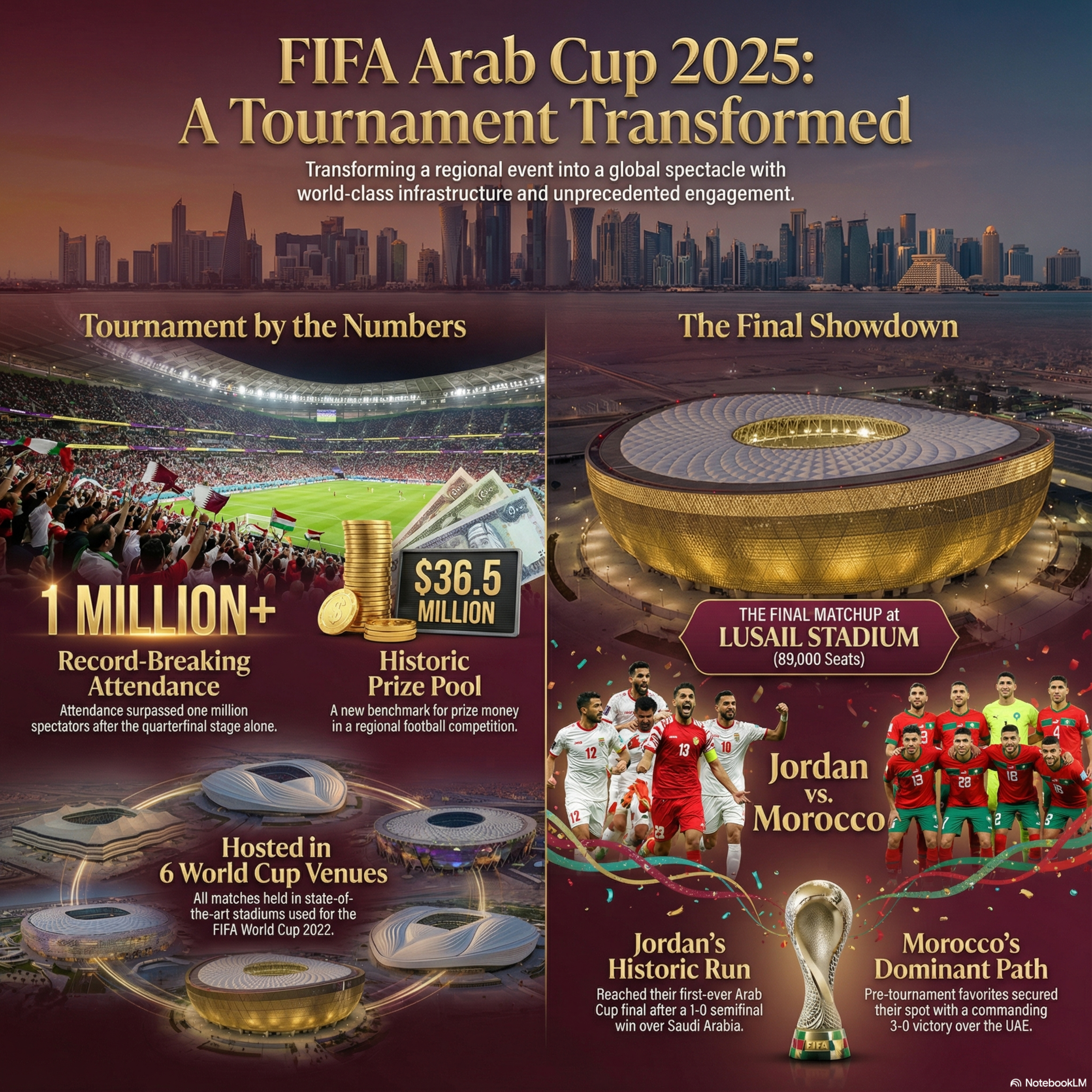
Let's dissect the money first, because nothing speaks louder in professional sport than the prize pool. And this figure is truly astonishing. We have to emphasize this, this is a regional competition, yet the total prize pool for the 2025 FIFA Arab Cup God, it amounts to $36.5 million. QAR 132.9 million. 36 and a half million. That figure fundamentally alters the tournament stature. It immediately sets a new extremely high benchmark for any regional competition globally. For comparison, many lower tier continental championships don't even approach that value.
Not even close. This massive financial reward, it dramatically elevates the stakes. It forces every National Federation to prioritize participation, ensuring they send competitive squads, which in turn guarantees the technical quality we were just talking about. I want to focus on the message this sends, too. The local organizing committee chairman framed this colossal investment not just as prize money, but as an act of legacy. What did he say? He said it reflects Qatar's leading role in the development of football across the region, leaving a meaningful legacy that benefits our communities and the broader region.
That's a visionary statement. They're strategically using finance to guarantee high quality participation and to attract the media and marketing attention that then creates the self perpetuating cycle of financial growth, right? When you offer 36 and a half million dollars, you are signaling to the world that this event is not an exhibition. It's a serious high value competitive platform and this stability married to that financial reward is what attracts the top tier commercial partners, something that was just impossible during the years of decade long hiatuses.
OK, here's where it gets really interesting. Let's look at the return on that investment from the perspective of the fan. The attendance figures are arguably the most impressive metric of success. They are unbelievable. 2025 Tournament 11th edition It surpassed the 1,000,000 Stadium spectators milestone after just the quarterfinal stage, reaching a total turn out of 1,022,592 fans. That number needs serious context. The entire 2021 edition, which again was considered a landmark success at the time, drew 571,605 total fans across the whole run.
So to highlight the explosive growth. The 2025 group stage alone attracted 812,318 fans. Wow. They blew past the entire attendance of the previous landmark tournament before the semifinals even kicked off. That is exponential sustained fan engagement. That is a clear, undeniable mandate from the public. It tells Wayfieu and Kosafa that fans will show up in massive, sustained numbers if you deliver a World Cup standard organizational environment and infrastructure. But how do you sustain that level of crowd day after day?
By creating unforgettable high stakes spectacles. Look at the single match attendance record set during the 2025 tournament, the clash between Morocco and Saudi Arabia. How many 78,131 fans? 78,000. That broke the previous 2021 record by over 14,000 spectators. When you have nearly 80,000 people packed into a modern venue, the atmosphere is electric. It was described as a cauldron of regional pride. And that atmosphere translates directly into phenomenal media coverage and sustained commercial interest globally.
And this leads directly back to the infrastructure impact. They utilized 6 venues. Every single one of them hosted the 2022 World Cup. Minimum capacity of 40,000. And critically, they achieved an average occupancy of nearly 80% throughout the tournament. This isn't just about big buildings, it's about the standard of operation within them. That 80% average occupancy, that's the key take away. It completely validates the massive investment in infrastructure. African regional bodies, they often struggle with pitch quality, security, fan comfort.
Which leads to diminished fan trust. Exactly, the Arab Cup demonstrates that utilizing and maintaining world class 40,000 plus capacity stadiums, even for a regional cup, sends a message of seriousness and commitment to the fan base. The quality of the venue validates the significance of the competition. It does. OK, so the organization is world class, the money is huge, the fans are turning up in record numbers, but none of that matters if the football itself isn't compelling. Was the competitive quality high enough to justify this status?
It was unquestionably high level. Observers weren't just being polite. They consistently compare the competitive intensity and the technical level of the 2025 tournament to full continental championships like the Asian Cup and Afghan. And we have concrete evidence of that quality. We do the participating nations. Seven of the teams competing in the 2025 Arab Cup have already qualified for the FIFA World Cup 2026. So this isn't ceremonial participation. Not at all. This confirms the tournament is featuring genuine top tier competitive quality and high stakes.
If you want to test your players against World Cup caliber opposition, this tournament provides it. And they committed to modern match integrity by adopting technology. Absolutely. The 2021 edition introduced Video Assistant Referee, or VAR to the Arab Cup for the first time in high stakes knockout games. Trust in the integrity of the officiating process is paramount. It tells the world this tournament takes itself seriously. It tells everyone, and especially the participating federations, that this tournament takes itself seriously at every single operational level.
The metrics are clear. Massive growth is possible. But for a listener in, say, Ghana or Kenya, the immediate question is how? How do Wefu see KAFA or KOSAFA actually replicate this? They can't just ask FIFA for $36 million tomorrow. It requires A systematic, tactical approach to organizational development. It absolutely does, and the good news is the blueprint isn't locked behind closed doors. The Arab Cup created a direct mechanism for knowledge transfer which African federations must utilize. It was that the FIFA Arab Cup Qatar 2025 observation program.
Tell us about that program. This is the practical how to knowledge sharing. Right, It was a five day intensive session that hosted 55 representatives from football associations across the world, specifically including African Fas. The key here is it wasn't a theoretical conference. It was hands on. It was hands on learning. Participants gained first hand experience directly from the local organizing committee's operational teams. This is where the dry facts of organizational success meet the messy reality of implementation.
What were the functional areas of learning? You know, the stuff that makes a difference between half a million fans and a full million fans. They covered the critical, often overlooked areas. Things like ticketing logistics, ensuring smooth fan entry and exit, metal services, protocols for high capacity crowds, security planning for World Cup level venues. Yeah, the marketing. And the sophisticated delivery of marketing rights. Participants toured every key site, stadiums, the main Media Center, the accreditation center.
The CEO of the LOC explicitly stated the goal was transforming the host nation into a global reference point for operational excellence. Let's focus on one of those points, ticketing logistics. When you jump from 500,000 total fans to over a million, your ticketing and crowd management system must be flawless. It has to be. For a regional African body that might be struggling with manual ticketing or fraud, what specific lesson is embedded in that knowledge transfer? The lesson is automation and security integration.
If you want 1,000,000 people to pay and show up reliably, you need secure digital platforms, sophisticated access control systems at the gates, and a robust data collection system. The observation program provided insights into how they plan for peak traffic flow and how they secured the ticketing supply chain to prevent unauthorized access or counterfeiting. For an FA like Zimbabwe, as their representative mentioned, this kind of logistical detail is everything. That's Norman Guanwadza, the head of finance and administration from the Zimbabwe Football Association.
What was his specific take away from this deep dive into operational excellence? He emphasized that planning is absolutely key for delivering major tournaments, and he specifically stressed the need for excellence in three critical, non glamorous areas. What were they? Procurement, transportation and resource management. He acknowledged that logistical efficiency is the foundational, often frustrating, groundwork necessary to support the entire public spectacle. Right. If your procurement process fails, your security personnel might not have vests.
If transportation fails, the teams can't arrive on time. It all collapses without meticulous planning. That attention to detail is just remarkable, and the sources highlighted Qatar's organizational depth by noting their ability to multitask major events. Yes, they showcased exceptional capacity management by hosting the final three matches of the FIFA Intercontinental Cup finals simultaneously during the rest days of the ongoing Arab Cup. So they were running 2 tournaments at once. Delivering 2 distinct major international football tournaments side by side proves that their organizational structure, the security, the staffing, the facilities management is robust enough to handle continuous high pressure usage.
That capacity is what builds trust. It builds trust in the entire international football. Now let's synthesize this into the four primary elements identified. These are the four pillars that must form the strategic blueprint for African regional elevation. I want to spend significant time on this because this is where the listener needs actionable analysis. Agreed. These 4 strategic levers are the replicable model. OK, Pillar A infrastructure investment. Quality venues matter. The lesson is moving beyond standard venues and utilizing stadium designed for the highest level of competition, 40,000 minimum capacity.
But let me challenge you on that immediately. Go ahead. Is it realistic to ask Wave View Nations to build 4 World Cup standard stadiums just for a regional cup? Isn't that an immediate limiting factor for this blueprint? That's an essential question. But the blueprint isn't necessarily about capacity, it's about standard. OK. The application for African regional bodies is to coordinate venue upgrades or commit to a fixed rotation of existing venues that meet established international standards for pitch quality, flood lighting, security and fan comfort.
So. It's about the quality, not the size. The Arab Cup proves that high quality, safe and modern infrastructure validates the spectacle. It commands fans higher attendance and better media rights. If the environment feels significant, the fans believe the event is significant. Even if the capacity is 20,000, if the quality is world class the message is the same. That makes sense. It's about signaling professionalism regardless of scale. Let's move to Pillar B Institutional backing. Certainty breeds investment.
The core lesson here is that long term multi edition commitment from the governing body. Yes, the 2033 guarantee. Which provides organizational expertise and financial credibility. This is non negotiable. Instability kills regional football. The commitment to 2029 and 2033 is the ultimate trust signal that certainty encourages long term fan interest. It allows rivalries to deepen. And traditions to form. Crucially, it attracts major, reliable sponsors who need a guaranteed return over many years, thus justifying that massive 36 and a half million dollar prize pool.
So African regional bodies must stop planning addition by addition. They must aggressively seek multi edition commitments from the continental body or secure fixed commercial partners to banish uncertainty and build that commercial trust. It sounds like this pillar requires political will just as much as financial power. Which brings us to Pillar C Consistent scheduling, creating ritual and tradition. This is about replacing the chaos of the past with a fixed regular cycle, the four year format.
Correct. When you establish a regular, predictable cycle, you turn an occasional sporting event into a cultural fixture. Fans can mark their calendars. They plan around it. And it helps the federations themselves, right? Absolutely consistent scheduling is essential for the African federations who struggle to integrate regional tournaments into an already packed calendar of qualifiers and leagues schedules. And what about the impact on play release? Consistent scheduling means national teams can factor the regional tournament into their long term player development strategy.
Exactly. Consistency provides predictability for clubs, minimizing disputes over player release. If, say, Sakafa commits to a fixed 4 year cycle, national teams can strategically decide which players to use years in advance. Which keeps the competitive integrity high while managing player fatigue. And club obligations. The past irregularity was the tournament's greatest weakness. Guaranteed fixed consistency is now the key to unlocking its potential. Finally, Pillar D Cultural integration Beyond the match.
The blueprint demands that the tournament be positioned as a broad cultural event, not just 90 minutes of football. This is how you attract families and nontraditional football fans. It's how you turn regional pride into a global attraction. The Arab Cup successfully integrated immersive fan zones at iconic locations like Katara, Souk, Waukee Flu Sail. It became a regional celebration. A massive regional celebration of culture and unity, the event blended entertainment, shopping, local cuisine, heritage.
So how can weyou view, for example, apply this? They might not have stadiums in a major development like Lucille, but they have vibrant local markets and unique cultural heritage. The application is simple. Connect the football event to the local experience. Utilize historic markets the Sioux in Butcher African host cities or coastal areas for cultural performances. Make it a magnet for tourism. Exactly. The goal is to make the event a magnet for regional tourism and family attendance by seamlessly blending the sport with local heritage.
If the tournament is positioned as a celebration of local culture, it gains a depth of meaning far beyond the final score. We've established the organizational environment is world class. Yeah, now let's see the result of that environment on the product itself, the football. The 2025 knockout stage delivered high drama, proving the competitive intensity that observers noted. The road to the final was highly compelling. It confirmed that competitive depth is increasing across the region, which is, at the end of the day, the ultimate payoff of this blueprint.
Let's breakdown the semifinals that determine the two finalists. We saw a commanding performance from a favorite and then a historic upset. We did. Morocco, who were rightly described as pre tournament favorites, secured a professional 3 nil victory over the United Arab Emirates. At Khalifa International Stadium. It wasn't a runaway initially though, the UAE actually held their defensive line quite well, but the quality eventually told. So how did Morocco break that deadlock? How did they demonstrate the kind of composure African federations need to emulate in these high stakes matches?
It was a beautiful example of exploiting space. The deadlock was broken in the 28th minute by Kareem Elberkawi who converted a superb cross with a clinical header. Then the Atlas Lions showed their counter attacking ruthlessness in the second-half after absorbing pressure from the UAE. A crap Elma Dewey capitalized on a swift break in the 84th minute to double the lead. And they sealed it in stoppage time. Veteran striker Abdurazzak Hamdallah netted deep into stoppage time to stamp their authority.
Morocco demonstrated clinical finishing and composure under pressure, key lessons for any team. I'm hoping to navigate a knockout bracket. But the real shocker, the moment that proved regional success is achievable regardless of historical ranking, was the other semifinal. Jordan won Saudi Arabia nil. A huge upset. That was a monumental historic moment for Jordanian football. They achieved their first ever Arab Cup final appearance. What was their previous best? A fourth place finish way back in 1988, this victory gives them a shot at their first major international trophy, which just validates the competition's high stakes.
And Jordan had to overcome a very strong Saudi side coached by the experienced Airway Renard. What was the tactical differentiator? It was a combination of precise attacking execution and immense defensive resilience. The match was tight and cautious for over an hour. And the goal? The decisive moment came in the 66th minute. Mahmoud Al Mahdi delivered a sharp, precise cross from the left flank. Al Rashton, showing brilliant positional size, headed it in from behind the Saudi defence, The only goal.
And Saudi Arabia pressed hard after. That they did, trying to use the quality of players like Salem, Al Dasari, but Jordan's defense just held firm. And we have to highlight the role of the goalkeeper in those tight knockout games. Absolutely. Jordanian goalkeeper Yazid Abu Leila made a spectacular, game defining save against Al Dasari late in the second-half that say was the difference between a final spot and a painful exit. A huge moment. Even a golden opportunity missed by Saudi forward Salah Al Sherry in the 87th minute speaks to the relentless pressure Jordan had to absorb.
The lesson here is clear. Tactical discipline and elite goalkeeping are essential ingredients for historical upsets. So the final was set, Jordan versus Morocco. But the most intriguing competitive lesson for African federations lies in Morocco's squad strategy during this tournament. This is a critical tactical take away for African powerhouses Nigeria, Senegal, Cameroon, Ghana. It was indicated that Morocco was strategically playing with what some observers described as their third team. Their third team.
What does that mean? This squad was composed mainly of players from the local Moroccan league or from the Gulf and Egyptian leagues. They deliberately left many of their European base stars out. So why is this strategy so revolutionary and instructive for African football bodies facing those perennial issues with player release for regional competitions? Because it turns a weakness the difficulty of securing top European players for regional cups into a strategic strength, Morocco used this high level, organized and financially lucrative tournament as an unparalleled opportunity to test and develop competitive depth.
So the African giants can do the same. They can rotate their squads, give fringe players high stakes competitive experience and evaluate the next generation in an environment that's equivalent to a mini World Cup. It's a no lose strategy. They develop their depth, they expose young players to crowds of 70,000 1000 plus, they gain valuable ranking points, and they still compete for significant prize money. All without over fatiguing their primary European based national team ahead of major continental qualifiers.
It's the definition of forward thinking, squad management. But this strategy only works if the tournament itself is highly organized, financially rewarding, and consistently scheduled, which loops us right back to the Four Pillars blueprint. Right. No top federation risks their developing players in a poorly run, sporadically scheduled tournament. No chance. And linking to the idea of a shared regional ecosystem, there was a fascinating coaching connection between the two finalists. Yes, this was a great detail.
Both Jordan and Morocco were led by Moroccan coaches. Jordan's historic success was explicitly tied to the fact that their coach, Amuta is Moroccan. And of course, Morocco was coached by a Moroccan. What does that tell us? It highlights the successful regional circulation of high level coaching methodology and expertise. It shows that the capacity for success is often homegrown and accessible within the regional ecosystem if you invest in local coaching development and allow that talent to move freely.
And the competitive intensity is locked in by that rigorous knockout structure. Quarterfinals, semifinals, 3rd place playoff and a final with the clear consequence of extra time and penalties if needed. That structure ensures every match is a true test of nerve and fitness. And a true test for those developing players. It ensures that the player development platform is truly high stakes. The intensity married to the massive financial reward and the massive stadium crowds creates an experience that prepares these regional players exceptionally well for the pressure of a full continental championship like AFCON.
We've covered the six decades of institutional failure, the historic turning point, the staggering metrics of success, and the resulting four pillar blueprint. So what does this all mean for the learner? It means the African game has a new, clear, proven road map to global elevation. The Arab Cups transformation hinges on three major actionable lessons that Wefu, Sakafa, and Kosafa must internalize immediately, right First, organizational stability. Secured through that commitment to fixed multi edition scheduling through 2033.
Second financial elevation proven by that 36 and a half million dollar prize pool, setting a new massive bar for regional financial rewards. And 3rd, the direct application of the Four Pillars blueprint, right? Investing in World Cup standard infrastructure to validate the spectacle, securing long term institutional backing to guarantee commercial trust, adopting consistent scheduling to build tradition and manage player release, and ensuring cultural integration to make the event a broad celebration of regional heritage.
The Arab Cup validates the idea that regional tournaments don't have to be perpetual, limited in scope or reputation or financial reward. Not at all. It offers an inspiring reminder that political vision, organizational commitment, and financial investment can create something truly extraordinary that challenges the global status quo and elevates the entire region. This raises an important question if these regional African competitions like the wave Hugh Cup of Nations or the kick off a challenge if they adopt this institutional blueprint.
With fixed reliable schedules. Massive financial incentive. And the strategic use of World Cup standard organizational expertise and infrastructure. What massive effect might that have on the competitive balance of the talent pipeline feeding directly into the Africa Cup of Nations? It wouldn't just improve the regional tournaments themselves, it would significantly deepen in the entire continental pool of talent, providing high stakes competitive experience for hundreds of fringe players who currently rely solely on their club careers.
It would create an even stronger AFCON. A stronger, more unpredictable and globally respected AFCON. This is not just a success story, it's a systematic model for sustained continental football growth across Africa. That is the deep dive into the blueprint for regional football success. Thank you for joining us. We'll see you next time.
 Apple Podcasts
 Castbox
 Castro
 Goodpods
 Moon FM
 Overcast
 Pocket Casts
 Podbean
 Podcast Addict
 Podcast Republic
 Spotify