AFCON Semifinals Tactics Indigenous Coaching Revolution
About this episode
AFCON Semifinals Tactics Indigenous Coaching Revolution
Listen now on Spotify, Apple Podcasts, Amazon and other streaming services! Don’t forget to subscribe, share, and leave a ⭐⭐⭐⭐⭐ review to help more players and coaches discover the power of Techne Futbol and Data Technology in the beautiful game.
#TechneAfricaFutbol #TechneFutbol #TrainWithTechne #Playermaker #TraceFutbol #Hudl #FootballTech #FootballInnovation #PlayerDevelopment #CoachTools #SmartFootballTraining #AfricanFootball #CAFOnline #FIFA #FIFAYouth #CAFDevelopment #YouthFootballAfrica #NextGenFootball #FootballScouting #TalentIdentification #DigitalScouting #EliteYouthDevelopment #FootballJourney #FootballAnalytics #FIFAForward #FutebolAfricano #TrainTrackCompete #FootballExcellence #FootballAfrica #TheFutureOfFootball
If you are not currently vibrating with continental pride, you must be in the wrong place. Welcome back to the Deep Dive. We have reached that electrifying moment. The the genuine a text of African football. The 35th edition of the Total Energies AFCON, posted magnificently by Morocco, has delivered everything we hoped for, and it's all culminating in a semifinal lineup for the ages. It really is. I mean, it's a truly historical convergence and you just can't overstate the significance here. We're looking at Morocco, Nigeria, Egypt and Senegal, 4 monumental nations that, you know, collectively they lay claim to 11 continental titles.
This isn't just another knockout stage. No, not at all. This is the ultimate meeting of pedigree, of history, and of course, current form. Each of these canes carries this immense weight of expectation, all of them just vying for that single coveted spot in the final. OK, so let's unpack this setup, because the tactical tension that's just radiating from these two fixtures is, well, it's intense. It's the purest possible collision of footballing philosophies and it really defines the entire narrative of this tournament.
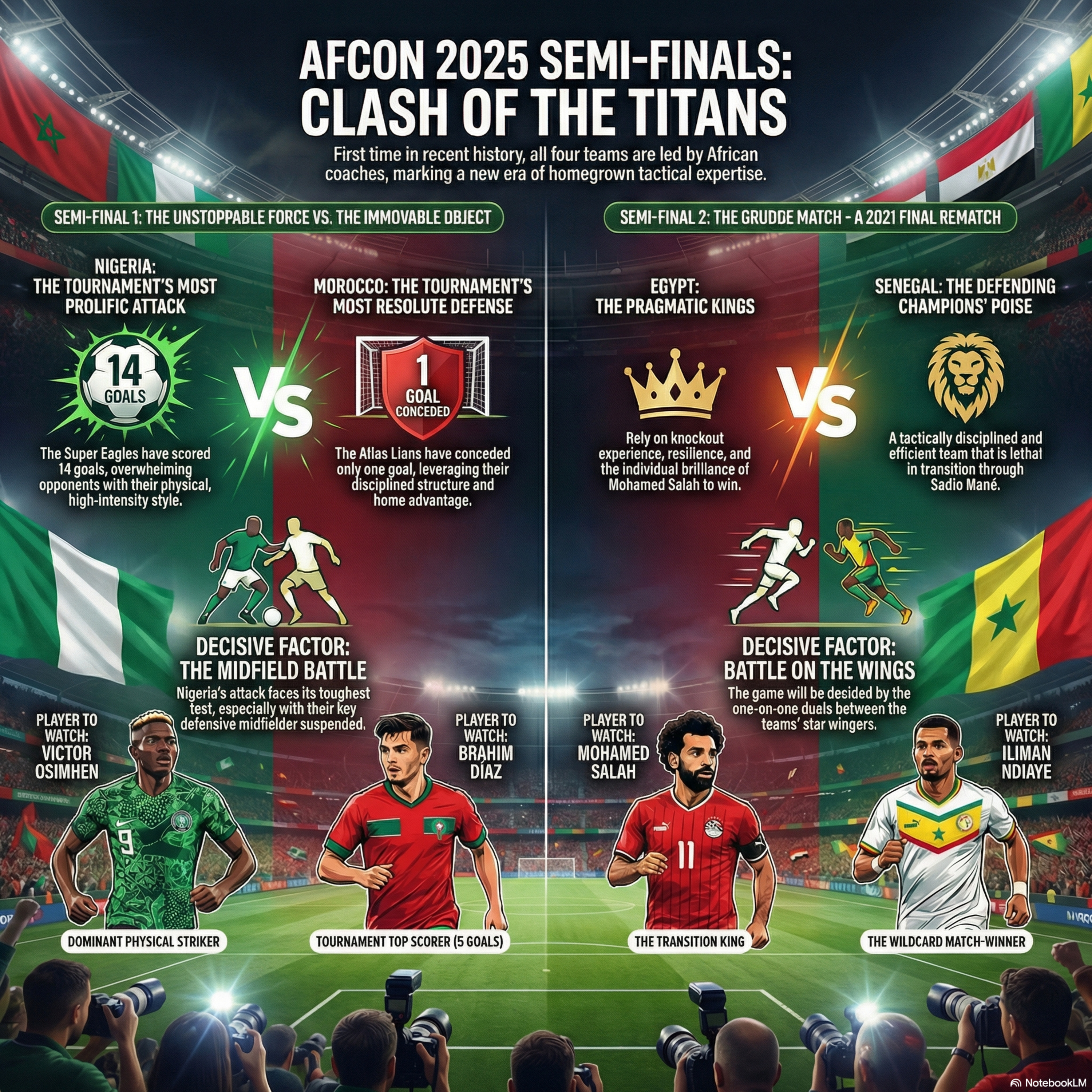
It does. I mean, just look at the match up in Rabat. You've got Morocco, the competition's most structurally resolute defense. They've conceded just a single goal across five matches. And who's standing opposite them? The Super Eagles of Nigeria, the tournaments most aggressive, most prolific attack, hammering in a staggering 14 goals. It's it's genuinely the immovable object versus the irresistible force. And that specific tension, you know that that clash between elite defense and overwhelming offense, that's the immediate story.
It's the explosive tactical narrative. But what's truly insightful, I think, is what this final four tells us about the strategic evolution of the broader African game. This tournament has validated 2 massive watershed themes that are reshaping how football is managed and played right across the continent. And the first one is maybe the most exciting and certainly the most visible. The Indigenous coaching revolution. Precisely for the first time in such a high stakes setting, at least in recent history, every single one of our semi finalists is guided by an African head coach.
You've got Walid Rigrigi from Morocco, Eric Shell for Nigeria, Hosam Azan for Egypt and Pip Thea for Senegal. This isn't just a, you know, a statistical anomaly. It signals A definitive, crucial shift. A shift towards what exactly? Towards trusting localized expertise, towards valuing tactical self-sufficiency and providing genuine tangible validation for our own massive talent pool in the technical and management areas. This is a profound moment of maturity for African football structures. It speaks volumes, doesn't it, about the institutional confidence that's now being placed in homegrown talent?
Yeah. And the second theme, this one is less about the personnel on the sidelines and more about the the invisible architecture that's defining the modern high tempo game technology. Yes. Specifically the successful, smooth and frankly seamless implementation of Semi Automated Offsite Technology, or SAOT. And why has that been so critical here? Well, the modern game, especially the way teams like Nigeria and Senegal want to play. High tempo, high risk, playing right on the shoulder of the last defender.
It demands instantaneous and absolutely precise officiating. SOLS has provided exactly that. It reduces the margin of error to millimeters. And critically, it ensures that the fast-paced, high flow nature of the match isn't constantly interrupted by these lengthy decision making delays. It just raises the technical standard across the board. OK, so here's our mission. For this deep dive, we are going to deconstruct the tactical and technical brilliance of these final four, what systems they use, how their start players function, and why those systems are so successful right now.
But crucially, we're also going to extract the actionable lessons from the four teams that fell in the quarterfinals. We're turning failure into a concrete blueprint for development, all for the ultimate structural benefit of the African game moving forward. This is your definitive shortcut to understanding the why behind the glory, the disappointment and the direction of travel for African football. So let's start at the very beginning, the architecture of success. To really understand why these teams are here, we have to analyze their goal scoring profiles and their methodologies.
The Golden Boot race is always a fascinating entry point, isn't it? It immediately isolates the key roles and the sheer efficiency within a squad. Leading the pack is Morocco's Brahim Diaz with five goals, and what's amazing is he scored in every single one of Morocco's matches. That level of consistency is just, it's so rare. Diaz is the absolute definition of clinical efficiency, and his role is so much more complex than a traditional forward. He operates primarily as a drifting playmaker. He often starts from the right, but then he moves centrally to overload the middle or drift into that left half space.
So he's not just a goal hanger waiting in the box. Not at all. His effectiveness comes from a combination of elite technical skill and, crucially, superior timing. We see him excelling in those late ghosting runs into the box, often converting cutbacks from the relentless runs of our craft. Akimi. He provides that pure individual X Factor. There were groggy needs to unlock the notoriously tight, deep defenses that Morocco always seems to face. His scoring record isn't about volume shots, it's all about the quality of the opportunity.
OK, then we shift to Nigeria where the attack is this 2 pronged devastating threat. Victor Awesome Hen sits on four goals, but his his gravitational pull on the defense feels almost more valuable than his actual scoring count. That's a great way to put it. Awesome Man is not just a goal scorer, he is the source of pure, beautiful chaos for Nigeria. His four goals? Yeah, they demonstrate his physical dominance and his aerial threat. But his primary function is to destroy the opposition's defensive structure by constantly pinning back, challenging and occupying 2 center backs, sometimes at the same time, he creates massive amounts of space.
He's the battering ram. He is the battering ram that crashes open the door. He ensures that second balls drop into dangerous, exploitable areas for the advancing midfielders or for his strike partner. He's the indispensable focal point that allows Nigeria's high pressure style to actually succeed. And that strike partner, the man who really exploits that chaos, is Ademola Lukman, currently sitting on three goals. We often hear about his effectiveness in half spaces. For you, the listener, what exactly does that mean and why is he so good there?
Right. That's a vital distinction we need to make clear. So the half space is that vertical corridor on the field. It's not the wide wing and it's not that congested central channel. It's the space between the opposition center back and their full back. Lookman is a master there because operating in that zone forces the defense into an impossible split second decision. Does the center back step out to meet Lookman and in doing so expose the central defense to awesome man or does the full back tuck in leaving the entire flank open for a Nigeria wide player?
Lookman's three goals, often coming from intricate link up play or long range efforts, are the direct result of him exploiting these forced defensive decisions. He is the true creative engine, linking that aggressive midfield diamond with the physical strikers. And we absolutely have to acknowledge the transition. King Muhammad Saleh of Egypt, also on four goals. His entire scoring profile just screams opportunism. That's the perfect way to describe him. Saleh is a lesson in economy and mental fortitude.
He doesn't need 15 chances to score. He relies so heavily on that blistering speed to get in behind offenses and, perhaps most crucially for Egypt, absolute granite composure from the penalty spot. His goals often arrive completely against the run of play. They capitalize on moments of opponent fatigue or transition, that split second when Egypt has been absorbing pressure and then suddenly springs forward. His presence alone is a psychological weapon. It forces defenses to divert resources and maintain a level of concentration that is just exhausting over 90 minutes.
Now let's dig into the timing of goals in the knockout stages, because analyzing when teams scored offers some really critical predictive data about their physical and mental habits. The quarterfinals showed a clear repeatable trend the post halftime blitz. The trend highlights the immense impact of coaching adjustments and mental intensity during the interval. It's fascinating. We saw both Nigeria and Egypt strike immediately after the break. Nigeria scored in the 47th minute against Algeria with Awesome Hen and Egypt scored in the 52nd against Cote d'Ivoire.
This period, the 1st 10 to 15 minutes after halftime, is the most volatile and African knockout football. It is where coaches transmit new information and if a defense isn't mentally sharp, they are punished immediately. And Nigeria's response against Algeria was particularly characteristic of their whole philosophy, wasn't it? That rapid 10 minute blitz, awesome head in the 47th, Adams in the 57th. It just demonstrates a team that is built to maintain relentless pressure when others are looking to catch their breath.
That's the hallmark of their high octane football. It is about intensity as a weapon. They realize that the opponent is often looking to conserve energy, or maybe they're still processing new tactical instructions. Nigeria maximizes that momentary defensive lapse. Now contrast that high speed approach with Morocco's methodology. Their goals speak to pure efficiency and immediate game management. They prefer scoring early, like Diaz's goal in the 26th minute against Cameroon, and then using structured, sustained possession and box overloads to secure the lead.
They avoid the need for high risk late flurries. They take the lead and then they manage the opponent into submission. And we can't overlook the pure utility of Egypt's set peace threat. Rami Rabi's goal against Cote d'Ivoire was a direct result of a dead ball situation. In these tight knockout games, where open play is often suffocated, converting dead balls becomes an indispensable tactical tool. Oh absolutely. Set piece expertise is the ultimate efficiency hack. When 2 defenses are disorganized, a corner or a free kick is the best way to bypass the complexity of open play buildup.
So let's synthesize these specific traits into the overarching team scoring profile, because the four methodologies remaining are distinct and, well, there's absolutely fascinating. Let's start with Nigeria, the overwhelming Force. Fourteen goals. That's nearly three goals per game. How do they maintain that level of potency? Their entire mechanism is built on that 442 diamond. It relies on the sheer physical dominance of the two strikers, Awesome Hand and Acor Adams. They simply overwhelm center backs physically, forcing them backward.
Lookman then exploits the resulting chaos in space in those half spaces. Just as we discussed, their danger zone right after halftime is a testament to their superior fitness and mental commitment to sustaining that high pressure. OK then, Morocco. Clinical efficiency. Nine goals scored, but only one conceded. The very definition of tactical balance. Their goals are derived from structured possession, which makes them fundamentally different from Nigeria. It's not about the volume of shots, it's about control of territory.
The key is their individual Diaz, El Cabe and Zayek operating in very tight channels and critically, their structure relies on that heavy right flank overload. Hakimi provides the relentless width and service, pulling the opposition defense wide, and that allows Diaz to slip into that interior pocket of space. Then you have Egypt, resilience and opportunism. They're less prolific and open play, but they're absolute masters of a late winter and the extra time scramble. This is a team that's defined by mental toughness and by history.
Their methodology is predicated entirely on Solo's explosive transition play and their unmatched expertise in set piece goals. They are built for knockout football. They're willing to absorb pain to suffer for long stretches, believing that one or two key moments usually orchestrated by Solo will be enough. They have the mental strength accumulated over seven previous titles to progress, even when the performance is, you know, suboptimal. And finally, Senegal controlled dominance. They win their games efficiently, often by slim margins, and they just manage the flow once they get ahead.
Senegal relies on exploiting the wide areas, it's wing play dominance. They utilize the blistering pace and directness of Sadio Manet and his male Asar. They aim to get the ball out wide quickly to feed a strong central striker and they are ruthlessly efficient. They score quickly, as they did early against Mali, and then they use their world class defensive structure, anchored by Coulibaly to control the pace, manage the clock and see the game out professionally. So we have the overwhelming force, the clinical machine, the pragmatic survivors, and the controlled dominators.
And if those are the identities, well, here's where the Analytical Fund really begins watching these philosophies collide in the semifinals. The semifinals are less about individual talent now and much more about the ideological clash of structures. Let's start with Semifinal 2, Morocco versus Nigeria, The battle for Rabat. This fixture pits Nigeria's explosive aggression against Morocco's almost obsessive structural integrity. Nigeria under Eric Schell has fully committed to this aggressive diamond.
A442 or maybe a 41212 system. This is a massive philosophical decision, isn't it? Prioritizing central dominance and high intensity. And their core strength is their quantifiable pressing intensity. We have concrete data that just speaks volumes. Nigeria has recorded APPDA that's passes allowed per defensive action of 6.6. This is the lowest, or at least one of the lowest figures in the entire tournament. OK, So what does that 6.6 actually mean for the listener? What does it look like on the pitch?
It means they allow the opposition barely 7 passes before a Nigerian player is actively engaging in a tackle and interception or press. This is a constant, relentless high energy effort to win the ball back high up the pitch. And that dual striker system with awesome Henan Adams provides that necessary offensive overload. They pin back the opposition's defense, which then frees up the midfielders lookman, for example, to surge forward in waves. It's exhilarating, high risk football, but the physical demands have to be unsustainable over 120 minutes without some repercussions.
And that demanding nature leads directly to their tactical vulnerability. While they score freely, conceding 4 goals in the group stage proves their highline exposes them to rapid counters if that initial press is bypassed. Furthermore, Coach Shell acknowledging this physical toll as publicly stated, his squad is tired. This is why he has hinted at a massive tactical switch to a more conservative deeper block for the semi final, a calculated yet deeply risky move to conserve energy against the home side.
But the shadow hanging largest over Nigeria, it has to be the indeedy void, the suspension of their captain Wilfred, indeedy their defensive anchor is a critical tournament defining blow. We cannot overstate this. What does that loss mean, not just tactically, but psychologically? Indeed, he isn't just a tackler, he's the structural lynchpin in that aggressive diamond. He serves as the sole screen for the back 4, the primary disruptor and the pivot who dictates the angle of the opposition's attack.
Without him, the tactical implication is clear. The central channels, particularly that pocket of space directly in front of the center backs, become massively vulnerable, and Morocco's technical players are precisely the ones capable of firing a direct, incisive pass into that newly exposed pocket. And the psychological impact? Losing your structural anchor, The man who provides that calmness amid the chaos of the high press right before the biggest game of the tournament. It forces every other player to compensate, which just drains mental energy.
The likely replacement, Rafael and Yadika, is a strong player, but he faces the monumental task of replicating the structural coherence of a leader who knows the system intimately. That instability, even for just a few minutes, could be absolutely fatal against Morocco's efficiency. On the other side of that, we have Morocco, the balanced protagonist. Raggarji's team is all about structural integrity and control, a carryover from their incredible World Cup philosophy. Yeah, they operate primarily in a 433, which shifts so quickly into a highly disciplined 4141.
Defensively, their strength is their defensive solidity. I mean, one goal conceded in five games requires elite organization that's led by Nayef, awkward ruin size and the tireless Arkhraf Hemi. They dominate structurally by creating massive overloads, especially on that right flank with Akimi and Diaz. The synergy forces the opposition defense to continuously shift resources, which eventually creates a space that El Cobby or Diaz can exploit. And we absolutely have to factor in the external environment here, the home advantage in robot that stadium atmosphere, it acts as the legendary 12th man, doesn't it?
Amplifying every successful tackle and demoralizing every opponent error. That home pressure is a profound strength, but it does carry a reciprocal weakness. Rig Raguvi has publicly acknowledged the immense pressure, comparing the semifinal to playing a final. Historically, host nations sometimes buckle under that unbearable weight of expectation. If Morocco's midfield structure is disrupted, which Nigeria's central diamond can achieve if they maintain concentration and the crowd grows frantic, that structural integrity could be tested like never before.
They have to control the game early to manage the crowds anxiety. So if Morocco is the control team and Nigeria is the chaos team, the key tactical battle is squarely in the midfield transition. Exactly the entire outcome hinges on whether Nigeria's replacement for Indeedy can successfully disrupt Morocco's measured build up play in that transition phase. If Morocco bypasses Nigeria's initial press quickly, Hakimi is going to have acres of space to attack Nigeria's exposed left flank. Conversely, if Nigeria forces turnovers high, exploding that Indeedy void as we discussed, Morocco's aging defense will face its first true test of raw pace and physicality against awesome men surging forward.
This match will be a pure test of which team can control those transition moments. OK, let's pivot to semi final one. The geopolitical and historical clash. Egypt versus Senegal. The grudge match. A repeat of the 2021 final. Senegal, the modern machine under Pape Thio, has shown remarkable maturity. They've retained the defensive strength that one of the previous title while injecting a more proactive attacking philosophy into their classic 43. Their efficiency is just lethal. They don't need high possession numbers to hurt you.
They boast lethal transition speed through Monet and Jackson, and they possess this incredible tactical discipline. They're capable of suffering without the ball for long periods, which they proved masterfully against Molly. The defensive core is arguably the best remaining in the tournament. Kaladu Kulabali remains an immense presence, anchoring a defense that has secured 3 clean sheets, and it rarely looks troubled. However they're acknowledged, weakness emerges when they face a truly stubborn low block.
They sometimes struggle to inject creativity and incisive passing into the highly congested final third, often relying too heavily on set pieces or the individual brilliance of Monet to breakdown pack defenses. That reliance on moments is precisely what Egypt will be targeting. And then we have Egypt, the pragmatic kings now led by the legend Hassam Hassan, who has instilled a pure, unapologetic win it all costs mentality. They are masters of adapting comfortable seating possession, shifting seamlessly between a 4231 and a highly defensive 541.
Egypt's primary tactical strength is really twofold. First, you have the Sala factor. Even if he seems quiet, he demands double marking from the opposition that automatically opens up valuable attacking space for others, specifically the high paced runners like Marmoush and Trezegan. Second, they have the wall their goalkeeper Mohamed El Shenawi, who is capable of single handedly keeping Egypt in games through unbelievable saves. And finally, those 7 continental titles provide an unmatched reservoir of knockout football experience.
They know how to survive, suffer and ultimately progress. But their defensive structure isn't perfect, is it? Conceding three goals to Cote d'Ivoire showed some real organizational cracks when they were pressed relentlessly. That seems to indicate a structural issue when their transition defense fails. It did. The organization sometimes struggles under sustained, coordinated pressure. Furthermore, tactically, they show an excessive reliance on Salah for offensive creativity. If Senegal manages to neutralize Salah's ability to run in behind, which they have shown they can do in past encounters, Egypt's Plan B often defaults to hopeful long shots or drawing fouls, which is just not sustainable against an elite defense like Senegal's.
This sounds like a game that's going to be decided by micro battles, so the key tactical battle here is definitively focused on the flanks. Absolutely. The complexity of this game will be decided. Wide is going to be a series of isolated, brutal one-on-one duels. We will see immense pressure placed on the defensive wing backs. Salah will go head to head with Senegal's left back, forcing that player into constantly choosing between covering Salah's runs or maintaining the back 4 shape. Conversely, Saudi Omenedia will batter Egypt's right back Muhammad Hani, using his pace and trickery.
The team that wins these individual battles, either by isolating their star winger successfully or providing sufficient cover for their pullbacks, will be the one punching their ticket to the final. OK, now we must transition to what I think is the most critical section for our listener interested in the future development of the African game, The quarter final autopsy. We need to analyze the exits of the four losers, Algeria, Cote d'Ivoire, Molly and Cameroon, not to criticize their efforts but to extract the clear critical lessons on development mentality and tactics that can serve as a blueprint for all African teams looking to reach this apex stage.
Framing the autopsy as a blueprint is essential Yes, let's start with Algeria, who lost 02 to Nigeria. The failure point there was clearly physical inferiority and just a staggering lack of offensive penetration. The. Statistic that should shock every football administrator on the continent is that Algeria recorded zero shots on target throughout the entire 90 minutes. That is a collective tactical failure. They're typically highly technical midfield built around fluid passing was utterly suffocated by Nigeria's aggressive diamond formation.
They were simply too passive in their defensive actions and. Passive play against a high pressing, high octane team like Nigeria is not just ineffective, it's strategically fatal, isn't it? You're basically inviting that relentless pressure. Exactly. They allowed Nigeria to dictate the tempo and the territory entirely. The tactical lesson for Algeria, and really for any African team relying purely on technical possession, is that passivity against intensity is suicidal. If you cannot match the press, you have to bypass it quickly.
The recommendation is stark. They need a physical enforcer in midfield, someone who can win the crucial second balls and provide defensive bite. And they absolutely must develop a robust Plan B for when their preferred central possession game is disrupted and their technical players are suffocated. Next up, Cote d'Ivoire, who lost that chaotic 2-3 to Egypt. Their failure point seems rooted in extreme defensive agility and a catastrophic loss of concentration. They scored twice, which should usually be enough to win a quarterfinal, but conceding 3, including a painful own goal, demonstrates a total failure to manage the game state and absorb pressure.
The tactical lesson is that they failed to consolidate possession after scoring and consistently played too high of a defensive line. That aggressive line was repeatedly and brutally exploited by the counter attacking pace of Salah and Marmouche. They mistook excitement for control. So they basically succumbed to the psychological mistake of overconfidence after scaring just assuming the momentum would carry them. Precisely, they lacked the defensive discipline necessary to see out a lead. The recommendation for Cote d'Ivoire, and indeed any team prone to high scoring chaos, is non negotiable.
They must urgently rebuild their defensive transition structure. You cannot win knockout games at this level when you are structurally vulnerable to the counter. The switch from attack to defense has to become an instinctive priority in training. OK, moving on to Molly, who played a genuinely competitive game but ultimately lost 01 to Senegal. Their problems seem to be inefficiency in the final third and a major lapse in discipline. Molly's tactical lesson is centered on the emotional cost of these high stakes matches.
They created good moments demonstrating technical quality, but they repeatedly failed to convert those moments into clear cut chances. Their lack of cutting edge was then compounded by a turning point that cost them the tournament. The red card shown to their key player? Ease Bazuma. Playing with 10 men against a ruthlessly disciplined defensive block like Senegal's becomes an impossible strategic task. So that one moment of disciplinary lapse cost them their entire chance at glory. It did. Discipline is paramount in these high stakes, low scoring knockout matches.
The recommendation for Molly is multifaceted. They need to improve their final third decision making, converting moments into goals, but equally important is maintaining emotional and tactical control. They have to learn that a key players dismissal cost the entire nation dearly when the margins are this fine. And finally Cameroon, who lost 02 to the host nation Morocco. Their failure point was the inability to handle the press from the very first minute. The tactical analysis shows Morocco pressed ferociously and smartly.
Cameroon fundamentally lacked the technical security and composure necessary to play out from the back against that intense pressure. This lack of technique, especially in that central defensive midfield area, led to dangerous turnovers in areas where Morocco could immediately punish them. They were simply overrun, technically and physically, in the zones immediately surrounding their own defensive 3rd. So the lesson here for Cameroon, and really for all African nations aspiring to tactical sophistication, is a deep, fundamental, technical one.
Absolutely. The priority must be developing truly press resistant midfielders. These are players who possess the technical security, the peripheral vision, and the composure to take the ball in tight spaces, shielded, and make the correct pass to bypass the opponent's first line of pressure. If you lack that technical base to transition the ball out of your own third cleanly against an aggressive pressing team, you were effectively gifting them the game that needs to be a core focus of development programs right across the continent.
This deep dive has really highlighted that success and failure are driven by both tactical systems and the the human and technical engines behind them. So let's return to our first major theme, the Indigenous Coaching Review. This truly validates the expertise residing right here on the continent. Starting with Waileedrig of Morocco, he's an incredible master motivator and he has successfully managed the immense suffocating pressure of a home AFCON. His tactical flexibility notably shifting defensive shapes and utilizing the full backs that secured the clean sheet win against Cameroon.
My assessment of his tournament management so far is a solid B plus pen. However, he faces his greatest test now. He needs a genuinely convincing, dominant tactical win against Nigeria to silence the home critics who still label his approach overly cautious for a host nation. Eric Shell of Nigeria gets a higher grade, I'd imagine, given the transformative impact he's had on that attack. Scoring 14 goals is just an undeniable success metric. Shell earns A definitive A He has fostered an excellent unified family atmosphere, which is great man management.
But his real genius has been tactical maturity. He took an already talented attack and unlocked its explosive potential through the diamond. His greatest tactical insight, however, is revealed by his pragmatic willingness to switch from his preferred aggressive diamond to a defensive low block for the semifinal. That capacity for adaptation, choosing necessity over philosophy, is the hallmark of elite coaching. What about Hassam Hassan of Egypt? She gets AB. His undeniable success has been instilling that fighting spirit, the famous never say die Egyptian mentality.
His decisive, aggressive substitutions, often throwing on extra attackers in the depths of extra time, have been game changers. However, his overall system remains porous defensively, showing a continued high reliance on individual brilliance from Sala over a robust systemic team structure. And Pape Theo of Senegal, the man guiding the reigning champion. Thia is an A. He's been quietly efficient and tactically sound. He oversaw A seamless transition from the previous victorious regime, maintaining the crucial defense of solidity while successfully improving the attacking fluidity through players like Jackson.
His experience as a 2022 Shan winner is evident in his calm demeanor and the absolute discipline he instills in that Senegalese side. Beyond the coaches, let's quickly acknowledge the outstanding player performances that have provided the cutting edge in this tournament using the specific rating averages we have available. The highest rated player in the tournament, a fact that may surprise some but shouldn't surprise those who've watched Nigeria closely, is Adam Ola Lookman. With a staggering rating average of 8.81, he is the true creative hub for Nigeria, the man linking the aggressive midfield and the powerful attacks seamlessly demonstrating superior vision and consistent final third execution.
Raheem Diaz of Morocco, the tournament's top scorer with five goals and a 7.54 rating, has provided that necessary X Factor to unlock those stubborn defenses. And Morocco's success is also built wide. Akruf Akimi, rated highly, is a force of nature. He functions almost as a pure right winger for Morocco given his freedom and positioning, making him the team's primary creative outlet via constant overlaps and accurate service. And returning to Nigeria, we must recognize the foundational importance of Wilfred and Didi.
Until his suspension, he was the essential glue, the structural core holding Nigeria's high risk aggressive formation together. His incredible tactical importance is now only amplified by his critical absence. And finally, let's drill down on the technology that has been crucial in maintaining the integrity and pace of these high stakes knockout matches. Semi automated off site technology SAOT. This is a genuine technological leap forward for the African game. The mechanism itself is just mind bogglingly precise.
Uses 12 dedicated tracking cameras combined with a sensor housed inside the match ball, and it tracks 29 distinct data points on each player, calculating positions 50 times every single second. It's incredibly sophisticated high speed calculation machine designed to remove human judgment from tight calls. And the practical impact on the flow of the game has been immediate and overwhelmingly positive. Yeah, historically, reviewing a complex offside call could take referees and the VAR team a painful 70 seconds, SO has reduced the average decision time to approximately 25 seconds.
For fast high temo teams like Nigeria and Senegal, this is critical because it ensures the pace and flow of the game are maintained. It rewards teams built for speed and high risk attacking play. In the specific context of the semifinals, that SO is going to be absolutely crucial in the Morocco versus Nigeria match. Give us a hypothetical scenario. OK, think about Awesome Man. He is constantly operating right on the shoulder of Morocco's last offender, trying to beat the offside trap by a hair's breath.
If Nigeria scores in the 89th minute and the goal is potentially offside, maybe Awesome Man's boot tip or his shoulder was 30 centimeters ahead of Agart's Hope instantly provides a 3D data proof. It will verify almost instantaneously that the goal is either on side rewarding Nigeria's high risk attacking philosophy, or precisely offside. In a match between two tactical giants where millimeter decisions will decide the final atsiwote is the objective tool ensuring the outcome reflects the play, not human error.
This level of precision is raising the officiating standard permanently across the continent. This has been an incredibly detailed journey through the tactical architecture of success and failure at the apex of AFCON. So what does this all mean for the immediate future? Let's conclude with a brief summary of the match predictions and the tactical blueprints for the remaining teams. In semi final one, Egypt versus Senegal, the prediction leads heavily towards Senegal to win perhaps 1 zil. The reasoning is that Senegal possesses a far more coherent, structured defense and a balanced midfield that should ultimately overcome Egypt's continued reliance on individual brilliance and the chaos of the counter attack.
In a tight knockout match, Senegal superior discipline and defensive solidity should triumph over Egypt's pragmatism. And if Egypt is to win, what is the mandatory tactical blueprint for Hassam Hassan? They must deny space at all costs. They need to deploy a low block, refuse to get into a track meet and force the match into a physical congested battle to totally nullify Senegal's technical superiority in transition. They have to rely solely on the explosive counter break via Salah and their lethal set piece delivery.
For semi final two, Morocco versus Nigeria, it's going to be an absolute classic. The prediction is Nigeria, 21 Morocco and I spec this one might just go into extra time. While Morocco boasts the elite defense, they have not faced an attack with Nigeria's sheer relentless firepower and physical threat. Awesome Hand will absolutely trouble Augurd and the Moroccan backline. While indeed his absence is the massive leveler, potentially forcing Morocco to control the midfield, Nigeria's ability to generate goals from chaos should just edge it.
Given the talent and the pressure, a high scoring encounter seems likely. And the crucial blueprint for Nigeria especially navigating the game without their structural anchor indeedy. Controlled aggression. They cannot press blindly for 120 minutes. Shell needs to use the trap he hinted at, Sit deeper, absorb pressure and invite Morocco forward. Morocco was far less comfortable trying to break down a deep discipline block than they are exploiting space and transition. Nigeria must counter with awesome men's devastating speed, looking to silence that robot crowd early to manage the immense emotional energy of the host nation.
The journey to this final has showcased the brilliance of the players, the technical advancement of the game through SO and most importantly, the definitive validation of our own African tactical minds in the form of these four incredible homegrown coaches. But if knowledge is most valuable when it's understood and applied, we have to look ahead beyond the final whistle. We have validated homegrown coaching expertise and we have embraced cutting edge technology like SO to ensure precise officiating.
But this begs important provocative question for everyone involved in the African game. If the quarterfinal exits exposed systemic failures and technical security, defensive transition and press resistance, what is the next structural elite beyond personnel and technology that African football needs to implement now to cement its tactical sophistication globally? Right, we've seen the failure points. Cameroon lacked press resistant players. Algeria lacked a physical midfield. Plan B Cote d'Ivoire lacked defensive transition structure.
The next structural leap must be standardizing the technical foundation and tactical literacy across all development programs. It's about translating these AFCON lessons into year round curriculum changes, ensuring that every player is fundamentally press resistant from the youth level up. That is the essential challenge. The knowledge is here, the application, the structural change and the long term investment must now follow. It's something for every coach, every federation and every fan to consider as we watch the culmination of this incredible, insightful tournament.
An absolutely massive deep dive into the architecture of African success and failure. Thank you for walking us through the tactical minutiae of this Apex moment. We'll be watching closely to see if the predictions hold true. It's going to be electric no matter the outcome. We'll catch you next time for the next deep dive.
 Apple Podcasts
 Castbox
 Castro
 Goodpods
 Moon FM
 Overcast
 Pocket Casts
 Podbean
 Podcast Addict
 Podcast Republic
 Spotify