AFCON Quarterfinals Structure Crushed Chaos
About this episode
AFCON Quarterfinals Structure Crushed Chaos
Listen now on Spotify, Apple Podcasts, Amazon and other streaming services! Don’t forget to subscribe, share, and leave a ⭐⭐⭐⭐⭐ review to help more players and coaches discover the power of Techne Futbol and Data Technology in the beautiful game.
#TechneAfricaFutbol #TechneFutbol #TrainWithTechne #Playermaker #TraceFutbol #Hudl #FootballTech #FootballInnovation #PlayerDevelopment #CoachTools #SmartFootballTraining #AfricanFootball #CAFOnline #FIFA #FIFAYouth #CAFDevelopment #YouthFootballAfrica #NextGenFootball #FootballScouting #TalentIdentification #DigitalScouting #EliteYouthDevelopment #FootballJourney #FootballAnalytics #FIFAForward #FutebolAfricano #TrainTrackCompete #FootballExcellence #FootballAfrica #TheFutureOfFootball
If your pulse has finally, finally settled since the Africa Cup of Nations quarterfinals, well, you're in exactly the right place. I'm not sure mine has to be honest. I'm not either. We just saw football in its most raw, it's most intense. But more than that, we saw a definitive test, a real make or break moment for two, well, two completely different ways of playing modern African football. That's the perfect way to put it. This wasn't just another knockout round. It was a tactical reckoning. It drew a line in the sand and established a new hierarchy on the continent.
A new hierarchy. I like that. Yeah, the scores are one thing, right? But the lessons, all right, The lessons embedded in how these teams played are so much more valuable. Absolutely. And that is exactly what we're doing today. We are going deep, deep into those quarterfinal clashes from the 35th Afghan, Mali versus Senegal and then Morocco. This is Cameroon and our mission for you is critical. We're not just here to read out the results. No, we are going to dissect every single strategic choice.
Every. Every biomechanical mistake, every moment of, you know, discipline genius to pull out a real systematic road map. We are basically handing you the ultimate CHEAT SHEET to understand where the African game is heading. And if there's one single Theme 1 core conflict that define this whole stage, it's this. The beautiful romantic reliance on individual brilliance. The moment of magic. Exactly The myth of sheer willpower it's facing, well, it's facing critical diminishing returns that chaos is being systematically beaten by coherent system based teams.
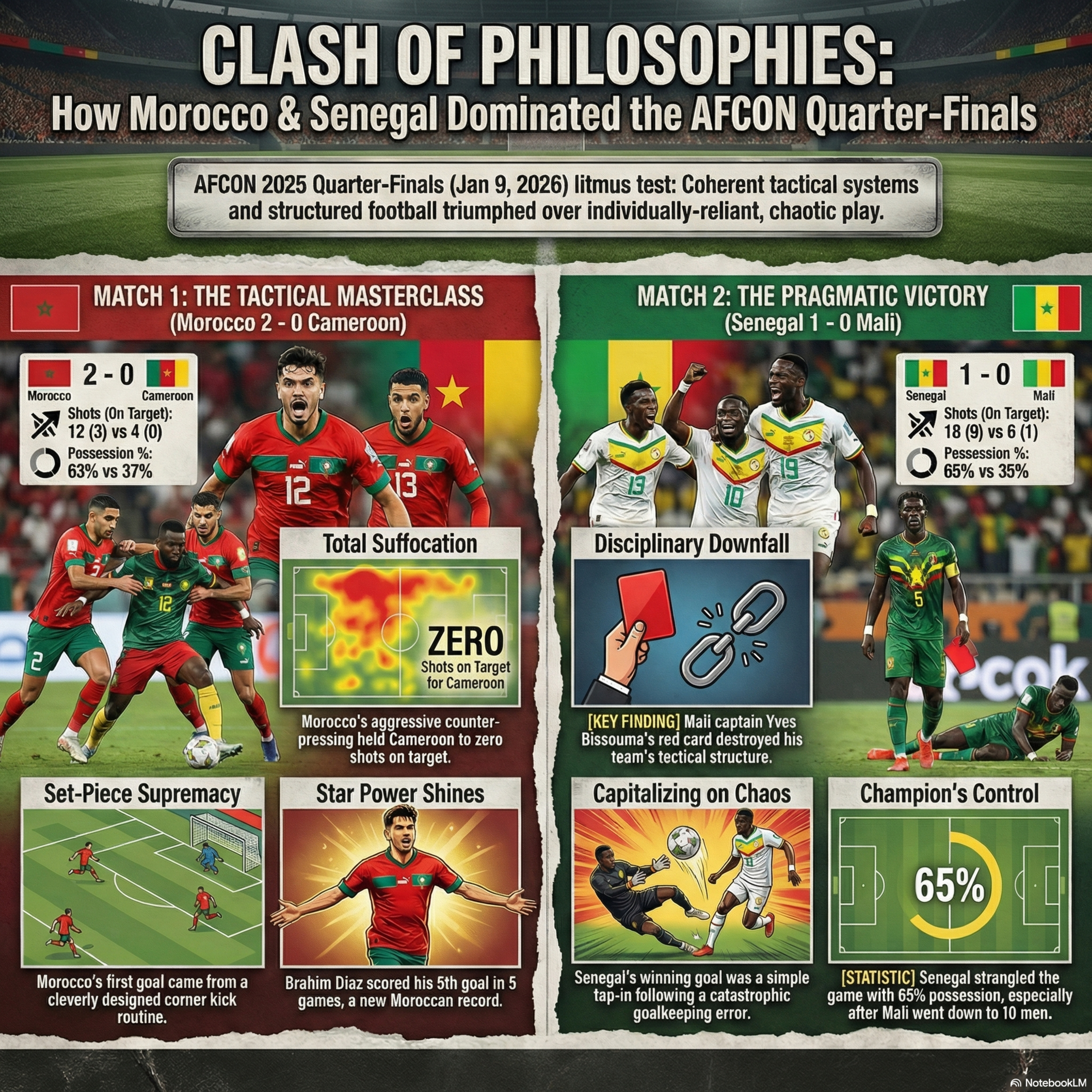
Structure is crushing improvisation. It's not just winning, it's dominating. OK, let's unpack this right away. Let's set the stage with the results because they tell the story perfectly. First, we saw the defending champs Senegal grind out a cold, clinical one deal win against Molly. Just ruthless efficiency. Ruthless efficiency. And then later that night, the hosts Morocco put on a show the commanding almost total dominance in A2 nil win over Cameroon. And the key take away here, before we even get into the tactics, is that the difference wasn't talent.
No, it was design the winners went through because their systems were meticulously built, not just improvised on the fly. Built, not improvised. That feels like it should be the central mantra for, I don't know, every federation on the continent, right? Now it has to be the quarterfinals didn't just knock teams out, they clarified the pecking order for the next decade. We saw that systematic robustness, what Morocco and Senegal brought to the table. It just consistently beats a reliance on individual heroics.
Which is what Molly and Cameroon tragically leaned into. Exactly. It feels like we're watching the final dramatic act of the myth of willpower in African football so you can have all the star power in the world. You can have Premier League players everywhere. Right. But if your entire structure collapses under pressure in a big game, that individual brilliance gets completely neutralized. And here's where it gets really, really interesting for me because the stats, the high level metrics, they don't just confirm this story.
They scream. It. They scream it quantitatively before we even look at a single formation. They absolutely lay the foundation for everything we're about to discuss. Just look at the numbers from Morocco versus Cameroon. Morocco didn't just win, they strangled the life out of the game. Possession was 63% to Cameroon's, what, 37%? A huge. Gap, but possession on its own can be a bit, you know, misleading The expected goals, the XG that tells the real story of who was actually creating danger. And what did that say?
Morocco generated an XG of 1.95, so they were creating multiple high quality chances. Cameroon, on the other hand, they struggled to even get to .85. Wow, less than half. And then there's the most devastating statistic of all, the one that serves as this this unbelievable indictment of Cameron's whole strategy. Zero shots on target. 0. I still can't quite get my head around that. Cameroon, the Indomitable Lions, for 90 minutes they were completely suffocated. They couldn't force the Moroccan keeper to make a single save.
That isn't bad luck. That is a total failure of structural design, A failure to link your defense to your midfield, your midfield to your attack. It's a coaching issue. It has to be. And it shows that Morocco's strategy, their defensive asphyxiation, their controlled high press, it worked to perfection. They cut the supply line so completely that any shot Cameron did take was either blocked or, you know, wildly off target because of the pressure. O What about the other game, Senegal versus Molly?
The score was tighter, just one nil. It was tighter, but the underlying numbers tell a similar story of control. Senegal also dominated the ball, holding 65% possession to Molly's 35%. Another huge margin. A massive margin and they outshot Molly 18 to 6, so even though the scoreline was close, Senegal was always, always in control of the tempo. So that level of ball control, it's not just passing for the sake of it, it's a conscious choice. It's about managing your own energy and starving the other team of the ball of.
Oxygen, precisely. And from this we can sort of synthesize what these two winners represent because they are slightly different sides of the same modern tactical coin. Morocco under rigor, Gee, they represent that technical possession, school of thought, high technical ability, intricate positional play, incredible organization and as we saw, deadly set piece efficiency. They want the ball and they want to live in your half of the pitch. Absolutely. Senegal on the other hand, they represent something else.
It's more about pure physical dominance, A compact defense, and just devastating speed on the counter attack. But the common thread. The common thread is that both are fundamentally built on a non negotiable system, a structure they're predictable in their preparation, but that allows them to be unpredictable in their execution. OK. Let's zoom in on that first case study then. Mali versus Senegal, A fixture that always, always has so much weight behind it. So much history. These nations have this deep, often tense relationship, and on the pitch, the dynamic has usually been Senegal dictating the play.
And Mali getting frustrated. Dealing with that pressure exactly and the context coming into this game is absolutely crucial for understanding what happened next, for understanding Mali's psychological collapse. Set the scene for US. Senegal arrived with this almost unthinkable record 15 match unbeaten run in AFCON regulation time. That speaks to incredible systemic stability. Meanwhile, Molly is carrying the crushing weight of being the eternal dark horse. You know the type, all the talent in the world, but they always seem to fall just short.
And that pressure, it gets into the players heads. It has to and the whole 1 new result came down to one single pivotal moment, the 27th minute, the goal by Illeman and DI and. We have to break this down not as some piece of Senegalese genius, but as what the technical analysis rightly calls a catastrophic failure of defensive fundamentals. This is a coaching moment. Let's get really granular here because it's so important. The sequence starts with Krepindiata getting the ball out wide, one-on-one with the Molly and left back and he.
Whips a cross in. Yes, but it's the type of cross that's critical. He didn't float it. He drove it with pace and crucially, it was at about hip height. OK, so why does that specific height matter so much, especially in that area of the pitch? Because it's aimed directly at what coaches call the corridor of uncertainty. The corridor of uncertainty. Explain that for us. It's that space around the six yard box where the ball is moving too fast and at a really awkward height for the goalkeeper Jiggy Diera.
It forces an instant conflicting decision. Do I come or do I stay? Do I stay on my line? Do I rush out? Do I try and punch it or catch it? It's just too close for him to feel comfortable staying on his line, but it's too far for him to come out and punch with any real conviction. The pace forces him to move backwards or sideways, and that makes secure handling exponentially more difficult. So he had to make a choice and he chose to try and catch it. And that's where the Grade A handling error, as it was called, happened.
Exactly. Biomechanically, his whole technique was flawed. The analysis is clear. His hands were in the secure W shape that you need to handle a driven ball. The W shape being the thumbs and index fingers making a sort of basket, a secure basket right? It minimizes the chance of the ball slipping through. But even worse, Diera's body weight was actually shifting away from the balls path as he moved. He couldn't get his body behind it to absorbed the impact. And the result was inevitable. The ball just slipped right through his grasp and spilled into the most dangerous area possible.
But even then, the goal still needs to be scored, and this is where having Elite switched on players in your system pays off. Yes, this is where Ileman and DI showed what's called elite cognitive reaction speed. This is what separates the great attackers from the good ones. What do you mean by that? While most of the defenders, including Kikikuyate, they reacted to the result of the error. You know the ball hitting the ground. And DI reacted the second he saw DIR. His hands looked insecure. So he's reacting to the possibility of a spill, not the spill itself.
He's already moving, he's gambling on the mistake and that's what allowed him to be there, to tap the ball into an empty net from three yards out. That goal was the perfect storm. A specific biomechanical defensive error. Colliding with a predatory, intelligent attacking mindset, it just proved that Senegal's clinical nature is part of their system. So we've established how the human error cost Molly the lead, but now let's look at how Senegal's system, their unflappable system, made sure that one moment was enough to win the game.
Right, the coach Papathea use this really interesting asymmetrical 343 that would often morph into a 433 depending on the phase of play. And once they got the lead, the system was all about pragmatism. Pure pragmatism. The number one objective became ball retention and recycling that 65% possession stat. It wasn't just aimless passing at the back. So what was it? If you look at the passing network analysis, it shows this classic repetitive U-shaped circulation pattern. OK, you've got to paint a picture for us, right?
What is AU shaped passing pattern look like on the pitch and what's his tactical goal? Imagine the ball moving horizontally across the back line from one center back to the other. Then it goes out to the wing back on one side. Then it comes back into the central midfielders who switch it out to the wing back on the other side. So the path of the ball literally forms AU on the field. And they're avoiding the middle. They're deliberately avoiding risky vertical passes through the congested center.
The purpose is twofold. First, it completely exhausts the opposition, forcing them to just shift from side to side for minutes on end. And 2nd, it patiently probes the flanks, just waiting for another defensive lapse like the one that led to the goal. That's a fascinating way to look at it. So it's less about trying to slice A-Team open through the middle and more about controlling their energy levels until a weakness appears out wide. Precisely, and the key to making that U shape work was Crependiata.
He got an 8.5 out of 10 rating and he deserved it. He was operating as a kind of hybrid winger, wingback. And his influence was incredible. He provided all the offensive width they needed, but he also tracked back relentlessly. He made a crucial goal, saving tackle and SUNY Yoko in the second-half. So he's a true system player. He's the perfect example. That blend of offensive threat and defensive work rate is what allowed Senegal to maintain their shape and control now, though. We have to talk about Molly's downfall, the complete disintegration of their tactical plan because of, well, pure emotional failure.
And this is the tragedy of it. Their initial 4231 was actually causing Senegal problems. It was for the 1st 20 minutes or so. Yeah, their high press was effective. They were forcing errors. They even made Khalidou Kulabali look uncomfortable. But that entire game plan depended on the discipline and the structure of their central double pivot. The two midfielders protecting the back 4, Bazuma and Hydara. That was the shield, and when that shield breaks, everything behind it is exposed. Enter Ease Bazuma.
2 yellow guards, 2 moments that just fundamentally destroyed everything Molly we're trying to do. And we have to distinguish between the two yellows. The first one, in the 23rd minute was a clumsy tactical foul. He was trying to stop a counter but he just mistimed it. A mistake of execution. A mistake of execution The second yellow right before halftime, was a complete and inexcusable loss of emotional control for a. Player of his pedigree, a Premier League player, you. Just can't do it. He was clearly frustrated by Senegal's possession and he just vented that frustration into a totally reckless challenge.
That's not tactics. That is a failure of discipline and temperament. And the cost was effectively instant elimination. His red card forced Molly to switch from that structured 4231. Which had two layers of protection. To a desperate, chaotic 441 with 10 men against a team that loves to keep the ball like Senegal. Tactically, you just cannot survive that. And that's why he got a 2 out of 10 rating. He was called the architect of his team's downfall, and rightly so. He forced his teammates to burn double the energy just to stay in the game.
But here's the crazy part. What makes it so frustrating if you're a Molly fan? Is that they actually played better for a spell right after the red card. Right, they simplified everything, dropped into a low block and went for direct counters and they still managed to generate 1.3 and three XG and create two big chances after going down to 10 men. Which just proves the point. If they had kept 11 players on the pitch, their initial plan might very well have worked. The failure was purely mental, psychological.
Which brings us to the bigger lessons for the African game from this match. That is the core diagnosis. Molly's defeat was a failure of temperament. The analysis calls it knockout anxiety. Anxiety. They come into these huge games carrying all this historical pressure, this expectation, and it manifests as a kind of victim mentality. They feel like things are going against them. And that leads to recklessness. It leads to overcompensation, lashing out and disciplinary problems. Pazuma's second yellow was a textbook case of losing emotional control, of being unable to process in game frustration.
So this is clearly a mental hurdle that the Malian Federation has to deal with. What's the strategic recommendation here? It has to be the urgent, comprehensive integration of sports psychology into the national team setup. It's not a luxury, it's essential. The talent is obviously there. It's generational. But the psychological fragility is now a documented systemic flaw. The players don't have the tools to manage that frustration when a small decision goes against them, and so their tactical discipline just fractures under pressure.
And then there was the second issue, the clinical deficit you mentioned. They still created great chances even with 10 men. Sunyoko ran himself into the ground but he just couldn't convert the chances he got, and that's the cruel reality of knockout football. The ruthless finishing. That's what separates the winners from the perennial dark horses. And this isn't about just doing standard shooting practice. The recommendation for Molly's technical staff has to be a focus on fatigue finishing. OK, you have to elaborate on that term.
What is fatigue finishing and how is it different from a normal drill? Normal finishing drills happen when players are fresh at the start of training. Fatigue finishing is about practicing shooting and decision making when you are under intense physical load. So you're trying to replicate late game conditions? Exactly. You might run them through 20 minutes of high intensity pressing exercises nonstop and then immediately with their heart rates through the roof, you force them into a shooting drill where they only have one touch to finish.
I see, so you're training the mind and body to maintain precision when you're exhausted? You're training the body to maintain its technique, the position of your non kicking foot, the angle of your hips when the mind is tired and you're operating at double your normal energy expenditure. That's the clinical edge Molly desperately needs. Let's shift gears completely now. Let's go to the evening game in Robot. This was less of a tight contest and more of a tactical demolition. A total demolition. You had Morocco, the host nation with all the pressure of their golden generation, facing this immensely fractured Cameroon side.
And you cannot talk about Cameroon's performance without talking about the chaos off the pitch first. The administrative context is everything here. It's the root cause of their on field failure. Their whole build up to the tournament was a mess. The power struggle. The public toxic power struggle between the FAA President Samuel Atone and the Ministry of Sports. It was destabilizing for everyone involved and LED to this disjointed preparation, culminating in the incredibly late appointment of their coach, David Pigou.
It's the ultimate proof that chaos off the pitch leads directly to chaos on it. You just can't build tactical cohesion. You can't develop complex attacking patterns when your coaching staff is appointed days before a major tournament and the players are distracted by all that infighting. Meanwhile, Morocco. Morocco delivered a master Class, A master class in modern sophisticated football and we have to start with that first goal, the 26th minute strike from Brahim Diaz. Which was hailed as a master class in set piece design.
This wasn't luck. No, this was straight off the training ground. Meticulous, deliberate preparation from Will lead Ragui and his staff. Break it down for us. OK, so it's a corner from the right. A crafikini steps up and the first critical detail is he doesn't float it in. He delivers a flat driven cross with serious pace towards the near post. The trajectory is designed to get there fast. To bypass the first line of defense quickly, yes. But the real genius, the deception that makes it a master class, was the movement of Ayub Al Kabi.
What? Did he do? He makes this darting run across the near post zone as if he's going to head the ball, but his real job isn't to score, it's to flick the ball backwards into the danger zone. And that move is designed to do what specifically? It's designed to completely disrupt Cameron's rigid zonal marking system. It forces the defender at the near post to react to his run, which pulls that defender out of position and creates a the vacuum of space right behind him. And into that vacuum steps Brahim Diaz.
Like an assassin, he arrives late, reading the play perfectly, and he capitalizes on the confusion of Kabi created his finish. Guiding it in with his thigh was unorthodox, but so effective. And that cemented his Man of the Match performance, a 9.5 out of 10, and it set a new Moroccan record, his fifth goal in five games. That is not luck, that is practiced structural goal scoring. And the second goal from Ismael Sibari in the 74th minute, that just sealed it. That felt like a statement about Morocco's intensity.
It was a triumph of rapid transition. It was the perfect visual of what their whole system is about. Their high, aggressive counterpress forced a turnover near the halfway line against a tiring, disorganized Cameroon defense. The transition was lightning fast. And Sibari found that little pocket of space, controlled it instantly, and fired a low, precise shot into the corner. It was systemic dominance exploiting mental fatigue. So let's talk about that system, that suffocation strategy. Rogue got an A rating and he's clearly evolved this team.
This isn't the low block counter attacking Morocco from the World Cup. Not at all. He's shifted to a dominant proactive possession based 4141 for this tournament and the result is what we're calling defensive asphyxiation. Zero shots on target. And that is a direct result of their high defensive line and their relentless counter pressing. When Cameron tried to clear the ball, it was recovered by Sophia Amrabot, the number six, or by the center backs within seconds. Seconds. They never let them breathe.
Never let them build any rhythm, never let them string 3 passes together. Amrabot was crucial as that pivot, but the real key was how the four advanced players in front of him functioned. How did he do it? It was all about Brahim Diaz. Nominally, he started on the right wing, but he was constantly drifting inside, abandoning the touchline and basically operating as a second number 10. And that created an overload in the middle. A numerical 4 versus three advantage right in the heart of Cameron's midfield.
That suteriority is what allowed Morocco to sustain attacks, to win the ball back high at the pitch and to exploit those little half spaces between the lines. He has completely replaced Hakeem Zeic as the creative engine of this team. So now we have to look at the other side of that coin to said that failed so spectacularly. Why? Why did Cameroon, with all these top players, register zero shots on target? It comes down to poor offensive coaching and tactical inadequacy. Coach Pigou got AD rating and it was deserved.
The primary issue was what the analysis called the midfield void. A massive, unforgivable disconnect between the defensive line and the attack. Pigou's setup was reactive, not proactive. The central midfield pivot of Bolivia and Anguisa was just bypassed so easily by Morocco's overload. And their passing accuracy was only 77%. For the guys who are supposed to be linking the play, that tells you everything. It highlights their inability to string passes together under that intense Moroccan pressure.
And if that midfield link is broken, your attackers are just stranded. Completely isolated a player like Brian Mabemo who got a four out of 10 rating. He was just an island of frustration. There was no system to get him the ball. He was just forced to chase hopeless long balls hoofed up from the defense. Which were easily eaten up by the Moroccan center backs. A Gordon Messina had him in their pocket all night. The team had no coherence. The players looked exhausted, confused. And that comes down to coaching.
Which brings us back to this idea you introduced earlier, the contrast between their style and modern positional play. Yes, Cameron Karoon played a dated, obsolete style of football. It relied on individual duels, on physicality, on just hoping for a moment of magic. Instead of huego de position. Instead of huego de position positional play. Take a moment and really define that for the listener who might not be familiar with that specific term. What is it and how is it so different from what Cameroon did?
So huego de position is a philosophy. It's all about creating and exploiting superiorities all over the pitch through coordinated movement and predetermined spacing. Superiorities in numbers or position. Numerical, positional or even qualitative, every player knows which zone to occupy at any given moment, so when the ball moves, the team shape is always maintained and there are always safe short passing options available. It's about structure. It's total structure. Cameroon, by contrast, played kick and rush.
They relied on winning the second ball on individual physical battles. And against a scientifically coached team like Morocco, that style is just tactically bankrupt. It doesn't don't work anymore. So if we connect that on field failure back to the bigger picture for African football, Cameron's defeat wasn't really about technique, it was institutional. It was fundamentally institutional. The 2 squads 2 coaches environment created a toxicity that just destroyed any chance they had. That's the immovable root cause, the.
Players were caught in this power struggle and that instability showed up on the pitch as a total lack of cohesion. Cameroon proved that the Indomitable Lions myth. The idea that sheer will and national pride can overcome chaos. Has been completely and decisively busted by the modernization of African football. Structure reigns supreme and administrative instability is the fastest way to lose. So what's the recommendation for the Cameroonian Federation? It sounds like they need something dramatic.
A total Year 0 reset. It's the only way and it has to start with the administration, not the players or the coach. A truce? The warring factions, the FA and the Ministry, they have to call a truce and align on a single vision for the next decade. Only after that can they appoint a proper technocratic coach. Someone with a clear four year mandate. A mandate to completely overcall the tactical curriculum, starting at the youth levels, to move decisively away from kick and rush and build around young technical talents like Carlos Baleba, who showed some flashes of potential.
OK. Let's zoom out now. Broader strategic lessons for the whole continent from these two games. We have to look at the coaches performances and what they tell us about the future. The coaching ratings tell a really clear story. Waleed Rogragui with his A is the gold standard right now, not just for Africa, but globally. And his great strength is his tactical flexibility. That's it. To successfully transition A-Team from that deep counter attacking World Cup unit to this high pressing dominant host side.
That's elite coaching and his in game management was flawless. Bringing on Cybari who scored. Perfectly timed substitutions. Then you have Pep, the of Senegal with AB plus what he's pragmatic, he's effective, he'd. Be a little unspectacular. A bit, yes. He's the definition of stability. He didn't panic when the game was tight. But the team does need to be more clinical. They rely a bit too much on the system, just wearing teams down. And Thompson Feet of Molly AB. He deserves some credit. He does.
His initial 4231 was working, he can't be blamed for Bazuma's red car, and his adjustment to the 441 actually kept Molly in the game. It's good management under impossible circumstances. And finally, David Pigou of Cameroon, AD. Which is a direct reflection of the institutional chaos around him. But still, failing to register a single shot on target is a damning indictment of tactical passivity. There was no Clan B. And it shows the danger of these last minute appointments. Exactly. The continent has to prioritize long term strategic appointments of coaches who can actually implement a modern game model.
And this is where technology enters the conversation. We saw its influence and it actually seemed to help the winners by setting the tempo. Let's talk about say semi automated offside technology. The speed of the decisions was so noticeable. It's a huge and often underrated tactical benefit. How so? Essa was resolving these really complex offside calls in seconds and that is crucial for attacking teams that rely on rhythm and tempo. You don't have those two-minute delays while they draw the lines on screen, so the.
Flow of the game is maintained. The flow is maintained, the attackers stay in the zone, They can focus on the next play without that constant psychological break of waiting for a flag. But the technology also showed its limitations, didn't it? Particularly with VAR and that pivotal Bazuma red card. Absolutely. So Bazuma gets his second yellow for a challenge on Idrisa Guy. Now we have to remember the VA protocol is rigid. VAR can't intervene on a yellow card. Not unless it's a case of mistaken identity.
So even though that red card had a decisive impact on the game and many argued the challenge was soft, the VAR room could not review the softness of either yellow car. So the technology operated exactly as designed. Technically correct adherence to protocol. But it still had this massive game altering influence that frustrated the aliens and, you know, arguably felt disproportionate. And it raises this really interesting philosophical question about the spirit of the game versus the letter of the law.
Should VAR have some mechanism to flag yellows that are just clearly out of sync with the offense? For Federation's, though, the lesson is simple. The. Lesson is clear, eliminate the risk. Get your discipline in order through mental conditioning because the technology is not going to save you from a correctly issued yellow card. So let's synthesize this. Let's give a final future outlook for the two eliminated nations based on everything we've talked about. For Molly, it's simple. The core issue is mental.
It's psychological. The talent base is absolutely top tier but their belief is so fragile under pressure. They need that mental conditioning. You have to fully commit to it and they need to find a disciplined, tactically astute leader to stabilize that midfield, especially if the Zuma can't be trusted to control his temperament. They are one discipline pivot away from being genuine title contenders. And Cameroon needs the most radical change of all. A total institution wide overhaul. The administrative chaos has to end today.
Until the FA and the ministry are aligned, no coach can succeed. Only then can you focus on the football. Only then can you rebuild around a player like Buliba, but with a clear modern tactical identity that moves away from that old kick and rush mentality. The final verdict, then, is crystal clear. The hierarchy has been redrawn by technical and tactical supremacy. Morocco and Senegal have the most robust systems. Technical possession versus physical transition speed. While Molly and Cameroon were undone by temperament, institutional chaos and tactical obsolescence.
This deep dive has shown, I think conclusively, that African football is moving firmly in One Direction towards systemic, well drilled and technically sophisticated teams. Success doesn't hinge on finding the next superstar anymore. No, it hinges on strategic long term coaching appointments and crucially, addressing the the mental and administrative stability that you need to compete at this level. The foundations have to be solid. You know, what stands out to me is that when you combine the home advantage, the insane form of breaking Diaz and the tactical brain of Regoggie, Morocco is just in pole position right now.
They are the epitome of modern structure beating historic chaos. And their path shows exactly what's required for the whole continent to compete at the very highest global levels. And if African football's future really does rest on adopting this tactical modernity, on moving towards the principles of positional play, Huego de posicion. Which is inherently technical and possession based. And that raises a really profound and urgent question for every single federation on the continent. OK, what is the final provocative thought that we should leave you, the listener with today?
If the top level of the game now demands this high level sophistication, what specific actionable investment in youth coaching and infrastructure is now required to successfully implement this demanding Vuego Pezion approach across the entire continent so that tactical modernity isn't just reliant on poaching a few overseas educated coaches? How do you build it from the ground up? Exactly. The deep investment in local youth coach education, in overhauling the curriculum from the grassroots up, That is the essential strategic long term development that has to happen next.
That is the next deep dive for African football.
 Apple Podcasts
 Castbox
 Castro
 Goodpods
 Moon FM
 Overcast
 Pocket Casts
 Podbean
 Podcast Addict
 Podcast Republic
 Spotify