AFCON Best XI Diversity Versus Data
About this episode
AFCON Best XI Diversity Versus Data
Listen now on Spotify, Apple Podcasts, Amazon and other streaming services! Don’t forget to subscribe, share, and leave a ⭐⭐⭐⭐⭐ review to help more players and coaches discover the power of Techne Futbol and Data Technology in the beautiful game.
#TechneAfricaFutbol #TechneFutbol #TrainWithTechne #Playermaker #TraceFutbol #Hudl #FootballTech #FootballInnovation #PlayerDevelopment #CoachTools #SmartFootballTraining #AfricanFootball #CAFOnline #FIFA #FIFAYouth #CAFDevelopment #YouthFootballAfrica #NextGenFootball #FootballScouting #TalentIdentification #DigitalScouting #EliteYouthDevelopment #FootballJourney #FootballAnalytics #FIFAForward #FutebolAfricano #TrainTrackCompete #FootballExcellence #FootballAfrica #TheFutureOfFootball
If you thought the action on the pitch in Morocco was electric, you have no idea what was happening behind the scenes in our data center. We have been wrestling with a true footballing conundrum, a beautiful, madding debate that cuts right to the heart of what this tournament, the 35th Africa Cup of Nations, truly means. It's more than just a debate. It's a it's a philosophical conflict, really. It's the battle between your heart and the hard drive. Exactly. So welcome back to the Deep Dive. Our mission today is laser focused.
We are performing a forensic deep dive into the AFCON 2025 group stage. We have dissected every single metric, metric, match ratings, tactical analysis, expected goals, defensive dual win rates, and the analysis reveals a stark, fascinating truth about the continent's footballing landscape. And you have to understand the context here is crucial for all this data makes sense. Morocco provided a world class environment, I mean pristine pitches in Rabat, Casablanca and Marrakesh, which elevated the technical standard of the tournament dramatically.
But this rise in technical quality, it sort of acted like a centrifuge. It separated the established elite from the developing nations with with brutal efficiency. The gap between teams like Morocco, Algeria and Nigeria and the rest. It's never looked wider. And that widening gap leads us straight to the great question we're analyzing today. When the dust settles on the group stage, how do you construct the best XI? Do you go for the 11 objectively highest performers, the statistical Titans, regardless of where they come from?
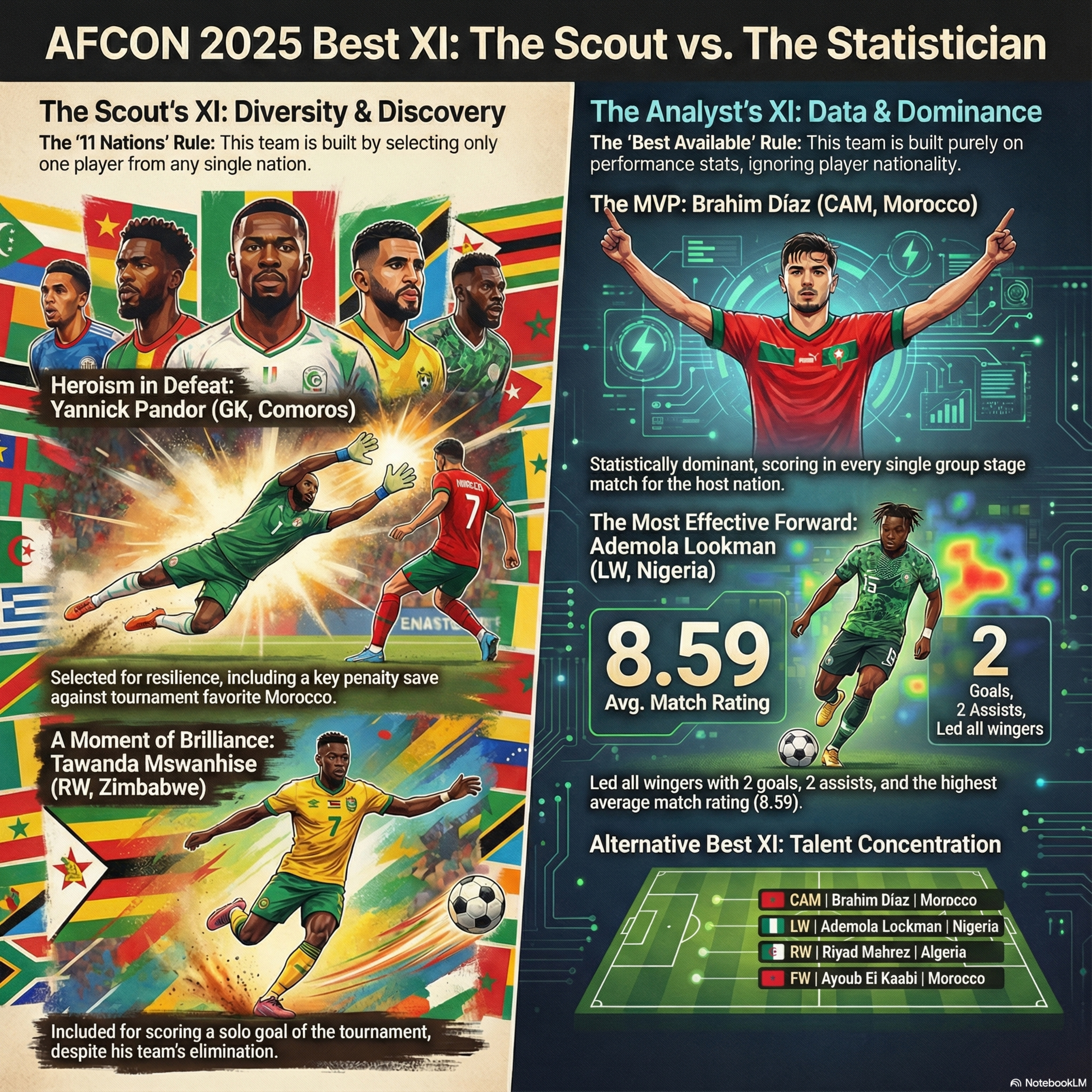
Or do you prioritize representation? Is the goal a diverse selection designed to spotlight talent across all 24 nations to celebrate the sheer breadth of quality in African football? It's 2 completely different philosophies. Completely. We've got 2 competing methodologies that emerge from our analysis. On one side, you have what we're calling the De Santo selection. This list is constrained by a very specific rule, 11 players from 11 different nations. This is the romantic view, you know, heart.
Exactly the heart. It's the scouting philosophy that democratizes recognition. It's designed to ensure that players from every corner of the continent get a look, even if their teams went out early. And then there's our side, the cold data-driven alternative Best 11. This methodology is guided by nothing but pure statistical meritocracy. It's a best player available approach, ABPA approach. We're looking strictly at performance metrics, goals, assists, dual success, aggregate match ratings, and we don't care if the resulting team is 80% N African.
So we put the question directly to you, the listener. Which approach do you think genuinely benefits the African game more in the long run? The one that democratizes recognition or the one that brutally exposes the statistical truth of dominance? Let's unpack this position by position. To really appreciate this conflict, we need to internalize the sheer disparity that defined this group stage. It wasn't just about winning, it was about overwhelming control. Look at the undeniable powerhouses. Morocco, fresh off their World Cup heroics, came into this tournament with an almost unbelievable 18 match winning streak.
They exited Group A with seven points, a commanding plus five goal difference and, crucially, an average possession rate of 62 percent, 60. 2%, that's top tier European control. It is they dictate the pace, they suffocate the opponent and their players as a consequence just accumulate stellar possession and passing. Metrics and their North African rivals were right there with them, right? Algeria Algeria. The Desert Foxes were absolutely flawless in Group three games, a perfect 9.7 goal scored and only one conceded.
When we have teams performing with this level of systemic dominance, their individual players are naturally going to top the statistical leaderboards. They're just constantly in positions to succeed. The contrast then, is key because you have teens like Zambia, Zimbabwe, Comoros. Right. And their defenders were working triple shifts. We saw high defensive volume, clearances, blocks, interceptions. But volume without efficiency is just exhausting. They were suffering under relentless pressure, which means high goals conceded and, you know, disastrously low pass completion rates when trying to transition and this environmental.
Reality directly informs that De Santos methodology. The value of the 11 Nations only rule is that it forces the scouting lens to look beyond the obvious superstars. You're a scout. You already know Akraf Hakimi or Brahim Diaz. Of course, but the constraint compels you to identify the diamond in the rough, the player who shines despite the environment. It pushes you to find someone like Yannick Pandor from Comoros or the young defender Jacques Ekomi from Gabon. This is crucial for continental development.
But, and this is the fundamental problem, the cost, the diversity tax, as we've termed it, is this the typical distortion it creates? To fulfill that quota, you have to exclude the second best player from the best teams. Take Nigeria, They scored eight goals. The most potent attack. The tax might force you to take only one Nigerian player. Or even 0 just to include the best player from a team that earned a single point. It creates an artificial reality. It ignores the concentration of elite talent.
And that's where our alternative Best 11 methodology steps in. We reject the quota. We reject sentimentality. We. Embrace the best player available. The BPA approach based strictly on performance metrics, goals, assists, XG, successful tackles, progressive passing, and the consistent high aggregate match ratings. We don't care about balance representation, we care about the scoreboard truth. If the data says 4 Moroccans are the best then that's the team. OK, let's dive straight into that hard truth, starting with the goalkeeper position.
This is the ultimate test of that narrative heroism versus, you know, statistical efficiency. The romantic choice, the one the Santos selection championed, was Yannick Pandora of Kumaris. His selection is rooted entirely in context, playing for an underdog who knew they would face a storm of shots. And his moment was undeniably spectacular. Against Morocco, Pandora made 5 saves, including a massive penalty stop against Sufyan Rahimi. That singular act kept Comoros in a match where they were completely outclassed.
That's the resilience narrative. But if we dig into the metrics beyond that headline save the story shifts a bit. Panders distribution accuracy against Morocco under all that pressure, it dropped to 35.7%. For a modern keeper, that's a killer. Means instant turnovers. Exactly, His job became pure survival, not enabling the team. He was heroic, but ultimately Kimoros were eliminated with a negative goal difference. OK, wait. If we're talking about high volume heroism, we have to talk about Goit Sione Foco from Botswana.
He was even busier than Pander. Botswana conceded 7 goals, but Foco made a tournament high 14 saves. His performance against Senegal was so stunning it earned him a rare perfect 10 SOFA score rating. If we were awarding the keeper who did the most under duress, isn't Foco a better choice than Pandora? That's a valid challenge, and Foco is the statistical king of workload. But the alternative Best 11 isn't about workload, it's about efficiency and winning performance. And that brings us to our choice, Lupa Zedan of Algeria.
Now here's where the data clashes hardest with the eye test. Zedan faced way fewer shots because the Algerian defense was a fortress. So how can a keeper who was tested less be the best? Because modern goalkeeping isn't just about making saves, it's about control and facilitation. Zidane was the definition of cold efficiency. He secured 2 pristine clean sheets, conceded only one goal across three games. He maintained a 100% save percentage in the games he played. So he didn't have to be heroic, but he was perfect.
He was perfect, and his low expected saves number tells us that while he wasn't tested often, when he was tested he was flawless. And crucially, he was an integral part of Algeria's buildup. His distribution was reliable, and it contributed directly to their controlled possession game. He didn't just survive, he commanded, enabling Algeria to be the only team to get a perfect nine points. The efficiency argument is compelling. Moving to the back line, this gap in quality you mentioned, it becomes brutally apparent at right back.
Oh yeah, the sentence list made a controversial choice here. Matthew's Banda of Zambia. His inclusion is probably the most symptomatic example of the diversity tax Zambia finished bottom of their group. And the data on his performance against Morocco is it's damning. He got a 410 rating. He was defensively exposed repeatedly when Morocco brought on their pace and quality. Banda was just beaten. He lacked that high level tactical awareness. His selection satisfies the Zambian quota, but it ignores the reality of his performance.
Because in the same position you have the statistical champion Akarafikimi of Morocco. The comparison is just. Yeah, it's not there. It truly is a chasm. Hakimi is arguably the best attacking right back in world football, valued at 80 million, the reigning African player of the year. He is not just a defender, he is Morocco's primary tactical weapon. His average position on the pitch was often higher than the midfielders. So give us the specific metrics. What defines his dominance? Well Hakimi delivered 11 successful crosses across the group stage, generated 7 key passes placing him in the top five of all attackers, let alone defenders.
His presence meant Morocco's attack was perpetually tilted to the right, forcing opponents to commit multiple players just to contain him. Statistical models gave Morocco a 19 percent chance of winning the entire tournament, largely because of the unique offensive power he brings from a defensive position. So Banda selection is a kindness, Akinis is a necessity. OK, shifting to left back, a similar struggle to find consistent high impact performers outside the elite. The Santos list looked at players like Jacques Komi of Gabon, part of a team with 0 points, and Arsen Kawasi of Burkina Faso, who had a crucial goal.
Solid, but not transformative. We demand transformation, and that transformation comes from Arthur Masuaku of Dr. Congo. What made Masuaku stand out from the pack across the three games? Consistency and creative output from deep. Dr. Congo finished their group unbeaten. Relying on strong defense and timely attacks, Masuaku provided the key attacking dimension from the left. He got a critical assist and was the engine for several key attacks, including delivering the cross for the winning goal against Benin.
His technical quality, his ability to execute a perfect weighted pass at pace, it far exceeded his rivals. He brings genuine light, creative flair to our defense. Let's move to center back. And I found this fascinating because it's where the two philosophies, scouting potential and statistical excellence, actually converged. The Santos list made an undeniable selection in in Becazelli and Bokazi of South Africa. He was the breakout star of the tournament at only 20 years old, just signed by Chicago Fire.
He didn't just participate, he dominated. He was the defensive anchor for a South African team that expertly navigated a really tough Group B. So what specific data points make him an elite prospect rather than just a solid defender? It's his defensive dual efficiency host speaker. His defensive dual win rate was an astronomical 86.6%. That is a rate you see from the most dominant, experienced center backs in the world. 86%. Yeah, and against Egypt, which has coptier attackers, he attempted 6 tackles and won four, effectively neutralizing their threats.
This isn't just clearing the ball, this is winning one. V1 battles consistently under pressure. And crucially, he's a modern defender. He's not just a destroyer, he's a ballplayer. Absolutely. Beyond his destruction metrics, his ball progression was exceptional. He completed 44 progressive passes for a defender in a South African team that was often forced to defend deep to successfully execute 44 passes forward, breaking lines and starting attack that shows a remarkable composure and vision. His performance completely validates the eye test.
So we have the breakout star who partners him, who provides the organizational stability. That role belongs without question to Nayef Aguard of Morocco. While Ambokazi brings the individual dual dominance, Aguard brings the systemic organization and elite ball progression that a possession heavy side needs. Morocco conceded only one goal and it was a penalty. Agord was key to that wall. He was the commander given Morocco 62% possession. Agord's main job was ball retention and intelligent distribution, and he did it Florida State with an 88.4% passing accuracy.
He ensures that Morocco's defense rarely loses the ball in dangerous areas. He is the organizational glue. Now, you mentioned earlier that statistical ruthlessness means excluding some big names. Kali Dulibali of Senegal, a Global Icon, must have been right on the edge. He was. Kalibali was masterful in his first two games, but this is where statistical meritocracy is unforgiving. He got a red card in the final group match, and while one red card doesn't erase 2 brilliant performances, our metrics penalize disciplinary breaches because an expelled player can't contribute.
That lapse allowed the pure, unblemished consistency of Awkward and the sheer dominance of Imbukazi to secure the partnership. This backline Zidane, Hakimi, Hogwart, Masuaku and Bokazi. It tells a powerful story already. Moroccan structural dominance anchored by diaspora technical quality complemented by two exceptional prospects who flourished. It's a back line built on technical mastery. Now transitioning into the engine room, the midfield, the criteria shifts entirely. We stopped looking for pure defensive destruction and start analyzing how players convert solidity into destructive productivity and attacking influence.
The defensive midfield position gives us a superb comparison. The Santos list chose Mamadou Sangari of Mali. Mali finished undefeated with three draws and Sangare was the metronome. Solid, consistent, even had a 100% dribble success rate against Zambia. Sangare is a reliable 6. But reliability only gets you so far. We need decisive impact. We need the destructive Titan Rafael Anadika of Nigeria. Anadika statistical impact was enormous especially in that last group game against Uganda. Tell us why his performance was so significant.
It's the sheer weight of his contribution. A defensive of midfielder scoring a brace two goals is incredibly rare, especially when those goals were crucial to securing Nigeria's perfect nine points. That performance got him a stratospheric 9.01 foot mob rating. But more than the goals on, Yadika was pivotal to Nigeria's high press. We're talking successful tackles and interceptions, not just in his own third, but in the opponent's final third, leading to high turnovers. So Sangre maintained possession, Onyudika stole it and converted it into direct offense.
Precisely, while sangria provided quiet consistency, Onyudika provided decisive destructive productivity. His impact was felt on the scoreboard and in Nigeria systemic ball recovery. Adm, who scores twice and contributes to a perfect group record simply outweighs a player whose main role was maintaining 3 draws. OK, moving to central midfield, we had a battle of young controllers, Noah Siddiqi of Dr. Congo, a good steady performer known for his smart ball retention. But our choice is Lamine Camara of Senegal, the reigning See half Young Player of the year.
The gap here is in energy and all around influence. Why does Camara trump Siddiqui? Camara is the undisputed heartbeat of that Senegal midfield. Senegal won Group D with 7 points and a + 6 goal difference, and Camara was the catalyst for their high tempo play. He possesses the tactical intelligence to read both sides of the ball, covering immense amounts of ground. His metrics for distance covered and high speed runs were consistently above almost every other midfielder. He's box to box, energy personified.
And finally, the attacking midfield position. This might be the most painful example of the diversity tax. The Santos List picked Ibrahim Maza of Algeria, a wonderful 20 year old prospect who scored against Sudan. Great story, great player. Excellent prospect, deserving of recognition, but he was utterly overshadowed by the player who defines this position statistically. Brahim Diaz of Morocco. The Real Madrid star was statistically dominant. Just how historic was his group stage? It was almost unprecedented.
Diaz was the creative and goal scoring fulcrum of the host nation. He finished the group stage tied for joint top scorer with three goals. And the crucial detail is this. He scored in all three consecutive AFCON group matches. All three. All three. This feat equal to 49 year old Moroccan record. His technical level, his close control, his vision, his ability to execute complex passes under pressure was just a class above. So Maza is the promising glimpse of the future, but Diaz is the present king.
Absolutely. Diaz was the most decisive attacking midfielder in the tournament, directly contributing to Morocco's overwhelming goal difference and possession. Maza had a fantastic debut, but Diaz's output was simply non negotiable for a best XI based on statistical excellence. With the engine room set, let's look at the attack. This is where the goals are, and this is where the sheer concentration of talent on the elite teams really exposes that statistical gap. Starting at right winger, we find the ultimate battle between a spectacular individual moment versus grinding match winning consistency.
The Santos selection shows Towanda Miswanhais of Zimbabwe. Miswanhais had the highlight reel moment of the group stage. His solo goal, weaving past four defenders against South Africa, was a flash of genius. It put him on every highlight reel globally. It was sensational, but Miswanhais, his brilliance was isolated. Zimbabwe finished bottom of their group with one single point. You can't build a statistically rigorous best XI on a single brilliant moment when the campaign was the systemic failure.
The data demands consistent team enabling output. Which brings us to Riyadh Marez of Algeria. Marez was the definition of ruthless efficiency. He finished tied for joint top scorer with three goals and he was the undisputed leader of a team that got a perfect nine points. He scored twice against Sudan and his penalty against Equatorial Guinea was crucial. The difference in team outcome leading aside to 9 points versus one point is just too enormous to ignore. Mares takes the right wing spot. On the left wing, the Santos list shows Yan Diomande of Ivory Coast.
He brought with and Flair had seven successful dribbles. Against Mozambique. He was the spark. But dynamism without end product doesn't make a best X. The end product belongs, without a shadow of a doubt, to Adamola Lukman of Nigeria. Lukman was statistically the single most effective forward in the entire group stage. Let's breakdown those numbers, because they are astonishing. Lukman recorded 4 direct goal contributions, 2 roles and two assists in just three games. He was directly responsible for 50% of Nigeria's total eight goals.
His average match rating of 8.59 was the highest of any wide forward, bar none. Wow. He wasn't just scoring, he was creating space, making inverted runs that broke down disciplined low blocks. His tactual effectiveness is the key, isn't it? He wasn't just a flare player, he was a highly efficient decision making attacker honed in elite European academies. Precisely his decision making in the final third, when to pass, when to shoot, was a testament to his high level development, making him the undisputed left winger.
Finally, the center forward. Yeah, the Santos list picked Carl Etta Young of Cameroon for scoring the crucial winning goal against Gabon. Great moment, but not sustained excellence. Our choice came down to a fascinating debate between tactical influence and pure goal scoring efficiency. Victor Awesome Hen of Nigeria is the superstar, the reigning African player of the year. His tactical influence, his relentless pressing, his willingness to createspace for others like Lukman and Andy Deka is massive.
He's often the reason other players score. Exactly. But the alternative best excise about who? Statistically delivered the goods, and that is Ayub Elkabi of Morocco. He is tied for the Golden Boot lead with three goals. While Awesomehen's work rate is invaluable in a purely statistical best XI that rewards output, Elkabi's efficiency and lethality for the host nation secured the spot. He was clinical. His job is to score, and he did it with lethal consistency. OK, the data has spoken. It's time to reveal the final composition of our alternative best 11, the purely data-driven squad.
And let's really digest the map of power it reveals. Alternative best excite in a standard 4231 formation is a reflection of intense concentration of excellence. You have Engel, Luka Zedan from Algeria, the back line Afraf Hakimi of Morocco, Nayef Aguard also of Morocco and Bicasellian Bokazi from South Africa and Arthur Misaku from Dr. Congo. In midfield, Rafael Anidika of Nigeria and Lamine Kamar of Senegal. Then the attacking 3 Rahim Diaz of Morocco, Riad Maris of Algeria and Adamola Luchman of Nigeria and up top Ayog Al Kabi of Morocco.
When you look at that national breakdown, the statistical reality is overwhelming. Morocco leads with four players. Algeria and Nigeria each contribute to leaving only one spot each for South Africa, Senegal and Dr. Congo. This is the unvarnished truth. The absolute pinnacle of performance is currently concentrated in North and West Africa. And This is why the conversation about the diversity tax is so vital for the future of the African game. The alternative XEI identifies the excellence, which reveals the widening structural gap.
But the Santos list identifies the value. And value is what drives the economic engine of African football. Let's elaborate on that value. We're talking about players like the 20 year old Omukazi who didn't just survive against Egypt, he dominated. We're talking about Ibrahim Mazza, who scored a decisive goal for Algeria, showing maturity beyond his years. These are the players who succeeded in adverse high pressure contexts. They are the ones who, based on their AFCON resilience, are most likely to secure transfers to mid tier European leagues or to top clubs within the continent.
That scouting function. Identifying elite potential beneath the dominant surface is absolutely crucial. But if we step back and look at why Morocco, Algeria and Nigeria are dominating, the answer is the most defining strategic trend of the tournament, the rise of the diaspora. This is the key lesson. It is the majority of the top performing players, the ones who drove the efficiency and the high goal counts, were developed outside the continent, primarily an elite European Academy systems. This is more than just an anecdote, it's the structural reality.
Look at the sheer quality. Brahim Diaz, the former Spain youth international, was arguably the tournament's best player. Lucas Adan, the former France youth international, provided seamless low risk distribution and Atamola Lukman, the former England youth international, was the most productive forward his decision making world class. Even players like Lamine Kamara, who came through a Senegalese Academy, got an early transfer to a high level European structure, gaining access to the tactical rigor that enables them to operate at this intense level.
This infusion of technically and tactically proficient players is what has fundamentally raised the technical floor of the top African teams. Morocco with six goals, Algeria with seven, Nigeria with eight. They're scoring more efficiently than ever before because of this elite European training. The conclusion from the data is stark. On high quality pitches, the superstars are decisive. The gap between the Big 5 and the rest is structural. It is driven by the ability of these top nations to successfully acquire and leverage elite talent that has benefited from the best global training environments.
So we stand with two lists. The De Santos List is the romantic view of Afghan celebrating the diverse spirit of African football. Our alternative list is the objective cold hard reality of the scoreboard. And for the long term benefit of the African game, the core strategic question is this, how do we take the economic and aspirational value identified in that romantic Santos list, those breakout stars like in Bokazi and Maza and use it to bridge the statistical gap revealed by our alternative best 11?
Because we know the current technical excellence is reliant on the diaspora players developed and honed outside the continent. That reliance raises A crucial provocative question that we want to leave you with today. If African football is currently succeeding on talent trained abroad, what tangible practical steps most African Football Federation's implement today, not just in scouting but in investing in infrastructure, coaching, certifications and tactical education to cultivate that same high level technical foundation locally for the next generation of potential stars like a Bokazi and Kamara?
It's about creating sustainable excellence, not just importing it. That is the real challenge revealed by the AFCON 2025 data. Connor, that tension representation versus the reality of statistical performance and what it truly means for the future of the African game. Thank you for joining us for the Deep Dive.
 Apple Podcasts
 Castbox
 Castro
 Goodpods
 Moon FM
 Overcast
 Pocket Casts
 Podbean
 Podcast Addict
 Podcast Republic
 Spotify