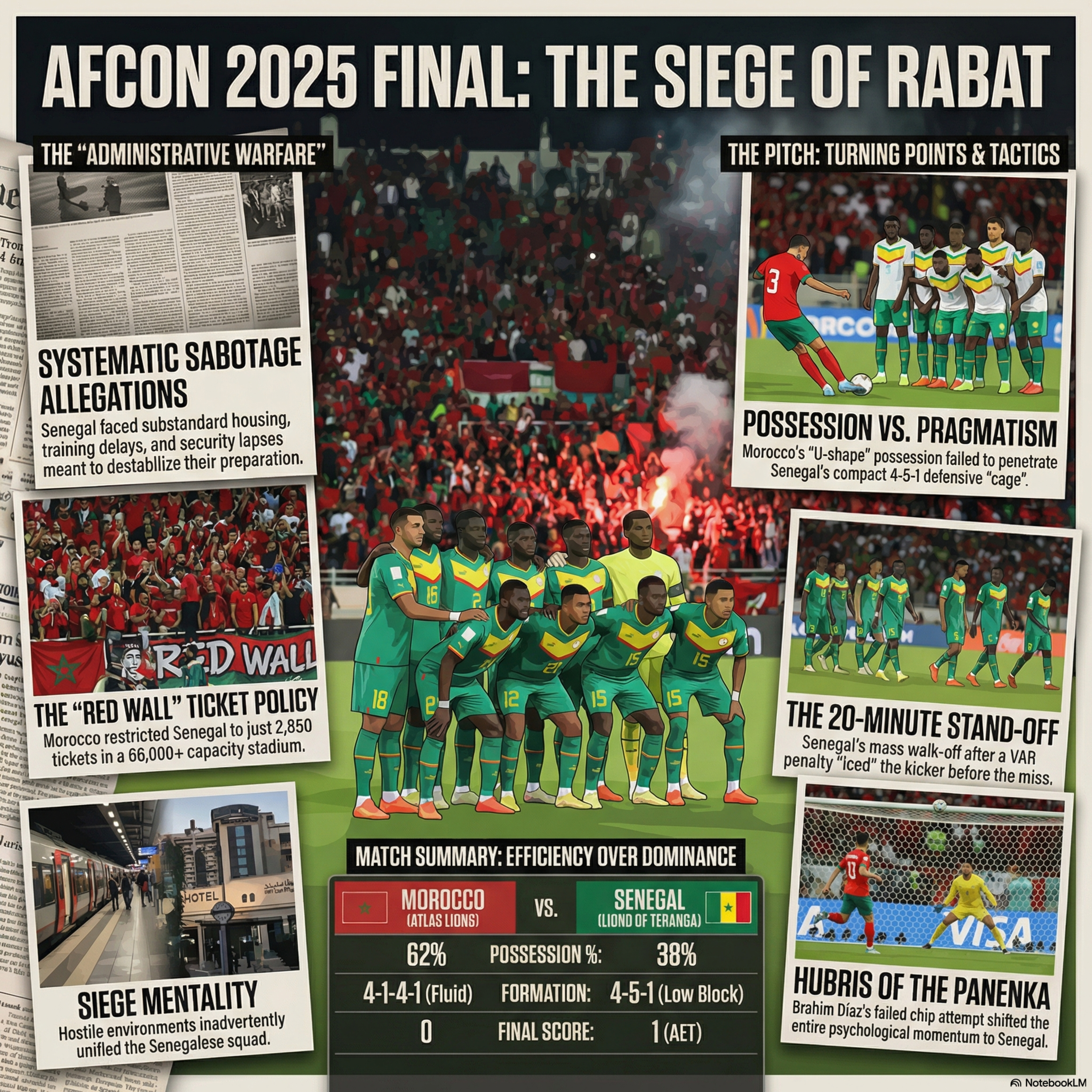
AFCON 25 Final Morocco Lost - Failed Panenka - Senegal Won
About this episode
AFCON 25 Final Morocco Lost - Failed Panenka - Senegal Won
Listen now on Spotify, Apple Podcasts, Amazon and other streaming services! Don’t forget to subscribe, share, and leave a ⭐⭐⭐⭐⭐ review to help more players and coaches discover the power of Techne Futbol and Data Technology in the beautiful game.
#TechneAfricaFutbol #TechneFutbol #TrainWithTechne #Playermaker #TraceFutbol #Hudl #FootballTech #FootballInnovation #PlayerDevelopment #CoachTools #SmartFootballTraining #AfricanFootball #CAFOnline #FIFA #FIFAYouth #CAFDevelopment #YouthFootballAfrica #NextGenFootball #FootballScouting #TalentIdentification #DigitalScouting #EliteYouthDevelopment #FootballJourney #FootballAnalytics #FIFAForward #FutebolAfricano #TrainTrackCompete #FootballExcellence #FootballAfrica #TheFutureOfFootball
OK, I want you to do something for me. Seriously. Just for a moment, wherever you are, just block it all out. I want to transport you. Let's go to Rabat, Morocco. The date is Sunday, January 18th, 2026. You're inside the Prince Moulay Abdela Stadium. What a place. And I want you to just look around. There are 66,526 people here, and it feels like every single one of them is wearing red. It is. It's a monolith of color and sound. They call it the Red Wall. And the noise, I mean, it's not just loud.
No, it's physical. You can feel it vibrating in your chest or rattling your teeth. But there's something else, something that really defines this night, something that maybe the cameras don't fully capture the rain it. Was relentless, wasn't. It it is absolutely pouring down. The temperature is 14°C, which you know on paper doesn't sound freezing, but you combine that with this driving rain and it is cold. It is wet, it is gritty, the kind of night that just seeps right into your bones. It was the perfect storm.
I mean that literally and metaphorically. The conditions are turning the pitch into like a slip and slide and then you have the emotional weight of it all. So much weight. You've got the host nation, Morocco, the Atlas Lions, and they are absolutely desperate to end A50 year curse. 50 years. 50 years without lifting that trophy. That's entire generations of heartbreak, all packed into one stadium on one night. And then who's standing in their way? The Lions of Taranga, Senegal, the defending champions trying to build a modern dynasty.
Exactly. The stakes could not possibly be higher. And you know, if you look back at the scoreboard now, if you just check the archives or look on your phone, it says Senegal one, Morocco 0. And you might think, OK. Tight game, yeah. Standard defensive final. But we're here today because that score line is probably the biggest lie in football history. This wasn't just a match. This was, I mean it was a geopolitical and psychological drama of the highest order. It totally transcends sport because when you actually dig into what happened that night and really in the days leading up to it, you're not just looking at 22 guys kicking a ball around.
And not even close. No, we're talking about administrative sabotage. We are looking at a 20 minute walk off protest in the middle of a final, a disallowed goal that basically broke the VAR protocol, a missed Panenka penalty, and a winner that doesn't even come until deep deep into extra time. It sounds like a movie script, like a script that would get rejected for being too unrealistic. But it all happened and today we are on a mission. We are not just going to recap the goals. Honestly, the goals are almost the least interesting part of the story.
They really are. We're. Going to dissect The Dirty tricks. We're going to look at the mental collapse of the favorites and this idea, this art of suffering that the Champions completely mastered. We need to figure out what this one specific game teaches us about the future of the African game. And that's the key, isn't it? This game is a case study. It's a lesson in psychology over talent and resilience over resources. So let's start peeling back the layers. Let's do it. And I think we have to start with what I'm calling the game before the game because usually, you know, the whistle blows and the match starts.
But here, the war started days before anyone even stepped on the grass. Absolutely. In modern sports science, we're all obsessed with this concept of marginal gains, right? Finding that 1% advantage. Right teams travel with their own pillows, their own chefs. Exactly. Their own sleep consultants, everything. But in this final, we saw that idea of marginal gains used darkly. We saw what the Senegalese officials just flat out called sabotage and it started the second their plane landed and they arrived from Tangier.
Okay, so paint the picture. Senegal is coming off a grueling semifinal. They're high on adrenaline, but physically they have to be just depleted. They get to Robot, the host city. What happens? Well, the standard protocol for a tournament of this magnitude is that everything is pre arranged to an elite standard. You know, you check in, you eat, you sleep. Recovery is priority #1 Instead, the Senegalese team is taken to a hotel that their federation immediately deemed substandard. Define substandard for us.
Are we talking about like the Wi-Fi being a bit slow or is this something that genuinely impacts performance? Oh, this is a performance issue. We are talking about functional deficiencies for high performance athletes. First, a lack of privacy, which is absolutely crucial for mental downtime. You can't have fans or media just lurking in the lobby of course, but more importantly we're talking about poor medical facilities. At this level, recovery isn't just about lying in bed. It's ice baths, it's massage therapy, it's physiotherapy.
If the hotel can't support the medical equipment or provide the proper space for the physios to work, you are actively degrading your players physical condition. So not exactly a five star welcome. Not even close. And here's why this really matters. It's not just about spoiled athletes wanting luxury. It's about science. It's about circadian rhythms. They are 48 hours away from the single biggest physical exertion of their lives. Every hour counts. Every single hour of sleep, every massage, every meal is meticulously planned.
So by forcing the Senegalese Football Federation to file official written protest to see half just to get moved to a proper facility, the hosts effectively opened up a second front. Instead of analyzing Morocco's midfield diamond, Senegal's administrators are in full on crisis management mode. It's friction. It's just designed to take up mental energy to distract them from the real prize. And it didn't just stop at the hotel, did it? Because there was this whole spy novel drama unfolding at the training grounds.
The training ground espionage. This was fascinating. So Morocco for the whole tournament had been based at the Mohammed 6th Football Complex. Now, for anyone who hasn't seen it, this place is it's the jewel of African football infrastructure. World class. It is absolutely top tier. It's better than what many top European clubs have. It's a football spaceship. A spaceship. I like that. It is and naturally as a finalist, Senegal was offered the use of these incredible facilities and they said absolutely not.
Wait a minute, They turned down the best facility on the continent. Why on earth would they do that? Because it's the enemy's den. That was their exact thinking. They were genuinely terrified of espionage. No, they believe that if they ran through their tactical walkthroughs there, they're set peace routines. There would be cameras rolling somewhere, and by dinnertime oleed Regrogui would have their entire game plan on his iPad. So they flat out refused. Is that paranoia or is it just prudence in that kind of environment, in a?
Final of this magnitude. I'd say it's probably prudence, but look at what happens next. So CAF assigns them the Olympic Stadium instead. Okay, problem solved. But, and here is the kicker, the administrative weaponization again. They only get the official notification 90 minutes before the session is supposed to start. 90 minutes. That's barely enough time to get the team busloaded and fight through traffic. Exactly. Anyone who's ever managed any kind of sports team knows that that creates chaos.
It completely compresses their schedule, it rushes their tactical briefing. It just injects chaos into a system that absolutely craves order and routine. Is it a distraction? Another. Fire to put out. Another one and then you have the arrival at the train station. This this is where it actually got dangerous. Yeah, I saw some of the footage of this. It did not look like a security court and it looked like a mosh pit. It was a siege, that's the only word for it. You have the Senegalese team arriving at robot train station and instead of police holding back the crowds, giving them a clear path, they are met by a chaotic mob.
Coach Pape Thea, he called it abnormal and he explicitly said his players felt in danger. That's a heavy word to use, danger that shifts the brain from competitive mode into survival mode. It does. But here's the fascinating psychological twist. When you treat A-Team like that, when you make them fight for a decent hotel, rush them to training and make them push through a hostile mob mob, you're trying to break them. Right, you're trying to intimidate. Them, you're trying to make them feel small and unwelcome.
But with a team like Senegal, with that kind of spirit, you might just be hardening them. You create a siege mentality. All of a sudden it's not just a football match anymore. It's US against the world. And that is a powerful, powerful motivator, that idea of they don't want us to win, so we're going to win just despite them. And Speaking of US against the world, let's talk about the stadium itself, the ticket controversy. This was the final piece of the administrative warfare puzzle. The Prince Malay Abdela Stadium holds what, nearly 70,000 people?
How many tickets do you think the Senegalese federation was allocated? Well, standard allocation is usually, what, 10%? Fifteen So 67000. They got 2850 tickets. You have got to be kidding me. That's a that's a rounding error. That's less than 5% of the stadium. It's strategic acoustic dominance. It's psychological warfare through sound. By limiting the Senegalese fans to one tiny, isolated pocket, Morocco ensured A monolithic wall of red and a monolithic wall of noise. That red wall. And it's not just about cheering, is it?
It has a real tactical impact. A huge one. It makes on pitch communication nearly impossible. A center back screaming at his midfielder to track a runner he can't be heard. The goalkeeper trying to organize his wall on a free kick. It's hopeless. It completely isolates the players from each other. So just a recap. Senegal walks onto that pitch. They're tired from the hotel move. They're rushed from the chaotic training session. They're feeling threatened by the mob at the station. And now they can't even hear themselves think.
The stage is set for a complete collapse. Everything suggests they should crumble. But that is not what happened on the field. So let's get into the chess match. This is where the contrast between the two coaches well lead Rugraggi from Morocco and Pep Thaya for Senegal becomes really, really stark. And Rugraggi changed his style for this tournament, didn't he? We all remember Morocco from the 2022 World Cup. Sit deep, absorb pressure, lethal on the counterattack. But in this final, they wanted the ball.
Yeah, and they fell into what I call the possession paradox. Rograggi wanted to be proactive and if you look at the stats they show Morocco had 62% of the possession in the final but it was completely sterile possession. What do you mean by that? We call it AU shaped circulation. Imagine the ball going from the left back across to the center backs, over to the right back and then back again. It forms a big U shape around Senegal's defensive block, but it never goes through it. They were passing around the defense, not hurting it.
All that passing, but no penetrating, so why couldn't they get through? What was Senegal doing so right? It was Senegal's little block. And this is where Peg Thiel deserves massive, massive credit. He was in a crisis. His captain, Khalidouk Kulabali, The Wall of Senegal was suspended for the final. A huge loss. Massive And then their winger Krepindiata was out I'll so he had to field a back four with an average age of just 23. 23 in a continental final. In that atmosphere, they're babies. He brings in a 20 year old Mama Dusar to fill in a kid, but Thea set them up in what I'd call a tactical cage.
He knew Morocco's main danger was on their right flank. That partnership between Hakimi and Brahim Diaz. To a superstar. Exactly So what did he do? He took Saudi O man, one of the world's best attackers, a global superstar, and he told him today you defend. He used Manny to double up on that side, creating a constant 2V2 situation. Hakimi India has had no space to operate. That's incredible sacrifice, Monet tracking back like he's a left back. It's the absolute definition of leadership and the strategy for the whole team was clear.
Except the suffering. Senegal only had 38% possession. They were happy to let Morocco have the ball in non threatening areas because they knew Morocco didn't have a big physical target man in the box to aim crosses at. They just sat deep, stayed compact and waited for their moment to transition. So you have this dynamic where Morocco is holding the ball but going nowhere and Senegal is coiled like a spring just waiting to snap. It feels like a stalemate, and for 90 minutes it basically was. And then total unadulterated chaos.
The explosion, this is where all that administrative tension, all that tactical frustration, it all just collided at once in stoppage time. OK, let's walk through this timeline because it's genuinely insane. We're at 90 + 2 minutes. Incident A The disallowed goal, right? Senegal wins a corner. The ball gets whipped into the mixer. Abdul Aysek gets up, heads it, it smacks off the post and his male star is there to tap in the rebound. Go right. Senegal thinks they've won the AFCON, no? No. B Because the referee, Jean Jacques Candala from Congo, blew his whistle before the ball crossed the line.
Why? What did he see? He called a push a foul by SEC on Hakimi as they went up for the header. Now when you watch the replay, it's a standard aerial duel, it's grappling, it's what happens on every single corner kick in world football. But the timing of the whistle is the crucial part. That's the technical tragedy of it. Because he blew the whistle early, the play is officially dead. That means VAR cannot review the goal itself because technically, in the eyes of the law, the goal never happened.
Oh that is just brutal. If he waits one more second, let's the ball go in, then VAR can review the whole sequence. By blowing early, he completely kills the play and removes the safety net of the technology. Exactly. And you can see the Senegal players just lose it. Remember the context, the hotel, the training ground, the tickets In their minds. This wasn't an honest mistake. This was home cooking. This was the conspiracy they've been feeling for days, finally manifesting on the pitch. They were absolutely furious.
And just as they're trying to process that, trying to calm down, the game restarts and then incident B happens. We're now at 90 + 24 minutes. Yes, the 24th minute of stoppage time, it was unbelievable. A penalty is awarded to Morocco. A foul on Brahim Diaz, he juggles into the box, there's a tangle of legs and he goes down and look, technically there was contact. An arm goes over the shoulder. But in that atmosphere, after what just happened with the disallowed goal, it felt like the final nail in Senegalese coffin.
But this is the moment where things went completely off the rails. The walk off the entire Senegal team just left the pitch. They walked off players, coaching staff, substitutes, everyone. A mass protest. They just abandoned the field. The game stopped for nearly 20 minutes. I have to ask, was this a genuine emotional breakdown, just a collective tantrum, or was there something more tactical going on here? That is the $1,000,000 question, isn't it? And at the time, it looked like pure anarchy. It looked like they'd lost their heads.
But let's analyze the result of that action. Who is standing there on penalty spot waiting to take the kick? Brahim Diaz. Brahim Diaz, the Real Madrid star. He has to stand there in the pouring rain for 20 minutes with the ball at his feet, thinking about the weight of a 50 year curse. The crowd noise, which was a roar of celebration, it slowly turns into a murmur of anxiety. The red wall starts to crack. He's icing the kicker whether pay file meant to or not. That walk off was the most effective icing of a kicker I have ever seen.
He froze him solid. And when Diaz finally, after all that chaos, gets to step up to the ball, the hubris took over. The Pennanka. The Pennanka, for anyone listening who might not know, just explain what a Pennanka is and why attempting it here in this specific moment was, well, it was a choice. A penenka is a soft, delicate chip right down the center of the goal. It's a high risk, high reward move that relies entirely on the goalkeeper diving to one side or the other. It's a move of pure confidence, almost arrogance.
You do it when you're 3 nil up, not in the last second of a continental final, in the rain, in the pouring rain, after 20 minute delay and the opposing goalkeeper is Edward Mendy, who is 6 foot 4A, giant of a man, and you're going to try and chip him. It's the exact moment Morocco lost the final even before Mindy caught the ball. It was a symbolic shift from technical superiority to just sheer arrogance. And Mindy? He didn't even dive. He just stood there. Stood there, he watched the ball just float towards him, and he caught it with what I can only describe as contemptuous ease.
He didn't just save it, he humiliated the attempt. He made it look pathetic. I can still see Mindy's face, just cool, calm, collecting the ball like he's picking up groceries from a shelf. That moment must have absolutely shattered the Moroccan psyche. It did. The psychological momentum swung 180° in an instant. Morocco was deflated. They had the victory on their foot and they literally threw it away with an Anca folly. And Senegal, they were galvanized. They felt invincible. We walked off, we came back and your best player, your superstar, couldn't even beat us from 12 yards.
So we go into extra time and the whole mood of the stadium, the whole mood of the game has shifted. Morocco is desperate and shell shocked. Senegal is energized. And then it happens. The 94th minute, the decisive goal. And it comes from exactly the thing Senegal had waited patiently for the entire game. A transition. One mistake. So paint the picture for us. How does it unfold? It's a combination of sheer fatigue and psychological shock from Morocco, their young midfielder Neil El Anawi. He's near the center circle, He gets dispossessed.
It's just a moment of hesitation. Maybe his legs are heavy, maybe his mind is still on the penalty. But Idris Aganigwai, the veteran, the old line of the midfield, he doesn't hesitate, Pouncer. He pounces on the loose ball and he just drives into the space that has opened. Up and Morocco's defensive line is high. They're pushed up. Way too high. They were still emotionally chasing the game they thought they should have won, kind of. Guy spots his midfield partner Pip Glide peeling off the shoulder of the last offender.
The pass is perfect way to just write to skid on that wet turf. And the thinnest. Absolutely clinical. A low, powerful drive across the face of the goal. On a wet surface like that, the ball just skids off the grass like a stone on a lake. The keeper, Bono, had absolutely no chance. It was in the back of the net before he could even get down. One mistake, one transition, 94 minutes of suffering, and then game over. That is the art of suffering in its purest phone. They waited patiently, absorbing pressure for 94 minutes for that one specific window of opportunity, and when it finally opened, they stepped right through it.
Incredible. So let's talk about the individuals who made this happen and those who didn't. We have to give out some grades here. Who were your standouts? Well, the man of the match has to be Edward Mendy. I'm giving him a nine point O. And it's not just for the saves he made in regulation, which were crucial. It was the sheer psychological dominance of that penalty moment. He won the mental battle against Diaz and by extension, against all of Morocco. Absolutely. And what about the kid, the 20 year old Mama Dusar thrown into the fire?
A star was born that night. I'm giving him an 8.5 out of 10. Can you imagine filling the shoes of Kalidou Kulabali in a final in that kind of hostile environment as a 20 year old? He didn't put a single foot wrong. He was a rock. Amazing. And on the flip side of that coin, Brahim Diaz. It's a tragedy honestly. It's tough but I have to give him a four point O. It's not just because of the penalty miss. For 90 minutes before that he was physically bullied and caged by Senegal's midfield. He was anonymous and the Pennanka in that moment, it's unforgivable.
It symbolized the whole team's mental fragility. And what about the coaches, The men on the sidelines? We touched on them, but let's put a number on their performances. Waleed Rigorguia gets a six out of 10 from me. He prepared A-Team to play pretty football, but he failed to prepare them for the pressure in the fight. He had no Plan B. When his U-shaped passing didn't work. He couldn't. Adapt He. Gets a 9.5 out of 10. It was master class in crisis management. Took all the negativity, all the sabotage and used the world against us narrative to fuel his team.
He trusted the youth when he could have panicked. In that walk off, whether it was 40, chess or pure emotion, it worked. He proved he's a top tier tactician and psychologist. So when we zoom out and look at the big picture, what does this one crazy game tell us about the future of African football? What are the big lessons here? I think the first and most important lesson is psychology over talent. Look, Morocco have the best infrastructure on the continent. That Mohammed the 6th complex is world class.
They have all this diaspora talent playing for Real Madrid, PSG, the biggest clubs in Europe, but they have a psychological block in finals. They played like a team that was afraid to lose rather than a team that was going on to win. Exactly. And you cannot play a continental final like it's a European league. Game. Requires grit, it requires St. smarts and physicality. Morocco lacked a Plan B striker, a big physical target man who could have disrupted that low block. They tried to be too pretty in what was essentially a street fight.
OK, that's a huge lesson. What's the second one? The dangers of administrative warfare. Morocco tried to gain all these little advantages off the pitch, the hotels, the training schedule of tickets, but it completely backfired. All it did was make their opponent more resilient and more united. It's a lesson for every federation on the continent. Professionalism and logistics is still a major hurdle. If you want to win, beat them on the grass. Don't try to beat them at the hotel reception desk. That is a great line.
And what about the technology, that whole VAR situation? Well, that's the scary part. For the future of the game, we saw what I'd call a protocol void. The match exposed that there was no clear, established procedure for what a referee should do in the event of a mass walk off. He was helpless and we also saw the ice effect. The stats are now showing that these long VAR delays, and we're talking 1820 minutes here, they drastically reduce penalty conversion rates. So the technology, which was designed for fairness, inadvertently contributed to the biggest miss of the tournament.
It's funny, isn't it? We keep adding technology to solve problems and it just creates these new, more complex psychological hurdles for the players. It does. And finally, the biggest lesson is the art of suffering. Senegal proved that in tournament football, the ability to absorb pressure, to stay organized and disciplined without the ball is far more valuable than aesthetic possession. It's not about who passes the ball more, it's about who survives the storm. Who survives the storm? I love that because that is exactly what they did.
They stood in the pouring rain. They took the insults that took the bad hotel. They took the pressure. And they survived. And that's why the trophy is going back to Dakar for a second time. So Senegal retains the trophy, and in doing so, they cement a legacy of incredible mental fortitude. And Morocco? Morocco retains the heartbreak and the curse. It's a harsh, harsh reality of sport. As we wrap up this deep dive, I just I want to leave you the listener with one thought. We spend so much time analyzing formations and XG and past completion rates and all this data, but this final, this final showed us something completely different.
It showed us that football is played in the mind just as much, if not more, than it's played on the grass in the pouring rain. A robot One team turned up trying to play a game of football. The other team came to win a war. And the Warriors won. They did, and I want you to think about that the next time you watch a so-called technical team go up against a gritty 1. Is technical perfection overrated when compared to pure unadulterated mental resilience? That's the question this game leaves us with.
Thanks for joining us on the Deep Dive A. Pleasure as always. We'll see you next time.
 Apple Podcasts
 Castbox
 Castro
 Goodpods
 Moon FM
 Overcast
 Pocket Casts
 Podbean
 Podcast Addict
 Podcast Republic
 Spotify