AFCON 2025 Tactical Geometry and Coaching Genius
About this episode
AFCON 2025 Tactical Geometry and Coaching Genius
Listen now on Spotify, Apple Podcasts, Amazon and other streaming services! Don’t forget to subscribe, share, and leave a ⭐⭐⭐⭐⭐ review to help more players and coaches discover the power of Techne Futbol and Data Technology in the beautiful game.
#TechneAfricaFutbol #TechneFutbol #TrainWithTechne #Playermaker #TraceFutbol #Hudl #FootballTech #FootballInnovation #PlayerDevelopment #CoachTools #SmartFootballTraining #AfricanFootball #CAFOnline #FIFA #FIFAYouth #CAFDevelopment #YouthFootballAfrica #NextGenFootball #FootballScouting #TalentIdentification #DigitalScouting #EliteYouthDevelopment #FootballJourney #FootballAnalytics #FIFAForward #FutebolAfricano #TrainTrackCompete #FootballExcellence #FootballAfrica #TheFutureOfFootball
Forget the usual, you know, tactical chess match of a tournament opener. AFCON 2025 just kicked off with coaches basically throwing away the script. Absolutely. We saw players doing the impossible late goals that just completely tore up the form guides. You know how that first round usually feels so tense and cagey? Yeah, that this just wasn't that. No, not at all. This was pure, unadulterated, high stakes football drama. It was forcing everyone, the coaches, the players and us, the silent audience, to sit up and take notes.
And what we're looking at here is so much more than just the score lines, right? Oh, absolutely. Those opening games are like a pressure picker and they distill the most important lessons for us. In real time too. Exactly. They show us which strategic decisions actually hold up, which players instantly step into those defining roles, and you know what the coaching philosophies truly are that are driving success on the continent. The difference between going through and going home is often decided in those first 90 minutes.
It really is. So our mission today is pretty simple. We're moving beyond the highlights, beyond just the scores. We're going for the why, yes. The why? We want to systematically pull out the tactical wisdom, the deep insights and the hard earned experience from those opening match days. We've been completely immersed in the breakdowns, the data, all 24 head coach profiles. And the goal is to arm you, the learner, with the knowledge that really defines the game at this level. We're hunting for the patterns.
The shift in formation the. Specific player roles, the non negotiables, all the things that define who thrives under that immense pressure and who, well, who buckles. Because that pressure to win the first game is often the biggest hurdle. And the lessons you learn from that, whether you overcome it or you succumb to it, are just invaluable for the future of African football. OK, let's unpack this. The energy and the pressure in these opening games were immense, and what we've gathered is like a blueprint for how to thrive in that environment.
Let's start with just the massive significance of round one. It's pretty much a universal consensus that an early win gives you a huge edge. It's everything. You get those three points, you take a massive stride toward the top 2, or crucially, one of those best third place spots for the knockouts. And that's where the tournament mentality really kicks in. It does a strong opening win, like the dominant three of them results we saw from Senegal or Algeria. It just immediately builds morale. It settles the tactical.
Rhythm and suddenly they control their own destiny. Controls the keyword because on the flip upside, a loss or even an unexpected draw just cranks up the pressure massively. Even for the big squads, that feeling of needing to play catch up right away can be crippling. We saw a few teams stumble with that. Yeah, teams that start poorly often really struggle to get their balance back, no matter how much star talent they have on the roster. We have to dive straight into the hosts Morocco and Group A, because their opening game against Comoros was an absolute master class in tournament anxiety it.
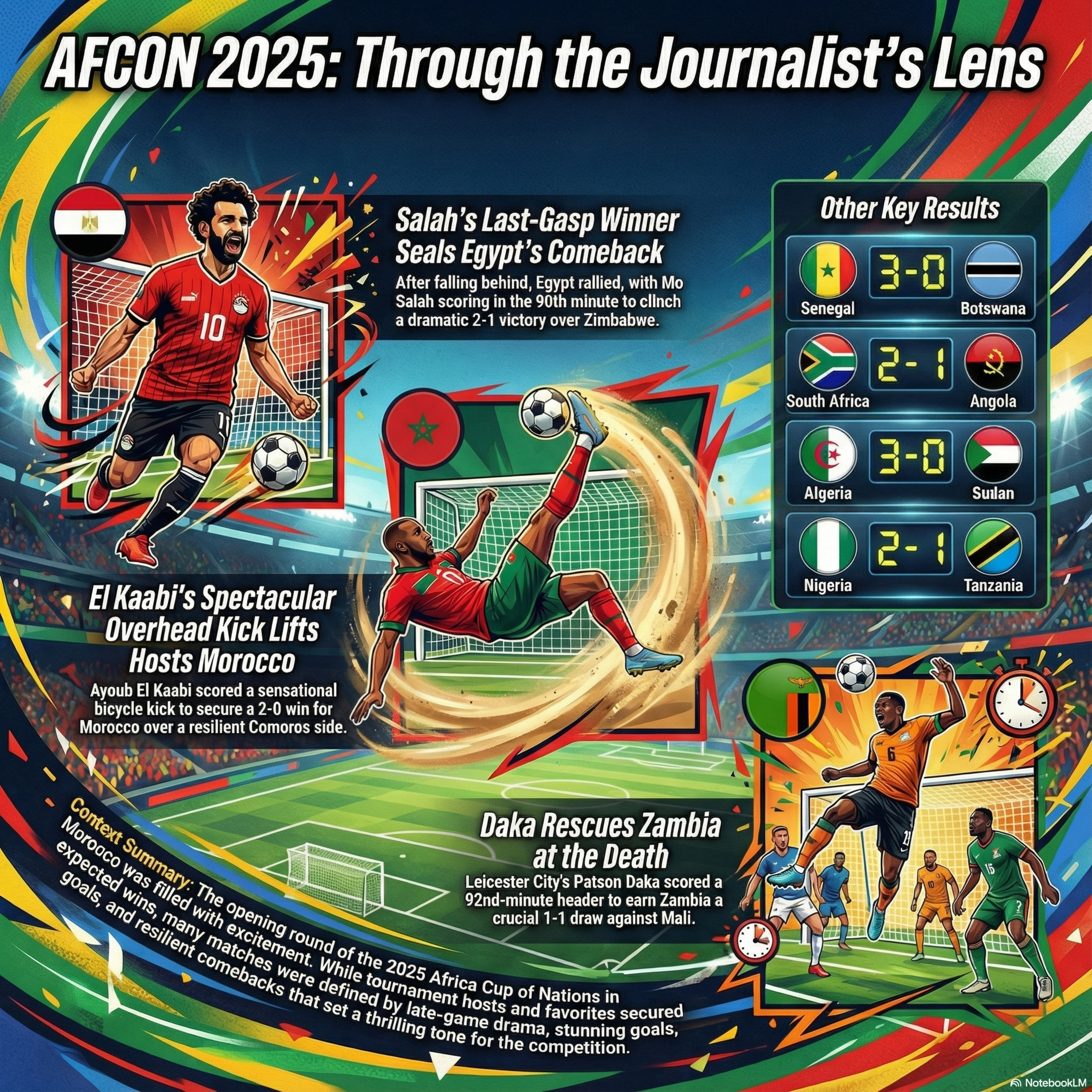
Really was Morocco won two nil, but if you were just watching that first half, you would not have predicted that scoreline. It was less a victory March and more of a tightrope walk. It was that classic struggle of a highly favored host nation, wasn't it? Morocco had all the possession. They controlled the territory. But they just could not turn any of that control into clear, decisive chances, and their nerves were tested immediately. An early blow, too, with Romaine Sais, the veteran defender, having to go off injured after only 15 minutes.
That's a huge potential loss for their tournament given his leadership. A huge loss and then the one chance they got to settle all those nerves was just completely squandered. The penalty. Raheem Diaz wins the penalty but Sufian Rohini misses it just 10 minutes in. And that's when the collective anxiety in the stadium doesn't just creep in. It takes over. It takes over. Every decision from then on feels heavy. Every pass is a little too slow. But look, we have to give immense credit to Comoros here.
They were the perfect example of a disciplined, organized defense. They. Are fantastic. Their defensive setup were so resilient, they kept a tight, narrow shape and they just frustrated every single attempt Morocco made to breakthrough. And their goalkeeper, Yannick Pandor, was absolutely sensational. He pulled off saves that kept the score locked at nil nil at halftime. The atmosphere at halftime was what was genuinely toxic. Reports were describing Morocco's display as slow, lethargic. I saw abysmal.
Abysmal. Yeah, they were booed going into the tunnel, which for a team with their World Cup history and all that home pressure, is incredibly destructive. It totally shifts the focus. It's not about the tactical plan anymore, it's about survival and trying to get your confidence back. Which means coach Walid Ragragi needed more than just a tactical adjustment. That's a huge psychological intervention you have to make in that dressing room. What do you even say to players who are being booed off at halftime in their own tournament opener?
You have to restore that belief, and fast. Well, whatever he said, it worked. Morocco came out for the second-half for the completely different mindset. You could see it instantly more attacking, more concise, and crucially, faster in their decision making. And the breakthrough finally came 55th minute Brahim Diaz, who, to be fair, had been tireless. In a constant threat. He pounced on a cross and steered at home. That goal just lifted the entire stadium. You could feel the shift. It injected that genuine constructive urgency back into their play.
But the pivotal learning moment, I think, came from how Kimoros was eventually undone. They showed admirable courage. You know, they pushed forward-looking for an equalizer. They didn't just sit back. And that ambition is what cost them against and now confident Morocco. That's the hard lesson of tournament football. Against the topside in the 74th minute, Kimoros tried to play out from the back. A commendable strategy, but one that requires absolute precision. And Morocco's press, which was now so focused, just caused it to unravel.
And Ayu of El Kabe capitalized spectacularly, a stunning overhead kick to double the lead. And what flair? The sources noted that El Kabe makes scoring bicycle kicks look almost routine. He has compilations of these things. He does. It's incredible. So the key lesson here for the African game is profound. When you're facing that resilient, disciplined, low block defense like Comoros executed perfectly for 50 minutes, you need more than just tactical agility. You need that flash of individual brilliance, that flare like Alcobi's, to finally force the breakthrough.
Right, the result reflected Morocco's control in the end, but the process really highlighted that need to adapt instantly when Plan A just isn't working. And crucially, it sets the stage what we'll talk about later. How do you consistently breakdown that kind of defense? The answer lies in things like central overloads and the role of the inverted fullback. That's a fantastic transition. Let's stick with Group A and look at the other tussle. Molly, 11 Zambia. This was another match that just showcased the incredible resilience of well of the underdog in this case.
Molly had a golden chance to seize total control in the first half but suffered the same fate as Morocco. They missed a penalty just before halftime. Elba la Tere was denied by a strong stop. Yep. Molly did eventually go ahead in the 61st minute, a goal from Lucene Sunyoko, and with their overall strength you thought, OK, that's the three points secured. But Zambia, we're just not going to let that happen. They were determined not to lose and to keep their progression hopes alive, and they fought back with everything.
And who else but their star man, Pat Sundaka? Of course. In the 92nd minute, from what was described as just a hopeful last gasp cross into the box sent in by BA, who ironically was the player who gave away the first half penalty, DACA heads at home. That is the definition of a clutch moment and it's such a huge mental boost for the Chipolopolo. It is. DACA is 1 of Zambia's undeniable stars and for him to get that goal with the death is just immensely important. It secures A vital point and completely changes the emotional tone of their tournament.
Molly stumbled and Zambia are right back in the conversation. And that draw means Zambia's fate is now entirely in their own hands. They face Comoros next, which, you know, is seen as a very winnable game. It puts them in a strong position. We saw some key performers in that game, too. Molly's Mama Dusingar was sensational in midfield, dribbling, passing, winning duels and so Yoko impressed on the right. But DACA proving his quality under that kind of pressure is the big headline from that one. Absolutely.
So if we move over to Group B, we saw maybe the most immediate, bold and strategically insightful tactical intervention of the whole first round. The Egypt versus Zimbabwe match Egypt 121, but they were shocked first. They started well but then Zimbabwe just hit them with a shot call Prince Dube, a sublime finish in the 15th minute and it just stunned the Pharaohs. And even though Egypt seemed to be in control, they were suddenly on the back foot and Zimbabwe settled into a really tight shape, frustrating them.
This is where the coach, Hassan Hassan, really showed his decisiveness. His response was drastic and immediate. It really illustrates that need for adaptability in modern coaching. We're on the 30 minute mark, which is incredibly early to substitute a planned starter. He takes off the attacking midfielder Imama Shower. And brings on a pure striker, Mustafa Muhammad. That is such a risky, bold move so early in the game. You're basically telling a starter 30 minutes in that the plan has failed. But here's the genius twist, the positional shift that came with it.
Right, the player who is previously playing as a striker, Omar Marmish, was shifted back into the number 10 role. That attacking midfield free roll. And that strategic positional change was the key, wasn't it? It was. Everything. It immediately elevated Marmosch's game significantly. He was given the license to drift to find space, and while Egypt went into halftime still down 10A terrible spot for the favorites, they were putting on consistent targeted pressure. And Marmish eventually got that crucial equalizer around the hour mark.
And the payoff for that incredibly gutsy first half change came right at the end, in the 90th minute. It was the first half substitute Mustafa Muhammad who assisted the winner for Mohamed Salah. Salah beat the defender, Teenage Adebi, and just buried the finish. The learning point here is absolutely critical for modern African coaching. It's the speed and the ruthlessness with which Hassan Hassan reacted. It wasn't a like for like. Change. Not at all. It was a total structural reorientation of the attack on the fly.
Shifting Marmish into that 10 role unlocked their entire offensive potential and ultimately delivered the three points. It just shows in tournament football, you have to be willing to abandon the script instantly if the opposition exploits a weakness. Sticking rigidly to a static plan is fatal. Just quickly on the other big groupie match, South Africa 21 Angola, a very strong start for Befana Befana. That first half was described as absolutely sensational, just end to end stuff, high tempo, really entertaining.
That energy really stood out. But there were two key elements for South Africa's win. First, that incredible energy. And second, the goalkeeping heroic of Ronwyn Williams. He made crucial match defining saves. It was drawing immediate comparisons to Mexico's Memo Ochoa. The guy who only shows up from major tournament. Exactly. Williams is definitely putting himself in the conversation for one of the best goalkeepers in the tournament, alongside Morocco's Bunu and Senegal's Mendi. And in midfield, Boulet from Orlando Pirates really impressed dictating play in that crucial #10 position.
And the match winner from Lau Foster sealed the victory. A really solid structural win for them. A. Very strong start for a team that got third place in the last edition. And we shouldn't forget the other big results from the traditional powers. Senegal 3 nil over Botswana, Jackson with a brace, Algeria three nil over Sudan, Marez with two, Tunisia 31 and Cote d'Ivoire the Champs with a professional one nil win. They all got that vital early edge. So the big take away from round one is that early points build belief, they establish tactical legitimacy, and they just massively reduce that choke pressure, right?
But now let's move from the high drama of the results to the deeper structural analysis. Let's talk about the tactical evolution that's defining the African game. This is where we move from the anecdotes to the strategic data. African football has fundamentally changed. It's moved way beyond just pure flair and individualism. Success is now deeply rooted in structured, hybrid modern tactics. It's about collective superiority over just individual brilliance. And we have some great data that supports this shift.
The 2023 AFCON saw the highest successful passes per game ever, 6/22, and the highest pass accuracy, 81%. That's a huge jump. What's driving that? It's deliberate structure and increased player proximity. I mean, passes are just inherently easier and more accurate when the player on the ball has multiple nearby options. The more teammates close by, the quicker you can circulate the ball. And crucially, you reduce the decision making time under pressure. Coaches are deliberately designing these setups to ensure high player proximity, especially in midfield, to just minimize errors.
And this leads us to the core concept of modern attack, which is essential for breaking down those disciplined defenses. We saw the overload define that for us, and maybe stress why rigidly sticking to a static formation like a fixed 433 basically cancels out that advantage. An overload is simply creating a numerical advantage in a specific zone of the pitch. The trick is positioning enough players there they had in the middle of the half spaces out wide to overwhelm the opposition. The goal is always to gain superiority.
Make passing easier, increase accuracy. Exactly. If two teams stick rigidly to A433, they just cancel each other out. Man for man. The match becomes a messy contest of individual duels. Modern coaches, like we saw with Hassam Hassan, use dynamic shapes and player movement in possession to create unpredictable advantages. OK, let's unpack these dynamic shapes, starting with one that sounds, well, completely alien to traditional football minds the 244 formation. Not the classic 442, the 244, right?
This shape, it looks really aggressive on paper, but it's surprisingly balanced and highly modern when it's executed correctly. So what's the composition? In position it's key. You have two center backs at the back, 2 defensive midfielders, the sixes holder positions just ahead of them, and crucially the two full backs push high and step inward into midfield to form a line of four. So you have maximum security at the back with the two center backs shielded by the two sixes, and then suddenly you have a numerical advantage in midfield because the full backs pushed up.
Precisely. And ahead of that four man midfield are 4 attackers, often positioned horizontally right across the pitch. The wide players push up to join the two strikers and they operate like wide forwards, constantly threatening the opposition's backline. So you get incredible solidity in the center and you're pushing maximum offensive threat forward, right? I see the offensive setup, but doesn't using 4 attackers leave you incredibly exposed defensively if the opponent breaks that initial press?
It feels like a massive gamble if those two holding midfielders get bypassed. That's a great point, and it gets to the underlying strategic genius of the Shape, which is based on what's called the pinning effect. The pinning effect. Opponents react not just to where the ball is, but to the shape of the team with the ball. Normally, a coach wants their fullbacks to press high to support the midfield. But the 244 cancels that idea out immediately. The opponents pullbacks can't push up. Exactly. Your 4 attackers demand the immediate attention of therefore sometimes 5 defenders.
They force the opponent's backline to stay deep, to stay pinned. So their fullbacks can't join the press because they're constantly worried about the direct threat over the top. Yes, and by keeping the opposition pushed back into their own half, that four man midfield suddenly has so much more time and space to operate. And time and space, as we know, are the ultimate currency in football. That's what allows for that 81% pass accuracy we mentioned. It's a genius concept. It's like a strategic sacrifice.
You're trading a bit of defensive mobility for maximum time in the midfield. It's almost like what teams do on set pieces, leaving attackers upfield to force defenders to stay back. That's a great analogy. It applies that same principle to open play. Guinea used this system prominently in the 2023 AFCON, and we'll definitely see its influence in this tournament. It might look bizarre on paper, but on the pitch it creates profound problems for the defending team. So if the 244 is about control and pinning, the next shape is all about engineering the opposite chaos.
Exactly. Let's talk about the disruptive 2431 again. It looks complex, but it's a real effective system. It shares that same defensive structure, the two center backs, 2 sixes and two full backs pushed up. But it adds this crucial, almost psychological twist in the final third. The structure here is 1 high striker supported by three mobile attackers just behind him. And the goal isn't just numerical superiority. It's chaos, confusion, and engineering disruption to calculated positioning. And the key to this chaos, which we saw Marmouche move into for Egypt, is the number 10.
That free roll is the pivot. Absolutely. The number 10 positions himself expertly between the opponent's midfield line and their defensive line in that. And even if the defense looks organized, that intelligent positioning just triggers A defensive dilemma. It causes massive indecision. So the dilemma is, should the central defenders step up to mark him, which pulls them out of their safe defensive line, or should the defensive midfielders drop deeper to close that gap which then exposes the space between their own lines?
That's the critical split second hesitation we're talking about, isn't it? It is in the heat of a big match. Both options are theoretically correct, but poor communication often leads to neither happening effectively. The defense expects a midfield to handle it. The midfield expects the defense to push up. And the result of that split second communication failure. The number 10 is left completely unattended, often with time, in a massive pocket of space right outside the penalty area, and when you have a create a player there, it's deadly.
And even if he doesn't get the ball, his presence alone stretches the defense. Right, it opens up critical space for the high striker ahead of him to run into. Senegal's Lamine Kamara performs this role excellently. He's a master of manipulating space and it just highlights how powerful it is for disrupting rigid defensive structures. So if we're looking for lessons for the African game, mastering these dynamic shapes, the 244 for pinning, the 2431 for Chaos, it's now a tactical necessity. It's not a luxury.
It's the next evolution of possession football on the continent, and if we look back at Morocco versus Kimoros, this necessity is stark. Kimoros defended brilliantly with a low block. To break that, you need these systems. Which brings us perfectly to the single most dramatically evolved position on the pitch, the fullback. Once considered, you know, just bit part players who run up and down the flanks. Now they are primary sources of creativity. The change is incredible. The change is absolutely stark.
Traditionally A fullback, defended wide recycled possession and maybe made an overlapping run a couple of times a game. They weren't the stars. So why did they become the ace up the sleeve for attacking coaches? It's because of how modern defenses operate. Modern scouting and analytics mean it's incredibly difficult for a traditional flair winger to consistently decide matches anymore. Defenses just double mark them, sit in low blocks, cut off the passing lanes. Exactly. That unpredictable, dribble heavy style gets neutralized by structure, so teams needed a new way to inject creativity from an area the opposition traditionally neglects.
Enter the inverted fullback. This is the style we expect to see everywhere at AFCON 2025. It's a core component of both those 244 and 2431 structures we just discussed. And the definition is simple. The fullback steps into central areas when the team has possession, operating like an extra midfielder. Morocco relies on this heavily under Rig Raguier. Players like Nuser, Mezrawi or Nigeria's Olena are so comfortable in these hybrid roles. What are the specific tactical advantages of this? It must be more than just another passing option.
It has three major benefits. First, that immediate numerical overload we talked about. You push a wide player centrally and you instantly turn a three man midfield into a four. It just makes ball progression so much smoother. So that stabilizes possession against a strong press. What about attacking delivery? How does that change the final ball? That's the second key advantage, the superior your delivery angle. When you cross from the touchline, the sideline acts as a natural defender, right? It limits your space, makes the cross predictable.
A whipped ball or a hopeful chip, right? But by inverting, the fullback gets the ball centrally with more time, more vision and more room to pick a pass. So instead of a predictable touchline cross, they're picking out killer passes from Zone 14. Exactly that danger central area just outside the box. It opens the door for disguise through balls, clipped passes, dangerous cutbacks, all things that are incredibly hard for defenses to anticipate because the pass is coming from a central disguised position, not the predictable wide channel.
So the fullback basically becomes a deep lying playmaker without having to start there. And the third benefit must be about movement, right? The confusion. It's the ultimate advantage. Unexpected movement. Defending is much easier when your opponents stay in predictable downs, but an inverted fullback can start centrally, drift and then suddenly burst beyond the winger from a deep position. Like a switch hitter attacking from an unexpected angle. Yes, and those late runs are extremely difficult to track.
It creates constant confusion and structural problems for the defense. It sounds like the inverted fullback is the modern necessity for African teams facing those deep low blocks. You look back at Morocco's struggle against Kimoros. That first half failure was because the Kimoros midfield was so rigid. The inverted fullback is the solution. Precisely. If you can't rely on the flair of your wingers anymore, you have to make the defensive structure bend by creating these central overloads and unpredictable passing angles.
We've talked drama, structure, roles, the tactical geometry of it all. Now let's transition to the men on the touchline, the 24 architects shaping this tournament. This is where philosophies and leadership styles converge. And we're tactical success fundamentally begins. The diversity in leadership is remarkable and it really reflects the complexity city of the African game. You have this fascinating blend of experienced foreign veterans and passionate homegrown heroes. Each carrying immense pressure and unique mandates.
The plan on the whiteboard means nothing without the right manager to implement it. Not a thing. So let's start with the homegrown heroes, those who carry not just tactical plans but the collective burden of national expectation. Waleed Regroghui of Morocco is the immediate star here. Regroghui is more than a coach. He's a symbol of modern African coaching after what he did at the World Cup. His mandate isn't just tactical, it's historical. On home soil, he has this almost unimaginable pressure of delivering Morocco's first Afghan title since 1976.
And we saw against Kimoro's that his philosophy involves trust, trusting his players to execute those switches and trusting his system, like the inverted fullback, to eventually break the defense down. His mission is legacy. Then you have Hassam Hassan for Egypt. A living legend, his appointment brought passion, debate and towering expectation as they chase an eighth title. And we already analyzed his genius, making that bold instant substitution. Moving Marmish to the 10. Hassan's philosophy seems to be built on immediacy and results.
He show he is not beholden to the lineup he chose 30 minutes earlier. That capacity for immediate tactical surgery is a hallmark of truly great tournament management. And Immers Fay for Cote d'Ivoire, his journey is one of the great redemption stories from interim coach who salvage a disastrous group stage to a national hero. And his task now is to prove that victory was the start of a new sustainable era built on consistency and structure, not just a one off miracle run. We're also seeing rising stars showing that national pride is matched by tactical intelligence.
Morena. Rumor Bola, for example, leading Botswana back to AFCON after 13 years. He emphasizes structure and organization, which is essential for a team that's, you know, punching above its weight. And Brahma Tray of Burkina Faso, the professor, he embodies that tactical intelligence and his mandate is to install a complex system so they can compete structurally with the giants. Cherry Muyuma of Gabon also represents that rare homegrown national coach. It all shows that African nations are increasingly trusting their own to deliver systemic, structured success.
OK, let's shift to the foreign veterans and the African specialists, the coaches who bring deep specialized continental experience which can be invaluable in Afghan. Patrice Beaumel of Angola is a prime example. He has so much African experience being alongside Urvi Renard for AFCON wins with both Zambia and Cote d'Ivoire. He doesn't just bring tactical clarity, he brings that crucial tournament know how. Exactly understanding the rhythm, the rotations, how to manage media pressure. That's essential for helping A-Team like Angola punch above their weight.
And we have to mention Hugo Bruise of South Africa, an AFCON winner with Cameroon in 2017. He's credited with reviving Bufana Bufana guiding them to 3rd place in 2023. His impact is built on instilling belief and crucially, a solid defensive structure that allows the midfield to flourish, which we saw with Williams and Bull against Angola. Paul Put with Uganda is another respected tournament specialist that's remembered for guiding Burkina Faso to the 2013 final. His reputation is built on organizing teams to maximize their potential, a skill Uganda will heavily rely on.
And Sebastian Desiber of Dr. Congo, A dedicated Africa specialist who transformed the Leopards into semifinalists in 2023. He brings continuity and strategic planning. And Grenat Rohr with Benin, a familiar face who guided Nigeria to the 2018 World Cup. He's tasked with rebuilding the squirrels, instilling structure, discipline and defensive robustness. Finally, let's look at the specific mandates the pressure cooker environments these coaches are in. Take Vladimir Petkovich of Algeria. No prior African experience, but he was brought in to restore discipline and structure after recent disappointments.
His mandate is clear. Bring organizational rigor back to a proud footballing nation. For him, success means enforcing a system, maybe that stable 244 that just minimizes individual errors. And David Pigou of Cameroon, he had the immense task of restoring their identity, their organization and critically defensive solidity to the five time champions. The pressure to return Cameroon to their expected standards is just huge. Then there's Eric Shelley with Nigeria. He faces maybe the most intense pressure for redemption after the World Cup qualification heartbreak.
For him, AFCON is both redemption and judgment. His task is to revive one of Africa's biggest football brands by getting all that talent to play in a cohesive, goal oriented system. They have to embrace that positional fluidity we talked about. But then you see the value of continuity in Juan Mica of Equatorial Guinea. 3 Consecutive AFCON qualifications through patient youth development. It proves that a clear long term vision can compete with the structural fixes the Giants are forced to make under pressure.
So across these 24 figures, it's a microcosm of modern football management. It's not just about hiring the biggest name anymore. No, it's about finding the right blend of tactical acumen, cultural understanding and the specific experience needed to navigate the unique challenges of African tournament football. The manager is the crucial variable that determines if theory translates into three points. This has been a deeply insightful look. Let's synthesize the key overarching lessons we've extracted for the African game from those opening matches.
1st, the absolute importance of resilience and immediate tactical fixes. As Hassan showed, the ability to implement bold substitutions and positional shifts instantly under pressure is crucial. The minute your opponent shows you a weakness, you have to exploit it. Sticking to a pre match plan is fatal. Second, success now relies on mastering dynamic possession shapes. Teams have to move beyond fixed formations and adopt fluid shapes like the 244 for stability and the 2431 to force defensive chaos.
The game is being won by superior geometry, not just superior athletes. And 3rd, the inverted full back role is rapidly becoming a modern necessity. It is the key to unlocking deep sitting defenses. The ability to create central opportunities from a wide starting position is just vital for any team seeking continental dominance. So what does this all mean for the future of the African game? I mean, the difference between advancing and going home might just be whether you can force chaos in the midfield with an intelligent #10.
Or if your full back knows exactly when to step inside to create that decisive central overload. The standard of strategic depth and preparation across all 24 teams is higher than it has ever been. If we connect this to the bigger picture, this blend of homegrown passion and cosmopolitan tactical acumen shows that African football isn't just copying global trends. No, it's adapting them to its own unique intensity. The blend of psychological management and structural innovation is setting a new benchmark for strategic preparation on the continent.
To leave you with a final thought, let's reflect on the profound importance of that number 10 position in the disruptive 2431 structure, the role Marmish stepped into so effectively. If one player's movement, just positioning himself between the lines, can cause so much chaos and communication failure in a high stakes tournament, how should youth academies and national teams prioritize developing players who are masters of space, Players who know where to stand to confuse the opponent, not just players who are masters of the ball?
That ability to manipulate defensive decisions that I think is the next strategic frontier for African football.
 Apple Podcasts
 Castbox
 Castro
 Goodpods
 Moon FM
 Overcast
 Pocket Casts
 Podbean
 Podcast Addict
 Podcast Republic
 Spotify