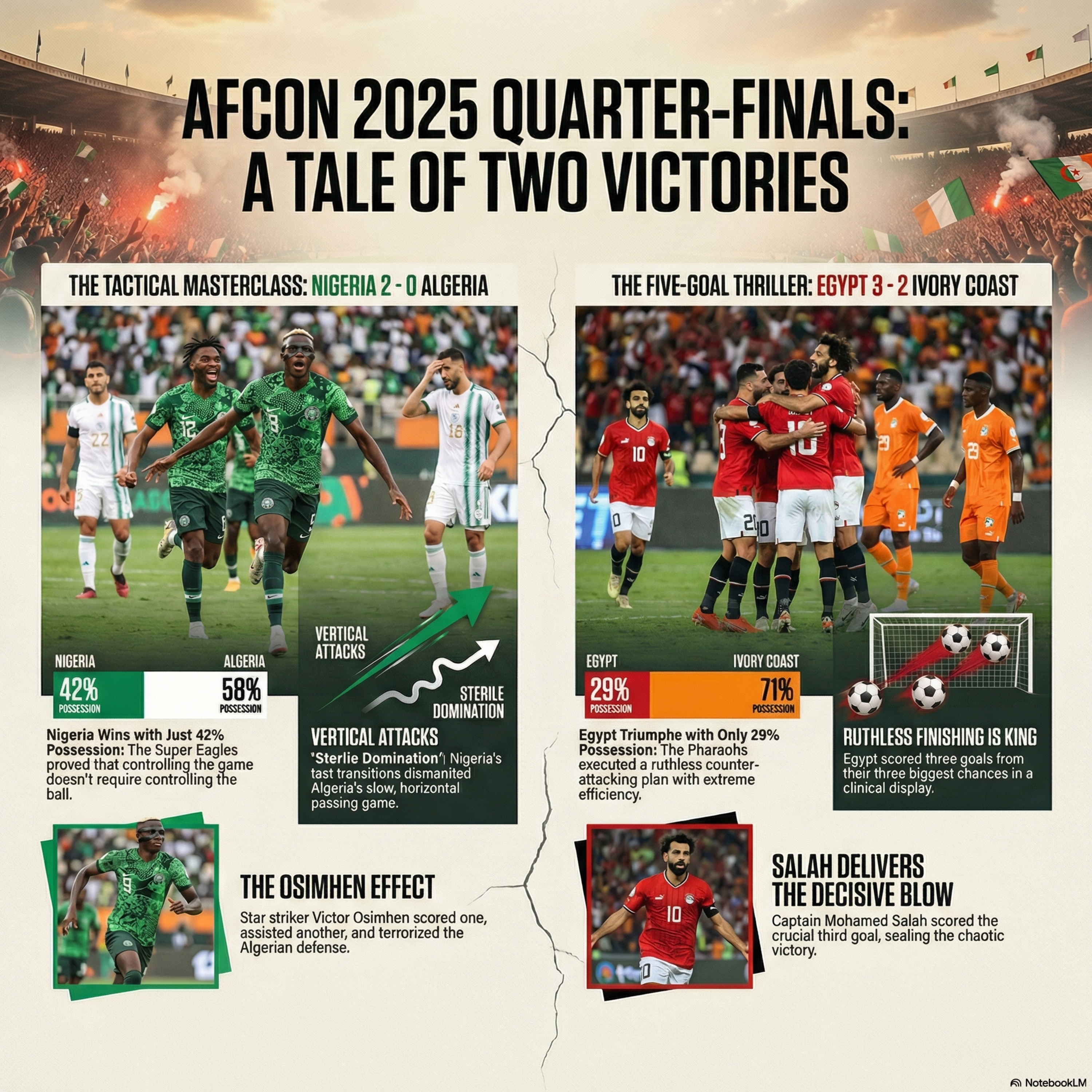
AFCON 2025 Quater Finals Day 2: A Tale Of Two Victories
About this episode
AFCON 2025 Quater Finals Day 2: A Tale Of Two Victories
Listen now on Spotify, Apple Podcasts, Amazon and other streaming services! Don’t forget to subscribe, share, and leave a ⭐⭐⭐⭐⭐ review to help more players and coaches discover the power of Techne Futbol and Data Technology in the beautiful game.
#TechneAfricaFutbol #TechneFutbol #TrainWithTechne #Playermaker #TraceFutbol #Hudl #FootballTech #FootballInnovation #PlayerDevelopment #CoachTools #SmartFootballTraining #AfricanFootball #CAFOnline #FIFA #FIFAYouth #CAFDevelopment #YouthFootballAfrica #NextGenFootball #FootballScouting #TalentIdentification #DigitalScouting #EliteYouthDevelopment #FootballJourney #FootballAnalytics #FIFAForward #FutebolAfricano #TrainTrackCompete #FootballExcellence #FootballAfrica #TheFutureOfFootball
Welcome back to the Deep Dive. You know, there's some days in sport that just feel different. They feel bigger. Yeah, like something is fundamentally shifted. Exactly. And January 10th, 2026 was one of those days. We're calling it Super Saturday because, well, what else could you call? It it was a continental seismic event, really. The AFCON quarterfinals delivered two matches that felt like finals in their own right. A collision of absolute heavyweights. You had Algeria taking on Nigeria and then Egypt facing the defending champions Ivory Coast.
And these weren't just games. I mean, they were fascinated. They were brutal at times and just so, so instructive for anyone who's looking at where the African game is headed. That's our mission here today. We're not just going to run through the scores, we're going to really dissect the tactical DNA of these matches. And it's not just the tactics, is it? It's the the infrastructure, the technology, all the factors that created the environment for these results to happen. Absolutely, because when you look at the big picture, a really clear pattern starts to emerge.
This quarterfinal stage, it felt like a real watershed moment. It did. You had Nigeria delivering, I mean just a master class in modern transition football. And in doing so, they sort of exposed Algeria's possession game as well. Almost obsolete. Sterile even. Sterile is the perfect word. And then you had the other game with Egypt. That was a victory built on something else entirely, Something we're calling, you know, tournament DNA. That innate psychological edge, That grit. The kind of thing that lets you manage a game.
Be ruthless and just find a way to win. So for you listening, that's the big question we're tackling today. How did the the advanced stadiums and technology change the game? And why, in these two massive clashes, did pure efficiency just completely triumph over control and, you know, beautiful possession football? Let's get into it. And I think we have to start with the foundation, the stage itself, the environment, the environment, because this AFCON in Morocco felt different. The venues weren't just stadiums.
They were, for one of a better word, smart stadiums. Highly networked. And that's not just a buzzword. This technology was influencing the game before a ball was even kicked. OK, so let's start from the ground up. Literally the biggest threat before these games was the weather, right? A ton of rain. A huge amount of rainfall in both Marrakech and Agadir. And you know, historically in African football that means one thing, a heavy pitch, a heavy waterlogged pitch. And that just kills technical football.
It turns the game into a physical slog and attritional battle. The ball slows down. Players can't turn quickly. But that's not what we saw at all. The Nigeria Algeria game especially was played at a blistering pace. The ball was zipping around like it was on a billiard table. How? It's this incredible bit of tech called the Sub Air System, which was installed under the turf at both stadiums. Sabair OK, so this is more than just standard drainage. Oh, way more standard. Drainage is passive, it just relies on gravity to slowly pull water through sand and pipes.
This is an active system acted how? It's essentially a giant vacuum power system. It uses negative pressure to literally suck the moisture out from the entire soil profile right down to the roots. Wow, so it's not just preventing puddles on the surf, Ohio. Exactly. It's keeping the entire foundation of the pitch firm and stable, and while it's pulling water out, it's also aerating the roots, which keeps the grass healthier and stronger. And that has a direct tactical implication, A huge one. A fundamental one.
If that pitch in Merrick had been slow and heavy, Nigeria's whole game plan would have been blunted. Their main weapon is that lightning fast counter attack. Right. And those quick vertical passes from someone like Alex Iwobi, the explosive runs from Azimhen, they would have literally gotten stuck in the mud. The ball wouldn't have reached them. So the fast pitch amplified their biggest strength. It amplified their speed, and at the same time, it actually worked against Algeria's slow patient buildup.
It made their horizontal passing look even slower. And you saw the same thing in the other game. You did the Ivorians with their high tempo wingers like a mod Diallo. They can sustain that pace for 90 minutes because the ground was firm. They could trust their footing. They could plant their feet, accelerate, make those sharp cuts without worrying about the turf giving way. I mean, this technology, it was a silent MVP of the quarterfinals. It guaranteed elite level conditions. OK, so the turf is perfect.
Let's move up from the grass to the the data highway that was running through these venues. Yeah, the connectivity, this is another game changer. We're talking high density Wi-Fi, 65G everywhere, and it's not just for the fans to post on social media. This is for the coaching staff. Military grade tactical telemetry. Exactly. Real time data feeds, video analysis, all being piped directly to the bench or to a tactical room just off the dugout. So the lag time between an event happening and the coach getting actionable intelligence on it is almost 0.
It's shrunk to seconds. I think about that. A coach can see a pattern developing and react to it almost instantly instead of having to wait for halftime. Can you give us a concrete example from, say, that chaotic Egypt versus Ivory Coast match? For sure, think about the second-half. Ivory Coast is just laying siege to the Egyptian goal. They've got all the possession. They're probing, looking for a way through. And Hassam Hassam, the Egypt coach, he has to do something. He does, and around the 65th minute you can see his defensive block make a subtle shift.
They started overloading their own left hand side, anticipating the Ivorian attacked on that flank. And that's not just a gut feeling. Probably not. It's very likely he was getting live data showing that the Ivorians passing patterns were heavily favoring that side. Maybe data on where front Casio is receiving the ball who he was linking up with? So he sees the overload pattern on a tablet, and he can immediately instruct his players to shift across and choke that space. Before the Ivorians even realize their main line of attack has been cut off, it turns coaching from being reactive to being proactive.
It's a whole new level of tactical chess. And it keeps the game flowing. Which brings us to the officiating technology. This was huge for the spectacle. Oh massive, the full deployment of semi automated offsite technology or SAOT. And as someone who has sat through 5 minute VAR checks that just kill the mood of a game, this was a breath of fresh air. The speed is the whole point. You have 12 dedicated tracking cameras in the stadium roof. 12 cameras just for this. Just for this and they're tracking 29 different data points on every single player's body 50 times a second.
So the calculation is instantaneous. There's no human drawing lines on a screen. It's all automated. The system knows the exact moment the ball is played and the exact position of every limb of every player. The decision is sent to the VAR, who just confirms it. It takes seconds. And that preserves the momentum of the game. It preserves the emotional flow. That Egypt Ivory Coast game was a thriller if you'd stopped it for 4 minutes to check a marginal offside. All the tension, all that energy, it just dissipates.
Players start arguing. The crowd gets restless. Right. It creates what you could call VAR fatigue. The players trust this system because it's so fast and so accurate. It keeps the intensity at a maximum, which is exactly what you want in knockout football. And Speaking of accuracy, we had that one incredible moment with the goal line technology, the GLT. In the Nigeria, Algeria game, the 35th minute, it was a massive moment. Describe it for us. It was a frantic scramble in the box. It was a corner came in, the ball was bouncing around and the Nigerian defender Calvin Bassy gets a toe on it.
He pokes it towards the goal. And an Algerian defender, Ben Sylvania, hooks it away right on the line. Right on the line and in the past that is a flashpoint. Huge protest from the Nigerian players, massive pressure on the referee. The whole game could have pivoted on that one subjective decision. But not this time. This time the referees watch just buzzed instantly with a simple message. No goal. The system confirmed the ball had not fully crossed the line. And we're talking millimeters. We're talking about the width of a blade of grass.
It was a perfect demonstration of the technology working Florida State to remove ambiguity and keep the focus on the football. So you've got the pitch, the data, the officiating tech. The last piece of the puzzle is the ball itself. Yeah, the ITRI ball from Puma. And it's more than just a pretty design based on Moroccan tile work. This is another piece of precision engineering. A piece of kinetic technology, as the notes say. That's a good way to put it. He has a design called Orbit of Six. It's made of 12 large anels, which is designed to reduce the number of seams.
Fewer seams means a more stable, predictable flight path. Exactly. For you or me, it might not make a huge difference, but for an elite player like Muhammad Salah, that stability is critical, especially for set pieces. Which is where Egypt absolutely capitalized. We saw it plain as day on Rami Raviya's goal against Ivory Coast. Salah whips in this corner with incredible pace. And in. Swinger and in swinger. And because the ball's flight is so true, it's not wobbling or knuckling in the air. Rabbi knows exactly where it's going to arrive.
He can attack a specific spot. He can attack a zone with confidence. It turns a set piece from a bit of a lottery into a precision strike. And for a team like Egypt, who knew they wouldn't have much of the ball, that was an absolutely vital weapon. So the stage is set. Technologically perfect pitches, real time data and precision officiating. It's the perfect context to now dive into how Nigeria used that environment to just dismantle Algeria. Yeah, that was a tactical demolition. The Super Eagles came into that match with a perfect record, but under a cloud of, well, chaos.
A lot of external noise. Rumors of unpaid bonuses that suppose it bust up involving Viktor Osman. A lot of pressure. And immense credit has to go to their coach, Eric Shell, for how he handled that. He did a masterful job. He basically cultivated this powerful siege mentality. He turned all that negativity into fuel. It became an US against the world narrative. And it was all about character proving the doubters wrong. Exactly. And you contrast that with Algeria. They were led by Vladimir Petkovich and on paper they look so solid.
The best defense in the tournament up to that point only conceded one goal. But they were so rigid, tactically stagnant and just completely over reliant on an aging Riyadh Maras. Who, at 34 just doesn't have that explosive pace anymore, does he? Not the kind of vertical speed you need in this modern game. So the stage was set for this fascinating clash of styles. Nigeria's disciplined, adaptable system versus Algeria's structured but maybe predictable control. And Algeria's stuck to their guns, a very possession heavy 433.
They ended up with 58% of the ball. And their full backs were pushing way up the pitch, almost playing like wingers at times. Super high, which in theory is supposed to pin the opposition back and create overloads out. Why? But there is a fundamental flaw in their system, wasn't there? A flaw that Nigeria just ruthlessly exploited. The flaw was the quality of that possession. It was completely sterile. It had no penetration. So let's visualize this for the listener. Their midfield 3, Zaruki, Budawi, Shaibi, they were comfortable on the ball.
Very comfortable, great at keeping it, but they never played the killer pass. They consistently failed to move the ball into what coaches call zone 14 zone. 14 being that critical area of the pitch, right in the middle, just outside the penalty box. The most dangerous area to attack from. Instead of passing through the middle, they played what we call U-shaped possession. Paint a picture of that for us. What does U-shaped possession actually look like on the field? Imagine Nigeria's penalty box.
Now picture the Algerian team forming a giant horseshoe shape around it. The ball moves from the left back to the center, back across to the other center, back out to the right back, and then maybe back again. So it's all side to side, lateral passing. It never goes through Nigeria's defensive block. Never. And what that means is that Nigeria's back four and they're holding midfielders, they can just shuffle from side to side as one compact unit. They're never stretched, they're never pulled out of position vertically or diagonally.
Exactly, they were completely comfortable Algeria was just circulating the ball in front of them in non threatening areas. It's the very definition of sterile domination. Possession without purpose. And on the flip side, Nigeria's setup was the complete opposite. Modern, adaptable, pragmatic. It was a hybrid 433 that could instantly shift into a 4312, and the key to that whole machine, the absolute engine, was Alex Iwobi. It was just magnificent. He wasn't playing as a traditional #10 he was playing deeper as a progressive pivot.
So he was dropping almost next to his own center backs to get the ball. Yes, his whole job was to be the link to get the ball off the defense and in one or two touches turn and play a vertical pass to start the transition. He was the architect. And then you had that front three. Awesome Hen, Lookman and Adams. A perfect blend of speed, power and intelligent movement. And they were constantly looking to run in behind. They knew Algeria's fullbacks would be high and that's where the space would be.
Lookman's movement was particularly interesting. He kept drifting inside from the wing. That was a brilliant tactical instruction. By moving centrally, he did two things. First, he was closer to a Wobi so they could combine quickly. And 2nd. More importantly, he dragged the Algerian right back with him and that created this huge empty channel on the left flank for Nigeria's own fullback on Yumaichi to bomb into. So they were manufacturing space, creating it where it shouldn't have been. Precisely, and the stats from the first half just tell the whole story.
Algeria had 60% of the ball. They look like they were in control. They had the illusion of control, but when you look at the expected goals, the XG, it's a completely different picture. Nigeria was creating all the real danger. By halftime, Nigeria's XG was .82. They were creating high quality chances inside the box. Algeria's, despite all their possession, was a tiny .15. Shows that possession stats can be so misleading. They had the ball, but Nigeria had the threat and we saw those warning signs long before the goals came.
You had that scramble in the 35th minute, Bassi's poke, the GLT decision that was a sign of intent. But the real foreshadowing moment, even though he missed it, was Acor Adams's chance in the 37th minute. The so-called miss of the tournament. It was a bad miss, no doubt I will be playing some clean through. Just a beautiful little pass and Adams tries to be clever and chip the keeper but puts it over. Agonizing for him at the time. But for the coaching staff, that moment was validation. It proved the game plan was working perfectly.
They were getting in behind Algeria's defense at will. They knew the goals were just a matter of time. And they didn't have to wait long after the break. Shell must have said something special at halftime. Whatever he said, it worked. They came out and it was just a blitzkrieg. They won the game in 10 minutes of pure vertical football. They pushed up the pitch. Shifted their line of engagement about 10 meters higher. Start pressing earlier and it paid off immediately. 47 minutes, the first goal.
Victor Awesomehen. Starts with that quick play down the left into the space Lookman's movement had created on your match. He gets the ball and whips in just a wicked cross. And awesome hens leap is just, it's something else. It's inhuman. His trademark just hangs in the air, gets above both Algerian center backs who were caught completely flat footed. And the power on the header, he heads it down, which is so hard to save. A textbook downward header. The Algerian defense just couldn't cope with his physicality and that vertical jump.
It was a fatal tactical error to play a high flat line against him. So that's one nil. And just 10 minutes later, the knockout blow, Adams gets his redemption. He does, and this goal was the perfect summary of Nigeria's entire tactical philosophy. It starts with Algeria losing the ball high up the pitch. They're panicking in a bit, pushing for an equalizer, and they get sloppy. The Whoopi picks it up instantly. And plays that incredible pass. The trivial that gorgeous outside of the boot pass that just curls perfectly into the path of Ausman's run.
And this is where that siege mentality you mentioned comes in. Ausman could easily have gone for goal himself. He could have, but instead, in a moment of supreme altruism, he draws the last offender, draws the keeper, and just squares it. A simple tap in for Adams into an empty net. It showed the team first ethos Shell had built. It wasn't about who scored, it was about securing the win. That whole move from winning the ball to it hitting the net took about 5 seconds. Algeria's structure just couldn't react in time.
So when you look at the whole performance, why did Nigeria win so convincingly? Transition efficiency, pure and simple. They didn't need the ball. They didn't want the ball, they wanted space, and they knew exactly how to find it. The data showed they were repeatedly getting a shot off within 6 seconds of winning possession. That's just devastatingly clinical. Modern game. And then you have the awesome hen effect. It goes way beyond his goal. He's a disruption device. He's a chaos engine. He won 7 aerial duels in that game.
He constantly occupied both center backs, which creates A gravitational pull. And that pull creates space for others. It creates 4 on three overloads elsewhere on the pitch, particularly in that central area where Iwobi was operating. It gave the architect the time and space he needed to work. And we have to give a huge mention to their defense. A clean sheet is a massive achievement. The back 4 was immense. Calvin Bassey in particular was an absolute rock. He physically dominated the Algerian attackers.
And they were cynical when they needed to be. They master the art of tactical fouling. They gave away 20 fowls, picked up five yellow cards. Which sounds bad, but it was strategic. It was highly strategic. Every time Algeria looked like they might finally string a few passes together and break the lines, a Nigerian midfielder would just make a clever foul break the rhythm. Stop the play, reset the defensive shape. It's frustrating to play against, but so effective. It's cynical, but it's intelligent game management.
They prioritize winning over everything else. And it said a clear warning to the rest of the continent. The warning being. That sterile U-shaped possession is dead if you can't penetrate zone 14. If you don't have the pace to threaten in behind, a disciplined transition based team will pick you apart. An incredible tactical lesson, and if that game was a clinical dissection, the next one was just a chaotic five goal heavyweight slugfest. Egypt versus Ivory Coast, the defending champions against the Masters of Tournament football.
So much history there A. Repeat of the 2006 final, I believe. It was, and you had Hosam Hassan, the Egypt coach who played in that era, making this huge pivot towards extreme pragmatism. While the Ivorians, they stuck to their expansive attacking principles, they wanted to dominate. And they did. I mean, they had a staggering 71% possession of the game, 71%. That is just an insane number, but it was high risk football, wasn't it? A. Very high risk. They played a high defensive line, they pushed so many bodies forward.
They were leaving huge gaps to the back, which is just asking for trouble against the pace of Salah and. And Egypt set up specifically to exploit that. It wasn't the Egypt we're used to seeing. Not at all. Yeah, Hassa Masan basically threw out the attacking flair playbook. He set them up in a 343 that was in reality an incredibly narrow and rigid 541 defensive block. So just parking the bus. It was more sophisticated than that. It was an extremely disciplined low block. Their defensive shape was only about 35 meters wide.
Which is incredibly narrow. Super narrow. The whole idea was to completely clog up the center of the pitch. Clog zone 14. They essentially said to Ivory Coast, you can have the ball out wide but you are not coming through the middle. So they invite the pressure and then what? Then they launch those rapid counters, but for that to work you need a special kind of player and the masterstroke selection from Hassan was Imam ashore. He was the key. He was the indispensable link, the vital ball carrier.
When Egypt won the ball deep in their own half, it was his job to drive forward 20 or 30 yards with it. He was the bridge between the defense and the isolated attackers. Without him, it's just a hopeful long ball up to Salah. With him, it's a structured, dangerous counter attack. He provided the dynamism. And again, the statue just beggar belief. 29% possession for Egypt against 71% and yet they won. It's the ultimate proof of the efficiency model. Egypt scored three goals for the three big chances they created.
They massively overperformed their XG of 1.10. While Ivory Coast, they had more shots, a higher XG, but they couldn't find that clinical edge. Exactly, Ivory Coast XG was 1.85 but they only scored once themselves plus the own goal. Egypt's shot to target ratio was 66%. It was just ruthless clinical finishing. And the game exploded into life from the very start, the 4th minute. An immediate ambush. It was defensive suicide from Ivory Coast. They tried to play cute short passes out from their own box.
A huge risk so early in a knockout game. And a shower pressing high just read it perfectly, intercepted A sloppy pass and instantly slid it through to Marmish. Who finished it beautifully. Great composure, fired it low into the corner and that goal was tactically priceless for Egypt. Because it meant they could immediately sink into that low block. Right from the 4th minute on, they can just sit in their shape and force Ivory Coast to break them down. It was a perfect start. But Ivory Coast did find a way back the equalizer in the 32nd minute.
From a set piece which again shows how crucial they are for low possession teams. Rami. Rabia with the goal. It's that Puma ball factor again. Salla whips in another perfect stable in swinging corner and the Ivorian marking is just awful. Ibrahim Sangaret completely loses his man. Just a basic defensive laps. Rubia gets a free run and powers the header home, a ruthless punishment for a simple mistake. The game goes back and forth, but the big psychological blow comes just after halftime. 52nd minute Salah.
And it was the Egyptian blueprint perfected Absorb, absorb, absorb, then explode A. Long ball out of defense. Finds a shower, the catalyst in acres of space. He drives forward, commits the defenders and then has the composure to just cut it back for Salah. And you just don't miss from there if you're Muhammad Salah. A calm side footed finish and that goal, it felt so symbolic. It was his 11th Afghan goal. Which equaled the all time Egyptian record held by his own coach Hossam Hassan. A real passing of the torch moment right there on the biggest stage.
And even though Ivory Coast pulled another goal back late on, Egypt just held on that grit, that tournament DNA you talked about they. Just know how to win these tight, ugly games. Sheer collective will. A couple of massive saves from El Shanoi. They just found a way. So breaking it down, how did they pull off this incredible 3 two win? 3 things. First, as we said, ruthless conversion. 3 big chances, three goals. You can be more efficient than that. Second, the Sala factor, the gravitational pull of Sala.
Even when he's just walking, he occupies 2 defenders. Their attention is always on him and that opens up so much space for players like Ashar and Marmish to operate in. His off the ball impact is just as important as what he does on it. And the third factor has to be a shower. He was the engine. The Catalyst won the ball for the first, assisted the third. Without his energy to bridge that huge gap between defense and attack, their entire system falls apart. He made the whole pragmatic approach viable.
So why did the Champions fail? Why did Ivory Coast lose despite having 71% of the ball? Defensive naivety. Simple as that. The sloppy pass of the first goal, the shocking marking for the second. You cannot gift goals like that in a quarterfinal and expect to win. It showed a lack of knockout discipline. And they had no Plan B. Absolutely none. When they came up against that narrow 5 man block, they just defaulted to pumping crosses into the box. Over 30 of them. And it's so predictable, it plays right into the hands of the defenders.
They needed intricate passing, clever movement through the middle to pull that block apart, and they just didn't have it. It's like the Champion's Curse manifested as a total inability to adapt when things got tough. So when we zoom out now and look at both of these results together, what's the big picture? What's the strategic synthesis? The big picture is that we are witnessing a huge continent wide shift in how football is played and won at the highest level in Africa. A move towards a new meta?
A definitive move to a transition based meta. Look at the key stat. Both winners, Nigeria with 42% possession and Egypt with 29%, lost the possession battle but won the XG battle. They created the better chances without the ball. Which proves that success is now being achieved by teams that are pragmatic, that manipulate space and that attack vertically with speed. So is possession football officially a liability in the AFCON knockout stages? It's becoming a massive risk because the defining tactical strength on the continent right now is the speed and clinical nature of the counter attack.
The pace of players like Awesome Hen, Salah, Lookman, it's world class. And if you over commit, If you play a highline and leave space behind you. You will be punished. It's tactical suicide in the current environment. It's interesting though, that we saw two very different types of managers succeed with this philosophy. A great point, you have Eric Shell with Nigeria who is the modern pragmatic tactician. He's all about systems structure, managing external noise and exploiting space in a methodical away.
His substitutions were all about game management, defensive changes to see out the lead. Exactly. And then you have Hassam Hassan. He's the old school motivator. He's leaning on history, on that tournament DNA, on individual brilliance and raw grit. His success was built on bold selection risks like playing a shower, and a super rigid defensive structure. Two very different paths, but they arrived at the same destination. Victory through superior efficiency. And the lessons from the losing teams are just as important.
They're a huge warning for Algeria. The lesson is that sterile possession is obsolete. Circulating the ball without getting it into the zone 14 is just a waste of energy against a good defense. And for Ivory Coast? For them, it was a lesson in psychology and discipline. Defensive sloppiness will undermine everything else you do well, and you have to be able to adapt your tactics when planning isn't working. They showed a real fragility when they went behind. So the modern African champion has to be a hybrid, technically gifted enough to counter at speed but mentally tough enough to suffer without the ball for long periods.
That's it in a nutshell. A fundamental move away from the old idea that you had to entertain and dominate the ball. Now it's about results, pure and simple. Which sets up two absolutely colossal semifinals. The lessons from Super Saturday are about to be put to the ultimate test. First up, Senegal versus Egypt. A rematch of the 2021 final. This is huge. And it's a much, much tougher test for Egypt than Ivory Coast was. Senegal are far more disciplined, more physical and their pressing structure is relentless.
So Egypt's 29% possession strategy probably isn't going to cut it here. I don't think so. That extreme low block is at risk of being completely suffocated by Senegal's press. Egypt have to find a way to keep the ball for longer, even if it's just sterile position of their own, just to get a breather. Otherwise, they'll just be under siege for 90 minutes. Exactly. The key battle for me is the physical one. Khalidou Kulabali, Senegal's absolute rock at the back against Omar Marmoush, Egypt's counter attacking spearhead.
That's where the game could be won or lost. If Senegal can shut down Imam Ashwar, they cut the supply line. Ashwar will be the most marked man on the pitch. Senegal's whole system will be geared towards stopping him from being that bridge. It's going to be fascinating. And then the other semifinal, the host nation Morocco, against the unstoppable force of Nigeria. This is the ultimate narrative battle, isn't it? Nigeria's devastating transition attack against Morocco's incredible organization, their world class defense and that massive home crowd.
Morocco will have all the ball, we can expect that. For sure, they'll probably have 60, maybe 65% possession, but as Nigeria just proved against Algeria, that plays right into their hands. This is the biggest test yet of that siege mentality. It is, and for me the entire game hinges on one specific duel on the flank. Akrafikimi VS Edemola Lookman. That's the one the world's best attacking full back against one of the tournament's most dangerous wingers. If Lookman can pin Hakimi back, force him to defend the Nigeria has a massive advantage because it neutralizes one of Morocco's main weapons.
But if Hakimi is allowed to run free and attack. Then Morocco dictates the game. He'll push Nigeria deeper and deeper. It is the chess match that will decide who goes to the final. And Morocco will have watched that Algeria tape. They'll know that just keeping the ball isn't enough. They have to learn that lesson. They have to penetrate. They have have to get into zone 14 with speed or Nigeria's coiled spring will just uncoil and punish them on the brake. So as we wrap up this deep dive, it feels like we've witnessed a real tactical turning point.
We have the quarterfinals proved that efficiency, pragmatism and transition speed are the new gold standard for success in African football. It's all about clinical conversion over the volume of possession. And it's about embracing A defensive structure, being willing to suffer, and moving away from that old pressure to simply entertain. The result is king. Which leaves us with one final provocative thought for you to think about as we head towards the final. Go on if the African game is now prioritizing efficiency over aesthetics.
If teams are winning by being tactically rigid and letting their opponents have the ball, how soon before we see a team lift the Afghan Trophy having had less than 40% possession in the final? That's not a hypothetical question anymore, is it? It's a rapidly approaching reality. I guarantee you the coaches of Senegal and Morocco are thinking about that exact possibility right now. The blueprint for victory might just be to give up the ball. An incredible thought. We will be back to breakdown the semifinals as the tournament continues to evolve.
Until then, thanks for joining us on the Deep Dive.
 Apple Podcasts
 Castbox
 Castro
 Goodpods
 Moon FM
 Overcast
 Pocket Casts
 Podbean
 Podcast Addict
 Podcast Republic
 Spotify