AFCON 2025 Egypt Match Exposes African Football Technology Gaps
About this episode
AFCON 2025 Egypt Match Exposes African Football Technology Gaps
Listen now on Spotify, Apple Podcasts, Amazon and other streaming services! Don’t forget to subscribe, share, and leave a ⭐⭐⭐⭐⭐ review to help more players and coaches discover the power of Techne Futbol and Data Technology in the beautiful game.
#TechneAfricaFutbol #TechneFutbol #TrainWithTechne #Playermaker #TraceFutbol #Hudl #FootballTech #FootballInnovation #PlayerDevelopment #CoachTools #SmartFootballTraining #AfricanFootball #CAFOnline #FIFA #FIFAYouth #CAFDevelopment #YouthFootballAfrica #NextGenFootball #FootballScouting #TalentIdentification #DigitalScouting #EliteYouthDevelopment #FootballJourney #FootballAnalytics #FIFAForward #FutebolAfricano #TrainTrackCompete #FootballExcellence #FootballAfrica #TheFutureOfFootball
Welcome back to the Deep Dive. I mean, if you were watching the AF Con 2025 round of 16, you know exactly what we're talking about. That electric, just visceral drama that you only get from Continental Knockout. Football. Oh, absolutely. It's 120 minutes of pure tension. It really is. It separates the Champions from the contenders and it's it's always breathtaking to watch. It is. But today we're going to go beyond just the emotional highs and lows. We're not really here to celebrate a victory, but to forensically dissect the stress test that this one specific match, a massive clash between Egypt and Benin, put on the entire infrastructure of African football.
Right. We've been handed this, I mean, an unprecedented analysis that looks right under the hood of this intense contest to find the hidden gaps, the weaknesses and, you know, the precise technology needed to lift the whole African game to a genuinely world class level. And that's the key, isn't it? The whole game. Exactly. Our mission today is pretty straightforward, but I think critical. We're using this single high stakes match as a kind of bluerint. We want to give you, whether you're a Federation head, a coach or just someone who wants to understand football strategy at its deepest level, a shortcut.
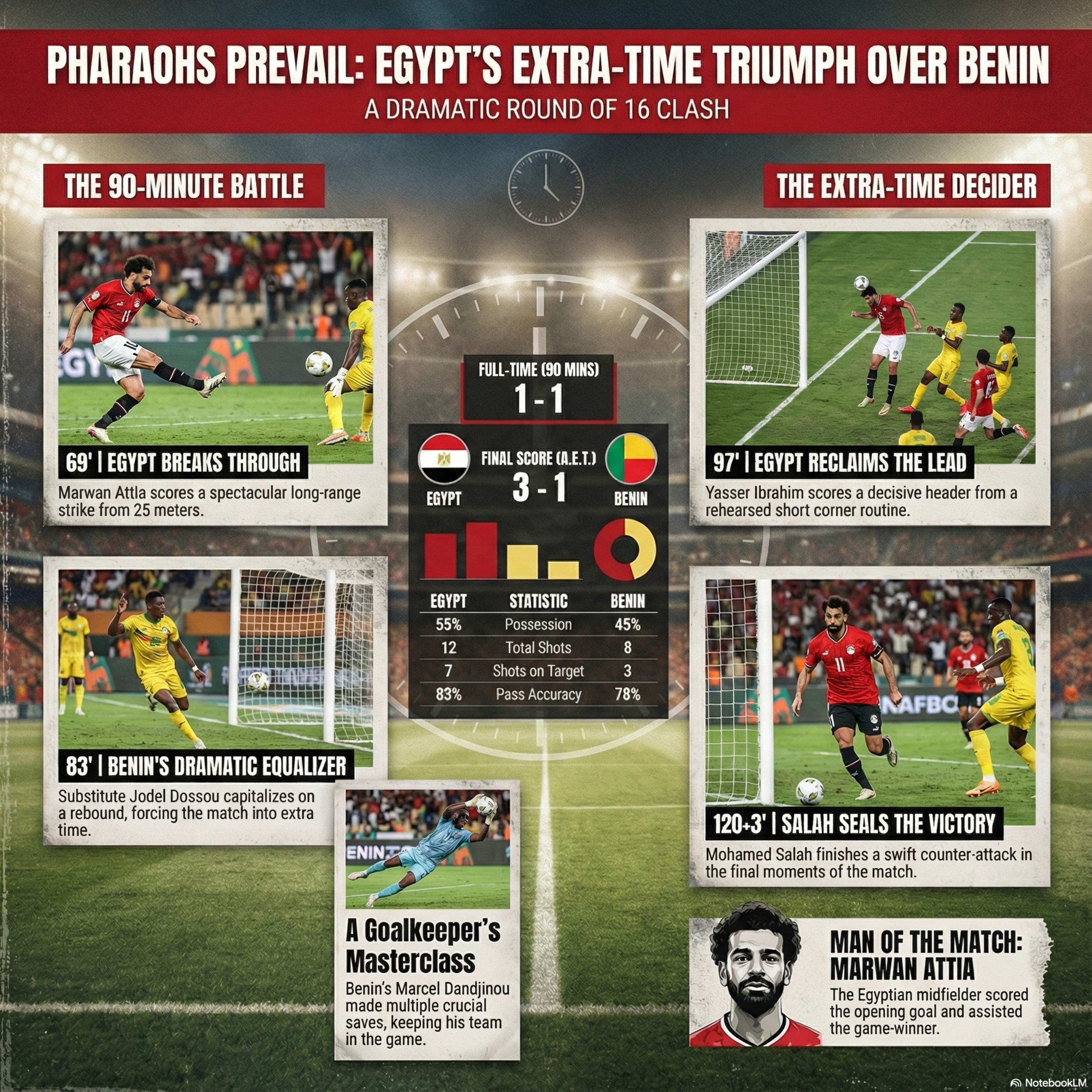
A shortcut. I like that. Yeah, a clear understanding of the infrastructure and the technology gaps that stopped so many African teams from consistently hitting those global benchmarks you see in Europe and South America. So this isn't just match analysis, it's it's strategic development applied in real time. And the result of this stress test, the scoreline that really framed our entire analysis, was Egypt 3, Benin one, but only after a grueling 120 minutes. That's the key detail right after extra time.
It is the single most important detail in the entire report. The fact that Egypt, you know the tournament giants seven time continental champions had to be pushed all the way to extra time by Benin A-Team punching way, way above its historical weight if. It had been a blowout. We'd have learned nothing. Exactly. Had Egypt won three ZIL comfortably in 90 minutes, it would just be another result. But because Benin forced them into that extra half hour, it exposed everything. Tactical vulnerability abilities, clear fitness disparities, and, crucially, technological deficits that, you know, they plague even the most established African footballing nations.
The breaking point, when it came, was so, so instructive. OK, let's untack this because the summary of this analysis laid out four major themes immediately. And these themes, and they really become the pillars for our whole discussion today. They're sort of the universal truths about the challenges facing African football development right now. So first we saw the stark, the failure of possession dominance. Egypt controlled the ball was around 55%. That's right. But they just could not translate that that control into early goals.
It points to a massive conversion efficiency problem. They looks dominant on paper but were for long stretches tactically infinite. And 2nd, on the flip side of that, Benin showed us the democratizing power of, well, tactical discipline. They proved that smart, organized coaching can level the playing field, frustrating a far more talented side just through sheer organization. But that tactical ceiling, it eventually hits a wall, right? A technical and physical wall. It does. It always does. 3rd the decisive factors that finally broke the deadlock and won the game were incredibly specific set piece proficiency.
We're talking rehearsed routines and measurable, superior late game fitness. This tells us that tournaments are often one in the lab and on the training pitch, not just by individual brilliance and open play. And finally, and this is maybe the most critical insight, the one that technology has to address right now, the pervasive challenge of passing inefficiency under pressure. Even Egypt's impressive 85% overall accuracy, it just plummeted in the most critical areas when time and space were squeezed.
So when a team gets tired. The technical execution just collapses. The analysis confirms this is a continental sticking point. That decay of execution under pressure, that is the perfect bridge because it tells us the fight isn't about raw talent anymore. Africa has that in abundance. We all know that. Oh, without a doubt. It's about implementing the systems that allow that talent to perform at maximum efficiency when the stakes and the physical demands are at their absolute highest. All right, let's start with the narrative flow of the game itself, because this was, I mean, an emotional marathon for both sets of fans.
It wasn't some tactical master class. It was a desperate battle. Absolutely. The 1st 60 minutes or so felt like a stalemate, didn't it? A real tactical arm wrestle. Egypt was prodding, trying to find a way through, but Benin was just rock solid. And then 69th minute Marwan Idiya finally breaks the deadlock one there. And at that point, you're thinking, OK, scripts written, The favorite has found the key. They'll cruise to the finish line now. You'd think so, but Benin showed immense character, they didn't fold, they kept fighting.
And then what? 8 minutes from time? Yodel Desu a late game substitute which is such a key detail he pops up with the equalizer. In the 83rd minute 11 and that goal just throws the whole match into chaos. Benin managed to drag the heavy favorite, the seven time champions through 90 minutes of hell and force extra time. I mean, regardless of the final outcome, that act of resistance is hugely significant for a developing team. And that resistance is precisely why the Next 7 Minutes became a perfect laboratory for our analysts.
Because in extra time, the story flips decisively, and it confirms all those underlying systemic differences we were talking about. Right, Yes, Sir, Ibrahim scores that crucial header in the 97th minute 21 that felt like a moment of planning, not luck. It was, and then right at the death, 120 + 3 minutes, you get that. A decisive composed moment from Mohamed Salah to seal it at 31. Benin pushed them to the absolute limit, but the systematic advantages of the favorites they ultimately prevailed when the physical and mental effort peaked.
So let's dig beneath that emotional timeline. If you pull back the curtain the statistics, they reveal exactly where the weaknesses were exposed and why Benin couldn't quite finish the job despite their heroic efforts. It all comes down to systemic efficiency. The primary metric to look at is possession versus threat. Egypt had 55% position. That's, you know, pretty standard for a team with superior midfield talent. But the fact that Benin's organized defense successfully frustrated them for 69 minutes, that illustrates a major universal challenge in African football.
Which is which is that teams often lack the cognitive and, yes, the technological tools needed to efficiently break down a disciplined low block. You hear the term possession without penetration all the time. And that's exactly what this was. What it looks up on the field is predictable movement. It's passing the ball horizontally from fullback to fullback, waiting for an opportunity that never comes because the defense is happy for you to have the ball in non threatening areas. So you're just killing time.
Basically, your own momentum, the lack of penetrating passes, the absence of those quick 1-2 combinations in the half spaces, the reliance on hopeful crosses. That's the signature of a team that hasn't drilled high precision, high speed attacking routines. And that is exactly what technical training technology is designed to fix. And then you have the most glaring difference, which was the clinical finishing gap. So Egypt had twelve shots in total, 7 on target. That's a 58% accuracy rate, which is pretty decent.
It's solid. But benign. They managed eight shots, and only three of those were on target. That's a 38% accuracy rate. And that 20 percentage point gap from 58% down to 38%, that's enormous. That is the difference between forcing the goalkeeper to make a save, earning a corner, maybe getting a rebound. And just missing the target completely, gifting possession right back to the other team. Exactly. And the analysis argues this difference isn't just circumstantial, it's systemic. It reflects A fundamental technical development deficit.
If Benin could lift their shot accuracy to even 50%, which is entirely achievable with dedicated systematic technical training focused on repetition and precision, that's maybe one or two more shots that force a mistake. The entire tactical dynamic changes. Investing in technical refinement. It bridges that clinical gap far more reliably than just waiting for a moment of individual genius to save you. I understand the goal in shot gaps, but let's talk about passing accuracy. Egypt's 85% overall?
Well, it's pretty good for a high pressure knockout match. Why is the analysis so insistent that this reveals a passing problem? Because the headline number, it hides the crucial context that overall 85% is inflated by safe, easy lateral passes in their own half. Between the center backs. Precisely. The analysis found that the accuracy drops significantly under pressure, especially in the final third, and even more so when players were fatigued. And that is where execution matters most. You can be 95% accurate between your two center backs, but if your pass accuracy drops to 65% when you're trying to throw out a ball to a striker in the box, your entire offense is stifled.
And Benin 78% overall is just further confirmation of that same gap. An even greater technical development gap in basic ball retention and distribution. They just surrendered possession too easily, which forced their discipline defense right back into action immediately. For a developing nation, every single possession is precious. Losing the ball cheaply because of a lack of technical refinement is an exponential drain on their already limited physical resources. And that. Leads us perfectly to the decisive metric, the fitness divide.
The source material is, I mean, it's unequivocal here. Egypt scored two goals in extra time. That is definitive proof of superior conditioning protocols compared to Benin, whose fitness decline was frankly visible to the naked eye after 90 minutes. This is perhaps the single most critical lesson for smaller federations like Benin. They executed a brilliant tactical plan. For 90 minutes. They had the organization, the commitment, the discipline. But 90 minutes of tactical brilliance gets completely negated by superior late game physical preparation.
Completely. You can have the perfect low block, but if your muscles are screaming with lactic acid, your reaction times are a fraction of a second slower and your concentration is fractured by the 100th minute, that low block is going to crumble. So we're talking about an objective biological limit, just overriding whatever tactical instructions the coach is shouting from the sideline. Exactly, and this is where the conversation turns instantly to technology. The level of fitness required to maintain high intensity defending for a full 120 minutes is only achievable through objective, data-driven load management and conditioning.
You can't just guess that your players are fit enough. You need systems that track their recovery, their training load, their objective output in real time. Without that data, smaller federations are always playing catch up and their best efforts will always be undone by systemic physical exhaustion. Now let's take those systemic observations and view them through the lens of the four goals that were scored. Because each goal is it's either a tactical master class or a tactical disaster just waiting to be analyzed.
OK, let's start with that initial breakthrough. Marwanathiya 69th minute. It was a spectacular strike from what, 25 meters out? But the report stresses that the build up was the key. It was a rehearsed right wing combination involving Hanny and Sala. The technical lesson here is the value of patient, rehearsed buildup that's designed to target space. Benin's defensive block was compact. They had numbers in the middle, but they were also narrow, and that narrowness meant they were vulnerable to a quick switch or a pass just outside the box.
That's right. When Haney and Sala combined out wide, they pulled defenders with them. That created a little pocket of space centrally. Haney laid the ball back to Attia, who was in that exact pocket, and he had the fraction of a second he needed to line up that technically perfect strike. It's that kind of detail that wins games. And it underscores that the key to breaking down a low block isn't always finding a through ball. Sometimes it's about creating space for a high percentage shot from distance.
And because it was a rehearsed routine, the execution was fast and efficient. This is where high level federations use technology like Oliver Pro EPTS data. They don't just track how far players run, they track the movement patterns of successful attacking routine. So they can replicate them. They use that data to quantify and optimize which player combinations generate the highest expected goals, and then they drill those specific movements until it's just Ure muscle memory. OK, now let's fli the script to Benin's equalizer.
Yol Dosu 83rd minute. It's a close range rebound finish. It comes from a deflected cross and a poor clearance. This goal feels like pure chaos, but was it actually defensive failure? It was a critical cognitive failure and the report highlights the specific detail perfectly. While the initial cross and the keepers clearance were, you know, technically subpar, the real failure lies in the positioning inefficiencies. Right after the shot. A key defender, Yasser Ibrahim, who would later be a hero, ironically was noted as ball watching instead of tracking the substitute Dassu's run into the box.
The cardinal sin of defending. Think about that moment. A defender, he's focused only on the flight of the ball and the keepers save and he neglects his primary responsibility, which is to track runners. Though Sue having just come on with fresh legs, he exploited that single lapse in awareness and this is fixable. This isn't a technical mistake, it's a failure of cognitive focus under pressure. Which technology can help with? Real time tracking tech paired with post match video analysis should flag exactly these kinds of cognitive failures.
Ball watching, poor scanning for immediate coaching correction for developing teams, training defensive awareness against fresh fast substitutes is absolutely critical. So if the equalizer was a result of a cognitive lapse, the third goal scored by Yasir Ibrin in the 97th minute, was the complete opposite. It was a product of pure precision and planning a header from a meticulously rehearsed short corner routine without Hia providing the pinpoint delivery. A beautiful goal. And this emphasizes A crucial point for African teams.
Set peace. Proficiency is a game changing weapon in these tight knockout matches where goals from open player so rare, two or three well drilled corner routines can literally be the difference between going home and moving on. Ibrahim was unmarked at the near post because of a clear zonal marking failure by Benin. And that marking failure is unforgivable at this level. But what made the routine work was Atia's technical consistency. The delivery has to be perfect. Low trajectory, high pace, aimed precisely at that near post.
If that delivery is just slightly over hit, the chance is gone. And that's where the tech comes in again. This is why the need for technical training tools, specifically things like precision passing stations, is so high on the priority list. They ensure that players like Atia can execute that perfect pinpoint delivery not just once, but consistently under matched conditions. Under exhaustion, the routine is only as good as the execution of the pass. And finally, the knockout punch. Muhammad Salah's goal at 120 + 3 minutes a composed how to attack finish after Benin overcommitted, where Salik carries the ball from his own half and just chips the advancing keeper with perfect control.
This goal, it just isolates the incredible value of elite cognitive performance under extreme, debilitating fatigue. Sala's decision making to carry the ball, to assess the keeper's angle to execute the chip was flawless. Now compare that level of composure in the 120th minute to the wasted one-on-one chance by Marmouche in the ninth minute when he was fresh. It's night and day. It is and that contrast the difference between Marmich's panic and Sala's calm, that is the systemic developmental problem.
You cannot rely on the genius of a Sala. You need technology that systematically develops high level decision making across the entire squad. Tools like a Champ Rox Pro X are designed designed specifically for this, training players to make high stakes, accurate decisions when their bodies are physically drained, ensuring that physical fatigue doesn't automatically translate into mental error. Let's deep in this discussion on the contrasting strategies that brought this game to 120 minutes. On one side you have Kosh Hassam Hassan's Egypt using a fluid 352, which dropped into a 532 when they were defending.
A very modern system. What made this formation effective for them? Well, they had numerical superiority in midfield, which allowed Atia, Adele and Trezegue to really dominate the central area and control that 55% possession. We talked about the wingbacks Henny and Hamdi. They provided essential width stretching Benin horizontally. And as we noted, the emphasis on set piece coaching was exemplary. 2 out of their three goals came from that. They built a system designed to control territory and win tight matches through practice, rehearse routines.
But the system had clear systemic weaknesses that almost cost them the game. Oh. Absolutely the most obvious was wasteful finishing, best personified by that early miss from Marmish. When you play a 352 you commit a lot of bodies forward and if you don't convert those early chances, you are so vulnerable to counter attacks and you give a ton of confidence to the defending team. And they relied on Salah a bit too much, didn't they? A dangerous over reliance on individual quality. You saw Salah constantly having to drop deep, sometimes into his own half, just to create passing triangles and get things moving forward.
That's a sign that the midfield unit wasn't consistently solving the creative problems themselves. It wasn't until the decisive introduction of fresh legs like Imam Assure in extra time that Egypt got a systemic push. It proves that superior talent only wins when it's backed by superior physical depth. OK, now let's look at the name. Granat Rohr set up a discipline 433, which in reality quickly became a defensive 451. Right, they were not there to play expansive football. No, they prioritized organization using a low block to compact banks of four, and they focused intensely on shutting down those central channels.
And they demonstrated the absolute power of good coaching and tactical adherence. They proved that tactical discipline, even with limited reasons compared to Egypt, can force parity with far superior individual talent. For 90 minutes, they were masters of frustration. They were, but their limitations were ultimately exposed by the sheer duration of the match. The first limitation was that vulnerability and set piece defending that one zonal marking failure in the 97th minute change the entire narrative of the game.
They focus so much on their open play organization that they neglected the crucial details of dead ball situations. And the second limitation. The most pronounced limitation, the one that was unfixable in the moment, was that sheer physical fitness decline. After 90 minutes, they simply couldn't maintain the high defensive intensity necessary to stifle Egypt for an another half an hour. And this brings us back to the link between technical and physical training. It's all connected. If Benin had improved their ball retention under pressure, which would come from technical training, they would have kept the ball for longer periods, alleviated the defensive pressure on themselves and conserve precious energy.
It would have effectively masked their underlying fitness deficit. They were forced to defend relentlessly for too long because their technical skills go down so easily. Let's talk about the individuals because they really do embody this continental contradiction. You have world class talent, but it's operating in underdeveloped systems. Great way to put it. Marwan Atia, Man of the match, 8.8 rating. His long range strike and his assist from the corner. They demonstrated the impact of a technically complete central midfielder, a player who can both execute complex attacking movements and break the lines.
He's the physical and technical prototype every African Academy should be trying to mass produce. Then you have Mohamed Salah 8.5 rating. His contribution wasn't constant throughout the game, but it was decisive. His quiet periods followed by that moment of pure cognitive brilliance in the 120th minute, it proves that elite decision making skills can just cut through tactical tension like a knife. So it makes you ask the question. It demands that Federation's asked how do we replicate and scale this level of mental acuity across an entire squad?
It can't just be reserved for the superstar. And we absolutely have to highlight Marcel Danjanou, Benin's goalkeeper, who earned an 8.2 rating for his outstanding saves. The report explicitly states he kept Benin in the match single handedly for long stretches. And this is a fantastic teaching point. Quality goalkeeping is essential, and it can absolutely mask systemic weaknesses like slow defensive recovery or poor tactical transitions. Danjnu was the hero, but relying on one player's heroism to prevent a system failure is just not a sustainable solution for long term progress.
So you can't just rely on the ceiling of one position. No, you need to lift the floor of the entire system. So the core lesson for all African federations, regardless of their size, is confirmed here. The world class talent is undeniably present, but the world class systems, the infrastructure, the conditioning protocols, the precise technical training required to support and multiply that talent, those are the key missing components. That is the divide this match exposed. This match wasn't just an emotional win for Egypt.
It provided compelling empirical evidence of the technology investment gap between African programs and those in Europe. And even for an established footballing nation like Egypt, the analysis found significant addressable deficiencies. OK, let's dive into those three specific actionable gaps identified in the analysis, starting with the Foundation Electronic Performance Tracking Systems, or EPTS. What was the deficiency in the Egypt Benin match? Well, the deficiency was obvious just watching the game.
Neither team showed any evidence of systematic GPS or Etts data integration. We saw reactive substitutions based on a coach seeing a player who looked tired. Not based on objective data. Exactly. Load management and extra time felt entirely reliant on subjective assessment, which is essentially coaching blind in the most critical minutes of a tournament. And the impact of that is huge and measurable. It is without real time load monitoring using robust systems like Oliver, Pro coaches are just gambling.
Institutions are reactive instead of strategic. Injury risks skyrocket, especially soft tissue injuries from overtraining, and there is no objective data to manage fatigue across the 120 minutes. And the analysis had a specific number on this right, the drop in pressing intensity for Egypt. Yes, this was the crucial quantifiable finding from the match. Egypt's average pressing intensity decreased a staggering 23% after the 75 minute mark. 23%, that's a huge number. What does that actually mean on the pitch?
It means everything because pressing intensity relates directly to the time and space you allow the opposition to operate. A 23% reduction means that from minute 75 onward, Egypt gave Benin 23% more time, 23% more space and 23% more comfort on the ball in dangerous areas. And that's exactly when Benin scored their equalizer. It's no coincidence that's the difference between a successful defensive phase and one that allows the opposition to control the midfield, maintain possession and score that crucial goal, which Benin did in the 83rd minute.
Had Egypt's conditioning been objectively managed using EPTS data, they could have made pre emptive substitutions or managed energy output to mitigate that 23% drop. And the analysis argues that Oliver Pro EPTS is absolutely critical for smaller federations, assigning Benin a priority rating of 95 for this technology. Why is it a higher priority for Benin than for Egypt? Because for developing team with limited financial resources, their player pool is shallow. If their best center back or their critical defensive midfielder suffers an avoidable soft tissue injury due to cumulative load, their entire tournament plan is compromised.
Oliver Pro, by providing objective load monitoring and injury prevention data, preserves those precious few assets. It is a defense against financial and competitive disaster. It makes the most of the talent they already have. OK, let's move to gap #2 precision passing development, which addresses that continental technical problem we keep talking about. The deficiency was the universal decay of passing accuracy, especially in high pressure areas. Yes, we saw Egypt drop from a high of 89% in the first half, down to 78% in extra time and the final third.
Passing accuracy was just universally poor for both teams when pressure was applied. And the impact of that technical deficiency is that it creates an artificial ceiling on your offensive efficiency. Exactly. You can have the perfect tactical system, but if the final pass is inaccurate, the chance dies and the discipline defense wins. This leads to frustrated attackers taking low percentage shots. The technical foundation simply isn't resilient enough under stress. So how does the technology, the A champ precision passing stations specifically address this gap?
Let's move beyond the theory and get into the practical training application. What does that look like? This is critical. These precision passing stations aren't just cones and bibs. They are sophisticated training systems that provide high repetition, data-driven drills focused on first touch, weight of pass, and immediate accuracy. Imagine a player receiving a pass, having to assess a target that lights up randomly, and then executing A weighted pass into a specific zone, all under a timer that mimics match speed.
So it's about decision making as much as technique. It's both. The system tracks every pass, provides immediate feedback, and forces the player to repeat the action hundreds of times until that perfect pass becomes second nature, even when they're physically exhausted. This directly solves the final third technical development gap, making it a critical need priority. 92 for Benin High, 88 for Egypt. It is the most universal weakness we saw and this tool offers the most direct solution. And gap #3 the cognitive element.
This is the difference between Marmish failing and Solace succeeding. The deficiency was clear. Decision making varied wildly. There was no evidence of systematic programs to bridge that gap between panic and composure. And the impact of this cognitive deficiency is immense. Cognitive failures under pressure are what cost you chances, points and progression. You need the whole squad operating at Sala's mental level, particularly when fatigue sets in. So what is that a champ rocks Pro X training actually look like in practice?
It involves specialized sensory and light based reaction drills. Layers are forced to stand the field, process multiple visual and auditory cues, and make rapid decisions on where to pass or move, all while performing a physical task like juggling or running. So you're. Overloading their brain while their body is working you're. Strengthening the link between the brain and the body under duress, this training ensures that the physical exhaustion players feel in minute 100 doesn't automatically trigger mental paralysis or panic.
If your attackers are cognitively robust, they take that extra second needed to place the shot rather than blasting it over the bar. This is a must have for the high stakes environment of continental tournaments. Finally, before we move on to solutions, the report noted the underutilization of AI powered scouting and video analysis systems like Pixel Lot. For federations operating on limited budgets, that seems like a massive oversight. It is. AI scouting doesn't just record games. It automates the identification and tagging of specific player behaviors and patterns across multiple leagues.
For a small federation that can't afford a huge network of human scouts traveling constantly, AI provides massive efficiency gains. It allows them to acquire talent smartly and maximize their limited recruitment budgets. Overlooking this tech is overlooking a massive competitive advantage. And so we've moved from diagnosis to prescription and the report is very good at framing these solutions practically distinguishing between immediate needs and strategic needs based on the Federation's financial capabilities.
Let's focus first on the immediate priorities, the zero to 6 month road map. For high resource teams like Egypt. The recommendation is clear. Total systems integration. What does that mean? It means they must deploy Oliver Pro EPTS immediately for real time load management to protect their multi $1,000,000 assets. They need to implement a CHAMP ROX Pro X for cognitive training specifically for their key attacking decision makers, Sala Marmouche Trezegat to minimize those costly early misses that plague their efficiency and the technical foundation.
A CHAMP precision passing stations must be installed to solve the final third in accuracy. And this isn't about spending money for the sake of it. This is pure business. The report suggests Egypt could see a phenomenal return on investment an estimated 340% / 5 years from implementing this integrated technology suite. That's right, that translates to better player health, fewer injuries, higher performance, consistency and ultimately greater prize money and player valuations. That makes a decision a no brainer.
Precisely. Now let's look at the blueprint for developing teams like the Benin Football Federation. Their needs are more fundamental and their resources are tighter, so the focus has to be on mitigating their most critical weaknesses. What's their first phone call? The critical need is immediate deployment of Oliver Pro EPTS, especially focusing on goalkeeper and outfield load monitoring to address that pronounced fitness drop we saw. That's the foundation of being competitive for 120 minutes and the absolute must have is a champ.
Precision passing stations. This combination directly tackles their twin weaknesses, fitness, maintenance and technical execution under duress. For Benin, those two things are non negotiable for sustained success in knockout tournaments. And looking slightly further out into the strategic recommendations for the next 6 to 24 months, the priority levels assigned in the report truly tell the story of what is missing across the continent. The data is definitive. Oliver Pro. The EPTS is rated critical A 95 for Benin and high age A-75 for Egypt.
This just confirms that fitness and injury prevention is paramount across the board. And a champ. Precision passing is critical. 92 for Benin and high age 88 for Egypt. We simply have to reinforce this point. The failure of passing under pressure is the most universal and acute technical weakness identified in this match. It proves that technical training, often overlooked in favor of purely physical drills, is the immediate systematic correction needed to unlock continental efficiency. And finally, H amp Rocks Pro X for cognitive training is high GH85 for Benin and high GH80 for Egypt.
The implication is that even if you're a high resource team, you still need to optimize the mental side of the game. The technology solution is consistent, the only real difference is the depth and speed of deployment based on your budget. And if we want to solve this problem sustainably, we have to start at the foundational level, youth development. You can't wait until a player hits the national team to introduce this kind of data literacy. You can't the report. Specifically introduces Soccer B EPTS as a cost effective tracking solution recommended for you 18 youth Academy programs.
This is essential. Federations have to establish these technological foundations early in the development pathway. If an 18 year old is already used to understanding their load data, their recovery metrics, and practicing with technical performance feedback, they are light years ahead. They're ready to transition seamlessly into a world class system. And this dictates the investment framework. While costs vary, the core message is that under investment in preventable areas, injury prevention, fatigue management and basic technical proficiency is the core failure holding African football back.
These technologies aren't discretionary luxuries, they are risk mitigation tools and efficiency multipliers. OK, let's bring this back to the heat of the moment, the tournament itself. Egypt advances, but now they face a monumental quarter final challenge against either the reigning champions Ivory Coast or Burkina Faso A. Huge test. The critical immediate implication of this 120 minute battle is recovery. Those extra 30 minutes are incredibly taxing and this immediately makes load management enabled by Oliver Pro non negotiable for their preparation over the next few days.
If they had that system deployed, they would already know exactly which players need specific recovery protocols. And the high risk nature of this deficiency was tragically highlighted by the concern over Mohammed Hamdi's knee injury sustained during the match. Advancing is great, but injuries do real tournaments. This incident just reinforces the immediate, desperate need for preventative tracking technology to protect key players and manage fatigue before it results in structural failure. And when we look at this match in its entirety, it just reinforces the central thesis of the whole analysis, doesn't it?
It really does. African football's incredible talent pool consistently exceeds its infrastructure. We have the athletes, but we lack the systemic support. The gap isn't just technical skill, which is often raw and powerful, but it's the systems that support, maintain and multiply that skill under extreme pressure. Benin's coaching quality was evident in their tactical discipline, but technology is the multiplier needed to turn that promising foundation into consistent knockout stage success. They couldn't multiply their effort because their technology floor was just too low.
And the data confirms time and again the universal weakness we keep coming back to passing under pressure. If African teens can systematically address this drilling technical accuracy until it holds firm even when the player is physically exhausted, that's when they consistently beat the disciplined low block. That's when they move beyond relying on individual magic and genuinely take the next step on the global stage. And the stage for the systemic change is already built. The market intelligence note from the report confirms the massive platform for growth.
You have significant continental viewership, world class hosting. As we saw with Morocco, the opportunity is there. The performance differentiation in this high visibility environment will increasingly be determined by technology adoption. Those federations who adopt these sophisticated systems first will dictate the competitive landscape of African football for the next decade. Hashtag tag outro. So we conclude our deep dive. A single high stakes knockout match provided A comprehensive blueprint for what African federations must prioritize immediately.
It's really a three pillar system required to transform the game. data-driven fitness via EPTS, technical precision via passing stations and cognitive resilience via mental training. These are the systems required to systematically move away from relying on individual brilliance, the spectacular goals, the heroic saves and towards creating true world class footballing infrastructure that elevates every single player on the pitch. And here is the final provocative thought for you, the listener and for every decision maker in African football.
The analysis demonstrates that the biggest obstacle to continental dominance isn't talent acquisition, which we have in abundance, it's infrastructure adoption. If the most successful African nation in history, Egypt A7 time champion, still exhibits these fundamental quantifiable gaps and load monitoring, passing accuracy and cognitive training, what does that mean for the vast majority of the continent? And how quickly can technology democratize the game? The future of African football depends less on finding the next superstar who can break the game open, and infinitely more on implementing the systems that ensure every player performs at their absolute data optimized peak minute after minute for 120 grueling minutes.
Well said. That was the deep dive. We'll see you next time.
 Apple Podcasts
 Castbox
 Castro
 Goodpods
 Moon FM
 Overcast
 Pocket Casts
 Podbean
 Podcast Addict
 Podcast Republic
 Spotify