AFCON 2025 1st Round Failure Was Not The Players
About this episode
AFCON 2025 1st Round Failure Was Not The Players
Listen now on Spotify, Apple Podcasts, Amazon and other streaming services! Don’t forget to subscribe, share, and leave a ⭐⭐⭐⭐⭐ review to help more players and coaches discover the power of Techne Futbol and Data Technology in the beautiful game.
#TechneAfricaFutbol #TechneFutbol #TrainWithTechne #Playermaker #TraceFutbol #Hudl #FootballTech #FootballInnovation #PlayerDevelopment #CoachTools #SmartFootballTraining #AfricanFootball #CAFOnline #FIFA #FIFAYouth #CAFDevelopment #YouthFootballAfrica #NextGenFootball #FootballScouting #TalentIdentification #DigitalScouting #EliteYouthDevelopment #FootballJourney #FootballAnalytics #FIFAForward #FutebolAfricano #TrainTrackCompete #FootballExcellence #FootballAfrica #TheFutureOfFootball
Welcome back to the Deep Dive. If you were watching the group stage of AFCON 2025, you saw something. Well, something truly shocking. It really was. This wasn't just a few upsets here and there, it was a systemic collapse. I mean, think about it, you've got this massive high stakes international tournament and eight teams, nations with incredible history, passion and, you know, world class talent. They just crumbled. It was startling to watch in the moment, yes, but when you look back it feels almost predictable.
We saw the early exits of Angola, Botswana, Comoros, Equatorial Guinea, Gabon, Uganda, Zambia and Zimbabwe. A. Huge list. A huge list, and the shock waves were immense, of course, but if you actually dig into the preparation into the administration behind these teams, the conclusion is less shocking and much more damning. Absolutely. Because when those final whistles blew, the immediate reaction everywhere was what happened to the talent? Did their player pool just dry up overnight? And that is precisely the wrong question to be asking.
It is. This deep dive into the systems running beneath the score lines reveals a pretty radical, and I think crucial conclusion. This was not fundamentally a failure of footballing ability. It was a quantifiable catastrophic failure in operational standards and the distinction, that's everything. That's the core thesis and we need to hit you with it right away. It wasn't the players, it was the plumbing. I mean, just think about the sheer wasted potential. You have Pat Zendaka, A clinical striker, scoring goals in Europe playing for Zambia, right?
You have Marshall Munetzi, a top tier midfield anchor in France for Zimbabwe. And then of course, the incomparable PRM Merko Bamiang for Gobble. These are elite professionals. They operate every single week inside these, you know, high performance, precision engineered environments in Europe. And yet when they come home to play for their national teams, they were rendered impotent by what were, frankly third rate systems. The talent was there, but the organization just actively undermined it. The parity is enormous.
You can see it so clearly when you look at the teams that sailed through Morocco, Senegal, Egypt, Nigeria. You're looking at organizations that have, for lack of a better word, industrialized their football. Industrialized. I like that. What does that mean in practice? It means they run on integrated sports science, high level data management and crucially, rock solid governance. There's a stability there. While the eight nations we're focusing on today, the eliminated cohort are still trapped in what's been described as administrative feudalism.
That's a powerful term, but it's accurate. It is for you listening, Administrative feudalism basically means a system where you know political loyalty and who you know Trump's actual competence and merit. Exactly. It means that these vital roles, general secretary, team manager, federation president, they're often handed out based on connections, not on a professional track record. Transparency is minimal, and there's this underlying sense that the system is there to serve the administrators, not the players.
And when that's your mindset, you get chaos. You get chaos in your logistics, your finances, your technical appointments. They were, I mean, they were bringing a knife to a gunfight. And the data absolutely proves it. So our mission today for you is to pull out the hard, painful lessons from this failure. We're going beyond the blame game to focus on what needs to happen now. A standards reset, a force move from that administrative feudalism to a high performance meritocracy. We are finding out what has to change to benefit the future of the African game.
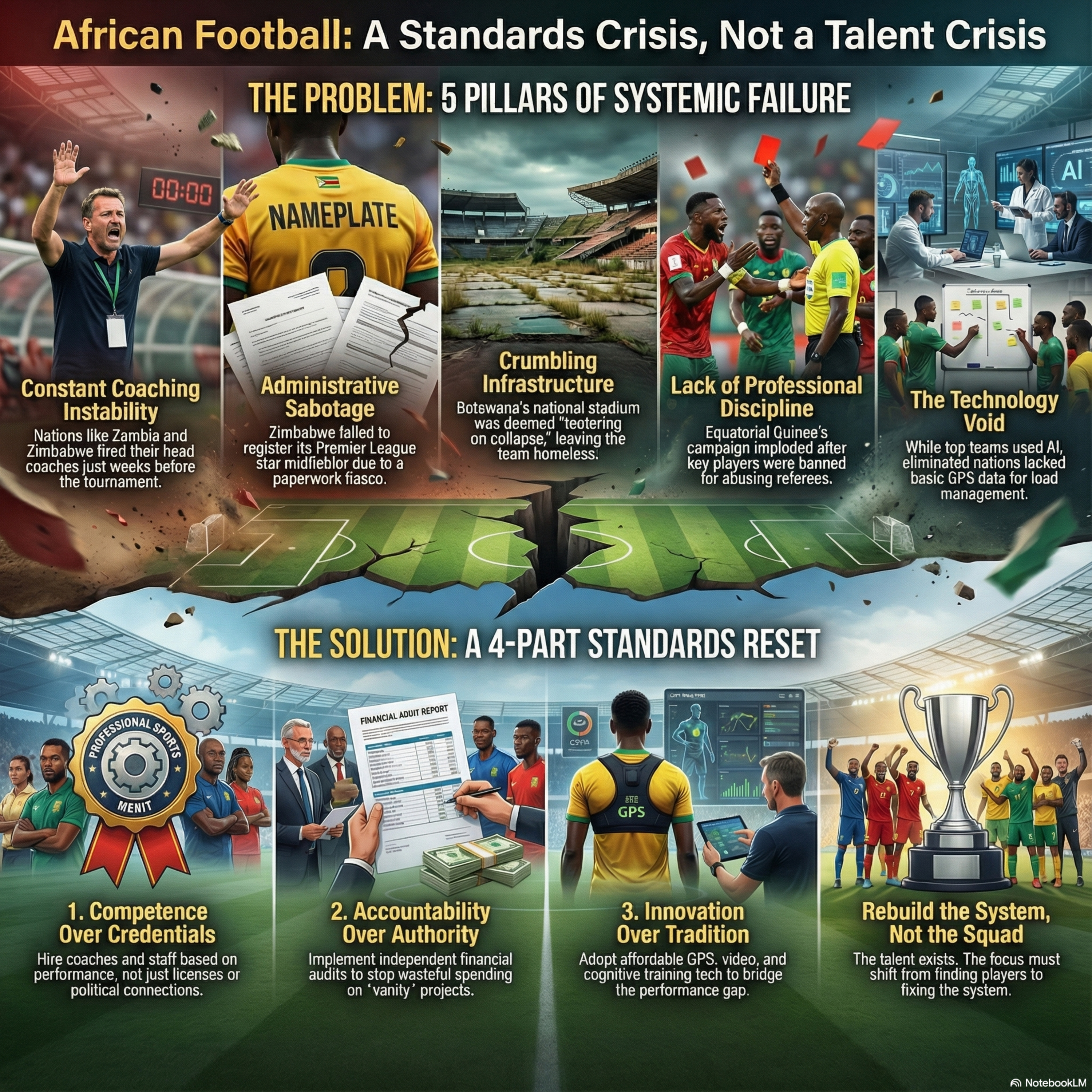
OK, let's really get into the mechanics of this disaster. We've established the problem is operational standards. Our analysis points to 5 corrosive pillars of failure that systematically crippled these eight nations before a single ball was even kicked. And these aren't just one off mistakes. These are structural defects. They're baked into the organizational DNA. Let's start with pillar one, the coaching carousel, or as you call it, strategic volatility. Yes, the failure of strategic stability.
I mean, think about it in military terms. If you change your general right before a major battle, you absolutely guarantee that the troops will be confused and the plan will just disintegrate. And the timing here is just, it's wild. Look at the specifications. Destructive timing. We saw nations like Zambia and Zimbabwe completely decapitate their technical leadership less than 8 weeks before the tournament kicked off in December. That's right, Zambia fired Avram Grant. Zimbabwe got rid of Michael Neese.
Both of these happened in October 2025. Now think about what you actually need to do to prepare for AFCON. Right, it's a whole process. It's a. Huge process. You need deep, specific scouting of your group opponents. You need to install your tactical movements both offensively and defensively, And maybe most critically, you need a physical conditioning plan designed to make your players peek at exactly the right moment during the tournament. So what happens to that plan when you fire the architect seven weeks out?
It creates A catastrophic tactical vacuum. The interim coach who steps in like Moses Saccone in Zambia, They have zero time, no time to build tactical continuity or just as importantly, player trust. The team just reverts to its most basic instincts, relying on individual talent OR, you know, vague motivators like fighting spirit. But let me push back on that a little bit. Sometimes don't we see that removing a coach who's maybe lost the dressing room, even if it's late, can give the team a psychological boost?
Isn't there a risk that keeping a failing coach is even worse? That's a fairpoint, and yes, sometimes you do get a small short term emotional lift, but tournament football at this level is one through systemization, not emotion. If you have a complex system, the players need months, not a few days to internalize it, especially when they're under pressure. So the tactical cost is just too high. The cost of that late stage tactical 0 to lack of defensive shape, confused attacking patterns, it far outweighs any temporary morale boost.
These teams arrived leaderless and tactically unprepared. It's that simple. OK, Pillar 2 administrative sabotage. This category is just astonishing. It's about sheer fundamental incompetence with the most basic professional logistics. We have some truly gobsmacking examples of governance that prioritized public image over actual operations. Let's talk about the Zimbabwe case. Marshall Menezzi in English Premier League level talent, playing at the highest level in France and he was unable to join the national team for the tournament.
And the reason why it's just infuriating. It wasn't an injury, it wasn't lack of form. It was paperwork. Simple paperwork incompetence. The federation failed to manage the deadlines, failed to secure the necessary medical clearances and, crucially, couldn't get the liability waivers from his European club sorted in time. Can you break that down for us? I mean, was it just one person forgetting to send an e-mail, or is it a bigger, more structural problem? Oh, it's definitely structural. FIFA regulations for releasing players are very, very specific.
They require formalized communication guarantees, especially for a high value asset like Munetsi. The failure shows two things. First, the FA lacks any kind of integrated digitized system for tracking their professional players documents. And second, there was a complete breakdown in communication between the administrative office and the technical staff who were desperate to have him on the pitch. They sacrificed their best player because they couldn't manage a calendar. It's a total lack of professionalism on the most essential governance tasks.
Unforgivable. And then you have the Angola case, which is a story of fiscal irresponsibility on a well, on a monumental scale. Indeed, the Angolan federation reportedly burned $12 million on a single vanity friendly against Argentina right before the tournament. $12 million for our listener. To put that in perspective, that's almost 1.5 billion Kenyan shillings for one exhibition game. It is, and the decision was all about spectacle and ego, not substance. Instead of investing those reserves and actual development and player bonuses in technology, in modern infrastructure, that could have actually improved the team's performance.
They paid a massive appearance. Fee. They paid a massive fee. It's a damning indictment of prioritizing image over results. That money could have funded comprehensive tech systems for their entire national player pool for years to come. Which brings us to Pillar 3, the most immediate physical barrier infrastructure decay. You just can't be an elite athlete if you're forced to train in a non elite environment. And the Botswana National Stadium crisis is a truly painful example of this. Their main stadium was closed for renovation.
The only alternative, the Obeditani Chalumi Stadium, was described by their own sports minister as teetering on the brink of collapse. Teetering on collapse. Major structural issues, leaking roofs, failing power supply, the whole 9 yards. So their national team, the Zebras, had no high quality professional facility to train at in the crucial weeks leading up to Afghan. None. They were forced onto substandard, slow, often uneven surfaces. This is a direct physical barrier that immediately degrades performance.
The poor conditioning and technical sharpness you develop on slow, bumpy pitches is a world away from the pristine high speed surfaces they use at the AFCON venues in Morocco. And that difference shows up in the stats. Immediately it translates directly into deficits and high intensity running and ball control. We'll see that in the data later on. Pillar 4 Integrity and discipline deficits. This is about the internal culture that rots A-Team from the inside out. Equatorial Guinea is a grim lesson here.
Their entire campaign imploded because of a lack of control and discipline. It all culminated in bands for two key players, including their captain Carlos Acapo, for vocally abusing referees after a loss. A total breakdown of professional conduct on the international stage. It is, and if you connect that behavior back to the wider ecosystem, it's a symptom, not the root cause. This kind of outburst often comes from a domestic environment where officiating is seen cynically. It's viewed as a transaction or an obstacle you have to overcome, not as a regulatory authority.
So when the rules are actually enforced rigorously at an international level, they can't handle it. Exactly. It creates A cynical, high pressure, undisciplined player base that just lacks the mental fortitude you need for tournament football. And finally, Pillar 5, the technology void. To me, this is the most damning gap of all because it's quantifiable. It's the difference between analog and digital precision. Look at the top teams. Morocco for instance used AI driven performance clustering and really sophisticated data analytics.
Now contrast that with the eliminated nations who collectively lacked even the most basic tools, specifically GPS load management data. Help us define that what exactly is AI driven performance clustering and what edge does it give a team like Morocco? Well, it basically automates strategic analysis at a speed no human staff could ever match. Instead of a coach which just subjectively watching game film, AI systems analyze thousands of data points from opponent player movements to fatigue markers in their own squad, and it identifies these clusters of performance.
So like a hidden pattern? Exactly. For example, it might identify that a specific opponent midfielder always tracks back 15% slower after the 70th minute when it's humid. That allows Morocco to exploit that precise tactical window. It turns subjective scouting into objective, automated tactical directives. And without that level of precision, the eliminated team, those are essentially operating blind. Completely blind, lacking basic GPS data leads directly to preventable soft tissue injuries to fatigue.
Into this total reliant on the subjective eye test for player rotation. We know successful teams like Egypt and Senegal rotate players based on precise load data to optimize fitness. These other nations were just guessing and it showed up ruthlessly in the final 15 minutes of matches when fitness and concentration just fell off a Cliff. So we've laid out the five structural failures, the coaching volatility, the admin sabotage, infrastructure decay, discipline deficits, and the technology void. Now let's look at the direct outcome, the tournament performance diagnostic.
This is where the data really proves that this failure was in fact structurally preordained. Absolutely. The group stage was a ruthless test of efficiency, and for these eight nations, finishing third or fourth in their groups was just the mathematical consequence of such poor administrative groundwork. Let's just look at the raw numbers, the statistical brutality of it all. Botswana, Gabon and Equatorial Guinea finished the entire tournament with 0 points. Zero points, three nations. Comoros managed 2 draws but Sword Zero goals and then the defense just so fragile.
Uganda and Botswana both conceded seven goals each in just three matches. It's an autopsy of failed preparation, but let's focus on that goals conceded column for a second. I really believe this is the clearest proxy we have for organizational disarray. OK, make that connection ironclad for us. Why does a high number of goals conceded point directly to bad governance rather than just, you know, bad defenders? Because conceding a lot of goals is rarely about one or two players making simple errors.
It's a multi layered failure. First, it's a failure physical conditioning. The players are too tired to track back. They can't maintain their positional discipline for 90 minutes. Which goes back to the bad training pitches. Exactly. Second, it's a failure preparation. The scouting reports were either non existent or too generic to actually analyze the opponent's threats. So your defenders are always reacting, not anticipating. And 3rd, and this is probably the most critical, it's a failure of systemic stability.
The late coaching changes. The coach hasn't had the time to install a robust, trusted defensive shape when the team is chaotic off the pitch. That translates directly into chaos in your own defensive 3rd. And we saw that correlation proved without a doubt all three nations that got zero points, Botswana, Gabon, Equatorial Guinea, they all suffered from acute high profile off field crises right before or even during the tournament. Crisis equals vulnerability and vulnerability equals goals conceded.
Precisely. Now if you look at Zambia and Angola, they did marginally better. They managed to get 2 points each from draws, but while that's better, they still lack that cohesive integrated game model and the psychological conditioning needed to turn a draw into a win. So they could hang in there, but they couldn't land the knockout punch. Right, they managed to scramble for two points, but they couldn't get that crucial victory. And that comes right back to the late coaching changes in the pre tournament disruptions like Angola's morale killing, vanity spending.
They were competitive, but ultimately they were incomplete. We need to go deeper now. Section 3, individual nation forensic profiles. To really grasp the scale of this catastrophe, we have to look forensically at the specific institutional failure that defined four of these nations. Let's start with Angola and the fiscal mismanagement crisis. Angola's campaign was really defined by that one single self-inflicted wound, the $12 million spent on the friendly against Argentina. This wasn't just a poor decision, it was a foundational choice to prioritize optics over operations.
And the financial return on that decision is just staggering when you look at it. The ROI was catastrophically negative. Angola only earned $500,000 in prize money from their AFCON performance, so they spent 24 times their eventual earnings on a single exhibition game. That immediately frames the organization as one dedicated to spectacle over substance. It does, and it frames it that way in the minds of the public and, critically, in the minds of the players. Trust was fractured instantly. Professional players, they know the cost of things.
They understood that the Federation chose to pay Lionel Messi's appearance fee over investing in their own crucial logistics, upgrading infrastructure or securing proper performance bonuses for the actual squad that was competing. That creates apathy, not commitment. Absolutely. And you can see how that administrative distraction impacted the coaching. The coach, Patrice Beaumel, spent his prep time fighting public battles, arguing with FIFA over player release dates. He was distracted. Focused externally while the internal systems were just crumbling.
Exactly, and the reliance on subjective coaching was a massive tactical handicap. They had no GPS data so load management was based on instinct. And he saw the result. Against South Africa, their defensive structure just collapsed late in the game due to clear fatigue. They conceded a goal and that sealed the loss. That late game vulnerability is a tech spic sign of poor conditioning and subjective rotation. So if Angola wants to survive the standards reset, the imperatives are crystal clear. They are non negotiable.
First banded any friendlies cap spending on any single match to say 5% of the annual budget and redirect the rest internally. Second, digitize the Jarabala their domestic league. They have to mandate tech systems and professionalize their admin. And 3rd, invest in surfaces, redirect funds to hybrid turf and modern training pitches. The financial rot has to stop. All right, let's turn to Botswana, which tragically represents the infrastructure paralysis crisis. This is story where the physical reality of decay just made elite performance functionally impossible.
This is one of the most sobering profiles in the analysis. Botswana suffered a near total infrastructure collapse that literally left the national team homeless. Homeless. With the national stadium closed. The only alternative, the Obedientani Chalumi Stadium, was not just old, it was structurally unsound, as we said, teetering on the brink of collapse with massive issues. So the team, the Zebras had absolutely nowhere of high quality to train at home. And what does that do to their technical level?
It means they couldn't perform the conditioning protocols required for modern football. You can't run an elite explosive conditioning program on a substandard, unsafe field, and this was compounded by administrative failure. The Botswana Football Association, the BFA, failed to secure any friendly matches in that crucial November window. What was their excuse? They cited a need for internal training sessions. But wait, if they had nowhere proper to train, using that as an excuse sounds more like a cover up for logistical failure.
It absolutely was. They couldn't guarantee a suitable safe venue for an international opponent so they just pulled the plug. It left the team tactically undercooked and lacking any high stakes match fitness. And the technology gap confirmed this right? They had zero tracking systems. What did the data show when they played against an elite team? The data was a perfect mirror of their preparation. I guess the team, like Senegal, Botswana, covered 12% less high intensity distance. This wasn't a tactical choice, it was a physical limitation.
That 12% deficit is a massive structural gap that resulted directly from the inability to track conditioning data and the lack of quality training surfaces. You can't bridge that gap with just determination. So Botswana's reset has to start with the physical environment. Precisely. They need emergency stadium rehab, and this requires immediate government intervention. Turn that stadium into a high performance hub. Second, a tech partnership. Purchase affordable GPS units for the entire national pool to track conditioning objectively.
And finally, expatriate recruitment. But they have to actively scout and integrate dual nationals to rapidly inject external professional standards into their isolated system. OK, let's move to maybe the most alarming case of all Gabon suffering from the institutional toxicity crisis. This is beyond incompetence. This is completely poison. Broken system. It really is. The fallout after they were eliminated was just it was stunning. What did the Japanese government do? In a move that shocked the entire football world, the government suspended the national team, the Panthers, and unbelievably banned stars like Obama, Yang and Bruno Okoye Manga from all future selection.
And they announced this on live national television. That is a flagrant violation of FIFA statutes on political interference. That risks a global ban for the whole country, doesn't it? It's the textbook definition of institutional toxicity. The state basically admitted its systems were broken and rather than fixing them, chose to destroy the team and punish the result. It treats players as disposable assets who have to pay for administrative failure. And the toxicity runs deeper than just that government intervention.
Our analysis points to deep seated problems within Fegafoot the Federation itself. Oh yes, the entire environment was contaminated. There were long standing scandals involving the Fegafoot president, including serious allegations of sexual abuse cover ups within the women's and youth teams. That signals a culture of impunity at the highest level. It does, and to compound that their U 17 national team was disqualified from Afghan qualifiers just before this for rampant age fraud. They failed mandatory MRI test, so they're cheating to compete and they're still failing.
So you have a federation cheating in youth tournaments, covering up abuse, and then a government banning its star players for losing. How can a world class talent like Obama Yang even begin to function in that environment? His elite expertise honed over a decade at clubs like Arsenal and Barcelona? It's completely wasted. The Gavinese environment is too poisonous, too cynical, too chaotic to absorb or apply That high level of professional knowledge corruption acts as a roadblock to knowledge transfer.
The transformation imperatives here have to be radical. They require complete top down intervention. A FIFA normalization committee is the likely necessary first step to repair the governance. Second, they need a fundamental safe sport framework immediately to address the abuse scandals. And 3rd, immediate tech adoption to bring in transparency and objective performance tracking, stripping away the ability for politically motivated selection. They have to clean house. Our final case study is Uganda, which experienced the domestic instability crisis.
The problem here wasn't just with the national team, it was a symptom of a domestic league at war with itself. That internal warfare within their federation FUFA created chaos that destabilized the local players who are the core talent base. The Uganda Premier League format was controversially suspended and changed mid season, which caused highly publicized boycotts by major clubs. So the domestic players who need stable competitive games to prepare, they aren't getting that consistent preparation for the international stage.
Not at all. The foundation of the national team was crumbling and on top of that the domestic officiating was in an acute crisis. UPL referees went months without pay. Which leads directly to allegations of corruption and match fixing just as a means of survival. Exactly. A domestic league that is at war with its own officials and clubs where integrity is compromised cannot possibly produce a winning, cohesive national team. And the performance on the pitch reflected that instability. Defensively porous, they conceded seven goals, including three one losses to both Tunisia and Nigeria.
The coach, Paul put he publicly blamed a lack of maturity. And his frustration is understandable. But that maturity gap is a symptom of the broken system, not the root cause. When players operate in a financially precarious, unstable domestic league, they develop bad habits under pressure and those manifest as tactical and mental lapses at the international level. Now, Uganda did have a video analyst, but they still lacked A comprehensive data strategy, correct? They did. Having one analyst isn't enough.
They lacked an overarching data strategy for the UPL. This meant the coach had to rely heavily on subjective opinion on the eye test rather than objective performance and conditioning data to select and prepare his team. So the imperatives for Uganda are entirely structural and financial. First and foremost, league stability is paramount. They have to fix the UPL format immediately. Second, they need to professionalize officiating by establishing an independent referee body that ensures timely payment and maintains integrity.
And third, they need mandatory video analysis technology like the automated Pixel Lott system for all UPL teams to bring objective analysis to the entire domestic player pool. Now that we've detailed those individual profiles, let's zoom back out and do a comparative analysis. We need to quantify this vast operational chasm, the difference between a modern functioning federation and one crippled by analog failure. This is where the system's gap becomes undeniable. Let's start with coaching stability versus volatility.
The numbers are incredibly OK. Look at Morocco. Coach Waleed Regrei has been there for 40 months, with 0 leadership changes in the 24 months leading up to the tournament. That continuity is the bedrock. It allows for tactical refinement for deep trust. And contrast that with the eliminated nations. Zambia had a coach with a tenure of one month at the time of the tournament. After two other changes in the last two years, Zimbabwe was even worse. One month tenure following three changes in two years.
That's almost a new coach every eight months. Continuity is not a luxury, it's a necessity. Teams like Senegal maintain system continuity across their whole management structure. When you change the coach every few months, the players are constantly starting from zero. New terminology, new defensive shapes, new fitness plans instead of deepening their knowledge. This results in the brittle performances we saw. OK, next, the technology chasm. This is the difference between operating in 2026 and organizationally operating in 1996.
The technology adoption matrix scores are just devastating. Botswana, Zimbabwe and Angola score between a zero and a 2 out of 10. Compare that to the top performers. Morocco and Egypt scored a nine and a 10 out of 10. And what does a 10 out of 10 tech score even look like for a team like Morocco? It's not just about 1 gadget, right? No, it's about comprehensive data integration. Morocco uses advanced AI, cognitive training units, full time staff dedicated to data science, and integrated software that tracks everything from player nutrition to psychology.
The eliminated nations, meanwhile, are operating with none or at best, basic video that's reviewed manually. The implication for injury prevention here is just massive. It's the difference between guessing and knowing. The inability to track objective player load data is a killer. Angola relied on eye tests, meaning players were likely over trained or under trained. Egypt on the other hand, knows exactly how much strain each player can handle and rotates based on precise GPS data. That technological gap is a competitive disadvantage that costs you goals and points.
Let's talk about the infrastructure reality check. The physical gap is just as jarring. Morocco's facilities are world class, 10 out of 10 hybrid pitches high tech performance centers. Zimbabwe, conversely, scores a 0 out of 10. Their main national sports stadium is banned by CF, forcing them to play home games in neutral venues, sometimes thousands of kilometers away. You cannot compete globally when you are homeless domestically. How do you instill professional standards or optimal fitness when your base environment is substandard or non existent?
It creates A psychological deficit that compounds the physical one. The players never experience a consistent professional environment, making the leap to the AFCON standard virtually impossible. Finally, the administrative integrity index. This separates the stable meritocratic organizations from the chaos merchants. Senegal scores a near perfect 9 out of 10. High autonomy from politics, stable finances, excellent player administration. Contrast that with Gabon scoring 0, plagued by government interference, and Zimbabwe scores A1, explicitly marked down for failed player administration.
And that Marshall Munetzi incident, losing a Premier League star because of paperwork, is the single perfect and devastating representation of that category. It summarizes the entire crisis in one failure. The diagnosis is complete. The evidence is overwhelming. We we know what failed. So now in Section 5, let's talk about the path forward, the standards reset framework. This is about moving from observing the crisis to outlining the specific necessary paradigm shifts. The 1st and maybe most crucial shift is moving from certificates to competence.
The problem right now is hiring coaches based only on their badge level for pro license, for example, without rigorously assessing if they can adapt to the harsh realities of African logistics and volatile infrastructure. That's a common mistake, isn't it? Assuming knowledge from pristine European conditions automatically translates to managing a team whose training pitches are collapsing. Exactly. It's like hiring a top surgeon to run a field hospital with no resources. The theoretical knowledge is there, but the situational competency is 0.
The solution is to implement rigorous situational competency interviews and create a mandatory African context certification for coaches. We have to measure competence in challenging environments, not just theoretical expertise. And what's the KPI for that? How do we measure the success? Beyond a measurable reduction in coach turnover, we need to see an observable statistical improvement in second-half performance. That second-half tactical adjustment is the ultimate test of a coach's agility and communication under pressure.
Shift 2 addresses the deep seated issue of political appointments moving from positions to performance. Federation roles, general secretary, team manager are far too often political appointments or favors. These are operational roles and incompetence here, as we saw with Munetzi, is catastrophic. The solution has to be decisive. It must be mandate, merit based hiring for all key operational roles, and critically, there has to be immediate, decisive action, the public firing of administrators responsible for these kinds of catastrophic operational errors, regardless of their political connections.
And the KPI for that. Simple non negotiable metrics, 100% player registration accuracy and 0 logistics related training cancellations. If you can't get the paperwork and the buses right, you cannot run a national team. Shift three authority to accountability. This goes straight to the money directly addressing the Angola $12 million problem. Financial control is non existent in many Fas. They operate with impunity. The solution is to enforce the creation of independent audit committees that publish mandatory quarterly financial reports via a publicly accessible online portal.
Total transparency? What KPI measures this A. Measurable reduction in vanity spend, The huge appearance fees, the excessive travel, and a corresponding verifiable increase in documented development spending on tech, infrastructure and youth systems. The money has to flow from ego projects to performance development. And finally, shift 4 tradition to innovation. This is out forcing the game to abandon its reliance on vague, subjective concepts. The damaging reliance on terms like natural talent and fighting spirit over concrete data is a failure strategy.
Those terms sound nice, but they're excuses for not implementing professional standards. So the solution is the mandatory rapid adoption of affordable, proven technology. Yes. And the KPI here is straightforward and non negotiable data availability for 100% of national pool players across all age groups tracked consistently. That is the minimum entry standard for professional global competition in 2026. Let's get intensely practical now. We've mandated technology, but we know the budgets are tight.
So what specific cost effective technologies provide the immediate pathway to this reset? What offers a rapid return on investment? We've identified 3 key accessible and proven solutions that completely bypass the high cost normally associated with high performance sports science. OK, the first is Oliver Sports implementation, the affordable GPS solution. We've heard about systems costing 10s of thousands of dollars. What makes Oliver different? Oliver's design for budget conscious implementation uses a cost effective leg mounted GPS tracker, only about $150.00 per unit and crucially it measures all the key performance indicators, velocity, acceleration, ball interactions without needing expensive vests or complex infrastructure.
It's designed for mass adoption. How specifically could this have prevented the Munetzi disaster in Zimbabwe? This is the perfect use case. Zimbabwe's failure was partly about securing Munetzi's release from his European club. If Zimbabwe had mandated the Oliver system, they could have sent a unit to him. They could have remotely tracked his rehab data at his club. This provides objective, indisputable proof of fitness to the European club, satisfying their liability concerns and securing his release.
The ROI is immediate. Preventing one injury or administrative loss to a key player pays for the entire system for the squad. Solution B. Pixel Lot AI implementation The video solution. This directly solves the scouting problem, especially for domestic leagues. Pixel Lot Air provides automated camera systems that film, track, and analyze play without needing a human cameraman. This is a game changer because it solves the manpower shortage and is extremely cost effective. So it continuously creates a high quality video lake of every domestic player for every single match.
Precisely this allows national coaches to scout local talent remotely, bridging the huge analytical gap between European based players who are filmed constantly and the domestic pool. If you've gone to have this in the UPL, their coach would have objective analysis on every potential player, not just opinions. Discovering 1 hidden talent provides a massive return on investment. And solution CA champs ICMT implementation the cognitive solution. This addresses that common coaching complaint about a lack of maturity under pressure.
This is so crucial. H Amps uses ROX Pro reaction lights, small, rugged, cost effective devices to train scanning and decision making speed. Raw skill is one thing, but converting that into game intelligence, the ability to look up process information and make the right decision quickly under pressure, that's the difference between an AFCON champion and a group stage exit. So it directly targets the cognitive process, helping players bridge that gap. Yes, and from a financial perspective, improving cognitive speed makes local players exponentially more attractive to European leagues, which generates critical transfer revenue that could be reinvested into the system.
Let's tie this all together with the integrated angle of pivot investment strategy. This is a devastating comparison. We have to contrast the cost of these necessary modern systems with the catastrophic financial waste. Instead of spending $12 million on one failed vanity friendly, Federation should invest a maximum of 3 million in this full technology stack. Oliver Pixel Lot and A Champs and implement them across the entire national system. That's four times less money for a foundational infrastructure that raises standards, prevents injury and improves the player product for years.
The rollout is practical and faced. Phase 1 zero to six months get all over GPS for the senior in U 23 teams. Phase two 6 to 12 months implement pixel lot for the top domestic league. Phase 312 to 24 months introduce a Champs into the Youth Academies. This is a practical, cost effective path toward meritocracy and away from feudalism. So here we are. We started with the shock of elimination, but the conclusion is now unassailably clear. The failure of these eight nations was not a tragedy of talent.
It was definitively a tragedy of administrative standards. The evidence loop is complete. When a federation spends 12 million on an exhibition match but can't manage a basic player registration, when a team is banned by its own government for losing, when a coach has changed seven weeks before the battle, when a team is forced to train on facilities that are collapsing. The result finishing at the bottom of the group is mathematically inevitable. The true gap facing the African game today is not the players.
The talent is immense, the passion is undeniable. The difference between the perennial winners like Morocco and Senegal and the eliminated 8 is one thing. The system. African football doesn't need more star friendlies or more vague promises of spirit. It needs the humility to adopt objective technology, the discipline to maintain professional standards and the integrity to protect its players from self-serving political interference. And here is the provocative closing thought for you to carry forward.
If these foundational systems are rebuilt through technology, through stability, through integrity, the inherent talent across the continent will conquer the world. We know it can, but if African football ignores the standards deficit, choosing to rely on tradition and hope for luck, this cycle of failure will repeat inevitably in AFCON 2027. This standards reset is the non negotiable imperative facing the continent today. This is the hard conversation that has to happen now. We'll see you next time for another deep dive.
 Apple Podcasts
 Castbox
 Castro
 Goodpods
 Moon FM
 Overcast
 Pocket Casts
 Podbean
 Podcast Addict
 Podcast Republic
 Spotify