A System Blueprint For African Football
About this episode
A System Blueprint For African Football
Imagine for a second that you and I are sitting quietly in the back row of this dimly lit, heavily air conditioned conference. Room right way in the back, just taking it all in. Exactly. We are the silent audience here, and at the front of the room there is this absolute master class taking place On the whiteboard is nothing less than the ultimate blueprint for, well, revolutionizing the future of African football. It's quite a scene to picture. It really is. You look at the board and suddenly it hits you.
We aren't just talking about a game anymore. We are looking at the literal architectural schematics for elevating our beloved sport to the absolute pinnacle of the global stage. Yeah, it's a profound shift in perspective. I mean, I was sitting there taking in the sheer volume of knowledge, wisdom and just pure strategic experience, and it completely flipped my understanding of football. I really thought we're going to talk about players, you know, but we're looking at structural blueprints. Exactly.
When you are in that room, you realize you are no longer just a spectator watching 90 minutes of play. You are witnessing the engineering of the entire ecosystem that makes those 90 minutes possible in the first place. The actual engine room. Precisely the transition here is moving away from the the fan banter of weekend match results and stepping into the role of a system architect. And that is our exact mission. Today we are taking a deep dive into this incredible well of insight. Our singular focus for this deep dive is how do we extract the specific high level mechanics to completely transform and benefit the African game.
Because the conversation has to change. It has to. We have to move far, far away from just arguing about who scored or who the referee robbed on a Saturday afternoon. Today is about the hidden mechanics. The things fans don't normally. Exactly. We are unpacking system strategies, sports technology, AI, scouting and governance. We were talking about building a football modernization intelligence platform. Which is a massive undertaking. It's huge. OK, let's unpack this. To fundamentally benefit the African game, we must first change how we talk about it, right?
We have to move from what happens on the pitch to the systems that actually build the pitch. Help me understand that shift. So let's break down the difference between descriptive content and diagnostic content. All right. Descriptive versus diagnostic. Right descriptive content is what currently dominates the global football landscape. It is the gossip, the fan reactions, the endless circular debates about, you know, whether a manager should have played A433 instead of a 4231. The. Stuff you hear at the pub.
Exactly. That is the fan economy. It is emotional, it is immediate, and it is entirely reactive. Yeah, that makes sense. Diagnostic content, on the other hand, asks A fundamentally different question. It asks why things happen. It looks at the underlying conditions. So it's. Looking at the root causes. Exactly. The core thesis we are exploring from this master class is that African football possesses immense, almost unparalleled raw talent. You can go to any neighborhood in Dakar, Lagos or Nairobi and find technical ability that rivals anything in Europe or South America.
Any day of the week. But that raw talent is consistently held back by uneven systems, low technology penetration and highly inconsistent governance routines. So it's like focusing only on match results is like staring at a car's speedometer but completely ignoring the engine. That's a great way to put it. If the engine, meaning our governance, our infrastructure, our tech, If that is broken, the speed doesn't matter. Met over the long haul now. You might hit 80 miles an hour going downhill, but you're going to stall when you hit the mountains.
We've been blessed with the best natural resources in the world, but we haven't built the refineries. What's fascinating here is how that analogy hits the mark perfectly. If we want to change the game, we have to focus on the key areas that dictate outcomes over a decade, not just over a week. Over a decade. Right, we have to understand concepts like electronic performance and tracking systems, EPTS. Wait, let me stop you right there, because if you're listening to this on your way to training or maybe sitting at your desk, electronic performance and tracking systems sounds like something out of a NASA laboratory.
It does sound a bit sci-fi. It really does. It doesn't sound like a football pitch. Let's Eli 5 explain it like I'm 5. What does EPTS actually mean for a team in Africa? Sure, let's unpack EPTS. It's not just a fancy tight fitting vest that players wear under their jerseys because it looks professional. Right, the sports bras, Yeah. Exactly. People joke about them, but it is a highly sophisticated hardware and software ecosystem. Inside that small pod on a player's back is AGPS tracker, an accelerometer, A gyroscope, and often a heart rate monitor.
Wow. All in that tiny pod. Yes, and it tracks a player's exact position, acceleration, deceleration and physiological load up to 10 times a second. 10 times a second. OK, so it's generating a massive amount of data. A phenomenal amount, yeah. And the reason this matters to an African Academy is injury prevention and asset protection. OK, Asset protection, explain that. Imagine a 16 year old Academy player in Senegal. He is your brightest prospect, potentially worth millions in a future transfer.
The next big star, right? Without Epts, a coach relies on the eye test. The player looks tired, or maybe he says he feels fine because he desperately wants to play. Which they always do. They never want to sit out. Exactly. But with the EPTS, the system flags that his high speed running volume has spiked by 40% over the last two weeks and his Sprint velocity has dropped by 5%. Oh wow. The system mathematically predicts a hamstring tear before it actually happens. You pull him from training, you save his hamstring, and you protect a multi $1,000,000 asset.
That is a system. OK, that makes it so real. It's not just a dashboard, it's an insurance policy on your best players. Right, exactly. And what about AI enabled analysis? Because AI is like the buzzword of the decade, everyone is talking about it. How is AI actually scouting a player differently than an experienced scout sitting in the stands with a notepad and a cup of coffee? Well, a traditional scout watches a game and makes subjective judgments based on their experience. He has a good touch or she lacks spatial awareness.
Right. Very feeling based, yes. AI scouting removes the subjectivity and scales the evaluation infinitely. He uses computer vision to watch video feeds of matches. Just normal video feeds. Yes, broadcast feeds. And it doesn't just track the ball, it tracks the skeletal movements of all 22 players on the pitch simultaneously. That is wild. It calculates the exact angle of a player's hips when receiving a pass under pressure in the 88th minute. It analyzes past completion algorithms and expected threat metrics.
Wait, it can track hip angles? Yes, skeletal tracking is incredibly precise now, and it can process thousands of matches from obscure lower leagues across Africa in a matter of hours. While a human scout could maybe watch two games a day. Exactly. So it flags a 17 year old defensive midfielder in a regional tournament who mathematically profiles exactly like a young Angola Kante. Unbelievable. So by framing football as a system problem, a challenge of standards, infrastructure and measurement, we move completely beyond the fan economy.
We do. We create immense value for the true decision makers. We are talking to the Academy directors, the club executives, the federations. We are giving them the tools to shift from being fans to being architects. And this brings us to a crucial rule of modernization. Category leadership in an underserved market always starts as narrative leadership before it becomes budget leadership. OK, wait, I don't buy that yet. Break that down for me. Sure. You're saying we have to change the story before we get the money?
I mean in business sure, but football is highly political, sometimes highly corrupt, and almost always cash strapped. That's certainly the reality on the ground. Right. So are you telling me a Federation president is going to spend $2,000,000 on data infrastructure just because we wrote a few brilliant deep dives online? Doesn't immediate cash flow trump a good narrative? It is a fair challenge, but let's look at the psychology of institutional investment. People, even highly political federation presidents, do not invest millions of dollars into unfamiliar infrastructure like AI scouting or Epts until they have been thoroughly convinced.
Convinced by what? Convinced by a compelling narrative that those systems are absolutely essential for their own survival and prestige, you have to change what is considered standard. Think about it, 10 years ago having an analytics department was a luxury. Today, if a talk to your club doesn't have one, they are viewed as negligent. They'd be left out of the. Room Exactly. That shift didn't happen because budgets magically increased. It happened because the narrative changed. The story of what constitutes elite football shifted.
So we have to shift that story for Africa. Yes, if we change the narrative in Africa, if we relentlessly make the conversation about systems, data and governance rather than just raw talent and passion, the pressure builds. The pressure from who? The investors, the sponsors and international partners, they start demanding those systems. The capital is waiting for the narrative to mature. So we literally have to talk the future into existence. We have to set the agenda so firmly that the executives and the investors realize this is the only way forward.
That is the power of narrative leadership. But if that's the goal, it brings us to a huge operational problem. Once we realize the African game needs this new system focused narrative, how do we actually get that narrative to stick? It takes work. Right, because we can't just drop A50 page PDF once a year and expect the entire continent to transform. No, you cannot change a continent's football paradigm with intermittent white papers. You need a relentless, systematic presence. You need a publishing machine.
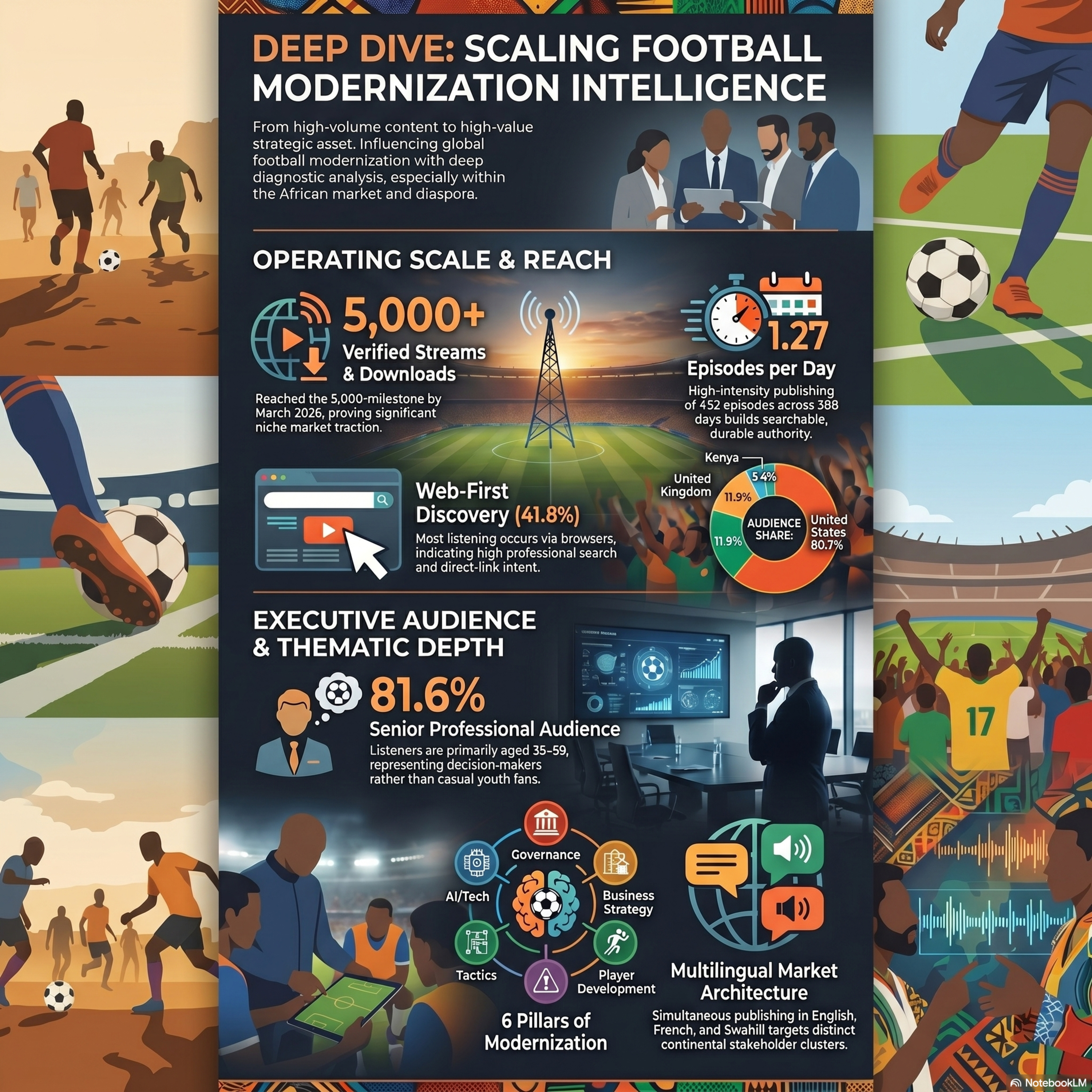
A publishing machine and the blueprint from the master class reveals exactly what that machine looks like. It does, and the numbers are quite demanding. We are talking about a strategy of incredibly high volume output. The operating pace laid out here involves producing hundreds of deep insights in a short window. It's maintaining a pace of roughly 1.27 updates every single day. That is more than one definitive system level deep dive into the sport per day. It is a staggering cadence, yes, but it serves a very specific psychological and strategic purpose.
Which is what? Because it sounds exhausting. When you publish at that volume, you achieve feed dominance. You maintain constant relevance. You condition the market to expect your presence. You're just always there. Always. Think about the nature of football discourse. It is highly perishable. Oh absolutely. A game happens on Saturday and by Tuesday nobody cares. Exactly. A controversy over a new FIFA transfer rule or an announcement about a new AI broadcasting technology loses its relevance window in a matter of days, right?
By moving at a speed of 1.27 updates a day, you capture those relevance windows before they close, and you constantly reinforce your position as the definitive voice of modernization. But hold on, here's where it gets really interesting. If we are just shouting into the void every single day about everything from AI skeletal tracking to women's football development to transfer regulations, aren't we just adding to the noise instead of fixing the game? That is the risk, certainly. I mean, 1.27 updates a day sounds exhausting for the reader too.
Publishing 1.27 times a day about everything is like a team pressing for 90 minutes straight. The high press. Yeah, by the 70th minute, they're exhausted, disorganized, and the opponent, or in this case the reader's attention, just easily bypasses them. You lose your structural shape. That is a brilliant way to frame it and it highlights the exact vulnerability of this model. It's what we call the shadow costs of high frequency publishing. Shadow costs. I like that. High cadence can absolutely dilute quality if every single piece of knowledge is treated as equal.
If a quick 200 word reaction to a coaching change is given the exact same weight as a deeply researched 5000 word thesis on Federation governance, the archive becomes noisy rather than authoritative. It's just a wall of text. Right, you run the risk of topic diffusion. If you try to own every single conversation in the listener's mind, you end up owning nothing. So how do we fix that? How do we press effectively without losing our shape? How do we keep the feed dominance without exhausting our audience and losing our authority?
The solution found in the blueprint is a tiered editorial architecture. Tiered editorial architecture. OK, you must forcefully separate the rapid reactions from the flagship definitive Dee dives. We need a clear visual hierarchy. Imagine a pyramid. OK, picture pyramid. At the base you have your daily pulse. These are the rapid responses, the 1.27 updates that keep you relevant in the algorithms and top of mind for your audience. The day-to-day stuff. Right. But at the top of the pyramid you have your anchor pieces.
These are the master classes. These are the pieces that decision makers know are absolutely essential to learn. So we have to design the platform so a federation president interacts with it differently than a casual scout? Yes. When a major investor or an Academy director looks at the platform, they need immediate, unavoidable signals separating the daily noise from the foundational knowledge. They need to know what's important. Exactly. The foundational knowledge is what will actually help them restructure their operations.
The base of the pyramid captures their attention. The top of the pyramid changes their behavior. OK. That makes operational sense. We categorize. We say this is for your daily commute, but this is for your boardroom meeting. Precisely. But if we are publishing that much and we have this perfectly tiered pyramid, we have to talk about how we are communicating it. Because doing all of this in English alone won't cut it. Not at all. Africa is massive, complex, and deeply multilingual. To elevate the entire African game, this narrative has to speak to the entire continent and its diaspora.
And this leads us to the strategy of Pan African multilingual replication, right? The blueprint dictates taking this core systems knowledge and publishing it across English, French and Swahili. Which is an amazing ambition. It really signals inclusivity and a deep respect for the diversity of the audience. It does. But translating a highly technical diagnostic report on electronic performance tracking systems into Swahili doesn't automatically mean the local coach in Mombasa is going to use it. No it doesn't.
Explain the trap here, because it feels like there is a huge pitfall if we aren't careful. You are identifying the danger of performative translation. Performative translation. Simply taking the exact same English text and running it through a translation engine into Swahili or French without localized market design is a massive strategic error is a trap. Because the context is missing. Exactly. It triples the workload without tripling the impact. Linguistic accessibility does not automatically equal market access.
So if we are perfectly translating the value of these systems into Swahili, does an Academy director in East Africa need the exact same message as a tech vendor in Paris or a diaspora investor in London? Absolutely not. Give me a concrete example of how this actually works. How do we localize the design? If we connect this to the bigger picture, language must map directly to network strategy. You cannot just change the vocabulary, you have to fundamentally change the context and the call to action.
OK, let's take the concept of AI scouting we discussed earlier. Right, the skeletal tracking stuff. In English, the content might be strategically targeted at the global diaspora, international capital markets and foreign investors. You say they have the money. Yes, so the English version focuses on the ROI of investing in AI, scouting for an African club. It talks about asset valuation, global compliance and securing venture capital. Very corporate, very financial. Exactly. Now, in French, you might align much more closely with specific elite Academy networks in West Africa or policy conversations happening with francophone federations.
So the tone shifts entirely. It does. The French version focuses on structural integration, matching European Academy standards and navigating FIFA's clearinghouse rules for francophone player transfers. That is so specific. And then in Swahili, you are aligning directly with East African practitioners, local coach education and grassroots capacity building. The people on the ground, right? So you take that same core concept of AI scouting, but you frame it around how a local coach in Dar es Salaam can use affordable mobile phone based data tools to get their players noticed by bigger leagues.
Same underlying technology, completely different strategic angle translation must equal targeted influence. Man, so if the localized distribution and the specific angle don't match the language, you are just doing translation for vanity. You're just checking a box. You are speaking into the void in three different languages instead of 1. Exactly. You have to speak to the psychological realities of the person reading it in that specific language. OK, So we are translating perfectly. We are targeting Swahili for grassroots impact, French for Academy networks and English for capital.
But wait, I'm looking at the data from the Master Class blueprint and it completely contradicts this grassroots fantasy. Let's actually look around the room. Who is consuming this content? Who holds the keys? The demographics are always eye opening. Because the data tells a totally different story about where the power actually lies and who is shaping the narrative of the African game right now. The demographic and geographic realities are always the ultimate truth tellers in any strategic initiative.
What does the data reveal? The numbers are incredibly specific and deeply revealing. The blueprint highlights a milestone of reaching 5000 deep engagements or streams. That's a solid number for niche content. Right, that's 5000 times someone sat down to engage with dense systemic football modernization content. But look at where they are the geographic split. 60.7% are in the United States. Over 60%. 11.9% are in the UK, only, 3.4% are in Kenya and 2.5% are in Brazil, which suggests an interesting Lucifone spillover effect.
Those numbers completely shatter the assumption that a platform dedicated to African football is primarily consumed domestically within Africa. And it gets deeper. Look at the platforms they are using. A massive 41.8% are using web browsers. Web browsers OK, then you have Apple at 25.9%, Spotify at 21.2% and Podcast Addict at 7.1%. But the age profile is what really stopped me in my tracks. Let's hear it an overwhelm filming 59.7% of this audience is aged 45 to 59. Another 21.9%, or 35 to 44 Less than 1%, are under 22.
Wow, let's spend some time profiling this user because understanding them is critical. Who is the 50 year old using a web browser to consume deep dive football analytics? Right, because it's not a teenager arguing on Twitter and it's not a 20 year old player. Who is this person? We are talking to mature senior executives. The web browser statistic is the psychological smoking gun here. Because they're at work. Exactly. When over 40% of your audience is consuming 60 minute diagnostic master classes via web browser, it means these people are actively researching at their desks.
They are sitting in offices in New York, London or Los Angeles. They aren't at the gym. No, they likely have a notepad open or a secondary monitor displaying data. Give me a persona, who is this guy? Consider a 52 year old diaspora hedge fund manager in Chicago. OK, Chicago. He has been highly successful in finance, he loves the game and he is looking for a legacy investment back home in Africa. He wants to build something. But he isn't going to throw his money away on a poorly run, chaotic club.
He is using his web browser during his lunch break to research systemic football modernization. That makes total sense. He is evaluating African football as an investment thesis, looking for structural pathways. Or it could be a European scouting director at a Bundesliga club sitting at his desk in Germany, trying to understand the changing governance structures in West African academies so his club can safely navigate player acquisitions. So what does this all mean? If our goal is to build the African game, but 60% of our audiences in the US, are we totally missing the mark?
Not necessarily. Are we just gentrifying the conversation about our own sport? Should we be worried that only 3.4% of this audience is actually in Kenya? This raises an important question, but this is the crux of the globalized sports economy, and it requires a dual market logic. Dual market logic. We are not missing the mark. We are confronting the realities of where the structural influence and the capital currently sit. The 60% in the US and 12% in the UK represent the international capital, the advanced sports tech vendors and the highly successful African diaspora.
They can actually fund African modernization. Right, because modernization isn't cheap. Exactly. We have to educate them, give them confidence in the African market and show them the systemic pathways to invest safely. So we are warming up the global capital. We are proving to the guy in Chicago that Africa isn't just a place for raw talent extraction, it's a place for systemic high return investment. But simultaneously, that 3.4% in Kenya is a mandate. We cannot just talk to the West about Africa.
We must use targeted local outreach to build grassroots capacity. How do we reach them if they aren't on web browsers? If the local Kenyan coach isn't downloading a massive audio file because of data costs, we adapt. We take those Swahili translations and turn them into low bandwidth text based summaries distributed directly through local WhatsApp coaching networks. Them where they are. We use the global EAR, which is absolutely listening and ready to fund, to legitimize and support the local grass roots transformation.
OK. So our audience is made of mature decision makers, global investors at their desks in Chicago and local coaches on the ground in Nairobi. That's the ecosystem. But here's the friction point. How do we actually sell them on adopting these new systems? Because handing a 50 year old executive or a veteran African coach a massive 40 page dossier on AI skeletal algorithms isn't going to work. No, it will sit on their desk unread. Exactly. We have to master the art of translation. And I don't mean French to Swahili this time, I mean translating tech into reality.
You are hitting on the biggest bottleneck in football tech on the continent. The barrier isn't the technology itself, it's the translation of its value into pitch realities. Say more about that. Buyers do not purchase technology. Nobody wakes up and says I really want to buy a highly complex data dashboard full of standard deviation graphs that I don't understand. Right, they purchase solutions to their pain points. They purchase injury risk reduction. They purchase better Academy productivity. They purchase match control.
They purchase higher transfer market valuations for their players. We have to unpack the psychology of what I call the information assumption. The information assumption. There was a pervasive, naive belief in the sports tech world that if we just give African clubs better information, if we hand them the tracking metrics, the performance models, the beautiful dashboards, their decisions will automatically and magically improve. But that completely ignores human nature, politics and institutional reality.
Let's use a vivid hypothetical to illustrate this. Think of a club president of a major African team. A sports tech company gives him a state-of-the-art diagnostic dashboard. OK, he's got the iPad. Right on Thursday, the dashboard clearly shows that his star strikers physical output, his high intensity sprints and recovery times has dropped by 30% over the last three matches. He is in the red zone for a major muscular injury. The red zone, so he needs to rest. Intellectually, the president knows he should force the manager to bench the striker.
But there is a massive Derby match on Saturday. Exactly. There's a massive Derby match. The fans expect the star striker to play. If the striker is benched and they lose, the fans will riot, the media will demand the president's resignation and the club's local sponsors might pull out. The pressure is immense. Furthermore, maybe the striker's agent is a powerful political figure who demands his client plays under that immense pressure. Bad incentives, extreme cash pressure, entrenched patronage.
The beautifully designed data dashboard gets thrown in the trash. The striker plays, tears his hamstring in the 20th minute and is out for six months. That is the information assumption failing in real time. It's like trying to sell a young striker a new pair of boots by reading them the chemical makeup of the synthetic leather. Right. Look at these amazing polyurethane polymers. No, tell me it makes me run faster and strike harder. We have to speak football, not tech. Explanation of the technology is necessary, but it is deeply insufficient without implementation support that respects these psychological and political realities.
You have to know the context. The market desperately needs fewer jargon, heavy dashboards and more translated consequences. If you are selling an AI scouting platform to an African federation, you do not talk about machine learning parameters or computer vision frame rates. Because their eyes will glaze over. Exactly. You talk about obtaining transfer value. You say this system will prevent your best under 16 talent from slipping through the cracks and being poached by foreign intermediaries for pennies.
Now you have their attention. The sweet spot for elevating the African game is connecting the unmatched emotional passion of football to the cold, hard logic of systems. Emotion drives the intent. The system provides the result. I love that. So we have our new diagnostic narrative. We have our relentless publishing machine kept in shape by a tiered hierarchy so we don't exhaust the audience right. We have our localized Pan African languages. We understand the psychology of our desk bound global diaspora audience and we know how to translate cold tech into the emotional reality of winning football matches.
The pieces are all there. But how do we pull this all together? How do we build a lasting institution from this blueprint that permanently elevates the African game? Because we can't just be a think tank forever. Well, eventually you have to build. We can't just be the smartest guys in the room if the room isn't building anything. We find ourselves at a strategic crossroads, and the master class lays out three distinct operational paths for building this institution. OK, three paths. Let's hear them.
Path 1 is becoming a media LED authority. This means focusing purely on prestige. You create those definitive deep dives, you build a massive audience, and you essentially become the undisputed intellectual voice of African football modernization it. Sounds nice. It's. Clean. It's highly respectable and it requires low overhead, but it it leaves the actual messy physical implementation to others. It's being the professor. You write the brilliant textbook, but you don't actually build the bridge.
You just hope an engineer reads it. That's a perfect analogy. Path 2 is the advisory funnel. In this model, the insights and the media presence are strategically used to directly route leaders into modernization, diagnostics, consulting, audits, and structural reviews. So it's more hands on. Yes, the knowledge published is simply the front door to active hands on transformation inside the clubs and federations. And the third path. Path 3 is becoming an ecosystem orchestrator. This is by far the most complex.
It means becoming the literal connective tissue of the global game. Meaning what exactly? You connect the tech vendors in Paris with the federations in West Africa, funded by the diaspora investors in New York and implemented by the local clubs. You host the digital platforms, the summits, the data exchanges. You become the marketplace itself. So which one actually moves the needle for Africa? Which path does the blueprint recommend? The recommended path is a hybrid, but it must be heavily anchored in the advisory funnel.
We must take the ideas and turn them into action. We have to get our hands dirty. However, to execute the advisory funnel successfully with that mature high net worth audience we identified, there are crucial operational fixes required immediately. The most pressing is standardizing brand identity to stop what is termed trust leakage. Trust leakage. Let's break that down. Explain how trust leaks out of a brand in reality. Let's go back to our 52 year old diaspora hedge fund manager in Chicago. Our guy on his lunch break, right?
He hears a brilliant 60 minute breakdown of AI scouting on the platform. He is inspired, he has the capital and he wants to invest in an Academy structural review. He's ready. To write a check. He goes to look up the organization online to initiate $100,000 consulting conversation, but when he searches, the audio content has one name, the website has a slightly different low resolution logo, the LinkedIn profile is registered under a confusing unrelated corporate entity, and the digital metadata is completely inconsistent.
Oh, I see where this is going. In the world of high trust, high value consulting, inconsistent labels look profoundly unprofessional. This investor deals with Goldman Sachs and McKenzie. Right, he expects a certain standard. If your digital house isn't in order, his confidence erodes instantly. The trust leaks out of the brand before a single e-mail is even sent. The transaction dies on the vine simply because of bad metadata. That makes total sense if you were going to tell me how to organize a multimillion dollar state-of-the-art football Academy, your own website better not look like it was built in 2005.
Precisely. And what is the second operational fix? Building visible proof of impact It is not enough to be smart in public anymore. We need visible, undeniable case studies, executive briefings, and documented impact notes. Hard evidence. We must be able to show that when an African club adopted these specific systems, their youth injury rates dropped by 20% or their transfer revenue increased by 40% / 2 seasons. It's the danger of strategic drift. If we don't actively choose to become an institution, if we don't seal up the trust leakage and show the hard proof, we will just remain a high put noise machine.
We need a single sharp category statement, something like the Football Modernization Intelligence Platform that explains how data, technology, and governance change decisions in Africa and beyond. We need named offers like a club Modernization diagnostic or an AI Scouting readiness audit. You can't just buy smart thoughts from a website, you have to buy a diagnostic. That is the essence of productizing the thesis. You are turning philosophy into a tangible product. But I have to push back here really hard.
Go ahead. Can we genuinely do all of this? Can we be a media brand, an advisory funnel and a connector without losing our soul? That's a valid concern. My fear is that we just sounding like a giant, endless sales pitch. If I'm listening to a deep dive on football tactics and I realize halfway through it's just a thinly veiled infomercial for a consulting firm, I'm turning it off immediately. How do we balance that? It is the most delicate balance in modern publishing, but the key is a concept called editorial generosity.
Editorial generosity. Tell me more. The knowledge you share must always remain completely free, incredibly rigorous, and profoundly valuable on its own merits. You never hold back the what, the how or the why. So no pay walls on the ideas. Exactly. The content must be so good that a coach could use it to improve his team without ever paying you a dime. OK. So where does the business come in? You make the pathways to taking action utterly frictionless. We do not hard sell. We don't say buyer consulting.
We simply say. Here is exactly how AI scouting is changing African talent valuation in exhaustive detail. If your federation needs to audit its current readiness to actually implement this safely, here is the clear professional pathway to do so. With us, we just make it incredibly easy for the market to buy the modernization we are teaching, the intellectual integrity. The deep dive remains pure. The commercial architecture just becomes quietly visible for those ready to act. Editorial generosity You give away the recipe, but you offer to build the kitchen.
That's a beautiful way to phrase it. Wow, OK. That is how you change a continent sporting trajectory. Let me try to wrap my arms around all. This not a lot to take in. We started in the back row of this master class and we've just been handed the complete architectural playbook. We are fundamentally shifting the conversation from descriptive match day gossip and emotional reactions to diagnostic systems, infrastructure and governance. Yes, we are utilizing EPTS and AI not as buzzwords, but as mechanisms to protect and elevate our raw talent.
We are mastering the publishing cadence, moving at 1.27 updates a day to own the narrative. But structuring it into a tiered pyramid so we don't exhaust our audience's attention. Keeping our shape. Keeping our shape, we are executing A localized Pan African language strategy, not just translating words, but targeting English to the global capital, Swahili to the local grass roots and French to the Academy networks. A truly continental approach and we understand the deep psychology of our audience.
We know we are speaking to the 50 year old diaspora investor at his desk, using global capital to fuel local transformation, and we are translating Coltec into winning football realities. We are solving the information assumption by realizing that emotion drives the intent and the system provides the result you guide. Finally, we are sealing the trust leaks, showing our proof of impact, and building an advisory funnel fueled by pure editorial generosity. That is the complete blueprint. If you are listening to this right now, whether you are an Academy coach in Nairobi trying to protect your players hamstrings, a hedge fund investor in Chicago looking to build a legacy, or just someone who is insanely curious about the hitting mechanics of football, this is your blueprint.
It's all laid out for them. You are now equipped with the strategic lens to see the game differently. You aren't just watching the speedometer anymore. You know exactly how the engine is built. You have the tools to influence your own corner of the football world. The structural tools are all there, the diagnostic frameworks, the psychological understanding of the audience, the linguistic reach and the technological translations. We have the blueprint. We absolutely do. But it leaves us with one final profound question to consider as we look toward the future of the sport.
If African football finally and fully embraces these analytical systems and governance models while simultaneously retaining its unmatched raw St. talent and deep cultural passion, well, will it merely catch up to the global standard? Or will it completely redefine what the global standard is?
 Apple Podcasts
 Castbox
 Castro
 Goodpods
 Moon FM
 Overcast
 Pocket Casts
 Podbean
 Podcast Addict
 Podcast Republic
 Spotify